"All good books are alike in that they are truer than if they had really happened
and after you are finished reading one you will feel that all that happened to you
and afterwards it all belongs to you; the good and the bad, the ecstasy, the remorse,
and sorrow, the people and the places and how the weather was."
Ernest Hemingway
Showing posts with label Dystopian future. Show all posts

Thursday, August 31, 2017

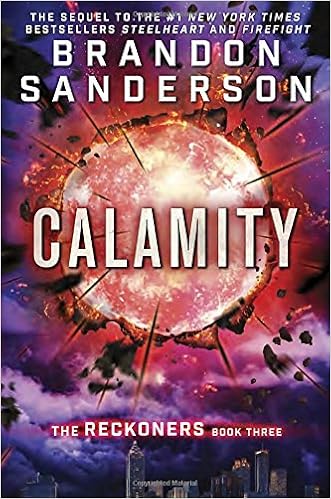
Calamity

Image result for calamity by brandon sandersonCalamity
Brandon Sanderson
2016

The Summary
"When Calamity lit up the sky, the Epics were born.  David's fate has been tied to their villainy ever since that historic night.  Steelheart killed his father.  Firefight stole his heart.  And now Regalia has turned his closest ally into a dangerous enemy.

"David knew Prof's secret, and kept it even when the Reckoners' leader struggled to control the effects of his Epic powers.  But facing Obliteration in Babilar was too much.  Prof has now embraced his Epic destiny.  He's disappeared into those murky shadows of menace Epics are infamous for the world over, and everyone knows there's no turning back...

"But everyone is wrong.  Redemption is possible for Epics--Megan proved it.  They're not lost.  Not completely.  And David is just about crazy enough to face down the most powerful High Epic of all to get his friend back.  Or die trying."

The Good
Although Calamity seemed to fall a little flat, I will admit that I have grown to love Brandon Sanderson's work.  The Reckoners series, as a whole, is full of fantastical imagery, imaginative characters, and adventure.  I was particularly fascinated by Ildithia (formerly Atlanta).

Like Babilar, Ildithia is a city of and controlled by epics.  Unlike the watery nightmare of Babylon Restored, Ildithia is a city turned to salt--much like how Steelheart turned Chicago into steel--that slowly crumbles and rebuilds every week.  It moves slowly across the country, an oddly flourishing city maintained by Larcener, Stormwind, and others that inches its way over the landscape.

It's an incredible image that sticks in my mind:  a city of salt stone laced with layers of color that sparkles in the light, one with dusty streets and salty air.  Sanderson does such an amazing job of coming up with these ideas, like incredible cities and unusual epic powers and quirky characters.  I love his work; I certainly want to explore more even if I was a little disappointed with Calamity.

The Bad
I loved Steelheart and I enjoyed Firefight immensely; I did not like Calamity nearly as much.

Calamity is a fascinating book.  Ildithia is an incredible place, an entire city made of salt that destroys and reconstructs itself every 7 days.  Sanderson is wonderfully imaginative and inventive and he's a spectacularly writer; however, Calamity was such a disappointment for two reasons:

One, I did not like the conclusion.  I mean, the epilogue is sort of sweet and I thought it was nice that David managed, for once, to catch a break, but I absolutely hated learning the truth about Calamity.  (I'm going to start discussing spoilers from the previous book, so turn away now if you don't want to hear more.)  Granted, it was an intriguing plot twist to learn that Calamity was actually an epic through which all powers were descended; however, I didn't like the idea that Calamity was actually some kind of alien being.

Two, I disliked the alternate dimensions Megan conjured.  As we learned in the last book, Megan isn't just an illusionist, she can actually tear holes into the fabric of reality and dive into alternative universes.  Cool, right?  Except it pokes some major holes in the plot of the story and it just adds another layer of complicated ugliness that I just didn't need or want.

I loved the series overall, but, as I dwell on this finale, I can't help thinking it could have been so much better.  The Reckoners had the makings of an epic (no pun intended) series--one that I would remember for a long time, one I would convince myself I needed to grace my own shelves--but it just seemed to fall apart.

Calamity just isn't nearly as good as it's predecessors.

The Ugly
Violence, death, destruction.  What do you expect when the world has been turned upside down by epics?

Oh, and fair warning:  a main character will die before all is said and done.  Just be prepared for it.
Tuesday, August 22, 2017

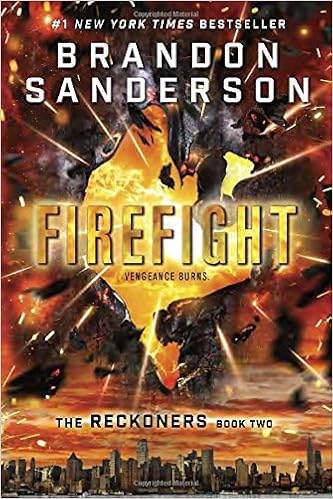
Firefight

Image result for firefight by brandon sanderson
Delacorte Press
Firefight
Brandon Sanderson
2015

The Summary
"Newcago is free.

"They told David it was impossible--that even the Reckoners had never killed a High Epic.  Yet Steelheart--invincible, immortal, unconquerable--is dead.  And he died by David's hand.

"Eliminating Steelheart was supposed to make life simpler.  Instead, it only made David realize he has questions.  Big ones.  And no one in Newcago can give him answers.

"Babylon Restored, the city formerly known as the borough of Manhattan, has possibilities, though.  Ruled by the mysterious High Epic Regalia, Babylon Restored is flooded and miserable, but David is sure it's the path that will lead him to what he needs to find.  Entering a city oppressed by a High Epic despot is risky, but David's willing to take the gamble.  Because killing Steelheart left a hole in David's heart.  A hole where his thirst for vengeance once lived.  Somehow, he filled that hole with another Epic--Firefight.  And he's willing to go on a quest darker and even more dangerous than the fight against Steelheart to find her, and to get his answers."

The Good
Honestly, I enjoyed Firefight almost as much as I enjoyed Steelheart.  Fast-paced and action-packed, Firefight is a great sequel to the Reckoners series by Brandon Sanderson.  Adding in Regalia and Obliteration gave the book an added layer of depth and danger, not to mention you're actively wondering what will happen to Prof--and you can't help wondering where Megan fits in to the grand scheme of things.

Is she good?  Is she bad?  And what will happen when Prof finds out that she's back?

Granted, I couldn't help equating some of the drama to a soap opera; however I enjoyed the novel overall.  I was also excited to learn more about Megan's powers and I was floored by the truth about Calamity.  Megan is incredible, by the way, but the "star" is still a bit of a mystery.  I won't say anymore, of course, for fear of spoilers.

Just know that Megan's powers are not what they seem and Calamity has a cause.

The Bad
I really enjoyed Firefight, don't get me wrong, but I really thought it had too much going on at once.  It's almost overwhelming the intensity of the action, how they never seem to catch a break.  It's just one fight after another after another, and it's packed with plot twists that made my head spin.

It's good, I won't deny it; however, it just has a little too much happening.

The Ugly
Death.  Gore.  Violence.

The usual.

Tuesday, August 8, 2017

Steelheart

Image result for steelheart book
Delacorte Press
Steelheart
Brandon Sanderson
2013

The Summary
"Ten years ago, Calamity came.  It was a burst in the sky that gave ordinary people extraordinary powers.  The awed public started calling them Epics.

"Epics are no friends of man.  With incredible gifts came the desire to rule.  And to rule man, you must crush his will.

"Now, in what was once Chicago, an astonishingly powerful Epic named Steelheart has installed himself as emperor.  Steelheart possesses the strength of ten men and can control the elements.  It is said that no bullet can harm him, no sword can split his skin, and no fire can burn him.  He is invincible.  Nobody fights back...nobody but the Reckoners.

"A shadowy group of ordinary humans, the Reckoners spend their lives studying Epics, finding their weaknesses, and then assassinating them.  And David wants in.

"When Steelheart came to Chicago, he killed David's father.  For years, like the Reckoners, David has been studying, and planning, and he has something they need.  Not an object, but an experience.

"He has seen Steelheart bleed...

"And he wants revenge."

The Good
I loved Steelheart.  It's action-packed, it's interesting, and it takes everything I know about superheroes/supervillains and completely turns it on its head.  Part science-fiction, part fantasy, Steelheart is a wonderfully crafted dystopian world full of detail, depth, and intrigue.

It was so much fun to read.

I was particularly fascinated by the main characters, specifically the Reckoners.  David, as the narrator, is incredibly resourceful.  He sometimes feels like a caricature; however, he's surprisingly astute in his observations and he's wildly intelligent.  I'm always surprised by what he does and what he remembers.  He's daring, he's unexpected, which I found made Steelheart that much more interesting.

Not to mention, I found the ending to be spectacular.

After learning that Steelheart does have a weakness, I puzzled over what it might be.  Reading the prologue again, I couldn't imagine what it might be, but when David discover it, when that moment of recognition and discovery blossomed in his mind and mine, I was thrilled and astonished and excited.  I loved the conclusion.  It startled me, yes, but I found the irony of the situation to be so very satisfying.

I will definitely read the rest of the series.  Firefight is up next, followed by Calamity--and I can't wait to dive back in.

The Bad
No complaints.

The Ugly
Steelheart is graphic, bloody, and riddled with gore.  Bad things happen in Newcago, and you get the impression that, no matter what happens, things aren't really going to get better.

Tuesday, July 25, 2017

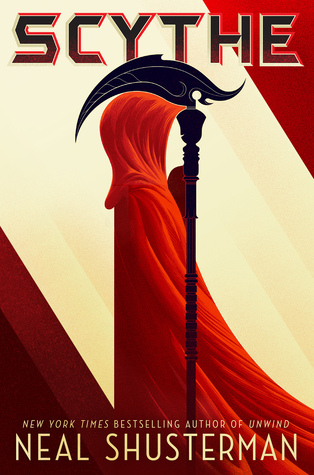
Scythe

28954189
Simon & Schuster
Scythe
Neal Shusterman
2016

The Summary
"A world with no hunger, no disease, no war, no misery.

"Humanity has conquered all those things, and has even conquered death.  Now scythes are the only ones who can end life--and they are commanded to do so, in order to keep the size of the population under control.

"Citra and Rowan are chosen to apprentice to a scythe--a role that neither wants.  These teens must master the 'art' of taking life, knowing that the consequence of failure could mean losing their own.

"Scythe is the debut of a thrilling new series by National Book Award-winning author Neal Shusterman in which Citra and Rowan learn that a perfect world comes only with a heavy price."

The Good
Scythe was incredibly compelling.  I'll be honest, it's one of those books that I just couldn't put down.  I mean, on the one hand, it's like a train wreck:  something very bad is happening, but it's hard to look away.  On the other hand, it's an breathtaking story with endearing characters, a fascinating setting, and an intriguing plot.

As the story goes on, it's easy to become attached to Citra and Rowan.  You're right in the middle of their story from the moment Scythe Faraday selects them as apprentices, so you quickly become invested in their lives and caught up in their world.  I was particularly fascinated by how their world worked, because everything down to the smallest detail is micromanaged by the Thunderhead, a "cloud" system in which the collective knowledge of all humanity is stored.

Neal Shusterman creates a unique story with Scythe, because he doesn't immediately offer readers a dystopian world event if that's what we eventually get.  It wouldn't be a stretch to say dystopian is a popular genre in YA literature (think:  Hunger Games, Maze Runner, Cinder, City of Ember--and I'm sure there's more); however, Shusterman doesn't start with a terrible world.  In fact, in Scythe the world is perfect in every way.

There's no war, no disease, no hunger, no inequality, no aging, no natural death.  Humanity has reached the zenith of its evolution:  it is perfect.  Yet beneath that veneer of perfection, you have the Scythes who help keep the human population in check--and you have a world that, for all its perfection, is stagnating.

What does humanity have left to achieve if everything has been done already?

Scythe is one of those YA novels that causes readers to ask some very hard questions about the life and death, humanity's relationship to technology, and what would really happen in a Utopian society.  It's an exciting, spine-tingling thrill ride, but it's also an intriguing examination of human psychology because it made me wonder, "What is really the purpose of life when life never ends?"

The Bad
It's a bit of a long book, admittedly; however, it captured my attention so completely, I don't think I put it down for two days.

The Ugly
I'll be honest, I thought this book was pretty intense.

Although death is everywhere in this book, it seems like such a distant concept as people can no longer really die.  You have revival centers where, if someone unexpectedly dies, they're brought back to life.  Diseases are nonexistent, aging is a thing of the past, and horrific accidents are merely an inconvenience.  There's blood and gore and horrific things that happen, yet they're only temporary--and it's really difficult to digest this cavalier attitude about death.

Besides which, I think I was spooked by the way people lived.  I don't mean the general prosperity or lack of disease or the utopia the Thunderhead has appeared to create; rather, I was a bit perturbed by a general disrespect for life.  In one of the journal entries between chapters, which are shared by the various Scythes readers meet, I stumbled across one that really made me think:
"If you've ever studied mortal age cartoons, you'll remember this one.  A coyote was always plotting the demise of a smirking long-necked bird.  The coyote never succeeded; instead, his plans always backfired.  He would blow up, or get shot, or splat from a ridiculous height. 
"And it was funny.  [...]  Because no matter how deadly his failure, he was always back in the next scene...
"I've seen human foibles that have resulted in temporary maiming or momentary loss of life.  [...]  And when it happens, people laugh, because no matter how gruesome the event, that person, just like the coyote, will be back in a day or two, as good as new, and no worse--or wiser--for the wear. 
"Immortality has turned us all into cartoons."
Human life has been downplayed, made into something laughable.  More importantly, it's not seen as a finite, precious thing; rather, it's a indefinite commodity that can be wasted.  Immortality has created a type of stagnation in human culture.  There's nothing new to discover, nothing new for which to strive, nothing new to create--so what's really left?

Scythe brings up some very interesting questions about life and human emotion and immortality, specifically what it could mean and what it could bring.  It's entertaining, yes; however, it also makes you think and it makes you wonder.  It feels distinctly dystopian, even though humanity is arguably faced with a Utopian society; it makes you wonder what's the real price tag for a perfect world.

Tuesday, November 29, 2016

Rook

23399192
Scholastic Press
Rook
Sharon Cameron
2015

The Summary
"History has a way of repeating itself.  In the Sunken City that was once Paris, all who oppose the new revolution are being put to the blade.  Except for those who disappear from their prison cells, a single, red-tipped rook feather left in their place.  The mysterious Red Rook is a savior of the innocent, and a criminal in the eyes of the government.

"Meanwhile, across the sea in the Commonwealth, Sophia Bellamy's arranged marriage to the wealthy René Hasard is the last chance to save her family from financial ruin.  But when the search for the Red Rook comes straight to the doors of the Bellamy House, Sophia discovers that her fiancé is not all he seems.  Which is only fair, because neither is she.

"As the Red Rook grows bolder and the stakes grow ever higher, Sophia and René find themselves locked in a tantalizing game of cat and mouse.

"Daring intrigue, delicious romance, and spine-tingling suspense fill the pages of this extraordinary epic tale from award-winning author Sharon Cameron."

The Good
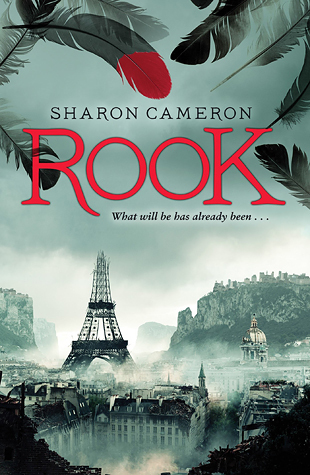
I absolutely loved Rook.  I found it at my library purely by accident, sitting atop a display of random young adult novels in the teen section, and I was immediately attracted to the cover.  I recognized the image of Paris on the cover, replete with a skeleton of the Eiffel Tower rising in the distance.  It looked familiar and yet, at the same time, it was completely and utterly foreign...and I couldn't help myself.

I was immediately intrigued by the Red Rook.  Sophia lives an intriguing double life as both the daughter of an impoverished aristocrat and the Red Rook.  (I'm not ruining anything for readers by mentioning Sophia's alter ego, as her identity is hinted at on the book jacket and confirmed in the first couple of pages.)  She's a clever and capable heroine, who manages to save lives and, ultimately, start a revolution.

Personally, I liked her.

And, while I was a little suspicious of René, I eventually grew to like him.  He and Sophia work well together.  They both have (possibly deadly) secrets; they have unusual skills that help them fit quite nicely in their line of work; and they make a living thwarting the government.  I liked seeing their relationship develop, and I liked seeing how Sophia reacted to someone who had many of the same skills and talents as she.

Granted, I wasn't a fan of the love triangle--René and Sophia seemed to harbor a mutual affection, while Spear and Sophia have history.  Although Sophia views Spear as more of a brother, their relationship is, nevertheless, complicated--but it wasn't as bad as, say, Twilight.  Or Vampire Diaries.  Or Something Strange and Deadly.  Or any number of other young adult fantasy/sci-fi romance.

Overall, I liked Rook.  It reminded me of Cinder and the rest of the Lunar Chronicles by Marissa Meyer.  While it does fall under the rather broad label of dystopian young adult fantasy (think Hunger Games, Divergent, The Maze Runner, Life as We Knew It or, even, The Giver), I really enjoyed Cameron's novel.  I enjoyed the characters, the unexpected twists and turns, the ambiguous references to the past, the complicated political climate.  It's quickly become one of my guilty pleasures.

The Bad
Admittedly, I did dislike the pace of this novel.  For the most part, I enjoyed Rook.  I liked the intermingling of tense, suspenseful story-writing with political intrigue and romance, and I liked how the story would flip between characters and give me insight into what's happening at any given moment.

However, I hated how it slowed toward the end of the story.  I think Rook was bogged down by too many twists and turns, by too much build up.  It would have fared better if it had trimmed out a little of the fluff--the budding romance between Sophia and Rene, the dwelling on LeBlanc's political aspirations, the myriad of preparations to depart for the Sunken City--and focused more on the core of the story.

Also, I would have liked a little more detail about what happened to Paris and society as a whole.  I know about the Great Death, which apparently was a near-extinction level event that practically wiped out the human race, and I understood vaguely that the so-called "Ancients" were essentially us; however, I didn't quite understand what happened between the Great Death and the present day of Sophia's world.

One character postulated some theories, such as a reversal of the magnetic poles or a weakening of the atmosphere, which could have led to the change in climate and the gradual decline of humanity, but I don't have much detail.  I mean, what happened to Paris that it became the Sunken City?  How and why did the Commonwealth build itself into some semblance of Regency era England?  What happened that technology was completely and utterly wiped out--and why was it so distrusted?

I would have loved a little more detail, and I was a little disappointed when I didn't find it.

The Ugly
Death.

There's a lot of gruesome ways to die in this book, whether by guillotine or knife blade or poison or simply exposure in prison.  Le Blanc and the Allemande, intent on quelling the populace and bringing rebels to heel, leave a trail of bodies in their wake--and it's really quite gruesome when you think about it.

Saturday, October 15, 2016

Read Harder Challenge (Part Seven)

I finished some new books for my Read Harder Challenge, and I've completed more reading tasks:
  1. Read a biography (not memoir or autobiography)
  2. Read a dystopian or post-apocalyptic novel
  3. Read a book about religion (fiction or nonfiction)
St. Martin's Griffin
First up, I finished Florence Foster Jenkins by Nicholas Martin and Jasper Rees, which inspired the recently released movie of the same name.  Florence Foster Jenkins was not a traditional singer.  At a young age, she was well known for her skill with a piano and her love--and, more importantly, support--of music; however, it wasn't until she was 76 years old that she undertook to become a concert singer.  She's best remembered for her concert at Carnegie Hall and her vinyl recordings, which introduced the world to her rather...unique voice.

I enjoyed reading Florence Foster Jenkins.  Drawing from multiple resources, including Florence and her common law husband, St. Clair Bayfield, Martin and Rees' book does an incredible job of shedding light on Florence, her work, and her time.  It's intriguing without becoming dull, amusing without ridiculing its rather unorthodox subject, and chock full of interesting historical facts about Florence and the New York artistic scene of the early 20th century.  Overall, I enjoyed it and I highly recommend for any readers to take a moment to listen to Madame Jenkins on YouTube to get a better idea of how her singing voice sounded.  You (probably) won't regret it.

23399192
Scholastic Press
Next, I completed Rook by Sharon Cameron.  The Sunken City--formerly Paris, the City of Lights--is a place of danger, desperation, and despotism.  Ruled by the corrupt Premier Allemande and the bloodthirsty LeBlanc, the Sunken City is brimming with discontent and revolution--and, at the heart of it all, is the mysterious Red Rook who spirits people from their cells and wreaks havoc against the Premier's puppet government.

A story packed with action and adventure, political intrigue and danger, Rook has quickly become one of my guilty pleasures.  I know it falls under the rather broad category of dystopian young adult fantasy (think Hunger Games, Divergent, The Maze RunnerLife as We Knew It or even The Giver), but I really enjoyed Sharon Cameron's novel.  I enjoyed the characters, the unexpected twists and turns, the ambiguous references to the past, the complicated political climate.  I wasn't a fan of the love triangle and, yes, I will admit that the story seemed to drag in a few places; however, altogether, I really liked it and I think it settles in nicely next to Cinder.

Last, I rounded out my reading with God in Pink by Hasan Namir.  Ramy is a young Muslim man living in Iraq in 2003, right in the midst of a war and a cultural revolution--and he also happens to be gay.  Struggling with what he knows his brother would term a "sexual deviancy," Ramy tries to balance his feelings with his obligations to his family and his faith.

Arsenal Pulp Press
Truthfully, I struggled with this novel, because I was not comfortable with all the depictions of heinous violence and wanton savagery.  I understand that mindless cruelty, thoughtless barbarity is simply a fact; I understand that it happens, that it's not something you can ignore if you live on the planet Earth.  I know it exists, but it's still hard to read about terrible things happening to other people.

I didn't hate this novel; rather, the opposite.  I thought God in Pink was a magnificent book depicting life in war-torn Iraq for a gay Muslim man.  It's poignant and it's guaranteed to make an impact, but, at the same time, it will tear out your heart.  I recommend reading it with great caution, like I would for Native Son by Richard White, Beloved by Toni Morrison, or The Grapes of Wrath by John Steinbeck.  Read it, but expect deep emotional turmoil.

Wednesday, June 15, 2016

Afterlife with Archie

18339901
Archie Comic Publications
Afterlife with Archie:  Escape from Riverdale (Volume 1)
Roberto Aguirre-Sacasa
Francesco Francavilla
2014

The Summary
"This is how the end of the world begins...

"All hell breaks loose when a fateful accident sets in motion a series of terrifying events that will threaten the town of Riverdale like never before!  When the dead begin to rise, craving human flesh, it's up to Archie, Betty, and Veronica, and the Gang to fight for their lives against the zombie hordes led by their former pal, Jughead...

"Harvey Award-winning writer Roberto Aguirre-Sacasa (Archie Meets GLEE, Stephen King's The Stand) and Eisner-winning artist Francesco Francavilla (The Black Beetle, Guardians of the Galaxy) bring the apocalypse to the world of Archie in a tale that is both gruesome and heartbreaking."

The Good
A friend recommended reading Afterlife with Archie after we stumbled across Scooby Apocalypse #1 (which I haven't read, but it intrigued me enough that I might) and started on the topic of strange and unusual remakes of our favorite comic books.  She's been a fan of Archie for years and told me it was awesome, even if you aren't a fan of Archie.  So, I decided to go to my local library and check it out.

And I was pleasantly surprised.

Unlike my friend, I'm not really a fan of Archie, or Jughead, or Veronica and Betty.  (I liked Sabrina, but that's a bit of a different story.)  I just couldn't seem to enjoy their interweaving narratives, and I didn't care for the familiar, everyday antics of high school adolescents, especially when I was in high school and saw such things every single day.  I simply wasn't interested.

My attitude toward Archie has changed, of course, since I picked up Afterlife with Archie.  Not only does it offer an intriguing blend of horror and reality, it gives you a new perspective on the characters you once knew.   (Seriously, you'll never look at Jughead the same way again.) It's gut-wrenching to see the gradual collapse of Riverdale, and it tore at my heart to see the safe, calm serenity of Archie's world turned upside-down.

But it was so good.

The story is solid and stands on its own, even if you don't have any experience with Archie or his friends, and it has an unexpected depth; the characters are familiar, but they've been tweaked enough to make them new and intriguing; and the art is stunning, helping to set the grim tone of the entire story and portray the violence the survivors of Riverdale are forced to face.  And it's perfectly scary, enough to give you chills when you're reading it.

Although it incorporates all the old rivalries and romances, it's a story about desperation, loss, and survival--and it's perfectly brutal.  It's a new twist on a favorite classic, and it's well worth reading.  I'd highly recommend it to fans of Archie or the zombie apocalypse genre.

The Bad
Although I didn't have a background with Archie, I understood most of the story and I found it was easy to discern the ties--all the old jealousies, the heated rivalries, and the convoluted friendships--that connected them.  However, I think if I had been familiar with Archie and his friends, I think it would have had more of an impact.

Yes, Afterlife with Archie can stand on its own two feet, but I imagine I would have better understood some of the references to locations, friendships, rivalries, etc. if I'd been familiar with other Archie comics.

The Ugly
Zombies.

Afterlife with Archie is almost on par with The Walking Dead for gore.  No joke, it's hyperviolent and bloody and slightly terrifying.  If you're not a fan of zombies or can't stomach the sight of familiar characters having their throats torn out, I definitely wouldn't recommend it.

Wednesday, April 13, 2016

World War Z

Random House
World War Z
Max Brooks
2006

The Summary
"We survived the zombie apocalypse, but how many of us are still haunted by that terrible time?  We have (temporarily?) defeated the living dead but at what cost.  Told in the haunting and riveting voices of the men and women who witnessed the horror firsthand, World War Z is the only record of the plague years."

The Good
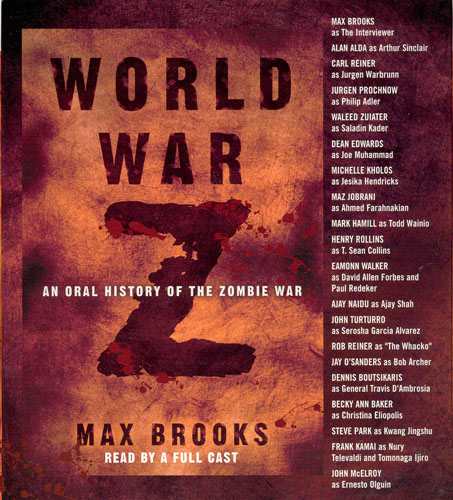
I ventured back into Max Brooks' zombie-infested world recently with the help of an audiobook.  Already an ardent fan of World War Z, I was intrigued by the idea of actually listening to the story and, since it featured a full cast (among them Nathan Fillion, Martin Scorsese, and, of course, Mark Hamill), I couldn't wait to get started.  While I was a little disappointed to learn I found an abridged copy after borrowing it from my library website, I wasn't disappointed by the storytelling.

It was thrilling to hear the stories brought to life, to hear the voices of these characters that I'd envisioned in previous readings of World War Z.  I loved listening to my audiobook and, if I'm being honest, I finished it in a little over two days.  I popped in my earbuds and listened to my audiobook at every opportunity, listening to the brutal civil war in Israel during my car ride to work, listening to Todd Wainio recount the Battle of Yonkers as I walked my dog, listening to events unfold in the castles of England when I cooked dinner.

I couldn't put it away, I couldn't stop.  I was hooked from the introduction, just like I'd been hooked when I first picked up World War Z--when I read those first few stories and became embroiled in the conflict, in the desperation for survival.

The audiobook is just as addictive as the novel.

The Bad
I had an abridged copy of World War Z.

Honestly, I feel like I missed out on so much.  The audiobook barely looked at what happened in India and Japan, didn't even touch upon events in Russia, didn't recount what happened in the flooded catacombs beneath Paris or the Pacific Ocean, and it certainly didn't tell the reader what happened to the astronauts stuck on the space station orbiting Earth.

Those are the stories I missed, the stories I'd dearly loved to have heard.  Don't get me wrong, I enjoyed listening to the audiobook and I would highly recommended it to any fans of World War Z; however, I wish it had had more of the stories I'd enjoyed.

The Ugly
Zombies.  Horrible, mindless, flesh-eating zombies.

It's bound to make you queasy at some point.

Friday, March 11, 2016

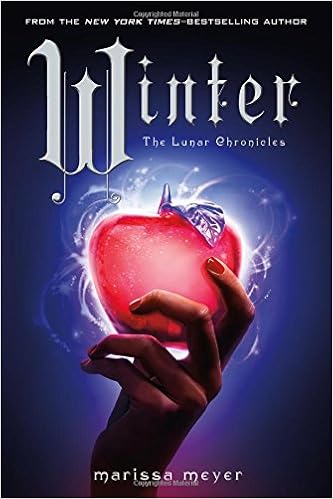
Winter

Feiwel and Friends
Winter
Marissa Meyer
2015

The Summary
"Princess Winter is admired by the Lunar people for her grace and kindness, and despite the scars that mar her face, her beauty is said to be even more breathtaking than that of her stepmother, Queen Levana.

"Winter despises her stepmother, and knows Levana won't approve of her feelings for her childhood friend, the handsome palace guard, Jacin.  But Winter isn't as weak as Levana believes her to be and she's been undermining her stepmother's wishes for years.  Together with the cyborg mechanic, Cinder, and her allies, Winter might even have the power to launch a revolution and win a war that's been raging for far too long.

"Can Cinder, Scarlet, Cress, and Winter defeat Levana and find their happily ever afters?  Fans will not want to miss this thrilling conclusion to Marissa Meyer's nationally bestselling Lunar Chronicles series."

The Good
I devoured this book.  Truthfully, I was obsessed with the entire Lunar Chronicles series.  I originally read Cinder in 2014, and then I promptly purchased all the available books (i.e. Scarlet and Cress) and finished the series in a weekend.  Although I haven't had the opportunity to read Fairest or Stars Above, I have fallen in love with the Lunar Chronicles.

Like Cinder, Marissa Meyer's latest book in the Lunar Chronicles has an intermingling of science-fiction and fairy tale elements, which I've enjoyed throughout the series.  It has many of the same qualities that I loved in the first book: a cast of quirky and intriguing characters, a perfect pace (enough to keep me embroiled without wearing me down), a wonderful tone and interesting descriptions, and an exceptional story.

Let me emphasize again:  I loved this story, and I love this series.

I couldn't wait to finish Winter and uncover what happens to Winter, what happens to Cinder and Scarlet and Cress, and what happens as Luna is gifted with a startling revelation--and, perhaps, a new queen.  It was exciting.  I finished the book in two days, and I was very happy with it.

Yes, part of me was simply relieved to have finished the series.  I'd been dying to read the conclusion of the Lunar Chronicles for more than a year, so, yes, I was excited to reach the epic conclusion I'd been craving.  While I wasn't completely on board with the way it ended (I would have liked for a few things to be different), I can't say I'm disappointed.

I was pleased to find that "happily ever after" so common in fairy tales.

The Bad
If I was bothered by anything, it might be Meyer's habit to let Cinder's story run on...and on.  I liked the story, I understood the need for new dangers and newer obstacles; however, I felt the final book dragged the story out unnecessarily.

Yes, Cinder needed to build her support on the lunar colony; yes, she needed to thwart Levana's authority; yes, she needed to rescue her friends and unite with Winter.  But why must it alternate between Cinder's capture and escape, recapture and daring second escape?

As Cinder and Winter and the entirety of Luna scramble to bring the story to a close, it felt like too much was happening, like everything was about to boil over, crash and burn so to speak.  It didn't, but it skirted a little too close for my taste.

The Ugly
Fairy tales are always laced with tragedy:  two children being left alone in the forest, a princess pricking her finger and falling into an eternal sleep, a young girl eating a poisoned apple, a little girl getting attacked by the Big Bad Wolf.

And Winter is no different.

Saturday, January 23, 2016

Read Harder Challenge (Part One)

As part of the Read Harder Challenge for 2016, I've picked several books to fulfill some of the criteria.  So far, I've managed to:
  1. Read a middle grade novel
  2. Listen to an audiobook that has won an Audie Award
  3. Read a non-superhero comic that debuted in the last three years
Candlewick Press
For my middle grade novel, I completed Flora and Ulysses:  The Illuminated Adventures by Kate DiCamillo.  A fun little book with amusing illustrations, Flora and Ulysses was a nice surprise for me.  I picked it up for the simple fact that it had a squirrel on the cover.  I simply couldn't help myself--I mean, who wouldn't be enticed by a book that has a squirrel as a main character?  (Not a friend of mine, I can say with certainty.)

Anyway, the main point is that I really liked DiCamillo's novel.  It caters to a younger audience, yes, but it's accessible and enjoyable to read even as an adult.  It toys with more mature themes, like divorce; however, it does so in a way that's understood by children and appealing to parents.  It's a good book with a good story (an odd story, but a good story nevertheless).  DiCamillo is also the author of  Because of Winn Dixie, and she further cements her reputation as an exceptional author with Flora and Ulysses.

Random House
Now, to fulfill my audiobook requirement, I actually revisited World War Z by Max Brooks.  I originally listened to the audiobook simply because I loved World War Z and I was intrigued to see what a full cast would be like reading it (especially since I discovered it featured Nathan Fillion, Martin Scorsese, and, of course, Mark Hamill).  It was just a happy accident that I happened to stumble across an Audie Award winner from 2007.

I highly recommend listening to World War Z if you've read the book--or, actually, even if you haven't read the book.  Having a full cast, World War Z  is singularly entertaining as an audiobook.  It's still full of the same stories, the same diversity and detail that made it such a wonderful novel, but, now, you have the chance to actually listen to those stories and more fully imagine the characters behind them.

(I will note, however, that I think I picked up an abridged version of the novel.  I don't know if the abridged novel is the only one available, or if there's a copy of the audiobook out there that has every single chapter, but, regardless, I recommend trying to get your hands on the full copy for the greatest effect.  My only complaint was that it left out some of my favorite chapters.)

Dark Horse
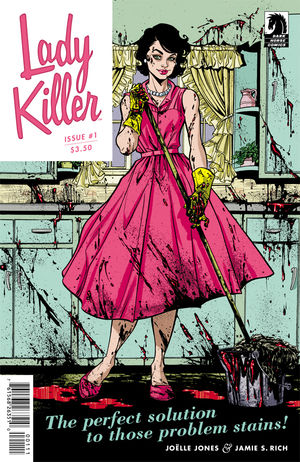
And then there's my non-superhero comic:  Lady Killer by Jamie S. Rich and Joelle Jones.  I picked up Lady Killer at my local comic book store on a whim, because I liked the cover (oddly enough) and I liked the idea of reading about a housewife who worked part-time as a hired killer.  It was a fascinating dynamic that intrigued and compelled me to pick up a copy for myself.

Josie Schuller is far from being a superhero:  she's pragmatic, ruthless, and cold-blooded.  She's a survivor, which means anything goes when it comes to protecting herself and her own (including her darling twin girls).  Overall, I liked reading Lady Killer.  It's probably one of the best comic books I've read within the last year--and it might simply be one of the best I've ever read.  Period.

---

For more on the Read Harder Challenge of 2016, check out Book Riot.  And for more book reviews from Reader's Reach, scroll through the archives to find something you might like.

And, as always, happy reading.

Wednesday, December 9, 2015

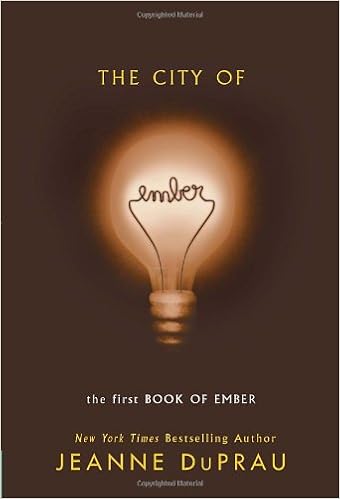
The City of Ember

Yearling
The City of Ember
Jeanne DuPrau
2004

The Summary
"Lights shine in the city of Ember - but at the city limits the light ends, and darkness takes over.  Out there in the Unknown Regions, the darkness goes on forever in all directions.  Ember - so its people believe - is the only light in the dark world.

"And now the lights are going out.

"Is there a way to save the people of Ember?  No one knows.  But Lina Mayfleet has found a puzzling document, and Doon Harrow has made discoveries down in the Pipeworks.  With these clues, they start their search."

The Good
The City of Ember was an interesting story.  Although I think I would have enjoyed it better if I'd been younger (since the novel is geared toward a younger audience), I liked the characters and quality of DuPrau's novel.

Lina Mayfleet is an endearing girl with a lot of spunk and a lot of courage; Doon Harrow is smart boy with enough skill and brains to take him places, even if he sometimes allows his pride get in the way.  As characters, they're enjoyable.  Maybe a bit naive, but they are children who have lived underground for the majority of their lives, so, you know, I suppose it's to be expected.

At any rate, I liked DuPrau's novel.  She's an excellent writer for children's literature and she's created an interesting world in her series.  I was fascinated by the imagery she used, the evocative language as she delves into characters' thoughts and slowly reveals the lives they lead.

I especially liked how DuPrau described Ember, illustrating how the city was slowly crumbling, revealing the thin threads of political corruption and greed that infested the leadership of the city.  The City of Ember has complex undertones, but DuPrau incorporates mature themes without being overbearing or making the story morbid.

I would highly recommend it for younger readers and, moreover, anyone who might enjoy post-apocalyptic stories.

The Bad
Although I liked DuPrau's novel, I found I probably didn't enjoy it as much as I would if I were a child picking up The City of Ember for the first time.  It's an interesting story, but it loses my interest at different intervals because it feels like a children's book - and I can only give it so much attention.

The Ugly
Ember is crumbling.  Supplies are running short.  Lights flicker and go out, fuel spent.  Lina and Doon are in a race against time to rescue their friends and families, searching for the Creator's clues, struggling to find an escape from a city that's slowly falling down around them.

It's scary to witness the slow decay of the city, watching as people fight for survival in a place that wasn't meant to last more than a hundred years and, ultimately, frustrating when you realize that people of Ember have a way to escape.  In fact, they've had the means to escape all along - but thanks to greed and desperation and misuse of political power, the way out may be lost to them forever.

Friday, March 6, 2015

The Maze Runner

The Maze Runner (Maze Runner Series #1)
Delacorte Press
The Maze Runner
James Dashner
2009

The Summary
Thomas has no memory of who he is or where he was before he reached the Glade.  He knows only his name, Thomas, and he knows he was meant to be a Runner in the maze that surrounds them, protects them, and, ultimately, traps them.

But, shortly after Thomas arrives, someone else is delivered to the Glade:  a girl, the first girl ever to arrive to the maze, and she has a message to deliver.  The world as they know it will change.  Forever.

The Good
The Maze Runner is a quick, suspenseful read.  It poses enough questions, throws out enough action and leaves enough bread crumbs, to keep you interested as you search for answers along with Thomas.  Furthermore, James Dashner certainly creates an intriguing concept:  a maze, a group of intelligent and self-sufficient adolescents seeking freedom from the Glade, and a number of sinister creatures known as Grievers.

The Maze Runner falls into the vein of The Hunger Games, pitting young individuals against seemingly insurmountable odds; however, it also calls upon William Goulding's Lord of the Flies.  It's an interesting blend of survival-horror and science-fiction and dystopian-apocalyptic, so it's something that might be worth perusing at least once.

The Bad
I wanted to enjoy The Maze Runner.  I really did try, but I just couldn't seem to sink my teeth into Dashner's novel like I originally hoped.  I mean, I enjoyed it - well, parts of it - but it just couldn't seem to hold my attention for very long.

Moreover, I found too many unanswered questions (yes, I realize there are still three more books in the series, including a prequel, so maybe I'm jumping the gun with such a complaint) and too much bloodshed for so many mysteries to linger.

And the conclusion just felt so peculiarly familiar to me.  I feel like I've read something similar.  Oh, wait, I have:  Lord of the Flies.

I'm not saying The Maze Runner is identical, but I thought it strange how Chuck was like a mirror image of Piggy (and, yes, they do share similar fates), how Chuck's relationship with Thomas seemed to parallel that of Piggy and Ralph.  To be honest, I found it a little eerie - and, confidentially, disappointing.  After a while, it started to feel like a remake of Lord of the Flies set in a post-apocalyptic future.

The Ugly
The conclusion.

Don't even talk to me about the concluding passages of The Maze Runner.  I can handle cliffhangers, I can handle tragedy, and I can handle disappointing conclusions, because I've had extensive experience with all three; however, I cannot seem to overcome my disappointment for how The Maze Runner ended.

For some reason, it just seemed to rub me the wrong way and I was disappointed in the worst way.  I'm talking the kind of disappointment you find when you finish the series finale of Dexter, or season 4 of The Glades on Netflix (and realize there's no season 5).

Let's just say, I was not a happy camper.

Wednesday, November 19, 2014

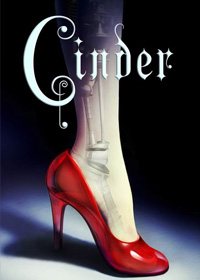
Cinder

Image courtesy of
www.marissameyer.com
Cinder
Marissa Meyer
2012

Cover Synopsis
"Sixteen-year-old Cinder is considered a technological mistake by most of society and a burden to her stepmother.  Being a cyborg does have its benefits, though:  Cinder's brain interface has given her an uncanny ability to fix things (robots, hovers, her own malfunctioning parts), making her the best mechanic in new Beijing.  This reputation brings Prince Kai himself to her weekly market booth, needing her to repair a broken android before the annual ball.  He jokingly calls it "a matter of national security," but Cinder suspects it's more serious than he's letting on.

"Although eager to impress the prince, Cinder's intentions are derailed when her younger step-sister, and only human friend, is infected with the fatal plague that's been devastating Earth for a decade.  Blaming Cinder for her daughter's illness, Cinder's stepmother volunteers her body for plague research, an "honor" that no one has survived.

"But it doesn't take long for the scientists to discover something unusual about their new guinea pig.  Something others would kill for."

Thoughts
Marissa Meyer's first book in the Lunar Chronicles is unique and fascinating.  It's Cinderella meets science-fiction; it's a classic fairy tale with a dystopian twist - and it is invigorating.

I love the fact that Meyer has completely re-imagined and revitalized a familiar old fairy tale and turned it into something wonderfully complex and fascinating.  And I especially love that the author has created a tough, intelligent, and pragmatic heroine in the character of Linh Cinder.

Cinder is smart.  She's self-sufficient.  She's inventive.  She's a mechanic - and a darn good one at that - and she doesn't need anyone to rescue her.  She may eventually find her Prince Charming, but she's more than capable of rescuing herself (which I really like about her).

Be forewarned, however, Cinder is tragic.  I'm just going to come out and say it:  There is no happily-ever-after.  This novel is only the first of four, which means Cinder's story still has a long way to go - and she still has a lot of trials and tragedy to face.

Overall Impression
I loved Cinder.

I devoured this book:  I finished it in less than two days, and then I promptly went online and bought the second and third in the series (the fourth one, according to Marissa Meyer's website, comes out in November of 2015 with a prequel appearing as early as January).

I loved the characters.  I loved the complexity of the story.  I even loved the sad parts (which broke my heart, but I loved them regardless).  So, long story short, I found Cinder to be a beautifully detailed story with appropriate amounts of suspense, action, and discovery to keep you invested from beginning to end.

Friday, July 25, 2014

The Age of Miracles

The Age of Miracles book cover
Image courtesy of
www.theageofmiraclesbook.com
The Age of Miracles
Karen Thompson Walker
2012

The Summary
Julia lives an ordinary life in California.  She struggles with school, she deals with the loss of friends and the reception of new ones, she copes with the fragmenting of her family.  However, on October 6, life - and the world as Julia knows it - changes forever when it is announced that the world's rotation is slowing.

Known simply as the slowing, the event triggers environmental disasters, affects gravity, and extends the days and nights by hours and days.  Eventually, time becomes irrelevant - and life becomes a matter of remembering the past and being remembered.

The Good
Karen Thompson Walker has a masterful grasp of language.  The Age of Miracles is filled with beautiful descriptions and expressive, almost poetic, language that makes this novel especially enticing to read.  Even the characters are carefully detailed, carefully cataloged and defined by the narrator, giving them a clear and precise form in the novel.

The changes that occur in the world - that is, how the slowing affects the world and its inhabitants - are fascinating, too.  Walker puts a lot of thought, a lot of detail in describing and chronicling the changes that are sometimes too subtle to see, sometimes too enormous to ignore.

And it's interesting to see the effect of the slowing on people:  how they react to the change of days, the change of weather, the change of life as they know it.

The Bad
I'll be honest, I wasn't entirely satisfied with Julia's story.  Since she creates it from a future place and time, she has the benefit of hindsight and she employs that hindsight in every chapter.

I was frustrated by her frequent references to the future - that is, her constant comments that left a sense of foreboding without actually revealing more than a morsel of the truth - which left me waiting and wondering about the future (if a future existed), instead of simply enjoying the story as it was happening.

Too much of my mind ended up being dedicated to Julia's ambiguous future, rather than enjoying the story of her past.

The Ugly
When all is said and done, The Age of Miracles isn't a story about survival and human adaptation.  It isn't about rebuilding and reinventing; it's a tale of extinction.  It is Julia's memoir of the past:  what happened when the slowing began and how life altered dramatically when it happened.

This novel shows the end before the very end.

Friday, March 21, 2014

World War Z

Max Brooks - World War Z
Image courtesy of
www.maxbrooks.com
World War Z
Max Brooks
2006

The Summary
As the greatest conflict in human memory, the "Zombie War" changed the world and everyone in it - and one man is intent on retelling the memories of those days, preserving history that may one day be forgotten.

He starts his interviews at the beginning of "The Crisis" and follows the thread of history from one country to the next (China, America, South Africa, England, Antarctica, Israel, etc.), until the "present day" when humanity no longer faces extinction.

The Good
Max Brooks' novel is fabulous.  I personally loved the concept of reading "interviews."  Not only do readers have the opportunity to experience different stories - different characters with different experiences - we have the chance to see what happens to different parts of the world and how various countries encounter the same conflict.

It's also fascinating and inventive.  I mean, World War Z answers questions I didn't even know I had about a zombie apocalypse.  For instance, what happens to astronauts stuck on space stations?  Do zombies float - or do they sink and walk on the ocean floor?  Can a person fool a zombie?  And what happens to the global economy after everything goes kaput?

There's an amazing breadth and depth to Brooks' novel.  Although you never receive a complete explanation as to how the zombies came into being and how or where the apocalypse really beings (there's plenty of supposition between all the characters involved, so you're not completely left in the dark), it's so fully comprehensive that you never notice it lacking.

Honestly, it's enough to see what happens to the world from "Day One" to the end of the war that you're satisfied with the answers you receive.

The Bad
I don't have anything negative to say about Brooks' book.  It's intriguing and detailed and, while there are certain elements that make it difficult to read (on an emotional level), it remains one of the best books I've read.

Perhaps my only complaint was trying to recognize the different names individual characters called zombies:  the tried and true "zombie," but also Zed Heads, Gs, Zacks, etc.  But context clues basically cleared that up.

The Ugly
World War Z is a story about a zombie war, so, of course, you'll be faced with gratuitous amounts of gore and violence and bloodshed.  You'll read "reports" and "interviews" about people being eaten alive, being trapped in their cars and dying of exposure.

And, if that isn't gory and disheartening enough for you, there's stories of human desperation - murder, cannibalism, suicide, genocide - and world-changing amounts of pollution from burning cities and the living dead walking from one corner of the earth to the other.

It isn't a pretty picture.

Brooks creates a terrifying world in his novel, a dystopian future guaranteed to give you chills.  In fact, it's the stuff of nightmares, especially when you're sitting up at midnight and reading with only a dark, creaky house for company.

Tuesday, February 25, 2014

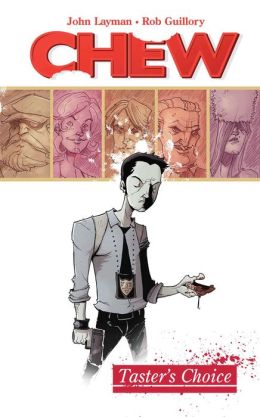
Bonus: Chew: Taster's Choice (Volume One)

Chew, Volume 1: Taster's Choice
Image courtesy of
www.barnesandnoble.com
Chew:  Taster's Choice (Volume One)
John Layman
Rob Guillory
2009

The Summary
Tony Chu is a police officer - turned FDA agent - and he is a cibopath.  As a cibopath, Tony can taste or eat anything (and I do mean anything) and figure out what it's made out of, where it comes from, and what happened to it.

In fact, he can figure out just about anything from a single bite.

Except beets.  Beets don't work.

Now, along with Agent Mason Savoy (a cibopath like Tony), Tony can - and will - use his gift to solve food-related crimes.  Like contraband chicken.  Or cannibalism.  Or murder.

The Good
Quirky and dark, Chew is a unique blend of cleverness and the supernatural.  Throw in a hint of political intrigue, and you have a surprisingly good series to read.

Strewn with bits of comedy, fast-paced action, and odd-ball mysteries that can only be solved by the FDA - currently, the most powerful bureau in the U.S. government and, perhaps, the entire world - and the cibopathic abilities of Tony Chu and Mason Savoy, Chew is energetic and pretty fun to read.

The characters are unusual and intriguing enough to keep you riveted, and the story is well-constructed and interesting to hold your attention from beginning to end.  It moves quickly, so it's easy to read in one sitting and easy to become hooked.

The Bad
Altogether, it's a good story.  An odd art style, yes, but it's vivid in its depictions and it's oddly fun.

However (and this is a very big "however"):

If you have an aversion to violence, or foul language, or things just plain gruesome - like vomiting induced by a sabocrivner (one who writes so vividly that people can actually taste the things she describes), or homicidal cannibals - or other unsavory events, Chew may not be the best read for you.

The Ugly
Because Tony can receive psychic impressions from the food (and other things) he eats, he encounters some very unusual situations during his investigations.  Situations that invariably force him to eat unsavory foods.

And other things.

Like fingers.  Or dead animals.

Saturday, December 7, 2013

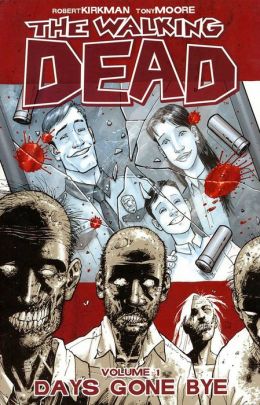
The Walking Dead: Days Gone Bye (Volume One)

The Walking Dead, Volume 1: Days Gone Bye
Image courtesy of
Barnes and Noble
The Walking Dead:  Days Gone Bye (Volume One)
Robert Kirkman
Tony Moore
2006

The Summary
When small-town sheriff Rick Grimes is caught in a shoot-out with his partner, Shane, he doesn't expect to wake up in a coma weeks later - and her certainly doesn't expect to learn the world is a very different place, a place rife with abandoned cities and zombies.  But his grave situation doesn't deter him from finding what's most important:  his wife and his son.

His former partner, however, just might.

The Good
Packed with stimulating art and gripping story-telling, Days Gone Bye is a graphic novel that is sure to please.  Not only does Tony Moore, the artist, render the story with great detail and care, Robert Kirkman, the author, creates a suspenseful tale woven with equal parts tragedy and horror and human insight.

In particular, Kirkman's skills as a story-teller in formulating compelling characters, unique stories, and appropriate amounts of action - and suspense - will keep you on the edge of your seat from cover to cover.

Granted, much of The Walking Dead focuses on the journey of Rick Grimes as he travels to Atlanta in search of his family; however, Kirkman and Moore's novel branches in many different directions as new character and newer dangers emerge.

It's interesting and it's gripping, no two ways about it.

The Bad
I would not recommend The Walking Dead to a younger audience.  Filled with stronger language, gore, frightening images, and a fair dose of horror, Kirkman and Moore's novel is probably a little graphic for some readers.  Honestly, I don't think I read a single issue in this first volume in which multiple people didn't die.

I suggest if you don't like stories that make your stomach twist with grief and worry, or make your heart sink inside your chest, this book may not be for you.

The Ugly
Riddled with gore and tragedy, The Walking Dead is a post-apocalyptic horror story bent on making you squirm the farther you read.  As you learn in these first few issues, it's not just the zombies about which you have to worry - it's the survivors.

Wednesday, April 25, 2012

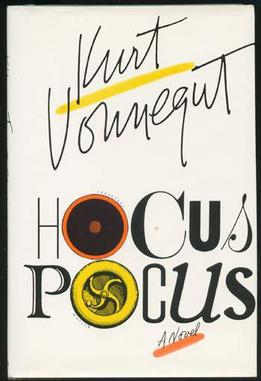
Hocus Pocus

Image courtesy of
www.wikipedia.com
Hocus Pocus
Kurt Vonnegut
1990

The Summary
Hocus Pocus chronicles the chaotic life of Eugene Debs Hartke, a professional soldier turned college instructor turned prison warden turned prison inmate.

The Good
Kurt Vonnegut knows how to show you a good time in his novel.  Not only can he point out the sheer absurdity of human nature, but he can make you laugh at the comic possibilities of the future and the way the world turns out.

You'll be in no shortage of laughter, when you pick up Hocus Pocus.

Additionally, Vonnegut fabricates his narrator into an oddly likable character.  He cheats on his wife, he participates in a prison riot (not really), he habitually lies to others, he ends his narrative with a math equation - but, despite this, he writes a fairly compelling and amusing story.

His refusal to use words instead of numerals, his unusual capitalization habits, and his ability to abstain from swearing are strangely endearing.

And Hartke has a dark sense of humor.  You almost can't help laughing, especially when he describes certain crises the world faces or his children's animosity toward him for reproducing.

The Bad
Despite the endearing oddities of Hocus Pocus, the novel does contain an element of violence and human absurdity that might make you want to tear your hair out.  Human morality seems compromised, social justice has no bearing, and equality seems, more or less, thrown out the window.  And Hartke exists right in the middle of it all.

It's absurd and sad simultaneously, a tragedy with a comic twist.

The Ugly
Sadly, the world just isn't what it used to be - if it ever was what it used to be.

Wednesday, April 4, 2012

V for Vendetta

Image courtesy of
www.booksamillion.com
V for Vendetta
Alan Moore
David Lloyd
1982

The Summary
Based on an alternative future, in which England suffers under the reign of totalitarian rule, V for Vendetta follows the actions of a "terrorist" named V as he tries to undermine the government and watches the deterioration of society.

Additionally, V for Vendetta is a coming-of-age story for Evey Hammond as she matures in a world where the human spirit is often crushed beneath the heel of an indifferent society.

The Good
If you have ever watched the movie version of V for Vendetta, putting it out of your mind may be the best course of action.  While the movie remains entirely loyal to the ideas of the original story, the two, except for a few plot points here or there, are vastly dissimilar beasts.

Now, as for the novel, Alan Moore and David Lloyd make a dynamic duo.  In their work, they have crafted an unusual and compelling story that will enthrall - or, quite possibly, repulse - you.

Their story is occasionally heart-wrenching, more often brutal, always graphic, and absolutely awe-inspiring.  And the artwork gives it a depth and texture that it might not have possessed otherwise.  It's impressive to think how well Moore's story and Lloyd's artwork act together, like peanut butter and jelly (or some other food related analogy), to form such a rich and challenging work.

The Bad
Let's just say, V for Vendetta doesn't compromise when faced with unsavory topics, like violence, abuse, corruption, unjust persecution, adultery, or oppression, among other things.  It confronts them head-on, rather than trying to hide them from you or give them a slight veneer of sanity.

So, it practically goes without saying that this is not a novel for younger readers, or individuals offended by intense subjects (or nudity).  And it's important to remember that V for Vendetta calls for a certain type of reader, as Lloyd comments in a letter from 1990, saying, "There aren't many cheeky, cheery characters in [it]...and it's for people who don't switch off the news."

Don't expect any particularly light-hearted subjects.

The Ugly
Obviously, the government and society won't hold much appeal within this story, beyond providing the necessary antagonists to V's protagonist.  And certain characters, I assure you, will get under your skin and disgust you beyond all measure.

Like Mrs. Heyer (a miserable woman, whose only goal in life seems to be vaulting her husband to a position of power and making him as wretched as humanly possible) or Lewis Prothero (the so-called "Voice" of England, who harbors a callous disregard for human life).

They're all quite demented, if you think about it.