"All good books are alike in that they are truer than if they had really happened
and after you are finished reading one you will feel that all that happened to you
and afterwards it all belongs to you; the good and the bad, the ecstasy, the remorse,
and sorrow, the people and the places and how the weather was."
Ernest Hemingway
Showing posts with label Science. Show all posts

Friday, May 26, 2017

Unfinished 7

2082136
W.W. Norton Company
Okay.  So, I started reading Bonk by Mary Roach after I finished reading Packing for Mars.  After reading a review on Goodreads that cracked me up, I decided I would give it a try--and I kind of regret it.

First off, Mary Roach is hilarious.  I liked Packing for Mars, and I think I could have enjoyed Bonk if I just hadn't been traumatized by some of the stories.  I like to think I'm not a prude, but when sex leads to disfigurement, count me out.  I just can't do it.  It gives me this weird squirmy feeling inside, and I just can't cope.

Mary Roach is a great author, but I just don't think I can handle Bonk.

-

25507925
Gallery Books
I picked up Tyler Oakely's Binge out of curiosity.  I'd seen it in the YA section at my local library and I thought it might fit my Read Harder Challenge, so I thought, "Why not?"  It seemed interesting and it would help me mark off one of my challenges.

Wrong.  On both accounts.

Oakley is a pretty funny, I'll give him that; however, I just wasn't taken with his memoir.  I like that he's so very candid about his experiences, even the most embarrassing ones, but I found there is something as too much of a good thing.  Oakley tells me a little more than I would normally like to know about his personal experiences, and I just found myself quietly closing the book and returning it to my library.

-

Death of a Darklord by Laurell K. Hamilton had so much potential.  It was beautifully written, it carried intricate characters with interesting talents, it had magic and fantasy and adventure.  It struck all the right notes for me.  I was so excited to read it, especially as I started in on the first couple of chapters.  I was intrigued by the villain and I wanted to see where the story would go.
30229
Wizards of the Coast

And then I made the mistake of looking up the book on Goodreads and discovering, much to my astonishment, that it was part of a series.  I learned Death of a Darklord is a stand-alone novel in a series roughly based in the same world (or something along those lines).  Not necessarily a bad thing, right?

Except it's part of a horror series.

When I picked up Death of a Darklord, I expected a fantasy novel.  I expected magic, mischief, adventure, trials and tribulations, before eventually culminating in a relatively happy ending.  There's always a little tragedy in every fantasy story; however, I always expect to find a satisfying conclusion, if not an outright happily-ever-after.

Death of a Darklord is a horror story.  It's full of tragedies, one after the other--and it literally doesn't get any better.  If I'd gone into this novel with the knowledge I was reading a tragic story, I probably would have been fine with it.  As the cover gave no inclination as to what I would find, I started reading with the expectation of a good ending and I was incredibly disappointed.  I put it aside without ever really finishing it.

-
27833668
Pantheon
War and Turpentine wasn't a bad novel.  It's based on Stefan Hertsman's grandfather, a would-be painter who lived through and fought in World War II.  Hertsman regales readers with embellished stories of his grandfather, his grandmother, his family, and, ultimately, his legacy.

It's an interesting book that reminds me of The Things They Carried, in that there are some truths buried beneath the fiction; however, it just didn't grip me like Tim O'Brien's earlier novel.  Personally, Hertsman's novel isn't for me.  I didn't care for the style or the feel of the novel, even though I wanted to enjoy it; I didn't like the characters, I didn't like the way they felt or the way they made me feel; moreover, I found myself growing bored with it at regular intervals and casting it aside for more interesting fare.

I'm sure it's a fine book, but it's just not for me.
Friday, March 3, 2017

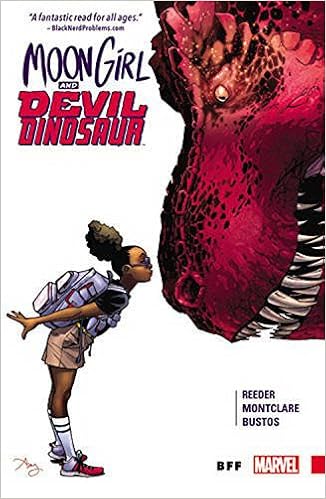
Moon Girl and Devil Dinosaur: BFF (Volume 1)

Marvel
Moon Girl and Devil Dinosaur:  BFF (Volume 1)
Brandon Montclare
Amy Reeder
Natasha Bustos
2016

The Summary
"Lunella Lafayette is an inhuman preteen genius who wants to change the world!

"That job would be a lot easier if she wasn't living in mortal fear of her latent inhuman gene.  There's no telling what she'll turn into--but Luna's got a plan.  All she needs is an Omni-Wave Projector.  Easy, right?  That is, until a red-scaled beast is teleported from the prehistoric past to a far-flung future we call...today!  Together they're the most Marvelous Team-Up of all--the Inhuman Moon Girl and time-tossed Devil Dinosaur!  But will they be BFFs forever or just until DD's dinner time?  And Lunella soon learns that there are other problems with having a titanic T. Rex as a pet in the modern-day Marvel Universe.  School, for one.  Monster hunters are another--especially when they're the Totally Awesome Hulk!  Then there's the fact that everyone's favorite dino didn't journey through time alone.  Beware the prehistoric savages known as the Killer-Folk--New York City's deadliest tourists!  Can Lunella handle all this turmoil...and keep herself from transforming into an inhuman monster?"

The Good
Featuring smart, sassy Lunella and, of course, the indomitable Devil Dinosaur, Moon Girl and Devil Dinosaur is an amusing and adventurous comic to read.  More to the point, it's a good comic for all ages as it's both entertaining and accessible without compromising on complexity or content.  (Plus it's a great comic for the Read Harder Challenge for 2017, just so you know.)

I admit, I was a little hesitant to pick up Moon Girl and Devil Dinosaur.  I'd seen single issues in the local comic book store and, for some reason, I couldn't imagine myself reading them.  They seemed too young for me or too cartoonish or too...well, something, but then I discovered the first volume collection and I immediately fell in love.

Moon Girl and Devil Dinosaur is one of those comics that has a feel-good message and a strong moral (i.e. girls can like science--and they can be kick butt heroes just like anyone else), but it also has a good story, a strong female protagonist, hilarious hero-villain interactions, unusual adventurers and unconventional victories.  It reminds me a bit of Squirrel Girl, minus the acorns and furry tails, of course.

Granted, it's a bit absurd, but it's fun and it's wonderfully light-hearted and it's incredibly colorful.  I loved how expressive each panel seemed, taking into account facial expressions and background colors and movement.  Plus, I just loved Lunella.  She was such a fun character to follow and she a great narrator.  Sassy, but not obnoxious; humorous, but not clownish; intelligent, but not overwhelmingly smart.  She was a perfectly balanced character.

Overall, I thought it was a great comic and I'm so glad I took the opportunity to read it.

The Bad
Hulk.

For some reason, I just couldn't take the "Totally Awesome" Hulk seriously.

The Ugly
It's easy to forget that Lunella is only 9-years-old.  She's such a strong, dynamic and intelligent character, you sometimes don't think that she's still in elementary school.  But then you come across a scene where she's broken-hearted, sobbing because she's terrified her Inhuman genes will turn her into a monster--and that's when you remember.

She's just a kid.  She still needs her mom and her dad.

It's a bit heart breaking.

Monday, January 23, 2017

Packing for Mars

Packing for Mars: The Curious Science of Life in the Void
W.W. Norton & Company
Packing for Mars
Mary Roach
2010

The Summary
"Space is a world devoid of the things we need to live and thrive:  air, gravity, hot showers, fresh produce, privacy, beer.  Space exploration is in some ways an exploration of what it means to be human.  How much can a person give up?  How much weirdness can they take?  What happens when you can't walk for a year?  have sex?  smell flowers?  What happens if you vomit in your helmet during a spacewalk?  Is it possible for the human body to survive a bailout from space?  To answer these questions, space agencies set up all manner of quizzical and startlingly bizarre space simulations.  As Mary Roach discovers, it's possible to preview space without ever leaving Earth.  From the Space Shuttle training toilet to a crash test of NASA's new space capsule (cadaver filling in for astronaut), Roach takes us on a surreally entertaining trip into the science of life in space and space on Earth."

The Good
After hearing about Mary Roach's book through the reader grapevine, I was absolutely fascinated by the idea of space travel to Mars.  Since I fell in love with The Martian by Andy Weir, I've been intrigued by Mars and outer space more than ever.  (That's part of the reason I slogged through How to Read the Solar System--and, you know, why I've been so inexplicably excited to start on John Carter of Mars.)

And I wasn't disappointed.

Packing for Mars is a fun and insightful science book.  Truthfully, it reminds me of Bill Nye:  humorous, but informative.  Roach makes science approachable and, dare I say it, fun.  Her writing is easy to read, yet she doesn't compromise facts or treat her reader as a big dummy for not understanding the intricacies of space.  Moreover, it gives you answers to questions that you never even knew you had.

Want to know what happens to a fuse when it's shot into space?  (Answer:  If a fuse blows in space, it fries everything; it's why they had to invent the transistor.)  Want to know what happens if you lay in bed for days on end with very little movement?  Want to know what happens to the human body when it meets lower-than-normal gravity?  Roach has answers to all these questions and more, and she does it with some highly humorous musings.

Overall, I found to Packing for Mars to be highly informative, incredibly rewarding--and lots of fun.

The Bad
I admit, I did sometimes lose interest in Packing for Mars.  Sometimes, I just wasn't interested in the subjects and I couldn't keep my mind focused enough on the trials and tribulations of animal test flights, or some other such thing; however, I think that's more my failing, rather than some grievous fault with Roach's book.

The Ugly
Porn.  In space.

For some reason, I was perturbed by the entire concept.  It bothered me, more than I'd like to admit, and I found myself in for some highly awkward reading.

Thursday, May 5, 2016

How to Read the Solar System: A Guide to the Stars and the Planets

22488004
Pegasus Books
How to Read the Solar System:  A Guide to the Stars and the Planets
Chris North
Paul Abel
2014

The Summary
"What exactly is the solar system?  We've learned the basics at school, but do we really understand what we are seeing in the night sky?  Expert astronomers Chris North and Paul Abel provide a fascinating guided tour of our solar system and explain its many wonders.

"They at all the major players including our more familiar cosmic neighbors--the sun, the planets, and their moons--as well as the occasional visitors to our planet--asteroids, meteors, and comets--in addition to the distant stars and what might lie beyond our solar system, including the mysterious Earth Mark II.  North and Abel recount the history of how our solar system came to be and decipher the myths that once shaped our astronomy.

"Through their cogent explanations of the latest scientific discoveries, they reveal how any amateur astronomer can view and interpret the solar system and enrich their understanding of our universe."

The Good
I'm actually really glad I finished How to Read the Solar System, because it offered me insight into the solar system that I certainly didn't have prior to reading North and Abel's book.  While it is a bit dry and quite dense, I should point out that it's not a bad book.

I learned something interesting about each of the planets and a whole assortment of facts about dwarf planets, the Sun, comets and asteroids, and more, which was one of the most important aspects of reading this book.

For instance, I learned that Io, one of Jupiter's many moons, has boasted volcanic activity (specifically cryovolcanic activity, since it's an icy wasteland); sound waves travel faster through plasma, which gives scientists the opportunity to measure the internal activity of the sun (since it's made up primarily of plasma); and meteor showers are essentially the debris left behind by commets, like a dust storm that the Earth passes through during its orbit.  It's fascinating, really.

While How to Read the Solar System isn't a book I would read twice, it's a vast well of information that's sure to hold appeal for readers who greatly enjoy science, astronomy, technology, and even mathematics.  It's definitely worth checking out, especially if you're curious about the solar system and the explorations humankind has made into space thus far.

More importantly, it gets an added bonus point in my book for having an index.  I was able to easily look up the most intriguing bits of information if I didn't feel like skimming.

The Bad
I will admit, I was sometimes bored with this book.  Like terribly bored, so bored that when I read it at night I fell asleep within a few minutes.  Don't get me wrong, it's not a bad book by any means, but I simply lost interest when the authors went into too great a detail.

Like when they explained how amateur astronomers should find a specific location in space, like how to find a particular moon by Jupiter, or which filter to use use in order to observe the sun (helpful, if I understood where one might find such filters.  Or if my telescope worked properly), or pinpointing the exact degree to which one might adjust a telescope to find Venus.

I'll be honest, if it didn't directly link to me in some way, I found myself losing interest.  Quickly.

The Ugly
I wish How to Read the Solar System had had more pictures and photographs to share.  I would have loved some full color photos from the universe, depicting images from deep in space or shots of auroras or pictures of the planets and the Sun.  It was a little dull without them.