"All good books are alike in that they are truer than if they had really happened
and after you are finished reading one you will feel that all that happened to you
and afterwards it all belongs to you; the good and the bad, the ecstasy, the remorse,
and sorrow, the people and the places and how the weather was."
Ernest Hemingway
Showing posts with label Graphic novels. Show all posts

Tuesday, January 30, 2018

Bandette: Presto! (Volume 1)

Image result for bandette: presto
Dark Horse Books
Bandette:  Presto! (Volume 1)
Paul Tobin
Colleen Coover
2012

The Summary
"She is alluring, she is mysterious, she is Bandette!

"The world's greatest thief is a costumed teen burglar by the nome d'arte of Bandette!  Gleefully plying her skills on either side of the law alongside her network of street urchins, Bandette is a thorn in the sides of both Police Inspector Belgique and the criminal underworld.  But it's not all breaking hearts and purloining masterpieces when a rival thief makes a startling discovery.  Can even Bandette laugh off a plot against her life?

"This beautiful hardcover includes the complete first adventure from Paul Tobin and Colleen Coover's enchanting series, plus Urchin Stories illustrated by guest artists Steve Lieber, Jonathan Case, Erika Moen, Jennifer Meyer, Rich Ellis, Alberto J. Alburquerque, Tina Kim, and Mitch Gerads; an original illustrated tale; and more."

The Good
Bandette is a fun, adventurous graphic novel featuring a quirky heroine--although heroine may be stretching it a bit.

Bandette is a thief, and a very good one; however, she's also a friend to many and an enemy only to those who would do true evil.  She's a bit of a Robin Hood character, but she enjoys thievery a little too much to be classified as a hero.

Overall, it's a very mild book with fun characters, colorful adventures, and funny stories.  Even when faced with deadly enemies, Bandette manages to have a good time.  She's intelligent, she's capable, she's kind-hearted--and she's the best at what she does:  stealing things and infuriating Inspector Belgique.

The Bad
No complaints.

The Ugly
There are a few mature themes, but nothing terribly frightening or vulgar.

Friday, August 4, 2017

Ruroni Kenshin (Volume 3)

294959
Viz Media
Rurouni Kenshin (Volume 3)
Nobuhiro Watsuki
2004

The Summary
"'Spider's Web'...like ordinary opium, but better processed.  Half the cost to produce, but twice the profits!  To the people of Aizu, Takani Megumi was a daughter in a famous family of doctors, in which everyone--women and children alike--studied medicine.  But to grasping industrialist Takeda Kanryu, she is the hen who lays the golden egg--the only one who knows the Spider's Web formula!  To stay with Kanryu is to send even more to their deaths.  But to stay with Kenshin and the others is to invite theirs..."

The Good
Although I'm not as big a fan of the third volume as I am the second one, I was excited to meet the Oniwabanshu again.  There's something about the Oniwabanshu--about how they're just a small pocket of resistance against the tide of Meiji progress--that I like.

The Bad
I'm not sure why, but I just didn't like this volume as much as I did the previous one.  I like the Oniwabanshu and, personally, I love Aoshi.  He's one of my favorite characters, because he's not actually that bad of a guy, he's more of a complicated anti-hero; however, I don't like the Takani Megumi story arc.

For some reason, it's just not that appealing to me.

The Ugly
As always, blood.  Lots and lots of blood.

Wednesday, August 2, 2017

Rurouni Kenshin (Volume 2)

294966
Viz Media
Rurouni Kenshin (Volume 2)
Nobuhiro Watsuki
2003

The Summary
"When the chief of the Police Sword Corps himself comes asking for favors, things must be bad.  Hitokiri Udo Jin-e--a black-hatted, crazy-eyed slayer who fells both targets and innocent bystanders alike--is steadily working his way through a list of former Ishin Shishi patriots now ensconced within positions of power in the Meiji government.  Can Kenshin withstand the hypnotic, paralyzing effect of Jin-e...?"

The Good
I found that the second volume of Rurouni Kenshin was equally enjoyable.  Not only has the art improved, it's still just as easy to become engrossed in the story; moreover, it has one of my favorite stories.

You see, in the first volume, you have the chance to see Kenshin as a warrior.  He's obviously impressive with his sakabato; however, he's still Kenshin.  Readers see glimpses of his previous personality, like a hint of viciousness that he very rarely betrays, but it's not until his confrontation with Udo Jin-e that you see him as the hitokiri he once was.

There's something thrilling about seeing Kenshin fight and fight well against someone who is, confidentially, quite terrifying.  I kind of like seeing the hitokiri side of Kenshin, but I also think I like that he's able to pull himself from the brink and resume his happy-go-lucky facade.  I think it makes him a better, more complex character.

The Bad
No complaints.  Besides the seventh volume, where we get to meet Saito Hajime, I think it's one of my favorites.

The Ugly
Blood.

Udo Jin-e is vicious.

Monday, July 31, 2017

Ruroni Kenshin (Volume 1)

Rurouni Kenshin, Volume 01
Viz Media
Rurouni Kenshin (Volume 1)
Nobuhiro Watsuki
2003

The Summary
"140 years ago in Kyoto, with the coming of the American 'Black Ships,' there arose a warrior who, felling men with his bloodstained blade, gained the name Hitokiri, man slayer!  His killer blade helped close the turbulent Bakumatsu era and slashed open the progressive age known as Meiji.  Then he vanished, and with the flow of years, became legend.

"In the 11th year of Meiji, in the middle of Tokyo, this tale begins...."

The Good
I originally watched the anime, before I picked up the first volume of Rurouni Kenshin and, honestly, it's been some time since I last read it; however, I was glad to sink back into Meiji era Tokyo and reacquaint myself with Himura Kenshin.  Jumping back into the graphic novel wasn't as difficult as I imagined.  The manga reads right to left, but it only took me a few minutes to reorient myself and I was happily plodding through the story.

I'm pleased I still enjoyed Rurouni Kenshin.  I mean, I didn't always understand the humor (of course, I never understood the humor when I first read it either), but I enjoyed returning to Kenshin, Kaoru, Yahiko, Sanoske, and everyone else.  There was a bit nostalgia there, because I remember devouring this series when I first read it; however, I found I still enjoyed it.

I like the action balanced by moments of silliness; I like the dueling kindness and ferocity of Kenshin; I even like Yahiko and Kaoru's arguments.  I find it fun to read and I enjoy it with the same enthusiasm I once did.  It's absurd, yes, but it's fascinating at the same time.  It offers a glimpse into Japanese culture and, as it's an area with which I'm unfamiliar, it's very insightful.

More to the point, as an adult, I find that I like reading the side notes Nobuhiro peppers throughout his narrative.  I once skimmed through the commentary, because I thought it was boring, but, now, I enjoy reading the "Secret Life of Characters" and finding out the different inspirations for Rurouni Kenshin.

Likewise, reading the series ago allows me to notice details I didn't catch in previous readings.  It has been literal years since I read Rurouni Kenshin, so it's nice to know I still remember the story; however, it's also interesting to see the small details I missed and the sudden clarity I have about earlier details that I hold from reading later volumes.  I know more about Kenshin now than I did then, which means it's a completely different experience to read the earliest volumes.

The Bad
Like I mentioned, I'm not sure I understand the humor in Rurouni Kenshin.  Some things are funny, some things are not.  It's kind of an acquired taste, I think, but it's pretty easy to acclimate.

One thing I have noticed since returning to the earlier volumes is how different the artwork looks to me now.  I mean, the earlier panels have thick, heavy lines in comparison to the lighter, thinner shapes of later volumes.  You can tell Nobuhiro's earlier work; that is, it shows in the heaviness of light and shadow, the proliferation of lines, the heavier details.  It's quite different from the last volume.

The Ugly
Violence.

Kenshin isn't a killer.  He vows never to kill again and he carries a sakabato, a reverse-edged sword; however, that doesn't mean he can't injure, wound, and potentially maim.  Moreover, some people don't have the same qualms as Kenshin and they won't hesitate to hurt others.

Tuesday, March 7, 2017

Geis: A Matter of Life and Death

Nobrow
Geis:  A Matter of Life and Death
Alexis Deacon
2016

The Summary
"The chief matriarch is dying.  Drawing her last breath, she declares a contest:  let fate decide the one worthy to rule.  Fifty souls are summoned in the night; fifty souls bound to the same fate.  But this is no ordinary trial...

"And so begins the first task."

The Good
Honestly, I was unexpectedly fascinated by Geis.  It's a book that I did, but somehow didn't, like.  That probably sounds strange, but Geis is a graphic novel that's difficult to explain.  It's rich with imagination, but terrifyingly dark, hinted with macabre undertones that make you shiver and make you think.

It's a startling combination of adventure and horror and supernatural elements, fabricating a dark and fascinating world that's rich, but stark in its shadows.  I was reluctantly intrigued by Geis.  I almost didn't want to read it, but, at the same time, I ended up devouring it in a matter of hours.  It's so morbid that you almost can't help following along with the story.

Overall, it's a fine comic.  It had an interesting story, a well-developed world, and a fascinating cast of characters that caught my attention.  Although I'm still not sure how I feel about Alexis Deacon's book, I will probably read the second volume when it arrives on the scene.  I could use some closure--I feel I'm invested now.

The Bad
I can't quite put my finger on it, but something didn't quite catch me with Geis.  It left me with a lot of conflicting emotions, and I'm not quite sure how I feel about it.  I wasn't overcome with joy when reading it, yet I didn't find it horrible or distasteful; rather, I liked it.  I liked it even if I didn't care to like it.

It's a muddle.

The Ugly
The premise of this book is a competition.  Fifty individuals are summoned to the castle of the chief matriarch to witness her death and receive her decree on who shall succeed her; however, a dark enchantress is added to the mix....and she has other plans in mind.  The chief matriarch creates a trial:  whosoever succeeds in the competition shall be crowned the new ruler.

And everyone else dies.

Seriously.  That's how it goes.

Only one person will survive the trial, which means everyone else will meet horrible, gruesome deaths--and, somehow, the enchantress will triumph over all.  I won't say anything more for fear of ruining the story; however, I will note that I was surprised by the dark turns that Geis seemed to make.  It's almost difficult to read in that regard, because I don't foresee the series ending very well.

Tuesday, January 3, 2017

The Night Bookmobile

6881206
Abrams
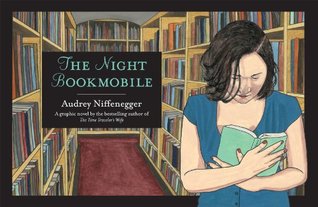
The Night Bookmobile
Audrey Niffenegger
2010

The Summary
"The New York Times bestselling author of The Time Traveler's Wife and Her Fearful Symmetry, Audrey Niffenegger, has crafted her first graphic novel after the success of her two previous critically acclaimed novels-in-pictures, The Three Incestuous Sisters and The Adventuress.

"The Night Bookmobile tells the story of a wistful young woman who one night encounters a mysterious disappearing library on wheels.  This library includes everything, and only everything, she has ever read.  Seeing her history and most intimate self in this library, she embarks on a search for the bookmobile.  But over time her search turns into an obsession she longs to be reunited with her own collection and therefore, her memories.

"The Night Bookmobile is a haunting tale both of transcendence and the passion for books, and features the evocative full-color pen-and-ink work of one of the world's most beloved storytellers."

The Good
I read The Night Bookmobile at the suggestion of a coworker, and I found I was fascinated by the notion of a library existing that contains every single item that you have ever read.  It reminded me a bit of the Archive in Jim Butcher's Dresden Files, and I couldn't help but be intrigued by the premise of Niffenegger's graphic novel.

Truthfully, I love the idea that every piece of information ever written is collected somewhere, tucked away in some supernatural library that can only be accessed by the right people.  It's something that has enchanted me for years, and I was glad to see it enacted in another story.  However, I'm not sure what to make of the way The Night Bookmobile handled the matter.  I'm still trying to figure out how it makes me feel.

Overall, The Night Bookmobile is a curious story.  It's not a tragedy, per se, but it isn't exactly a happy little story about a woman and her library.  It makes you think, it makes you feel things you might rather not feel, and it makes you question your own mortality...and wonder, what exactly, you will leave behind.

The Bad
I'm really not sure what to make of The Night Bookmobile.

It's intriguing, but it leaves me feeling slightly squeamish.  I mean, as a reader, I love books.  I must have 400 books in my house alone, not counting the bag I keep packed full of library books or the random copies I keep squirreled away in my desk for a rainy day; however, I don't believe my adoration of books has ever turned into something unhealthy.

The narrator of The Night Bookmobile is a young woman who encounters a mysterious library, a collection of books in the back of a Winnebago that reflect each and every book she's ever read, and it sparks an obsession.  It's based on a similar tale by H.G. Wells, "The Door in the Wall," in which a young man becomes consumed by rediscovering the verdant paradise he found behind a mysterious green door.  They have many of the same undertones:  obsession, desperation, an all-consuming (read:  deadly) need to go back to a time and place that was, in a word, happier.

I was really bothered by the way The Night Bookmobile ended.  I know I'm going to ruin the ending, I'm sorry, but I just can't adequately express how I feel about the story without telling you how it ends and how it made me feel after all is said and done.  You see, The Night Bookmobile ends when the narrator commits suicide and becomes a night librarian.  Shortly thereafter, she discovers her collection has been decommissioned, because, and I quote, "only the living have libraries."

Truthfully, I couldn't decide if I was bothered more by the fact the narrator committed suicide in her desperate attempt to reconnect with her library or the fact that her library--in essence, her collective knowledge, her entire sense of being and self--simply disappears.  The entire story raises questions about mortality and what really matters in life...and what's leftover for the next generation.

It's haunting, and it makes me squirm.  I can't decide whether I like it or whether I hate it.  Part of me dislikes it, dislikes the narrator's suicide and the disappearance of her library (her knowledge); however, another part of me is intrigued by the entire thing, by the notion that all books written or read are available somewhere--and that something, however small, is left for the next generation, some semblance of knowledge is passed down and never really lost.

Like I said, I'm conflicted.  As a coworker noted, The Night Bookmobile is not a book that anyone can read without feeling something, good or bad, and forming an opinion about it.

The Ugly
Suicide.