"All good books are alike in that they are truer than if they had really happened
and after you are finished reading one you will feel that all that happened to you
and afterwards it all belongs to you; the good and the bad, the ecstasy, the remorse,
and sorrow, the people and the places and how the weather was."
Ernest Hemingway
Showing posts with label Appalachia. Show all posts

Friday, April 21, 2017

Read Harder Challenge 2017: Part 3

I finally finished the next part of my Read Harder Challenge.  I finished:
  • Read a book about books.
  • Read a book that is set within 100 miles of your location.
  • Read a collection of stories by a woman.

26531650
Simon & Schuster
Starting out, I finished reading The Bad-Ass Librarians of Timbuktu by Joshua Hammer, which details events beginning in 2012 when more than 350,000 manuscripts--many of which had been painstakingly collected by Abdel Kader Haidara--were endangered by Al Qaeda militants seizing control of Mali.  In his book, Hammer details how Haidara and other manuscript collectors managed to find, preserve, and rescue hundreds of thousands of manuscripts, before smuggling them out of the country under the noses of Al Qaeda.

As the summary attests, it's indeed a "brazen heist worth of Ocean's Eleven."  Personally, I found it fascinating to learn how Haidara became involved in the manuscript preservation business and how he and other librarians managed to steal away more than 350,000 manuscripts from Timbuktu.  I mean, the number is simply mind boggling.

Moreover, I was consistently fascinated by the history and culture of Timbuktu and Mali as a whole.  Hammer offers a rich variety of details, discussing the medical, cultural, historical, scholastic and artistic impact of Timbuktu.  Although his work can grow a little dry, every chapter offers fascinating insight into the history of Timbuktu and, more importantly, provides readers with an eye-opening portrait of the conditions faced by Mali's residents when Al Qaeda invaded.

Beauty and the Mustache
Cipher-Naught
Next, I checked out Beauty and the Mustache by Penny Reid.  Set in Tennessee, Beauty and the Mustache is a short, sweet little romance--which kicks off the Winston Brothers series and continues the Knitting in the City series, both by Penny Reid--that brings together Ashley Winston and Drew Runous.  After spending more than 8 years away from home, Ashley is forced to return to Tennessee to help take care of her ailing mother.  Expecting the same rough treatment from her brothers as from years before, she's surprised to learn they've changed.  She's even more surprised to meet their friend Drew, especially when she realizes he's exactly her type.

Overall, I really enjoyed reading Beauty and the Mustache.  Like I noted above, it's a short, sweet little romance and it's absolutely adorable.  It's sometimes bittersweet, sometimes tragic, but I immensely enjoyed reading Penny Reid's novel.  I found I connected to Ashley, our main character and narrator, on a personal level and I admired her sharp, sarcastic sense of humor, her intelligence, and her ability to go toe-to-toe with Drew's philosophical meanderings.

However, I will note I was bothered by one thing:  I did not like the setting.  I love the Smoky Mountains, don't get me wrong; however, I simply didn't like the narrator's inability to describe her surroundings.  I was incredibly disappointed by the setting descriptions, which were seriously lacking.  I wanted to hear more about the winding roads, the multitude of trees, the softly sloping mountains in the distance, or the way the hills fade against the horizon, deepening to a slate blue before disappearing altogether.

I wanted to hear about places I've known or seen, but, sadly, I didn't get that chance.  It was slightly disappointing.

2782459
Anchor
Last, I read Moral Disorder by Margaret Atwood.  I think I might have fudged the challenge parameters with this one, since it's really just a single novel; however, as it's labeled with "Other Stories," I assumed it would do the trick.  It centers around one woman--Nell--but it's a compilation of many short stories from different points in her life.

It begins with "Bad News," toward the tail end of Nell's life, but it jumps through time with each story and catapults Nell into the past, showing readers glimpses of her childhood and her adolescence and, finally, her transition into adulthood.

Truthfully, I didn't enjoy reading Moral Disorder that much.  Atwood is a fantastic writer and her prose packs a punch when she wants it, but, personally, I found I couldn't always connect with the stories in Moral Disorder, I couldn't always connect to Tig and Nell.  Granted, when I did connect with one of these stories, it moved me deeply and I worried for Nell, like I'd worry for a friend; however, I found it was a rather unremarkable journey for me overall.

Monday, April 17, 2017

Beauty and the Mustache: A Philosophical Romance

Beauty and the Mustache: A Philosophical Romance (Knitting in the City Book 4) by [Reid, Penny]
Cipher-Naught
Beauty and the Mustache:  A Philosophical Romance
Penny Reid
2014

The Summary
"There are 3 things you need to know about Ashley Winston:  1) She has six brothers and they all have beards, 2) She is a reader, and 3) She knows how to knit.

"Former beauty queen, Ashley Winston's preferred coping strategy is escapism.  She escaped her Tennessee small town, loathsome father, and six brothers eight years ago.  Now she escapes life daily via her Amazon kindle one-click addiction.  However, when a family tragedy forces her to return home, Ashley can't escape the notice of Drew Runous--local Game Warden, reclusive mountain man, bear wrestler, philosopher, ad everyone's favorite guy.  Drew's irksome philosophizing in particular makes Ashley want to run for the skyscrapers, especially since he can't seem to keep his exasperating opinions--or his soulful poetry, steadfast support, and delightful hands--to himself.  Pretty soon the girl who wanted nothing more than the escape of the big city finds she's lost her heart in small town Tennessee."

The Good
I enjoyed this novel immensely.  Ashley was a quirky character with a foul mouth and an unexpectedly sharp, shining wit.  She's intelligent, she's sassy, funny and self-deprecating, and she's very relatable.  She was also clumsy and awkward, but she was willing to take charge of her mistakes--like nipple twisting Drew by mistake within the first two pages (how embarrassing)--and recovers quite well.

Moreover, she's so incredibly familiar.  I related to her on an emotional level, because I have often felt the emotions she's felt, good and bad:  overwhelmed by obligation, fraught with uncertainty and doubt, love for a parent, affection for siblings as I learn new things about them and, suddenly, become best friends, excitement and relief to find a new book.  It sparked an instant, personal connection that I appreciated.

Overall, it was a fun, emotional but unexpectedly feel good book.  I really enjoyed reading about Ashley and the various antics her brothers would get into, and I loved that there was a gradual strengthening in her family as she takes care of her mother and gets to know her brothers again.  It's bittersweet and, occasionally, tragic, but it's incredibly heartwarming.

The Bad
As I've lived in the area Ashley often describes, I was a little disappointed by the setting.  That is, I think much of the imagery I envisioned came less from the author and narrator, and more from my own memories.

Take her descriptions of the Smoky Mountains, for instance.  They were seriously lacking.  Where were the descriptions of the winding roads, the trees, the softly sloping mountains in the distance as the landscape slowly marched into a deepening blue, the haze on a cloudy day or the startling clarity of the sky when the sun shines?  I've seen some beautiful places in this area, so I really think the author missed out with her narrator.  She could have told us so much more about her hometown.

Also, I was really bothered by the country slang Ashley used.  For example, I have literally never heard anyone in Appalachia say "butter my biscuits" or "that's melting the butter on my biscuits" or anything of the sort.  I've known a restaurant called "Butter My Biscuit," but I have literally never heard anyone say it in earnest.  It was pretty laughable.

Some of the folksy, country-fried sayings Ashley pulled out were just a little too much for my tastes.

The Ugly
Cancer.

Grab your Kleenex folks.

Friday, February 3, 2017

The Cats of Tanglewood Forest

Image result for the cats of tanglewood forest
Little, Brown and Company
The Cats of Tanglewood Forest
Charles de Lint
Charles Vess
2013

The Summary
"Lillian Kindred spends her days exploring the Tanglewood Forest, a magical, rolling wilderness that she imagines to be full of fairies.  The trouble is, Lillian has never seen a wisp of magic in her hills--until the day the cats of the forest save her life by transforming her into a kitten.  Now Lillian must set out on a perilous adventure that will lead her through untamed lands of fabled creatures--from Old Mother Possum to the fearsome Bear People--to find a way to make things right.

"In this whimsical, original folktale written and illustrated by two celebrated masters of modern fantasy, a young girl's journey becomes an enchanting coming-of-age story about magic, friendship, and the courage to shape one's own destiny."

The Good
After reading A Circle of Cats, I checked out The Cats of Tanglewood Forest with the encouragement of a co-worker.  I thought I would be stepping into the same old story--The Cats of Tanglewood Forest is, of course, an expansion of A Circle of Cats from it's small, short children's book to a middle-grade novel--but it's a complete reimagining of the world that Vess and de Lint created in their original book.

It was certainly worth reading, especially as I enjoyed A Circle of Cats.  I especially liked the addition of Old Mother Possum.  She was a wonderfully colorful character, and I enjoyed meeting her.  Moreover, I loved the expanded involvement of one T.H. Reynolds, who acted as guide and guardian for the young Lillian during her journey.

I don't know why, but I felt compelled to read T.H.'s dialogue aloud with an exaggerated Southern accent.  Think Colonel Sanders kind of southern or, better yet, Scarlett O'Hara kind of southern.  it was a strange thing to do, I admit, but it just felt so right.  Plus, I got a real kick out of it and I laughed my way through much of the book.

And, of course, I loved the artwork.  Charles Vess outdoes himself with The Cats of Tanglewood Forest.  He adds greater depth to the world and manages to breathe life into the characters, into the magical places to which Lillian must travel.  It's spectacularly colorful, wonderfully detailed, and utterly beautiful.  I was greatly impressed by his work, and I can't wait to find more from him.

Overall, The Cats of Tanglewood Forest was a great little adventure, and it's an excellent book for younger readers.

The Bad
Despite getting a little more insight into Lillian's odyssey through the verdant forests of Appalachia, I still didn't quite understand how her condition--that is, her being turned into a cat--became her fault?  I mean, some of it I can see and I understand why she needed to learn lessons about this dangerous, magical world; however, I'm still a irritated by some aspects of her journey.  Namely, her responsibility in it.

It bothered me, just a little.

The Ugly
Snakes.

Still snakes, but throw in the added danger of the Bear People.

Tuesday, January 31, 2017

A Circle of Cats

186448
Viking
A Circle of Cats
Charles de Lint
Charles Vess
2003

The Summary
"Lillian is an orphan who lives with her aunt on a homestead miles from anyone, surrounded by uncharted forest.  She wanders the woods, chasing after squirrels and rabbits and climbing trees like a possum.  Free-spirited and independent, Lillian is a kindred soul to the many wild cats who gather around the ancient beech tree.  One day, while she is under the beech, Lillian is bitten by a poisonous snake.  The cats refuse to let her die, and use their magic to turn her into one of their own.  How she becomes a girl again is a lyrical, original folktale that begs to be read aloud.

"Set in the hill country of the author's fictional city of Newford, A Circle of Cats is the much anticipated first picture book by longtime friends Charles de Lint and Charles Vess, whose masterful art is as magical as the story."

The Good
I enjoyed reading Circle of Cats.  I picked it up on a whim, curious to see more of Charles Vess' work (I loved his illustrated edition of Stardust by Neil Gaiman), and I'm incredibly pleased with Charles Vess and Charles de Lint's book.  Quite frankly, it's like nothing I've ever read--and I liked that about it.

Yes, it's a children's book, but it's accessible for all ages.  As an adult, I appreciated the subtle nuances of culture and magic that existed in the midst of the story, and I absolutely loved the artwork.  Besides which, it's not quite what you expect from a half-fairy tale/half-folklore story about cats--or, at least, it's not quite what I expected.

Moreover, it's unexpectedly southern.

I know that sounds almost ridiculous, but I enjoyed how it pulls from southern (specifically, Appalachian culture) and draws on many of the legends, stories, and fables of the area.  It lends magic to the real world, appreciating both the history and culture of Appalachia while simultaneously providing a compelling odyssey.

Although I liked Lillian as a character and I loved the charming legends surrounding the Father of Cats and the Apple Tree Man, I adored Vess' illustrations.  The art is absolutely beautiful, a unique blend of reality and imagination that's sure to impress.  I especially loved the greenery of the background and the mountains in the distance, the rustic charm of the landscape and characters, the almost cozy feeling that proliferates the pages.

It has a touch of something that makes it feel like home to me, and it makes me see that world with new eyes.  Honestly, that's probably one of the biggest draws for me with Circle of Cats and I highly recommend it to young readers and their parents, even if you're not the biggest fan of cats.

The Bad
Occasionally, I found Lillian's journey to be unfair.  I mean, she didn't ask to be turned into a cat--and yet she still had to pay the price?

No, I found that injustice rather hard to swallow.

The Ugly
Snakes.

Snakes, curses, and dangerous journeys.

Thursday, August 18, 2016

Dovey Coe

Atheneum Books for Young Readers
Dovey Coe
Frances O'Roark Dowell
2000

The Summary
"'My name is Dovey Coe and I reckon it don't matter if you like me or not.  I'm here to lay the record straight, to let you know them folks saying I done a terrible thing are liars.  I aim to prove it, too.  I hated Parnell Caraway as much as the next person, but I didn't kill him.'

"Dovey Coe says what's on her mind, so it's no secret that she can't stand Parnell Caraway.  Parnell may be the son of the richest man in town, but he's mean and snobby, and Dovey can't stand the fact that he's courting her sister, Caroline, or the way he treats her brother, Amos, as if he were stupid just because he can't hear.

"So when Parnell turns up dead, and Dovey's in the room where his body is discovered, she soon finds herself on trial for murder.  Can the outspoken Dovey sit still and trust a city slicker lawyer who's still wet behind the ears to get her out of the biggest mess of her life?"

The Good
Dovey Coe was an unexpectedly interesting and engaging piece of children's literature.  Featuring a tough, no-nonsense narrator and a story littered with hints of rural Appalachia, Frances O'Roark Dowell's novel is a fascinating little story about a young girl faced with a very big problem:  everyone believes she murdered Parnell Caraway.

Naturally, she didn't.  (Not that I would have minded.  Parnell was a cruel man who had designs on Dovey's sister and, eventually, Dovey whom Parnell blamed when Caroline wouldn't return his affections, and I grew to distrust him as much as Dovey did.  For good reason, too.)

In some way, Dovey Coe reminded me of Harper Lee's To Kill a Mockingbird.  I mean, for one, you have a rambunctious female narrator, a convoluted court case, and a lawyer with a heart of gold (looking at you Atticus).  It's interesting to see the parallels and, while it's certainly not as ground-breaking as Lee's novel, it strikes much the same tone, using a familiar Southern dialect to convey the language quirks of the region.  It makes me think of Scout Finch and Huck Finn, which I enjoyed.

Plus, I liked that Dowell didn't succumb to the usual tropes when portraying Appalachia as riddled with illiterate hillbillies.  (Deliverance, anyone?)  I know the history of the region, I'm intimately familiar with it, so I was relieved when the author reflected the history, culture, and dialect of the region without poking fun or ridiculing.  I thought she did a wonderful job of portraying the mountain communities of the early 20th century, and she does a wonderful job of depicting Dovey.

The Bad
The conclusion seemed to wrap up rather quickly.  That might seem like an odd complaint, but I think it's a valid one.  You see, Dovey Coe took quite a while to build up to the trial.  It gave plenty of background information on Parnell and Dovey and their families, it gave context to the community and the rivalry between the Coe and Caraway families; more to the point, it showed the circumstances that lead to the final, fatal conflict.

But the trial seemed to last no time at all.

In the aftermath Dovey's trial, readers learn the truth behind Parnell's death, which doesn't take more than a couple of chapters.  I was surprised and a little disappointed by the sudden--and startlingly quick--wrap up after I spent chapters and chapters (literally) learning about Dovey and Parnell and Caroline and everyone else.  The ending seemed almost anticlimactic by comparison.

The Ugly
Parnell really was a piece of work.  It's terrible to see his unbridled cruelty inflicted on others.

Thursday, July 28, 2016

The Peach Keeper

8546358
Bantam
The Peach Keeper
Sarah Addison Allen
2011

The Summary
"The New York Times bestselling author of The Girl Who Chased the Moon welcomes you to her newest locale:  Walls of Water, North Carolina, where the secrets are thicker than the fog from the town's famous waterfalls, and the stuff of superstition is just as real as you want it to be.

"It's the dubious distinction of thirty-year-old Willa Jackson to hail from a fine old Southern family of means that met with financial ruin generations ago.  The Blue Ridge Madam--built by Willa's great-great-grandfather during Walls of Water's heyday, and once the town's grandest home--has stood for years as a lonely monument to misfortune and scandal.  And Willa herself has long strived to build a life beyond the brooding Jackson family shadow.

"But Willa has lately learned that an old classmate--socialite do-gooder Paxton Osgood, of the very prominent Osgood family--has restored the Blue Ridge Madam to her former glory, with plans to open a top-flight inn.  Maybe, at last, the troubled past can be laid to rest while something new and wonderful rises from its ashes.  But what rises instead is a skeleton, found buried beneath the property's lone peach tree, and certain to drag up dire consequences along with it.  For the bones--those of charismatic traveling salesman Tucker Devlin, who worked his dark charms on Walls of Water seventy-five years ago--are not all that lay hidden out of sight and mind.  Long-kept secrets surrounding the troubling remains have also come to light, seemingly heralded by a spate of sudden strange occurrences throughout the town.

"Now, thrust together in an unlikely friendship, united by a full-blooded mystery, Willa and Paxton must confront the dangerous passions and tragic betrayals that once bound their families--and uncover truths of the long-dead that have transcended time and defied the grave to touch the hearts and souls of the living.

"Resonant with insight into the deep and lasting power of friendship, love, and tradition, The Peach Keeper is a portrait of unshakable bonds that--in good times and bad, from one generation to the next--endure forever."

The Good
I loved listening to The Peach Keeper.  It reminded me a great deal of Garden Spells and The Girl Who Chased the Moon, but it has its own unique characters--although a few familiar faces do make a repeat appearance--and its own unique story.  It has much the same flavor:  a quirky Southern town, small hints of magic, complex mother-daughter relationships, and a deep sense of family and tradition that influences the thoughts, feelings, and actions of characters.

Like Allen's other novels, The Peach Keeper is weighty with history.  Specifically, it focuses on the turbulent past of the Jackson and Osgood families--and, more importantly, the unshakable bond held by Willa and Paxton's grandmothers, Georgie and Agatha.  It's a complex story with finely detailed characters, deep family roots, and subtle hints of magic that paint a rich tapestry of loss and love.

I loved the way Allen beautifully describes the Appalachian Mountains.  In Garden Spells, The Sugar Queen, and The Girl Who Chased the Moon, readers are introduced to the mountains of southern Appalachia.  However, in The Peach Keeper, we get a glimpse of the Blue Ridge Mountains--a small range of green, sloping mountains and hills in western North Carolina and eastern Tennessee, running right through Virginia--and it's a beautiful sight to behold.

Since I'm familiar with the Blue Ridge Mountains and the surrounding region, I was inordinately pleased by Sarah Addison Allen's descriptions of the mountains and, more importantly, her fictional town Walls of Water.  It's a breathtaking location that feels right at home in the Blue Ridge Mountains.  More importantly, I was excited by her references to landmarks I knew and descriptions I recognized.  It was unexpectedly thrilling.

I also enjoyed the characters.  It's wonderful to see Willa and Paxton's relationship develop, to see a reflection of their grandmothers' relationship in their newly budding friendship, and it's incredibly sweet to see separate romantic interests crop up in their lives.  Love and excitement is the last thing Willa is looking for with Colin, and Paxton is trying to keep the status quo steady between herself and her best friend, Sebastian.

Their relationships are complicated--Willa trying to live down her past, Paxton trying to preserve her dearest friendship--but it's refreshing to see them confront their problems head-on, to see them work through the struggles to see their own self-worth and measure.  I enjoyed watching them grow, figure things out and fall in love.  It's almost sickly sweet, but it's all worth it for the feeling that everything worked out all right in the end.

The Bad
The Peach Keeper feels a little darker than Allen's other novels.  I mean, sure you find a particularly terrifying villain in Julian from The Sugar Queen, and you're confronted with domestic abuse in Garden Spells.  But most of these stories feel lighter, like you know that things will all work out in the end.

The Peach Keeper, on the other hand, has this dark undertone to it that influences much of the novel and makes it a more serious narrative.  Although it begins with Georgie and Agatha's ordeal in 1936, it doesn't really dissipate.  The violence feels fresh, more palpable, more pervasive, especially with the ghost of Tucker Devlin hanging over the story.

The Ugly
Murder.

A justified murder, but murder nonetheless.  It's a rather terrible story.

Wednesday, January 6, 2016

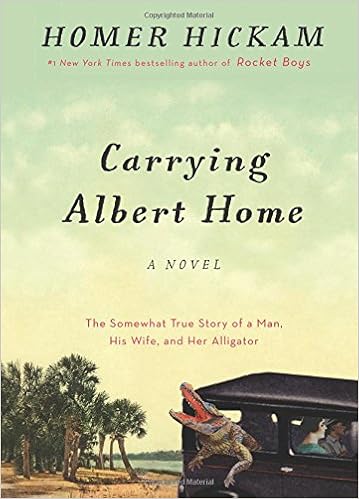
Carrying Albert Home: The Somewhat True Story of a Man, His Wife, and Her Alligator

William Morrow
Carrying Albert Home:  The Somewhat True Story of a Man, His Wife, and Her Alligator
Homer Hickam
2015

The Summary
"Elsie Lavender and Homer Hickam Sr.- the future parents of Homer Hickam Jr. - were high school classmates in the West Virginia coalfields, graduating just as the Great Depression began.  When Homer asked for her hand, Elsie instead headed to Orlando, where she sparked with a dancing actor named Buddy Ebsen (yes, that Buddy Ebsen).  But when Buddy headed for New York, Elsie's dreams of a life with him were crushed and eventually she found herself back in the coalfields, married to Homer.

"Unfulfilled as a miner's wife, Elsie was reminded of her carefree days in Florida every day because of Buddy's unusual wedding gift:  an alligator named Albert who lived in the only bathroom in their little house.  Eventually, Homer gave Elsie an ultimatum:  'Me or the alligator!'  After giving it some thought, Elsie concluded there was only one thing to do - carry Albert home.

"Carrying Albert Home tells the sweet, funny, and sometimes heartbreaking tale of a young couple and their special pet on a crazy 1,000-mile journey.  Told with the warmth and down-home charm that made Rocket Boys a beloved bestseller, Homer Hickam's rollicking novel is truly a testament to that strange and marvelous emotion we call love."

The Good
I enjoyed Carrying Albert Home.  It's a sweet, quirky story:  two people making an oddball journey through the south to return an incredibly expressive alligator to his natural habitat - I mean, it can't get any stranger than that.  Well, it can (and does, on occasion) as Elsie and Homer Senior stumble across bank robbers, bootleggers, rioters, smugglers, serial killers, and all manner of sundry creatures on their journey south.

And speaking of alligators, I loved Albert.  He is, I think, the best alligator I've ever read about in literature - then again, he may be the only alligator I've read about.  Nevertheless, I liked him (and the rooster) and their wild journey from West Virginia to Florida.  Their story, while highly unusual, is simultaneously hilarious and fun; more importantly, it's never boring.

Hickam has a storyteller's prose, weaving a tangled story of suspense and adventure and, ultimately, love.  Moreover, he manages to create wonderful characters that are sure to entertain.  Such as the strange, villainous duo of robbers Homer first encounters, or the bootlegger with whom Elsie spars.  It's a strange gathering of people and animals that left me laughing and shaking my head for the absurdity.

As I was reading, I learned to like Elsie.  Headstrong, defiant, inventive and, yes, courageous in her own way, Elsie was a fascinating female character; however, I have to say, I adore Homer (senior, of course).  Although Homer is a simple man - a coal miner by trade whose only aspirations are a steady job and a happy family - he is a smart man who is loyal to a fault and loves Elsie with all his heart, even if he can't always express it.

A lesser man wouldn't have bothered with a trip to Florida; a lesser man would never have faced bank robbers, rioters (with dynamite), bootleggers, poetry-writing serial killers, smugglers, or hurricanes; a lesser man wouldn't have fought so hard for a woman who wasn't sure of her feelings.  It's a sweet, strange love story that made me wonder from chapter-to-chapter, but I enjoyed it overall.

The Bad
Carrying Albert Home is a strange, strange book.  I don't know if the author intentionally made certain parts of his novel vague, or if he was attempting to give depth and symbolism to Albert's journey (like the rooster, who must play a much larger part than we know, but we never find out), or if he was doing something else entirely.

Either way, I often found myself thinking Elsie and Homer's journey to Florida was much bigger than either of them knew.

The Ugly
Homer and Elsie confront bank robbers, violent rioters in the midst of a strike, dangerous bootleggers, smugglers, serial killers, movie directors, and a number of other dangerous things that each had the potential to kill them.  Perhaps the ones who made my stomach turn most were Carlos and lovely Souffle.

Yes, that is really her name.  And, yes, they are about as strange as you can imagine.

But don't let their names deceive you.  You see, they're a couple of spiders who ensnare and eventually kill lost and wayward men.  Carlos is a poet; Souffle is his mistress - and they're both a special kind of crazy that's hard to describe.  Their method is simple, as Carlos elaborates to Homer:  "Though their souls were artless, Souffle gave them a moment of poetic joy and then I made their deaths perfect."

Souffle seduces them; Carlos kills them.  End of story.

It feels like a story from the Odyssey with Souffle akin to Circe - and, well, Carlos is simply a maniac with a pitch fork and penchant to create horrible poetry.  It's incredibly strange and, admittedly, a little horrifying.

Saturday, December 12, 2015

Bonus: The Girl Who Chased the Moon

Bantam
The Girl Who Chased the Moon
Sarah Addison Allen
2010

The Summary
"Emily Benedict came to Mullaby, North Carolina, hoping to solve at least some of the riddles surrounding her mother's life.  Such as, why did Dulcie Shelby leave her hometown so suddenly?  And why did she vow never to return?  But the moment Emily enters the house where her mother grew up and meets the grandfather she never knew - a reclusive, real-life gentle giant - she realizes that mysteries aren't solved in Mullaby, they're a way of life:  Here are rooms where wallpaper changes to suit your mood.  Unexplained lights skip across the yard at midnight.  And a neighbor bakes hope in the form of cakes.

"Everyone in Mullaby adores Julia Winterson's cakes - which is a good thing, because Julia can't seem to stop baking them.  She offers them to satisfy the town's sweet tooth but also in the hope of rekindling the love she fears might be lost forever.  Flour, eggs, milk, and sure...baking is the only language the proud but vulnerable Julia has to communicate what is truly in her heart.  But is it enough to call back to her those she's hurt in the past?

"Can a hummingbird cake really bring back a lost love?  Is there really a ghost dancing in Emily's backyard?  The answers are never what you expect.  But in this town of lovable misfits, the unexpected fits right in."

The Good
I actually picked up The Girl Who Chased the Moon as an audiobook.  This has been the first audiobook I've listened to since Hank the Cowdog was considered my favorite - back when we still had a cassette tape player in our car.  Granted, I think I prefer reading a book to listening to one; however, I was pleasantly surprised to find that I do still like audiobooks.

Like both Garden Spells and The Sugar Queen, Allen's novel is filled with little unexpected joys, everyday magic that jumps out and surprises you.  Like the wallpaper in Emily's bedroom, or Sawyer's "sweet sense," or the secrets of Mullaby's most illustrious family.  And it's interesting to see this magical dynamic at work in Mullaby, to see how the town accepts and even celebrates its oddities.

I really liked Julia.  Maybe more than any other character, even Emily, I liked Julia with her troubled adolescence and her steely resolve to leave Mullaby behind once she gets her father's business and her rocky relationship with Sawyer settled.  She's essentially damaged by her past, by a number of bad years in her youth, but she's managed to heal and she's managed to reinvent herself and, more importantly, grow into the woman she wishes to be.

I'm not saying Julia isn't flawed, and I'm not saying she isn't damaged; rather, I admire her for overcoming a number of challenges in her life - and she still manages to have hope.  That's why she continues to bake, why she continues to leave the window open when she's making her cakes:  she has hope for a better future and reconnecting with someone she thought she'd lost forever.

Additionally, Rebecca Lowman, who narrated the novel, did a splendid job of distinguishing between characters and reviving the cadence of a small North Carolina town.  She helped breathe life into the characters, playing upon the drawl and twang sometimes found in Appalachia, and she did a wonderful job of pacing the story, allowing it to unfold naturally.

The Bad
Despite my rekindled love of audiobooks, I've discovered that listening to a book just isn't enough for me.  Audiobooks just don't hold my attention as well as a physical books - and, admittedly, I'm more easily distracted.  I can't seem to immerse myself in the story as well as when I'm holding a book in my hands.

The Ugly
Adolescence is an ugly, ugly time.

For some, it's a passing phase; for others, it leaves lingering scars that can be forgiven if not forgotten.

Thursday, December 3, 2015

Bonus: The Sugar Queen

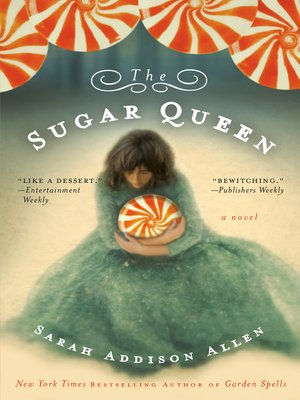
Cover of The Sugar Queen
Random House
The Sugar Queen
Sarah Addison Allen
2009

The Summary
"Twenty-seven-year-old Josey Cirrini is sure of three things:  winter in her North Carolina hometown is her favorite season, she's a sorry excuse for a Southern belle, and sweets are best eaten in the privacy of her hidden closet.  For while Josey has settled into an uneventful life in her mother's house, her one consolation is the stockpile of sugary treats and paperback romances she escapes to each night...until she finds it harboring none other than local waitress Della Lee Baker, a tough-talking, tenderhearted woman who is one part nemesis - and two parts fairy godmother...

"Fleeing a life of bad luck and big mistakes, Della Lee has decided Josey's clandestine closet is the safest place to crash.  In return she's going to change Josey's life - because, clearly, it is not the closet of a happy woman.  With Della Lee's tough love, Josey is soon forgoing pecan rolls and caramels, tapping into her startlingly keen feminine instincts, and finding her narrow existence quickly expanding.

"Before long, Josey bonds with Chloe Finley, a young woman who makes the best sandwiches in town, is hounded by books that inexplicably appear whenever she needs them, and - most amazing of all - has a close connection to Josey's longtime crush.

"As little by little Josey dares to step outside herself, she discovers a world where the color red has astonishing power, passion can make eggs fry in their cartons, and romance can blossom at any time - even for her.  It seems that Della Lee's work is done, and it's time for her to move on.  But the truth about where she's going, why she showed up in the first place - and what Chloe has to do with it all - is about to add one more unexpected chapter to Josey's fast-changing life."

The Good
Like Garden Spells, Allen's previous novel, The Sugar Queen has little threads of magic laced throughout the novel:  Josey has the uncanny ability to detect secrets; Chloe is plagued by books that magically appear when she needs them; Rawley is bound to keep promises, no matter the cost; Julian has a black mist that compels any woman within his reach to pay attention to him; and Marlena is surprisingly skilled at chasing away ghosts.

I liked the developing relationship between Josey and Adam.  Although Josey struggles with her self-confidence, her loyalty to her mother and her adoration for Adam - and although Adam hesitates to jump into a relationship with his whole heart - I enjoy the way their relationship develops.  It's slow to start, but it seems to expand and grow, weaving into their lives with an undeniable quickness.  Like Jake and Chloe, their chemistry seems undeniable.

I also enjoy the way Allen portrays her characters.  She gives them careful descriptions and pinpoints the little unexpected (read:  magical) things that populate their every day lives, linking them inextricably to a thin veil of magic that permeates the entire town.

And she's meticulous in showing character perspective, allowing her readers a peek into the lives of her characters - such as the way Josey equates the best things in life (and people) with sugary sweets, or Chloe recounts her moods and experiences in the books that follow her - by showing the world through their eyes.  In Sugar Queen, I found this simply added another layer to her characters.

Overall, it was an enjoyable novel.

The Bad
For me, The Sugar Queen just wasn't as good as Garden Spells.  I don't know why, but I simply found Garden Spells to be a much better novel in its style and its plot - and, more importantly, in its magic.  While I liked the magical elements of The Sugar Queen (meaning, I wouldn't mind having books follow me around on a regular basis), it felt a little more obvious.

Garden Spells, except for the apple tree (which was rather obvious), felt more subtle.  The Waverly sisters have peculiar gifts, but they aren't advertised; rather, their magic is woven into the fabric of their family, like fine threads, and it feels almost like a secret.  The Sugar Queen doesn't have that:  magic feels more like a nuisance than a gift.

The Ugly
Julian.  He frightens me more than the ghosts.

Friday, October 23, 2015

Bonus: Garden Spells

Bantam Discovery
Garden Spells
Sarah Addison Allen
2008

The Summary
"In a garden surrounded by a tall fence, tucked away behind a small, quiet house in an even smaller town, is an apple tree that is rumored to bear a very special sort of fruit.  In this luminous debut novel, Sarah Addison Allen tells the story of that enchanted tree, and the extraordinary people who tend it...

"The Waverlys have always been a curious family, endowed with peculiar gifts that make them outsiders even in their hometown of Bascom, North Carolina.  Even their garden has a reputation, famous for its feisty apple tree that bears prophetic fruit, and its edible flowers, imbued with special powers.  Generations of Waverlys have tended this garden.  Their history was in the soil.  But so were their futures.

"A successful caterer, Claire Waverly prepares dishes made with her mystical plants - from the nasturtiums that aid in keeping secrets and the pansies that make children thoughtful, to the snapdragons intended to discourage the attentions of her amorous neighbor.  Meanwhile, her elderly cousin, Evanelle, is known for distributing unexpected gifts whose uses become uncannily clear.  They are the last of the Waverlys - except for Claire's rebellious sister, Sydney, who fled Bascom the moment she could, abandoning Claire, as their own mother had years before.

"When Sydney suddenly returns home with a young daughter of her own, Claire's quiet life is turned upside down - along with the protective boundary she has so carefully constructed around her heart.  Together again in the house they grew up in, Sydney takes stock of all she left behind, as Claire struggles to heal the wounds of the past.  And soon the sisters realize they must deal with their common legacy if they are ever to feel at home in Bascom - or with each other."

The Good
I loved Garden Spells:  I loved the subtle magic of the Waverly family, the apple tree, the small town of Bascom, the edible flowers with their mystical properties - and, simply put, I loved every part of it.  Garden Spells was a perfect blend of magic and family history and love, creating a novel that delves into the past of one tiny Southern town and remarks upon the every day magic of the Waverly family.

Allen does a superb job of creating unique and endearing characters.  I was immediately smitten with all the citizens of Bascomb, and I absolutely loved Claire and Sydney as they reconnected with one another and their Waverly roots.  And Evanelle, their cousin who always seems to supply the right gift at the right time, now holds a place near and dear to my heart for her kindness and her eccentricity.

Furthermore, while Allen has a different tone and style to her writing than the usual novels I read, Garden Spells had a way of enchanting me.  It made me slow down and savor each chapter; it made me take things slowly, read carefully to fully appreciate all the details that Allen had to offer in her novel.  It was like the southern drawls that populate Allen's novels:  sweet, cadenced, slow, but warm and familiar, like hearing an old friend.

I had the opportunity to fall in love with the Waverlys and the town of Bascomb, and I wouldn't mind making a return visit.

The Bad
I don't think I really have any complaints about Garden Spells.  I mean, I will admit that it took me quite a while to sink into the story - it had a different tone, a different style to the novels I'm used to reading - but, once I finally entered Claire and Sydney and Bay's world, I didn't want to put the book down.

My only regret is that I don't own this book for myself.

The Ugly
Domestic abuse.

Tuesday, January 15, 2013

A Light in the Window

Image courtesy of
www.booksamillion.com
A Light in the Window
Jan Karon
1995

The Summary
Jan Karon's second novel, A Light in the Window, continues to follow the life of the kind, quiet Episcolpalian priest, Father Tim Cavanaugh, as he acclimates to his new life with Dooley Barlowe, a dog named Barnabas, and diabetes.

Moreover, the novel highlights the growth of the tiny mountain town of Mitford and the budding romance between Father Tim and his delightfully quirky neighbor, Cynthia Coppersmith.

The Good
Karon's novel follows in the same vein as her previous novel, At Home in Mitford, by emphasizing the uncommon good of common people.  Granted, life for Father Tim is far from being full of sunshine and bowls of cherries, but he remains stalwart and good - a Godly man with a good conscience and a good heart.

And you almost can't help getting involved in his life and the lives of the sometimes crazy, sometimes maddening people of Mitford.

More importantly, the novel is easy and entertaining.  It's enjoyable for its simplicity of style and language, and it's a feel-good story that leaves you with a lingering sense of happiness.

The Bad
Here and there, Mitford can get a little dull.  But it's real life.  It can't always be a thrill a minute.

The Ugly
In this go round, Karon's novel becomes a little more gritty and unpleasant.  Well, not so much unpleasant as more attuned to the rougher aspects of life.  The episodes with Buck Leeper, a construction worker now inhabiting Mitford, prove a point that not all people have lived happy lives.

Oh, and Father Tim has a few unpleasant run-ins with the newly widowed Edith Mallory.  (One word, "man-eater.")

Tuesday, June 12, 2012

At Home in Mitford

At Home in Mitford (Mitford Series #1)
Image courtesy of
www.barnesandnoble.com
At Home in Mitford
Jan Karon
1994

The Summary
At Home in Mitford tells the story of Father Tim, the local Episcopalian rector, as he learns to cope with his rebellious health (i.e. diabetes) and his growing attachment to his lovely neighbor, and lives a simple - if not active - life in the mountain hamlet of Mitford.

The Good
Jan Karon's novel is a tale about a good man with a good life, who lives among relatively good (although certainly eccentric) individuals, and keeps a good relationship with God. Characters like Father Tim and places like Mitford aren't normally found in popular fiction (and Karon's Mitford novels are quite popular, to tell the truth), because they show a facet of fiction not typically embraced: normalcy.

And At Home in Mitford is really as normal as fiction can get. Karon portrays life, regardless of whether it is boring and dull, or glorious and miraculous. It's life, and it's a good life.

Speaking of good, you could say it is a good novel for all ages, because Karon never - and I do mean never - incorporates gratuitous amounts of violence, foul language (in fact, I only found one obvious "curse word"), sex, drugs, or heavy drinking.

It's a plain, good novel into which you can invest you time - and, most likely, you will become invested in Karon's novel. It's hard not becoming invested in the lives of Father Tim and Dooley Barlowe and all the true characters of Mitford.

The Bad
On the flipside of being a plain, good novel, At Home in Mitford can become a little boring. Granted, there are a few mishaps - such as a dog the size of a Buick which listens to Scripture, a jewel heist, a kidnapping, and a diabetic coma - but there isn't a true catastrophe involved.

Life simply goes on. It will manage to keep your attention, but much of what Karon writes may almost seem too good to be true. I mean, really, a dog that listens to Scripture?

Who would have thought.

The Ugly
Except for some poor editing in a few areas, there is honestly nothing ugly in Karon's novel. Trust me, I've looked.

Friday, May 25, 2012

Storming Heaven

Image courtesy of
www.booksamillion.com
Storming Heaven
Denise Giardina
1987

The Summary
Set during the earliest years of the twentieth century, Storming Heaven reveals the darkest side of the embittered battles between coal companies and coal miners.  In particular, it tells the stories of four individuals who were each influenced and, in some ways, damaged by the coal mines of West Virginia.

More importantly, the author, Denise Giardina, attempts to tell the long-forgotten story of Blair Mountain:  the location for one of the largest rebellions in America after the Civil War and the first (and only) time the American military dropped bombs on American citizens.

The Good
Giardina has an amazing capacity for combining historical fact and creative license, borrowing both from her skills as a writer and her indepth investigations into history.  Although her novel may occasionally deviate from the raw facts, Storming Heaven remains true to life.

Moreover, Giardina also has a unique skill for bringing her characters to life and giving them a distinct set of qualities all their own.  Whether you are reading the chapters of C.J. Marcum, a socialist newspaper publisher, or Rondal Lloyd, a dedicated union man, or Carrie Bishop, a gutsy young nurse, or Rosa Angelelli, a Sicilian immigrant, each provides a specific view on the conflict and invites you to spend a few moments in the middle of their lives.

The Bad
Giardina does tinker with dialect and speech in her novel.  Storming Heaven is, after all, set within the mountainous regions of West Virginia and Kentucky, so certain inflections of speech and quirks in spelling will inevitably occur.

And, for some readers, this may prove to be a formidable barrier.

Although decidedly not as difficult as trying to understand Jim, or even Huck, in Mark Twain's Adventures of Huckleberry Finn, this novel may make you look twice.

The Ugly
In writing her novel, Giardina has no interest in remaining impartial or unbiased.  She ardently supports the position of the coal miner and the people most harmed by coal mining companies, as will become apparent from page one.

Additionally, Giardina intends no gentleness in chronicling the events leading up to the Battle of Blair Mountain.  Much of her book will rattle your faith in humanity, or perturb you to the very core of your being - or, yes, simply break your heart - for the sheer weight of misfortune visited upon these people facing the pure, unimpeded greed of mining corporations.

And I can guarantee Storming Heaven won't end on a note of great happiness.