"All good books are alike in that they are truer than if they had really happened
and after you are finished reading one you will feel that all that happened to you
and afterwards it all belongs to you; the good and the bad, the ecstasy, the remorse,
and sorrow, the people and the places and how the weather was."
Ernest Hemingway
Showing posts with label Germany. Show all posts

Wednesday, May 17, 2017

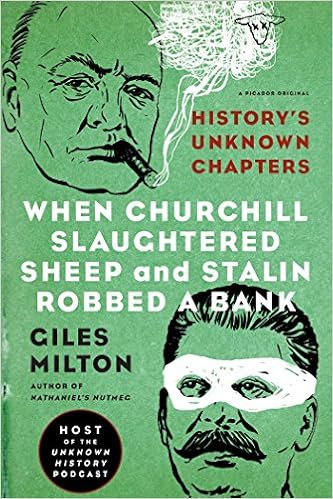
When Churchill Slaughtered Sheep and Stalin Robbed a Bank

Picador
When Churchill Slaughtered Sheep and Stalin Robbed a Bank
Giles Milton
2016

The Summary
"More addictive and mind-blowing true tales from history, told by Giles Milton--one of today's most entertaining and accessible yet always intelligent and illuminating historians.

"In the second installment of his outrageously entertaining series, History's Unknown Chapters, Giles Milton shows his customary historical flair as he delves into the little-known stories from history, including when Stalin was actually assassinated with poison by one of his inner circle; the Russian scientist, dubbed the "Red Frankenstein," who attempted to produce a human-ape hybrid through ethically dubious means; the family who survived thirty-eight days at sea with almost no water or supplies after their ship was destroyed by a killer whale; or the plot that served as a template for 9/11, in which four Algerian terrorists attempted to hijack a plane and fly it into the Eiffel Tower."

The Good
Giles Milton's work is as entertaining as always in this latest addition to his series, History's Unknown Chapters.  Personally, I loved learning new things about history that I didn't know, like the rehearsal for D-Day that saw more than 900 casualties.  Or the spy who broke into Auscwitz.  Or the man who broke into Buckingham Palace and decided to hang out in the Queen's chambers.  Or Guy Gabaldon, who captured several hundred Japanese soldiers without even firing a bullet.

When Churchill Slaughtered Sheep and Stalin Robbed a Bank is pared down into manageable, bite-size sections, which makes Mileton's book both easy-to-read and accessible.  Don't want to hear about how Charlie Chaplain's grave was robbed?  Skip it!  Don't care to hear about Stalin's assassination?  Then move on to the next chapter.

This book is great if you like random facts, if you like history, or if you like learning about weird, quirky people and strange happenings across the globe.  It's highly entertaining and it's accessible, which I--and I'm sure other readers--appreciate.

The Bad
As I discovered with When Hitler Took Cocaine and Lenin Lost His Brain, When Churchill Slaughtered Sheep and Stalin Robbed a Bank is a book to be read at short intervals.  I loved the random facts, the quick anecdotes that taught me something new; however, I mostly read it in between other books or when I was waiting--like waiting for an oil change, or waiting for a seat at a restaurant, or waiting for my boyfriend to pick me up.

It's more of a short, entertaining read to be taken up at short intervals, rather than consumed in one large gulp.

The Ugly
Reality truly is stranger than fiction.

Thursday, March 9, 2017

Rejected Princesses: Tales of History's Boldest Heroines, Hellions, and Heretics

Dey St.
Rejected Princesses:  Tales of History's Boldest Heroines, Hellions, and Heretics
Jason Porath
2016

The Summary
"Well-behaved women seldom make history...and these women are far from well behaved.

"Let's face it:  the list of historical women we learn about in school is lacking.  It's safe, it's censored, it's short.  And even when we learn about a true legend--say, Harriet Tubman--we get half the story (and it's usually not the half about her as a plantation-torching Union spy-master).  This is just the list of women we know about.  What of the women we don't?

"In place of complex, real-life heroines, we get sparkly, doe-eyed animated damsels who dominate children's minds everywhere.

"Rejected Princesses is here to provide an alternative to all that.

"In this fully illustrated, deeply researched, and totally entertaining collection, Jason Porath offers 100 women too uncompromising, too untoward, or too uncomfortable to fit the modern princess mold.  Gathering together a diverse set of some famous, some infamous, some forgotten, and some virtually unknown figures from history and myth, from all over the globe, this book presents the female role models we never knew we needed.  Yes, there are a few princesses, but there are also pirates, spies, journalists, activists, concubines, empresses, ninjas, pilots, samurais, mathematicians, sword-slingers, and war-lords too.

"These women were rebels and rulers, pioneers in their fields, and fighters for their causes (and sometimes for themselves).  In a time when women are still pushing for equal pay and equal opportunity, shouldn't we be putting brave women like Sybil Luddington, Hatshepshut, Nzinga Mbande, Josephine Baker, Khutulun, Rani Lakshimbai, Harriet Tubman, Emmeline Parkhurst, and Joan of Arc on equal footing with Cinderella or Sleeping Beauty?

"Women have always played a key, kick-ass role in revolutionizing our world.  The girls of today are the latest links in a long chain of geniuses, warriors, and fearless women.  It is the birthright of every woman to have a connection to that history.  Empowering, uproarious, and anything but traditional, Rejected Princesses seeks to provide just that."

The Good
I loved this book.

Yes, loved.

If it's not already apparent, I'm a bit of a history nerd and I love learning about quirky, unconventional history and feisty females who made their mark on history (see:  Bad Girls), so Rejected Princesses was the best of both worlds for me.

I imagine that many of the women featured in this book were too rebellious, too dangerous and, sometimes, too deadly to make it into high school textbooks; in fact, many of the women--whether resigned to the darkest parts of history or lingering at the edges of myth--were a pleasant surprise.  That is, I'd never read about them and I loved learning about them and the impact they made on history.

Here are some of my favorites:
  • Khutulun
  • Noor Inayat Khan
  • Julie d'Aubigny
  • Annie Jump Cannon
  • Iara
  • Mariya Oktyabrskaya
  • Olga of Kiev
  • Ching Shih
  • Sybil Luddington
  • Alfhild
  • Mary Bowser
  • Nanny of the Maroons
  • Tomo Gozen
  • Marjana
All of these women were incredible.  I mean, on this list alone you have fighters and warriors, spies and astronomers, pirates and Vikings, rebels and freedom fighters.  They're incredible.  Granted, I know some of them didn't exist (Marjana is a literary character, whereas Iara and, I think, Alfhild are myths and/or legends), but it was wonderful getting a glimpse into these individual cultures and their perceptions of women--and how these women flaunted conventions.

It was great.

And, of course, I can't forget the Night Witches from my list.  You can hear about me rhapsodize about the Night Witches here, so I won't go into much detail about them, except to say that they are without a doubt the most incredible pilots of World War II (I'm not joking) and, perhaps, some of the most incredible women about which I've had the pleasure to learn.

Overall, Rejected Princesses is a wonderful book.  Full of humor, colorful art, historical facts and, of course, incredible women, it's a great resource for those who wish to dabble in history--and it will show you just what it means to fight like a girl.


The Bad
No complaints.

I seriously want a copy for myself.

The Ugly
History is not always pretty--and, let's be honest here, it hasn't always been kind to women.  Some were burned at the stake because they were different; others were buried alive or faced a firing squad; some were even assassinated for their own violent reactions to society.  Not all these ladies had the luxury to happily retire.

Thursday, May 26, 2016

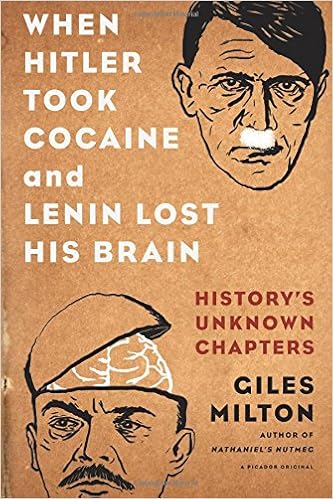
When Hitler Took Cocaine and Lenin Lost His Brain

Picador
When Hitler Took Cocaine and Lenin Lost His Brain
Giles Milton
2016

The Summary
"In this first installment of his outrageously entertaining series, History's Unknown Chapters, Giles Milton delves into the little-known stories from history, like when a cook aboard the Titanic pickled himself with whiskey and survived in the icy seas where most everyone else died; or the man who survived the atomic bomb in both Hiroshima and Nagasaki.

"Covering everything from adventure, war, murder, and slavery to espionage--including the stories of the female Robinson Crusoe, Hitler's final hours, Japan's deadly balloon bomb, and the emperor of the United States--these tales deserve to be told."

The Good
I enjoyed this book much more than I expected.  Actually, I shouldn't say that because I expected quite a lot from a book titled When Hitler Took Cocaine and Lenin Lost His Brain.  This is a book that, as my coworker pointed out, "you pick up just for the title alone."  And, honestly, I have to say I agree.

Giles Milton's book is filled with fascinating tidbits of information, weird history, and incredible stories that seem almost too strange to believe.  It's fun and it's interesting without being too overwhelming or dense.  It's divided into short, quick sections, which makes it easy to plow through a whole chapter in a matter of minutes.

Moreover, I loved that I learned new things about history that I never knew.  Like the man who survived two nuclear explosions, one at Nagasaki and one at Hiroshima.  Or the cook who survived the sinking of the Titanic by, he claimed, drinking enough alcohol.  Or Agatha Christie's eleven missing days, during December 1926--before she was found in a distant hotel under the name of her husband's mistress.  Or how Lenin's corpse was preserved and put on display, his brain being donated to another institution for study (and his heart entirely disappearing).

Sure, it sometimes gets a little gruesome and, admittedly, a little weird.  But it's fun and fascinating, grabbing your attention and holding it by offering new and, if possible, even more incredible stories.  It's worth reading, especially if you love history or even just weird, unexpected facts.

The Bad
Giles Milton's book is not an in-depth study of human history.  Primarily, it focuses on historical events starting in 1912 (i.e. the sinking of Titanic) and ends somewhere in the 1960s, which means if you want to look beyond the twentieth century, you may have to look elsewhere.  It's a great book for an overview of facts, rather than a detailed examination of events.

The Ugly
Some of these stories have a (relatively) happy ending, like the cook who survived the sinking of the Titanic, or the seamstress who lived on an inhospitable island for 2 years before she was rescued, or the heroic dog who saved his fellow soldiers during World War I--or the real life Captain America who was twice turned away by the army, and eventually became a highly decorated veteran of World War II.

Other stories, however, are a little more brutal:  the pair of explorers who died on Mount Everest, the assassination of Rasputin, the Englishwoman who adopted several children and subsequently murdered them, or the poor individuals who were put on display before a jeering mob.  These stories, for me, often provoked disgust or sympathy.

Some of these stories are disheartening, some of them are daunting because they reflect an especially dark chapter in human history that, while intriguing and strange and downright weird, are often cringe worthy.

Friday, December 5, 2014

The Book Thief

9780375831003
Image courtesy of
www.randomhouse.com
The Book Thief
Markus Zusak
2005

Cover Synopsis
"By her brother's graveside, Liesel Meminger finds her life changed when she picks up a single object, partially hidden in the snow.  It is The Grave Digger's Handbook, left there by accident, and it is her first act of book thievery.  So begins a love affair with books and words, as Liesel, with the help of her accordion-playing foster father, learns to read.  Soon she is stealing books from Nazi book-burnings, the mayor's wife's library, wherever there are books to be found.

"But these are dangerous times.  When Liesel's foster family hides a Jewish man in their basement, Liesel's world is both opened up and closed down."


Thoughts
The Book Thief is heart-wrenching and endearing and beautiful.  It is an unusual book, considering Death acts as the narrator of Liesel Meminger's story, but it's laced with beautiful and intriguing language, a sort of synesthesia in which colors are linked with perceptions and experiences, meetings with the dearly departed.

Death makes a surprisingly good narrator.  He's very precise, very measured in recounting Liesel's story, but he's also thorough and thoughtful.  Although I found him - or it, or whatever it is that Death might be considered - slightly unnerving, I enjoyed every last morsel of his tale.

I will also note that The Book Thief works upon you slowly.  It builds slowly, it takes time to reach that all-important resolution; however, it gives you ample time to form attachments.  You won't even notice how important these characters are to you, how attached you've become to them, until, suddenly, tragedy strikes and it's quick, explosive, heart-rending - and it's like you've suffered along with Liesel, like you've endured this horrifying and tragic loss with her.

You experience it.  You feel it.

And, as much as those final pages hurt, as much as they will wound you in the reading, you'll be glad you finished and you'll be glad you picked it up.

Overall Impression
As part of the final blurb on the cover synopsis, I read this:  "In superbly crafted writing that burns with intensity, award-winning author Markus Zusak has given us one of the most enduring stories of our time."

And, honestly, I couldn't agree more.  I was completely in love with every chapter, every page of Zusak's novel.

Don't get me wrong, The Book Thief left me in tears.  I mean, I completely lost it when I reached the conclusion, but I don't regret reading it and, truthfully, I feel as if I would have missed out on something truly wonderful if I had let it pass me by.

The Book Thief is an exceptional novel with wonderful characters, beautiful language, and a truly magnificent story.