"All good books are alike in that they are truer than if they had really happened
and after you are finished reading one you will feel that all that happened to you
and afterwards it all belongs to you; the good and the bad, the ecstasy, the remorse,
and sorrow, the people and the places and how the weather was."
Ernest Hemingway
Showing posts with label Space. Show all posts

Thursday, August 17, 2017

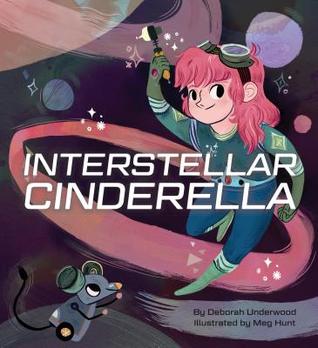
Interstellar Cinderella

22875394
Chronicle Books LLC
Interstellar Cinderella
Deborah Underwood
Meg Hunt
2015

The Summary
"Once upon a planetoid,
amid her tools and sprockets,
a girl named Cindrella dreamed
of fixing fancy rockets.

"With a little help from her fairy godrobot, Cinderella is going to the ball.  But when the prince's ship has mechanical trouble, someone will have to zoom to the rescue!  Readers will thank their lucky stars for this irrepressible fairy tale retelling, it's independent heroine, and its stellar happy ending."

The Good
I absolutely loved Interstellar Cinderella.  I happened across it one day at the library and I decided to read it before I returned it to the Children's Library, and I immediately fell in love with this little book.  It was so fun, so warm and colorful, so wonderfully depicted that I couldn't help enjoying it.

The art is lovely and bright, and the story is fun and heart-warming.  Meg Hunt does a fantastic job of envisioning the mechanical creations of Cinderella's world; Deborah Underwood recreates Cinderella as a smart, saavy, intrepid young girl, not to mention she gives Cinderella the agency to become what she's always wanted to be:  a rocket mechanic.

I think that's what I loved best about Interstellar Cinderella:  Cinderella isn't rescued by the prince; in fact, when he asks her to marry him, she turns him down.  That's right, Cinderella doesn't want to be married!  She's too young, she decides, and she has dreams of her own that she wants to make come true; instead, Cinderella offers to become his chief mechanic.

Interstellar Cinderella has two very important things going for it:  one, it creates an intelligent heroine who learns how to rescue herself; two, it makes it okay for a girl to focus on her dreams and aspirations of a career, rather than allow the expectations of other people dictate her life.

Yes, I know I got a lot more out of this children's book than I was probably supposed to find.  Yes, I know it's just a story.  But I found it heartwarming and, confidentially, inspiring.  It has a heroine who doesn't just dream, she tries to make her dreams come true.  She doesn't need anyone to rescue her, rather she can save herself.

And I like knowing there's that kind of heroine out there for the next girl to discover.

The Bad
I sometimes struggled with the rhyming scheme of the story, but, otherwise, no complaints.

The Ugly
There's nothing really terrible about Interstellar Cinderella.  It's a children's book.  Not to mention, it's basically Cinderella retold to include robots and space ships.  Her stepsisters and stepmother are terrible, but, spoiler alert, she manages to escape them.

It's a cute, fun book for kids.

Friday, May 19, 2017

Read Harder Challenge 2017: Part 4

This month, I finished a few more challenges, including:
  • Read a book by an immigrant or with a central immigration narrative.
  • Read a book published between 1900 and 1950.
  • Read a collection of poetry in translation on a theme other than love.

American Street
Balzer + Bray
First up, I read American Street by Ibi Zoboi, which follows Fabiola as she adjusts to life in America with her rowdy cousins and her reclusive aunt.  When she arrives in Detroit, she is confronted by a terrible crossroads that will change her life and haunt her as she goes in pursuit of the American Dream.  A fascinating inspection into the immigrant experience, American Street  was made all the more compelling by the fact that the author, like Fabiola, was emigrated from Haiti when she was only a child.

Overall, I liked American Street.  It's a good, solid book with interesting characters, a wonderful narrator, and a heart-wrenching story.  However, I often found myself divided, because I both loved and hated this book.  It inspired a lot of emotions, not all of them good, but it also made me think and it made me feel and it compelled me to read on through Fabiola's story even when I felt my interest waning.

But, most of all, I loved the hints of magical realism seeded throughout the story.  Fabiola has very strong beliefs and she particularly believes in the ilwas of Vodou, which adds a layer of mystery, a thin veil of magic that enriches her story.  You don't really discover if Bad Leg is really Papa Legba, or if he really is just some junkie off the street, like Fabiola's cousins say, but it's that uncertainty that imbues a certain strength in Fabiola's belief and offers uncommon insight into the landscape of Vodou.

John Carter of Mars (Barnes & Noble Collectible Editions): The First Five Novels
Barnes and Noble
Next, I conquered A Princess of Mars by Edgar Rice Burroughs, who also happens to be author of Tarzan of the Apes.  I picked up A Princess of Mars because I had it on my shelf and, more to the point, it seemed like an acceptable escape from reality; however, I wasn't always enchanted with the story.  I mean, it was really just mindless fun.

Originally serialized in 1912, A Princess of Mars is the first of many novels of the Barsoom Chronicles penned by Burroughs.  It follows John Carter, a former military man from Virginia, who finds himself ambushed in Arizona--and transported to a different world.  Mars (known as Barsoom to the native peoples) is a seemingly desolate land populated with dangerous creatures and war-like citizens, and Carter must find a way to survive if he eventually hopes to return to his home world.

For much of the story, it's really just Carter being really impressive with his super-strength and incredible agility and uncanny ability to learn languages--that is, unless he's rescuing the damsel in distress or endearing himself to the local wildlife.  Something interesting or incredible usually happens at the end of every chapter, so it's a bit of a page turner when Carter isn't boring you with facts that are obviously wrong or making you laugh with physics that could obviously never happen.

24601
New Directions
Last, I checked out Paris Spleen by Charles Baudelaire.  Paris Spleen is a short collection of poetry originally written in French in 1896 by Charles Baudelaire--and none of his poems are about love.  I found it exceedingly difficult to find a collection of poetry that didn't talk about love, because everyone likes to talk about love and relationships and affection.  They're warm, fuzzy feelings to which everyone can relate.

But Baudelaire doesn't base his poetry on warm, fuzzy feelings; instead, he examines a darker side of human life.  He looks at the every day pleasures of intoxicating drink, sensuous women, and fine art; however, he also shines a lot on oppression, city squalor, mistreatment, malice.  His work couldn't be farther from warm, fuzzy feelings, like love.

It worked for my Read Harder Challenge, but, I will admit, it's definitely an acquired taste.  Baudelaire is really something else.

Monday, January 23, 2017

Packing for Mars

Packing for Mars: The Curious Science of Life in the Void
W.W. Norton & Company
Packing for Mars
Mary Roach
2010

The Summary
"Space is a world devoid of the things we need to live and thrive:  air, gravity, hot showers, fresh produce, privacy, beer.  Space exploration is in some ways an exploration of what it means to be human.  How much can a person give up?  How much weirdness can they take?  What happens when you can't walk for a year?  have sex?  smell flowers?  What happens if you vomit in your helmet during a spacewalk?  Is it possible for the human body to survive a bailout from space?  To answer these questions, space agencies set up all manner of quizzical and startlingly bizarre space simulations.  As Mary Roach discovers, it's possible to preview space without ever leaving Earth.  From the Space Shuttle training toilet to a crash test of NASA's new space capsule (cadaver filling in for astronaut), Roach takes us on a surreally entertaining trip into the science of life in space and space on Earth."

The Good
After hearing about Mary Roach's book through the reader grapevine, I was absolutely fascinated by the idea of space travel to Mars.  Since I fell in love with The Martian by Andy Weir, I've been intrigued by Mars and outer space more than ever.  (That's part of the reason I slogged through How to Read the Solar System--and, you know, why I've been so inexplicably excited to start on John Carter of Mars.)

And I wasn't disappointed.

Packing for Mars is a fun and insightful science book.  Truthfully, it reminds me of Bill Nye:  humorous, but informative.  Roach makes science approachable and, dare I say it, fun.  Her writing is easy to read, yet she doesn't compromise facts or treat her reader as a big dummy for not understanding the intricacies of space.  Moreover, it gives you answers to questions that you never even knew you had.

Want to know what happens to a fuse when it's shot into space?  (Answer:  If a fuse blows in space, it fries everything; it's why they had to invent the transistor.)  Want to know what happens if you lay in bed for days on end with very little movement?  Want to know what happens to the human body when it meets lower-than-normal gravity?  Roach has answers to all these questions and more, and she does it with some highly humorous musings.

Overall, I found to Packing for Mars to be highly informative, incredibly rewarding--and lots of fun.

The Bad
I admit, I did sometimes lose interest in Packing for Mars.  Sometimes, I just wasn't interested in the subjects and I couldn't keep my mind focused enough on the trials and tribulations of animal test flights, or some other such thing; however, I think that's more my failing, rather than some grievous fault with Roach's book.

The Ugly
Porn.  In space.

For some reason, I was perturbed by the entire concept.  It bothered me, more than I'd like to admit, and I found myself in for some highly awkward reading.

Monday, June 13, 2016

Starlight: The Return of Duke McQueen (Volume 1)

StarlightTPBcover
Image
Starlight:  The Return of Duke McQueen (Volume 1)
Mark Millar
Goran Parlov
2015

The Summary
"Forty years ago, Duke McQueen was a space hero who rescued a world from tyranny.  But then he came home, got married, had kids and grew into an old man with nothing but his memories...until one night when an old, sparkly rocket ship descended from the heavens and called him back for one final adventure."

The Good
I really liked reading Starlight:  The Return of Duke McQueen.  I loved the entire book:  art, plot, characters--everything.  I especially liked Duke McQueen.  As the main character, he's looking to reconnect with his kids after the death of his wife and he's desperate to live down his reputation as a "space hero."  He's an older protagonist who has lived a full, happy life, which is refreshing to see, but he's still able to have one more fantastical adventure.

It's a fun, action-packed space epic that draws heavily from previous science-fiction adventures, like Star Wars, Buck Rogers, Adam Strange, and John Carter of Mars, among others.  As another reviewer from Kirkus put it, "I feel like this is a love letter of sorts from Millar to all those classic pulp stories."  And, yes, it does reminisce of those intergalactic adventures that defined a generation of entertainment, but I think it also manages to forge its own unique identity.

Starlight is a simple, but enjoyable graphic novel.  It has a dose of humor, heaps of action and adventure, a pinch of political intrigue, and a little bit of self-reflection on behalf of a retired military hero.  Since the story starts in the second half of Duke's life, after defeating a vicious dictator and saving a distant world from utter annihilation, it's interesting to see how Mark Millar depicts a character who has surpassed his golden years and has already solidified his identity.

Additionally, I liked the artistic style of Starlight.  Goran Parlov does a beautiful job of rendering Millar's story.  It has color and depth, a vibrancy that breathes life into the characters and gives them a physical form.  Moreover, I loved the illustrations of the strange world of Tantalus, of it's people (heroes and villains alike) and its strange technology.  It's the perfect marriage of narrative and art.

The Bad
Starlight, unfortunately, does succumb to a few all-too-familiar sci-fi tropes and clichés.  More importantly, it doesn't handle pacing very well.  First and foremost, readers don't really have the opportunity to explore much of Duke McQueen's past.  As I said, Starlight begins in the latter years of McQueen's life when he's no longer a spry young hero, but a wizened old man.  It stands to reason that readers are only given a brief and abbreviated history of his life.

However, not much is added in the way of explanation with the Brotean invasion or Kingfisher's rise to power or, more importantly, how the "rebel alliance" came to being.  The conclusion feels rushed and, honestly, doesn't really give any resolution.  Sure, it's a happy ending, but I feel like something is missing, like I haven't quite gotten the whole story--or, moreover, like I haven't quite had the chance to fully understand the consequences.

The impending sense of doom doesn't really dissipate.

The Ugly
Violence.

Quite a lot of violence, actually.  The Kingfisher is a vicious, ruthless ruler who will stop at nothing to obliterate--and I do me obliterate--his enemies, so Starlight can border on being a bit gory.  Otherwise, it's pretty mild.  I mean, I wouldn't recommend it for very young readers, but I think it's suitable enough for teenagers to read.

Saturday, May 21, 2016

Read Harder Challenge (Part Four)

I have three more books to add to my list for the Read Harder Challenge:
  1. Read a nonfiction book about science.
  2. Read a book originally published in the decade you were born.
  3. Read a book with a main character that has a mental illness.
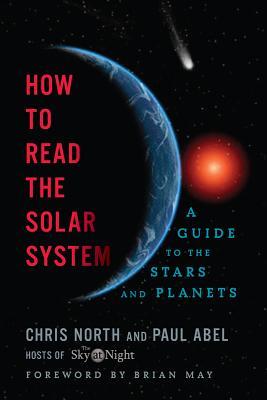
First on my list is How to Read the Solar System:  A Guide to the Stars and Planets by Chris North and Paul Abel, who host The Sky at Night on BBC.  I'm actually really glad I finished this book, because it offered me insight into the solar system that I certainly didn't have prior to reading North and Abel's book.  While it is a bit dry and quite dense, I should point out that How to Read the Solar System is not a bad book.
22488004
Pegasus Books
I mean, I was sometimes very bored when the authors went into great detail about indicating how amateur astronomers should find a specific location in space--like how to find a particular moon by Jupiter, or which filter to use use in order to observe the sun (helpful, if I understood where one might find such filters.  Or if my telescope worked properly), or pinpointing the exact degree to which one might adjust a telescope to find Venus--and I found myself losing interest.  Quickly.

I'm not saying it wasn't a good book.  I learned something interesting about each of the planets and the different heavenly bodies that inhabit space, which was an important aspect of reading this book.  For instance, I learned that Io, one of Jupiter's dozens of moons, has tectonic activity (specifically cryovolcanic activity, since it's an icy wasteland); sound waves travel faster through plasma, which gives scientists the opportunity to measure the internal activity of the sun (since it's made up of plasma); and meteor showers are essentially the debris left behind by comets, like a dust storm that the Earth passes through during its orbit.

I enjoyed actually learning something new, even if it's not quite as useful as one might hope.  Like I said, it's not a bad book.  Just a little dry and dense and, dare I say it, pedantic.  It's not something I would read twice, but it's a vast well of information that's sure to hold appeal for readers who greatly enjoy science, astronomy, technology, and even mathematics.  It's definitely worth checking out, especially if you're curious about the solar system and the explorations humankind has made.  More importantly, it gets a point in my book for having an index, so I was able to easily look up the most intriguing bits of information.

Next, I looked at The Professor and the Madman by Simon Winchester, which was more in line with my purview.  Titled The Surgeon of Crowthorne when it was originally published in Britain, Winchester's book underwent a slight change when it migrated over to the United States, becoming The Professor and the Madman--which was accompanied by the glorious subtitle, A Tale of Murder, Insanity, and the Making of the Oxford English Dictionary.  I mean, how could I not be the tiniest bit enticed?

25019
HarperPerenial
The Professor and the Madman is a story about the formation of the Oxford English Dictionary (OED), specifically one of the most prolific contributors in its history:  Dr. William Minor.  Minor was an American surgeon during the Civil War, who was eventually convicted of murder and put into a sanitarium; however, during his stint at Broadmoor Criminal Lunatic Asylum, he stumbled across a call for contributors to the dictionary.  Contacting Professor James Murray, who oversaw the entire project, he began to offer definitions for the OED and sent thousands of papers slips to Oxford, before his death in 1920.

As crazy as it might seem, it's all very true.

Like Erik Larson--who has written Devil in the White City, Dead Wake, and Thunderstuck--Winchester has a narrative quality to his work that makes it appealing without compromising the facts.  Winchester pulls from a variety of resources, including medical documents from Broadmoor (an infamous mental institution for the criminally insane in Crowthorne), correspondence between Professor Murray and Dr. Minor and other important individuals, as well as historical texts.  He uses information to benefit the story, supplying an electrifying narrative and, simultaneously, feeding his readers the true and unaltered facts.  It's all very, very good.

As for my final book, I read The Lives They Left Behind:  Suitcases from a State Hospital Attic by Darby Penney and Peter Stastny.  Although I suspect this final category--which recommends reading a book with a main character who has a mental illness--is referring to a fictional novel rather than a nonfiction narrative, I decided to run with the ambiguous wording and read something not about one character with mental illness, but ten.

The Lives They Left Behind explores the lives of Willard State Hospital patients who were admitted to the hospital during the late 19th and 20th centuries.  Penney and Stastny provides an in-depth look at some of the permanent residents at Willard, as well as offers a glimpse at the big picture of mental/psychiatric care during its formative years.  The book also provides photographs and illustrations that further illuminate the care patients received, and what sort of trials they went through with (or, in some cases, without) mental illness.
3322978
Bellevue Literary Press

Altogether, I found it to be a fascinating book.  It's an examination of psychiatric care that provides statistics, which can prove a bit dull, but it also connects on an emotional level and delivers nuggets of truth that are sometimes like a punch in the gut.  It's a tough read sometimes.  For instance, I had a hard time reading about the electroshock therapy that often caused patients to have convulsions, or the medications that were prescribed that often did more harm that good--or, worse, how some patients were treated even if they didn't suffer from a psychiatric disease.

Patients, like Ethel Smalls or Margaret Dunleavy, were most likely suffering from other conditions rather than mental disorder.  Ethel Smalls likely suffered from PTSD after losing her children and being on the opposite end of her husband's temper, enduring years of abuse that left her in a fragile state.  Likewise, Margaret Dunleavy was hospitalized after an uncharacteristic outburst due to a personal tragedy and chronic pain.  Neither woman displayed the usual characteristics of mental disorder, rather they were hospitalized because they were inconvenient.  It's a heartbreaking fact behind the stories of many patients.
Thursday, May 5, 2016

How to Read the Solar System: A Guide to the Stars and the Planets

22488004
Pegasus Books
How to Read the Solar System:  A Guide to the Stars and the Planets
Chris North
Paul Abel
2014

The Summary
"What exactly is the solar system?  We've learned the basics at school, but do we really understand what we are seeing in the night sky?  Expert astronomers Chris North and Paul Abel provide a fascinating guided tour of our solar system and explain its many wonders.

"They at all the major players including our more familiar cosmic neighbors--the sun, the planets, and their moons--as well as the occasional visitors to our planet--asteroids, meteors, and comets--in addition to the distant stars and what might lie beyond our solar system, including the mysterious Earth Mark II.  North and Abel recount the history of how our solar system came to be and decipher the myths that once shaped our astronomy.

"Through their cogent explanations of the latest scientific discoveries, they reveal how any amateur astronomer can view and interpret the solar system and enrich their understanding of our universe."

The Good
I'm actually really glad I finished How to Read the Solar System, because it offered me insight into the solar system that I certainly didn't have prior to reading North and Abel's book.  While it is a bit dry and quite dense, I should point out that it's not a bad book.

I learned something interesting about each of the planets and a whole assortment of facts about dwarf planets, the Sun, comets and asteroids, and more, which was one of the most important aspects of reading this book.

For instance, I learned that Io, one of Jupiter's many moons, has boasted volcanic activity (specifically cryovolcanic activity, since it's an icy wasteland); sound waves travel faster through plasma, which gives scientists the opportunity to measure the internal activity of the sun (since it's made up primarily of plasma); and meteor showers are essentially the debris left behind by commets, like a dust storm that the Earth passes through during its orbit.  It's fascinating, really.

While How to Read the Solar System isn't a book I would read twice, it's a vast well of information that's sure to hold appeal for readers who greatly enjoy science, astronomy, technology, and even mathematics.  It's definitely worth checking out, especially if you're curious about the solar system and the explorations humankind has made into space thus far.

More importantly, it gets an added bonus point in my book for having an index.  I was able to easily look up the most intriguing bits of information if I didn't feel like skimming.

The Bad
I will admit, I was sometimes bored with this book.  Like terribly bored, so bored that when I read it at night I fell asleep within a few minutes.  Don't get me wrong, it's not a bad book by any means, but I simply lost interest when the authors went into too great a detail.

Like when they explained how amateur astronomers should find a specific location in space, like how to find a particular moon by Jupiter, or which filter to use use in order to observe the sun (helpful, if I understood where one might find such filters.  Or if my telescope worked properly), or pinpointing the exact degree to which one might adjust a telescope to find Venus.

I'll be honest, if it didn't directly link to me in some way, I found myself losing interest.  Quickly.

The Ugly
I wish How to Read the Solar System had had more pictures and photographs to share.  I would have loved some full color photos from the universe, depicting images from deep in space or shots of auroras or pictures of the planets and the Sun.  It was a little dull without them.

Friday, March 11, 2016

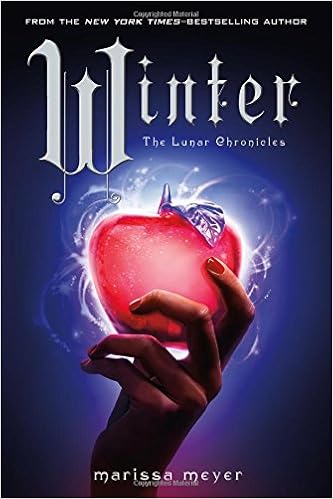
Winter

Feiwel and Friends
Winter
Marissa Meyer
2015

The Summary
"Princess Winter is admired by the Lunar people for her grace and kindness, and despite the scars that mar her face, her beauty is said to be even more breathtaking than that of her stepmother, Queen Levana.

"Winter despises her stepmother, and knows Levana won't approve of her feelings for her childhood friend, the handsome palace guard, Jacin.  But Winter isn't as weak as Levana believes her to be and she's been undermining her stepmother's wishes for years.  Together with the cyborg mechanic, Cinder, and her allies, Winter might even have the power to launch a revolution and win a war that's been raging for far too long.

"Can Cinder, Scarlet, Cress, and Winter defeat Levana and find their happily ever afters?  Fans will not want to miss this thrilling conclusion to Marissa Meyer's nationally bestselling Lunar Chronicles series."

The Good
I devoured this book.  Truthfully, I was obsessed with the entire Lunar Chronicles series.  I originally read Cinder in 2014, and then I promptly purchased all the available books (i.e. Scarlet and Cress) and finished the series in a weekend.  Although I haven't had the opportunity to read Fairest or Stars Above, I have fallen in love with the Lunar Chronicles.

Like Cinder, Marissa Meyer's latest book in the Lunar Chronicles has an intermingling of science-fiction and fairy tale elements, which I've enjoyed throughout the series.  It has many of the same qualities that I loved in the first book: a cast of quirky and intriguing characters, a perfect pace (enough to keep me embroiled without wearing me down), a wonderful tone and interesting descriptions, and an exceptional story.

Let me emphasize again:  I loved this story, and I love this series.

I couldn't wait to finish Winter and uncover what happens to Winter, what happens to Cinder and Scarlet and Cress, and what happens as Luna is gifted with a startling revelation--and, perhaps, a new queen.  It was exciting.  I finished the book in two days, and I was very happy with it.

Yes, part of me was simply relieved to have finished the series.  I'd been dying to read the conclusion of the Lunar Chronicles for more than a year, so, yes, I was excited to reach the epic conclusion I'd been craving.  While I wasn't completely on board with the way it ended (I would have liked for a few things to be different), I can't say I'm disappointed.

I was pleased to find that "happily ever after" so common in fairy tales.

The Bad
If I was bothered by anything, it might be Meyer's habit to let Cinder's story run on...and on.  I liked the story, I understood the need for new dangers and newer obstacles; however, I felt the final book dragged the story out unnecessarily.

Yes, Cinder needed to build her support on the lunar colony; yes, she needed to thwart Levana's authority; yes, she needed to rescue her friends and unite with Winter.  But why must it alternate between Cinder's capture and escape, recapture and daring second escape?

As Cinder and Winter and the entirety of Luna scramble to bring the story to a close, it felt like too much was happening, like everything was about to boil over, crash and burn so to speak.  It didn't, but it skirted a little too close for my taste.

The Ugly
Fairy tales are always laced with tragedy:  two children being left alone in the forest, a princess pricking her finger and falling into an eternal sleep, a young girl eating a poisoned apple, a little girl getting attacked by the Big Bad Wolf.

And Winter is no different.

Friday, March 4, 2016

Read Harder Challenge (Part Two)

Feiwel & Friends
Continuing with my Read Harder Challenge of 2016, I've managed to complete:
  1. Read a book over 500 pages long.
  2. Read a book of historical fiction set before 1900.
  3. Read a book that was adapted into a movie, then watch the movie.  Debate which is better.
Shortly after the New Year, I finished reading Winter by Marissa Meyer.  At just over 800 pages, it fit nicely into the "over 500 pages" category--and I couldn't be more excited.  As the conclusion of the Lunar Chronicles, which spanned four books (including Cinder, Scarlet, and Cress) and spawned a novella (Fairest) and a short story collection (Stars Above), Winter is the book I've been waiting all year to read.

In Meyer's latest novel, you have the opportunity to meet Winter, princess of Luna.  She is the step-daughter of Queen Levana, ruling monarch of the Lunar colony; moreover, she's the cousin of the lost princess, Selene (who's very important to the story, trust me).  Several years ago, she vowed never to use her manipulative powers again--which means she's slowly going crazy--and she quietly rebels against the queen.

Open Road Media
I loved the whole concept of Winter, the mixture of fairy tale and science fiction that originally enchanted me in Cinder, and I loved the story.  Winter is an unusual character:  she's totally batty, but she's genuinely nice and she's surprisingly adept at thwarting Queen Levana's wishes, considering she's spent a number of years under her stepmother's thumb (and suffered terribly for it).  Overall, I was inordinately pleased to get my hands on a copy and add it to my collection--and I couldn't wait to see what Meyer would do with the traditional "happily-ever-after."

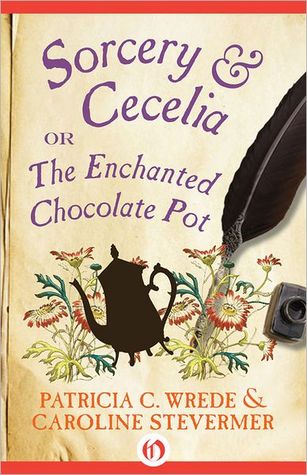
Next, I read Sorcery and Cecelia; Or the Enchanted Chocolate Pot by Patricia C. Wrede and Caroline Stevemer.  Although Wrede and Stevemer's novel technically falls into the realm of fantasy, I think (read:  decided) it can also be construed as a historical fiction novel.  Being set in England in 1895, it's at the very cusp of the 19th century.  So, yes, I think it qualifies.

Sorcery and Cecelia is a strangely pleasing novel.  Think Jane Austen, but throw in a bit of wizardry and magic for spice.  It's an enjoyable little story that features the exchange of letters between Cecelia and Kate, cousins who share an adventurous spirit--and a fiery attitude.  Their correspondence begins at a bit of a slow pace, but once the schemes of Miranda Tanistry begin to unfold, the adventure picks up pace and soon Kate and Cecelia are drawn into a twisted web of danger and deception--and, of course, intrigue with a distinctively Victorian flavor.

Greenwillow Book
It's an immensely satisfying story, and I was ultimately thrilled by the novel.  It appealed to my love of classic English literature and fantasy without compromising on either one.  Although I was initially hesitant to begin Wrede and Stevemer's novel (for the slow pace, mind), I'm glad I stuck with the story and finished it.  It was surprisingly enjoyable and, I'll point out, exceedingly fun.

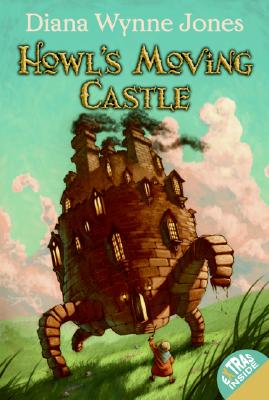
Last, I read Howl's Moving Castle by Diane Wynne Jones.  Finding a book that I wanted to read and watch onscreen proved a trifle more difficult than either entry listed above.  Howl's Moving Castle is both a classic young readers novel by Jones and an animated movie directed by Hayao Miyazaki.  Having watched Miyazaki's movie in the past, but needing a refresher, I decided it would be appropriate to pick up Howl's Moving Castle and decide which is ultimately best.

Except I don't really have an immediate answer.

Howl's Moving Castle as a book and Howl's Moving Castle as a movie are two very different beasts.  First, they are very different formats and have their own merits as such; two, they tell different stories; and, three, the characters feel completely different that I have a hard time classifying them as the same individuals.  For instance, in the book, Sophie is quiet and mousy as a young woman, but she's an outspoken curmudgeon when she's morphed into an old woman; however, in the movie, she's pretty quiet throughout and she's more like a doting grandmother, rather than the nosy old grouch in the book.

Studio Ghibli
Likewise, the stories have an entirely different flavor to them.  In the book, the Witch of the Waste is the real danger.  Her machinations have directed the kingdoms toward disaster and put Howl's loved ones in grave danger (and, yes, Howl does have loved ones outside Ingary).  Howl is, in fact, running from his responsibilities and putting a number of miles between himself, the King of Ingary, and the Witch of the Waste--and the curse she's heaped upon him.  But in the movie, Howl is caught in the midst of a war and the Witch of the Waste, while still a daunting figure, is certainly not up to challenging Howl, less so the Wizard Suliman (who is of a different gender entirely in the novel, but that's another story).

Anyway, as I said, I can't really pick which one is better.  Miyazaki's creation is wonderful:  beautiful animation, an intriguing and compelling story, and a whole heaping of creativity that takes a story and gives it wings--quite literally.  And Jones's book is absolutely lovely:  magical and creative, full of quirky characters and fabulous stories and a weaving, winding plot that's sure to keep readers on their toes.  Both are equally wonderful and entertaining, but if I lean more toward appreciating the book, I can only say I like it best for the fact that I can physically hold it in my hands and let my imagination truly wander.

Wednesday, December 16, 2015

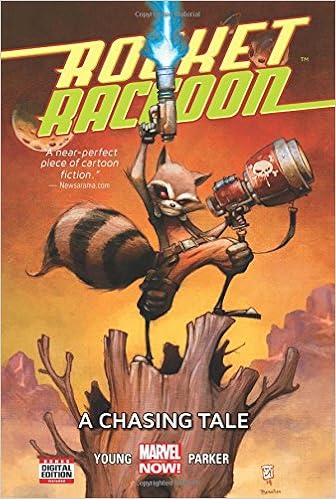
Rocket Raccoon: A Chasing Tale (Volume 1)

Marvel NOW!
Rocket Raccoon:  A Chasing Tale (Volume 1)
Skottie Young
Jake Parker
2015

The Summary
"Rocket Raccoon is the last of his kind:  a hero to the weak, a champion of good, a swashbuckling pioneer of valor (and guns).  But his high-flying life of adventure may be a thing of the past when he's framed for murder - and the authorities aren't the only ones on his tail!  (Get it?)  There's another Rocket Raccoon loose on the world, but the world just ain't big enough!  The lookalike killer is one step ahead of Rocket at every turn; now, it's up to our hero and his best pal, Groot, to find the truth!  With Macho Gomez and the Ex-Terminators tracking him, can Rocket make it out alive and clear his name?  Superstar creator Skottie Young brings his A-game as writer and artist on the series we've been waiting decades for.  Because really, Rocket and Groot are the only Guardians of the Galaxy you actually care about, right?"

The Good
A Chasing Tale is an amusing graphic novel that delves into the lives and misadventures of Rocket Raccoon and Groot, specifically their fight for survival against Rocket's scorned and angry ex-girlfriends - and a particularly pernicious doppelganger.

Overall, I enjoyed the first volume of Rocket Raccoon.  Skottie Young and Jake Parker know how to weave a story, and it's a rollicking adventure that leaves you on the edge of your seat.  More importantly, Young and Parker succeed in staying true to Rocket's and Groot's characters.  Rocket Raccoon, while slightly obnoxious and trigger-happy, works in nice contrast to Groot, who is stoic and not quite so impetuous.

Young and Parker find a nice balance between the characters, and all the while they managed to craft an engaging story that leaves you wondering how Groot and Rocket will continue to get along in the depths of space.

The Bad
Rocket Raccoon is a nice diversion:  it's fun to see what happens outside of the Guardians of the Galaxy.

However, I can't help wondering what's going on with the rest of the team - and what happens with Star Lord, Drax, and Gamora while Rocket and Groot find their way out of trouble.  I'm interested in the entire team, so it would be nice to see them more involved.

The Ugly
Relationships can get ugly, especially when you have a record for breaking hearts like Rocket Raccoon.

Saturday, September 26, 2015

The Martian

The Martian 2014.jpg
Broadway Books
The Martian
Andy Weir
2011

The Summary
"Six days ago astronaut Mark Watney became one of the first people to walk on Mars.

"Now he's sure he'll be the first person to die there.

"After a dust storm forces his crew to evacuate the planet while thinking him dead, Mark finds himself stranded on Mars's surface, with no way to signal Earth that he's alive.  And even if he could get word out, his supplies would be gone years before a rescue could arrive.

"Chances are, though, Mark won't have time to starve to death.  The damaged machinery, unforgiving environment, or plain old "human error" are much more likely to kill him first.

"Armed with nothing but his ingenuity, his engineering skills - and a gallows sense of humor that proves to be his greatest strength - Mark embarks on a dogged quest to stay alive.  But will his resourcefulness be enough to overcome the impossible odds against him?"

The Good
I loved The Martian.

I am not the most avid fan of science-fiction.  I mean, I've really enjoyed the Lunar Chronicles by Marissa Meyer (see:  Cinder), I like H.G. Wells, and I'm quite a fan for alternate universes and post-apocalyptic thrillers; however, I don't read much in the way of science-fiction.  (The sheer number of labels I've used to designate "fantasy" will tell you that.)  But I absolutely loved reading Andy Weir's novel.

Weir puts so much detail into his work:  he gives you maps of real locations on Mars, he uses jargon and real theoretical physics, he explains chemical reactions (being unafraid to throw a little chemistry into the mix), and, in general, he makes a hypothetical trip to the Martian surface seem like a legitimate venture.  Events, as they unfold, seem incredibly real and believable, like this could really happen - Mark Watney could really exist!  As quoted from the expanded edition, which features a small essay in the back:
"A castaway story for the new millennium, The Martian presents a fresh take on the classic man-versus-nature battle for survival by setting it on the surface of Mars - a planet completely hostile to sustaining human life.  Yet debut novelist and self-proclaimed space nerd Andy Weir manages to make every moment of astronaut Mark Watney's outer-space ordeal painstakingly realistic and believable. 
"At its heart, The Martian is a tale of survival of the geekiest.  Mark's scientific ingenuity, his radically inventive botanical solution to starvation, his ability to address seemingly insurmountable problems with rationality and practicality, his sanity-saving sense of humor, and his understated bravery become a moving testament to the human spirit.  When the ground team at NASA and his crew discover he is alive, their commitment to rescuing one man against all odds likewise speaks to humanity's deeply rooted sense of connection."
This is exactly how I felt about Weir's novel:  I absolutely loved it.

I loved reading Mark's log entries.  I loved having a glimpse into events on Earth.  And I especially loved the interludes that included his crew mates.  I loved the entire story, how it weaved together the narratives of many different individuals and combined scientific fact and theory to create a seamlessly blended story that kept me captivated from cover to cover.

The Bad
Mark Watney has a bit of a foul mouth (as do most of the other characters), but I can certainly understand why.  I mean, he's stuck on Mars - alone, by the way - with no way to communicate with his crew or ground control back on Earth, and he has a limited supply of food, water, air, shelter, and time if he wants to survive long enough for rescue.

When he says, "I'm pretty much fucked," I feel I can forgive him his strong language because, let's be honest here, he kind of is.

The Ugly
Survival can get pretty ugly, especially when you're trapped in space with limited supplies and nowhere to go.  If you think Mark has it rough, imagine his crew members if they get stuck in space without any advanced supplies.  I don't even want to imagine the desperate measures to which they would resort.

I'll just leave it at that.  I don't want to spoil any surprises.

Saturday, August 1, 2015

Guardians of the Galaxy: Cosmic Avengers (Volume 1)

Marvel
Guardians of the Galaxy:  Cosmic Avengers (Volume 1)
Brian Michael Bendis
Steve McNiven
Sara Pichelli
2014

The Summary
"There's a new rule in the galaxy:  No one touches Earth!  No one!  But why has Earth suddenly become the most important planet in the galaxy?  That's what the Guardians of the Galaxy are going to find out!  Join Star-Lord, Gamora, Drax, Rocket Raccoon, Groot and - wait for it - the Invincible Iron Man, as they embark upon one of the most explosive and eye-opening chapters of Marvel NOW!  These galactic Avengers are going to discover secrets that will rattle Marvel readers for years to come!  But while London deals with a brutal invasion by the Badoon, the fate of the Guardians may have already been decided millions of miles away!"

The Good
I loved the artistry put into it.  Even if my primary difficulty was with the flow of panels (you know, those large two page panels generally mix up reading direction), I enjoyed the way it progressed, how the illustrators are able to make your eyes follow the conscious stream of action.

Admittedly, I also liked the characters involved.  Although we primarily see the origins and development of Peter Quill (Star-Lord), separate stories are included for the other characters - interludes between adventures that are present at the very end of the volume - that show their activities before their fateful encounter with the Badoon and J-Son, Peter's father.

Character dialogues and interactions were a plus.  The characters - Groot, Drax, Star-Lord, Gamora, Rocket, and even Tony Stark - share a familiarity and easiness that's refreshing to find in a team.  They interact easily and there's a level of respect and camaraderie that that makes their missions undeniably exciting and reassuringly optimistic.  They fight against the odds, but there is a feeling of triumph regardless.

In short, I really enjoyed reading the first installment of Guardians of the Galaxy.

The Bad
I have only one minor complaint:  panel layout.  The story flowed easily, but some of the double-paged layouts were problematic.  Although not a problem on an e-reader, as you could see the entire two pages, it was a minor complaint I had with the physical version.  It was pretty easy to overlook and I enjoyed the comic regardless.

The Ugly
Well, Peter Quill is orphaned at a young age.  (You'll find out why very early on.)  Gamora is the daughter of Thanos, known otherwise as the "mad titan" (and he's a seriously terrible and terrifying creature).  Rocket is the only one of his kind, and he feels his solitude acutely.  Drax the Destroyer is angry and unfulfilled by his existence.  And Groot - well, I don't know much about Groot, but I'm going under the basic assumption that his story is equally tragic, that he's equally damaged.

Saturday, May 30, 2015

What If?: Serious Scientific Answers to Absurd Hypothetical Questions

Houghton Mifflin Harcourt
What If?:  Serious Scientific Answers to Absurd Hypothetical Questions
Randall Monroe
2014

The Summary
Randall Monroe, creator of the webcomic xkcd, answers a variety of scientific (and often absurd) questions he has received via his website - including questions such as:
  • What would happen if you made a periodic table out of the actual elements?
  • Is it possible to build a jetpack using machine guns?
  • What would happen if you took a swim in a spent nuclear fuel pool?
  • What are the results of a earthquake that measures 15 on the Richter scale?
  • What happens to the last artificial light if humans disappeared?
And much, much more.

The Good
I enjoyed Monroe's book.  It is absolutely hilarious, combining absurdity with comedy - and, yes, real scientific inquiry.

Although the questions may be completely, off-the-wall crazy - or, you know, dangerously stupid to try - Monroe makes a sincere attempt to give an answer.  The questions may not always make sense, the answers can be catastrophic, but the author makes a valid case for his explanation and throws in a touch of wry, biting humor that makes his book funny, informative, and enjoyable.

Monroe also spices up his book with illustrations.  Stick figures, to be precise.  The illustrations are rudimentary, but they have an incredible range of flexibility, conveying precisely what Monroe seeks to show his readers.  It makes What If? a little more interesting, and a lot funnier.

The Bad
Unlike Monroe, I have no experience with physics or mathematics beyond basic algebra, so I can't say one way or the other if his hypotheses are correct.  But they're surely interesting (and, occasionally, disturbing), and Monroe does a fine job of making his explanations accessible.

He obviously works hard to help his readers understand; however, the science behind his answers is, at best, complicated (read:  convoluted) - and, well, confusing.  Not that his book won't be interesting if you decide to pick it up.  Rather, I might recommend brushing up on your scientific vocabulary if you don't know what transuranic or megapascals means.

The Ugly
Somehow, the questions that Monroe answers always seem to end up with catastrophic consequences such as nuclear explosions, death, planetary destruction, species extinction, and worse.  I mean, it's rather depressing.

Poor moles.