"All good books are alike in that they are truer than if they had really happened
and after you are finished reading one you will feel that all that happened to you
and afterwards it all belongs to you; the good and the bad, the ecstasy, the remorse,
and sorrow, the people and the places and how the weather was."
Ernest Hemingway

Friday, March 11, 2016

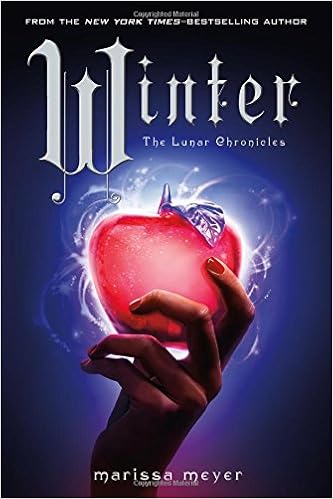
Winter

Feiwel and Friends
Winter
Marissa Meyer
2015

The Summary
"Princess Winter is admired by the Lunar people for her grace and kindness, and despite the scars that mar her face, her beauty is said to be even more breathtaking than that of her stepmother, Queen Levana.

"Winter despises her stepmother, and knows Levana won't approve of her feelings for her childhood friend, the handsome palace guard, Jacin.  But Winter isn't as weak as Levana believes her to be and she's been undermining her stepmother's wishes for years.  Together with the cyborg mechanic, Cinder, and her allies, Winter might even have the power to launch a revolution and win a war that's been raging for far too long.

"Can Cinder, Scarlet, Cress, and Winter defeat Levana and find their happily ever afters?  Fans will not want to miss this thrilling conclusion to Marissa Meyer's nationally bestselling Lunar Chronicles series."

The Good
I devoured this book.  Truthfully, I was obsessed with the entire Lunar Chronicles series.  I originally read Cinder in 2014, and then I promptly purchased all the available books (i.e. Scarlet and Cress) and finished the series in a weekend.  Although I haven't had the opportunity to read Fairest or Stars Above, I have fallen in love with the Lunar Chronicles.

Like Cinder, Marissa Meyer's latest book in the Lunar Chronicles has an intermingling of science-fiction and fairy tale elements, which I've enjoyed throughout the series.  It has many of the same qualities that I loved in the first book: a cast of quirky and intriguing characters, a perfect pace (enough to keep me embroiled without wearing me down), a wonderful tone and interesting descriptions, and an exceptional story.

Let me emphasize again:  I loved this story, and I love this series.

I couldn't wait to finish Winter and uncover what happens to Winter, what happens to Cinder and Scarlet and Cress, and what happens as Luna is gifted with a startling revelation--and, perhaps, a new queen.  It was exciting.  I finished the book in two days, and I was very happy with it.

Yes, part of me was simply relieved to have finished the series.  I'd been dying to read the conclusion of the Lunar Chronicles for more than a year, so, yes, I was excited to reach the epic conclusion I'd been craving.  While I wasn't completely on board with the way it ended (I would have liked for a few things to be different), I can't say I'm disappointed.

I was pleased to find that "happily ever after" so common in fairy tales.

The Bad
If I was bothered by anything, it might be Meyer's habit to let Cinder's story run on...and on.  I liked the story, I understood the need for new dangers and newer obstacles; however, I felt the final book dragged the story out unnecessarily.

Yes, Cinder needed to build her support on the lunar colony; yes, she needed to thwart Levana's authority; yes, she needed to rescue her friends and unite with Winter.  But why must it alternate between Cinder's capture and escape, recapture and daring second escape?

As Cinder and Winter and the entirety of Luna scramble to bring the story to a close, it felt like too much was happening, like everything was about to boil over, crash and burn so to speak.  It didn't, but it skirted a little too close for my taste.

The Ugly
Fairy tales are always laced with tragedy:  two children being left alone in the forest, a princess pricking her finger and falling into an eternal sleep, a young girl eating a poisoned apple, a little girl getting attacked by the Big Bad Wolf.

And Winter is no different.

Wednesday, March 9, 2016

Bonus: Finding Perfect

HQN Books
Finding Perfect
Susan Mallery
2010

The Summary
"When Pia O'Brian's best friend dies, Pia expects to inherit her cherished cat.  Instead, the woman leaves Pia three frozen embryos.  With a disastrous track record in the romance department and the parenting skills of a hamster, Pia doesn't think she's meant for motherhood.  But determined to do the right thing, Pia decides to become a single mother.  Only to meet a gorgeous, sexy hunk on the very same day.

"A former foster-care kid now rich beyond his wildest dreams, Raoul Moreno runs a camp for needy children in Fool's Gold, California.  After his last relationship, Raoul thought he was done with women and commitment.  Still, he can't get sweet, sexy Pia out of his mind--and proposes a crazy plan.  But can such an unconventional beginning really result in the perfect ending?"

The Good
I've had some experience with Susan Mallery's "Fool's Gold Romance" series.  So far, I've completed four books in the series (barely a dent considering there are nearly thirty books altogether), and I've found many of the same good qualities in each book.  Although I find the plot a bit predictable, I still enjoyed Finding Perfect.

Pia is a lovely character, who's faced with a difficult choice:  motherhood at the bequest of dying friend.  Given this strangely sweet request, she doesn't know what to do--and who can blame her?  Her decisions, however, reflect her growth as an individual as she dives into motherhood and struggles to balance her professional life with her love life.

I liked it.  It's one of many, which makes it something of a face in the crowd, but I liked reading it and that's really the only thing that matters.

The Bad
Reliable predictability.

Like most romance novels, Finding Perfect features a similar plot:  boy meets girl, boy and girl fall in love, boy and girl are driven apart by circumstances beyond their control and/or their inability to see eye to eye, boy and girl manage to live happily-ever-after.  Sometimes, it involves different circumstances--girl returning to her hometown, or girl recovering from some previous loss and learning she can love again, and etc.--but it's mostly the same.

That's what makes it a comforting.

The Ugly
Sure, motherhood is a beautiful thing.  But it can also be incredibly painful--and, well, scary.

There's so much that can go wrong and, for Pia, it's a heart-wrenching opportunity to relive a past loss that she never expected.  It squeezed at my heart unexpectedly and left me feeling a little breathless.

Monday, March 7, 2016

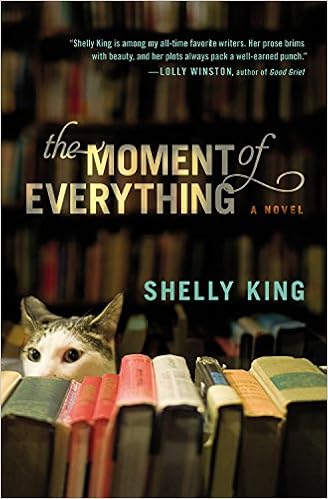
The Moment of Everything

Grand Central Publishing
The Moment of Everything
Shelly King
2014

The Summary
"Maggie Dupres has been 'involuntarily separated from payroll' at a Silicon Valley start-up.  Now she's whiling away her days in Dragonfly Used Books, a Mountain View institution, waiting for the Next Big Thing to come along.  When the opportunity arises for her to network at a Bay Area book club, she jumps at the chance - even if it means having to read Lady Chatterly's Lover, a book she hasn't encountered since college, in an evening.  But the edition she finds at the bookstore is no Penguin Classics Chatterly - it's an ancient hardcover with notes in the margins between two besotted lovers of long ago.  What Maggie finds in her search for the lovers and their fate, and what she learns about herself in the process, will surprise and move readers of this witty and tender novel."

The Good
I loved reading The Moment of Everything.  Maggie Dupres is a witty, vibrant narrator among a cast of funny and eccentric characters.  She's clever, but she's also capable.  Along with Dizzy, her best friend, she basically starts a company from the ground up--and then, when she suddenly finds herself in an economic rut, she eventually manages to make the best of it and befriends one of the most powerful ladies in the Silicon Valley.

Maggie is a strong, capable person, and she's a wonderful narrator to boot.  Her story isn't particularly extraordinary--heck, it's the story that a good portion of my entire generation was suddenly facing with the economic recession--but she tells it so well.  It's a sweet, romantic story, but it has a punch of reality to it that makes it worth reading.

I mean, you could probably characterize it as a romance novel; however, I think it's best to read it as a personal narrative, as Maggie's personal narrative.  Her story can't simply be quantified as a romance, that's too constricting, rather it encompasses a broad range of human experiences from love to heartbreak and financial uncertainty to job security.

It's a good story that I feel can appeal to a lot of people who have found themselves in her shoes, jobless and searching for what's missing in her life.  I find I enjoyed it from cover to cover, and not just because it's based in a bookstore.

Furthermore, I loved the other characters involved, especially Hugo.  Oh, I liked Jason--and Dizzy was a charmer, being both fabulous and wonderfully funny--but there was just something particularly special about Hugo.  He's full of strange wisdom and unusual life experiences.  He's a kind-hearted person with an eccentric streak and a (probably unhealthy) love for books.

And, okay, I adored Hugo for it.  I can see why Maggie loved and respected him as both employer and friend.  He seems a bit nutty, but beneath that veneer of eccentricity, he's incredibly intelligent and, like Maggie, quick-witted.  Their friendship is rich and wonderful, and their dialog is an unusual kind of perfection that I just can't even describe.  Their verbal exchanges had me cracking up at every opportunity.

I feel like I get the best of both worlds with The Moment of Everything:  a good story and good, solid characters.  Could I ask for anything more?

The Bad
Honestly, I have no complaints about The Moment of Everything.  It's one of those unusual novels that the more I dwell on it, the more I seem to like it.

The Ugly
Love is complicated.  Maybe even more so when two lovers are speaking to one another through a battered old copy of Lady Chatterly's Lover, and then their love letters are subsequently shared online.

Perhaps not the most conducive environment to starting a relationship.

Friday, March 4, 2016

Read Harder Challenge (Part Two)

Feiwel & Friends
Continuing with my Read Harder Challenge of 2016, I've managed to complete:
  1. Read a book over 500 pages long.
  2. Read a book of historical fiction set before 1900.
  3. Read a book that was adapted into a movie, then watch the movie.  Debate which is better.
Shortly after the New Year, I finished reading Winter by Marissa Meyer.  At just over 800 pages, it fit nicely into the "over 500 pages" category--and I couldn't be more excited.  As the conclusion of the Lunar Chronicles, which spanned four books (including Cinder, Scarlet, and Cress) and spawned a novella (Fairest) and a short story collection (Stars Above), Winter is the book I've been waiting all year to read.

In Meyer's latest novel, you have the opportunity to meet Winter, princess of Luna.  She is the step-daughter of Queen Levana, ruling monarch of the Lunar colony; moreover, she's the cousin of the lost princess, Selene (who's very important to the story, trust me).  Several years ago, she vowed never to use her manipulative powers again--which means she's slowly going crazy--and she quietly rebels against the queen.

Open Road Media
I loved the whole concept of Winter, the mixture of fairy tale and science fiction that originally enchanted me in Cinder, and I loved the story.  Winter is an unusual character:  she's totally batty, but she's genuinely nice and she's surprisingly adept at thwarting Queen Levana's wishes, considering she's spent a number of years under her stepmother's thumb (and suffered terribly for it).  Overall, I was inordinately pleased to get my hands on a copy and add it to my collection--and I couldn't wait to see what Meyer would do with the traditional "happily-ever-after."

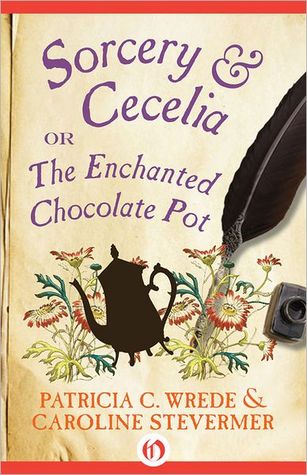
Next, I read Sorcery and Cecelia; Or the Enchanted Chocolate Pot by Patricia C. Wrede and Caroline Stevemer.  Although Wrede and Stevemer's novel technically falls into the realm of fantasy, I think (read:  decided) it can also be construed as a historical fiction novel.  Being set in England in 1895, it's at the very cusp of the 19th century.  So, yes, I think it qualifies.

Sorcery and Cecelia is a strangely pleasing novel.  Think Jane Austen, but throw in a bit of wizardry and magic for spice.  It's an enjoyable little story that features the exchange of letters between Cecelia and Kate, cousins who share an adventurous spirit--and a fiery attitude.  Their correspondence begins at a bit of a slow pace, but once the schemes of Miranda Tanistry begin to unfold, the adventure picks up pace and soon Kate and Cecelia are drawn into a twisted web of danger and deception--and, of course, intrigue with a distinctively Victorian flavor.

Greenwillow Book
It's an immensely satisfying story, and I was ultimately thrilled by the novel.  It appealed to my love of classic English literature and fantasy without compromising on either one.  Although I was initially hesitant to begin Wrede and Stevemer's novel (for the slow pace, mind), I'm glad I stuck with the story and finished it.  It was surprisingly enjoyable and, I'll point out, exceedingly fun.

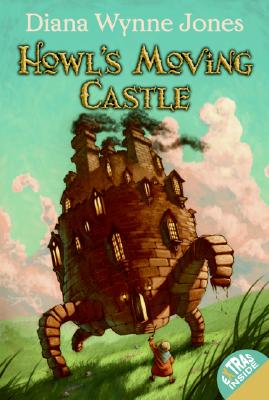
Last, I read Howl's Moving Castle by Diane Wynne Jones.  Finding a book that I wanted to read and watch onscreen proved a trifle more difficult than either entry listed above.  Howl's Moving Castle is both a classic young readers novel by Jones and an animated movie directed by Hayao Miyazaki.  Having watched Miyazaki's movie in the past, but needing a refresher, I decided it would be appropriate to pick up Howl's Moving Castle and decide which is ultimately best.

Except I don't really have an immediate answer.

Howl's Moving Castle as a book and Howl's Moving Castle as a movie are two very different beasts.  First, they are very different formats and have their own merits as such; two, they tell different stories; and, three, the characters feel completely different that I have a hard time classifying them as the same individuals.  For instance, in the book, Sophie is quiet and mousy as a young woman, but she's an outspoken curmudgeon when she's morphed into an old woman; however, in the movie, she's pretty quiet throughout and she's more like a doting grandmother, rather than the nosy old grouch in the book.

Studio Ghibli
Likewise, the stories have an entirely different flavor to them.  In the book, the Witch of the Waste is the real danger.  Her machinations have directed the kingdoms toward disaster and put Howl's loved ones in grave danger (and, yes, Howl does have loved ones outside Ingary).  Howl is, in fact, running from his responsibilities and putting a number of miles between himself, the King of Ingary, and the Witch of the Waste--and the curse she's heaped upon him.  But in the movie, Howl is caught in the midst of a war and the Witch of the Waste, while still a daunting figure, is certainly not up to challenging Howl, less so the Wizard Suliman (who is of a different gender entirely in the novel, but that's another story).

Anyway, as I said, I can't really pick which one is better.  Miyazaki's creation is wonderful:  beautiful animation, an intriguing and compelling story, and a whole heaping of creativity that takes a story and gives it wings--quite literally.  And Jones's book is absolutely lovely:  magical and creative, full of quirky characters and fabulous stories and a weaving, winding plot that's sure to keep readers on their toes.  Both are equally wonderful and entertaining, but if I lean more toward appreciating the book, I can only say I like it best for the fact that I can physically hold it in my hands and let my imagination truly wander.

Wednesday, March 2, 2016

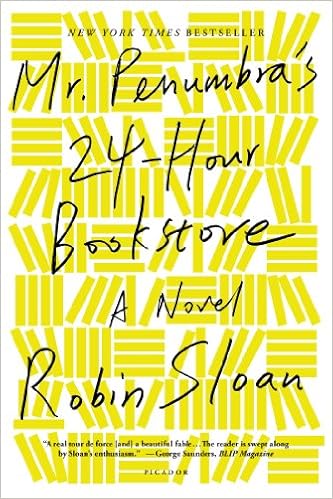
Mr. Penumbra's 24-Hour Bookstore

Farrar, Straus & Giroux
Mr. Penumbra's 24-Hour Bookstore
Robin Sloan
2012

The Summary
"The Great Recession has shuffled Clay Jannon away from his life as a San Francisco web-design drone and into the aisles of Mr. Penumbra's 24-Hour Bookstore.  But after a few days on the job, Clay discovers that the store is more curious than its name or its gnomic owner might suggest.  The customers are few, and they never seem to buy anything--instead, they "check out" large, obscure volumes from strange corners of the store.  Suspicious, Clay engineers an analysis of the clientele's behavior, seeking help from his variously talented friends.  But when they bring their findings to Mr. Penumbra, they discover the bookstore's secrets extend far beyond its walls.  Rendered with irresistible brio and dazzling intelligence, Mr. Penumbra's 24-Hour Bookstore is exactly what it sounds like:  an establishment you have to enter and will never want to leave."

The Good
Mr. Penumbra's 24-Hour Bookstore was an exciting novel for me.  Although you might not think it at first, Mr. Penumbra's Bookstore is a mystery--a mystery that must be solved to proceed into an unlikely adventure, a mystery which the narrator finds himself inexplicably following.  It's fascinating to see new aspects of the bookstore come to light as Clay Jannon discovers new secrets and learns new things.

Speaking of Clay, I found I absolutely loved all the characters Robin Sloan introduced.  Clay was an excellent narrator.  Witty, bright, and unexpectedly creative, he put his mind to the test and set out for answers on a grand scale.  I loved his sense of humor and his adoration of fantasy, and I loved all of his friends:  kind, contemplative Penumbra; brilliant and boisterous Matt; friendly, loyal Neel; and, finally, smart and sassy Kat.

They helped make the novel everything it was.

I spent much of my time curious, wondering where the story would lead.  It's a strange story, meandering between the nearly archaic world of Mr. Penumbra's bookstore and the modern interconnected universe of Google, but I wasn't disappointed.  I found the connections between characters, between the mysterious society behind the bookstore and the modern world, between history and the present made sense without being overwhelming.

Granted, I might consider it a touch over the top--fantastical adventures criss-crossing the United States, delving into medieval history--but I enjoyed the element of fantasy involved.  It intrigued me, invited me to read more.  And while I may have been slightly disappointed by how the story ended, another part of me was relieved and exhilarated by the unexpected changes.

The Bad
Honestly, I don't have any complaints.  The story was a little wild, a little unbelievable, but I, nevertheless, enjoyed it and had a fun time reading Sloan's novel.

Clay has a few internal monologues that I belatedly realized were said aloud, which tripped me up a bit; however, I thought it was clever and funny rather than annoying.  It made me wonder if Clay sometimes had moments when he thought, "Did I really just say that out loud?", and I couldn't help but giggle.

The Ugly
Even the best things can't continue indefinitely.