"All good books are alike in that they are truer than if they had really happened
and after you are finished reading one you will feel that all that happened to you
and afterwards it all belongs to you; the good and the bad, the ecstasy, the remorse,
and sorrow, the people and the places and how the weather was."
Ernest Hemingway

Thursday, May 12, 2016

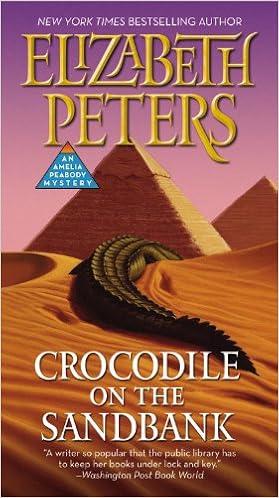
Crocodile on the Sandbank

Grand Central Publishing
Crocodile on the Sandbank
Elizabeth Peters
1975

The Summary
"Amelia Peabody, that indomitable product of the Victorian Age, embarks on her first Egyptian adventure armed with unshakable self-confidence, a journal to record her thoughts, and, of course, a sturdy umbrella.

"On her way, Amelia rescues young Evelyn Barton-Forbes, who has been 'ruined' and abandoned on the streets of Rome by her rascally lover.  With a typical disregard for convention, Amelia promptly hires her fellow countrywoman as a companion and takes her to Cairo.

"Eluding Alberto, Evelyn's former lover, who wants her back, and Evelyn's cousin Lord Ellesmere, who wishes to marry her, the two women sail up the Nile.  They disembark at an archaeological site run by the Emerson brothers--the irascible, but dashing, Radcliffe and the amiable Walter.  Soon their little party is increased by one--one mummy, that is, and a singularly lively example of the species.  Strange visitations, suspicious accidents, and a botched kidnapping convince Amelia that there is a plot afoot to harm Evelyn.

"But no villain, or mummy, is a match for the doughty Amelia.  How she arranges all to her satisfaction is just one of the pleasures of this delightfully witty mystery."

The Good
At the recommendation of a co-worker, I read--or, rather, listened to--Crocodile on the Sandbank and I found it to be a fun, lively little novel with excellent characters and a high sense of adventure.  I loved the setting and the intrigue, the historical anecdotes that the narrator liberally sprinkles throughout her narrative.  It's wonderfully fun and fascinating.

And, speaking of narrator, I really enjoyed listening to Amelia Peabody.

Amelia Peabody is a daring, sassy female protagonist with a dynamic personality and a scorching wit that makes her wholly unique in 19th century society.  She's quite intelligent, incredibly daring, and she's certainly not afraid to speak her mind.  After spending years in spinsterhood, she doesn't much care to ruffle a few feathers and step on a few toes, especially when it comes to hot-headed Radcliffe Emerson.

It's just plain fun, which, I think, is why I liked it so well.  It's full of mystery, romance, adventure, and intrigue, but it has a narrator who's thoughtful and intelligent and, occasionally, belligerent.  It's so much fun to dive into the story and see what happens next.

The Bad
Eleanor is pretty much characterized as the stereotypical shrinking violet, the helpless swooning maid in need of a heroic man--or, in this case, Amelia--to save her.  She's made of sterner stuff, obviously, but, as readers, we don't always get to see that side of her which I found to be a bit of a disappointment.  Amelia is bold and robust, so she often overshadows the softer spoke, more timid Eleanor.

The Ugly
You think the mummy might be the worst of it, but you'd be surprised especially whenever Lord Ellesmere and Alberto get involved.  It's really quite a mess and, when the unmasking comes, it's a regular Scooby-Doo episode.

Tuesday, May 10, 2016

Strange and Ever After

HarperTeen
Strange and Ever After
Susan Dennard
2014

The Summary
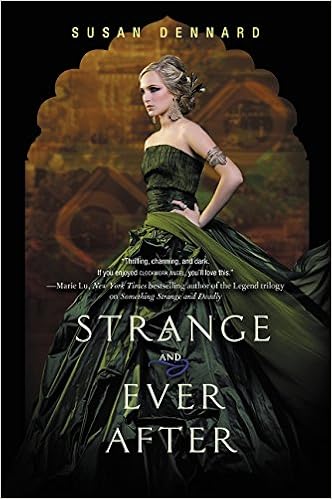
"It has been a tumultuous time for Eleanor Fitt since life as she knew it in Philadelphia came abruptly to an end.  While the Spirit-Hunters--Joseph, Jie, and Daniel--have helped her survive her brother's violent death and an invasion of Hungry Dead, Elanor has lost just about everything.

"And now, Jie is missing--taken by the evil necromancer Marcus.  Eleanor is determined not only to get her back but to end this nightmare altogether.  But to do so, she must navigate the hot desert streets of nineteenth-century Egypt amid the rising Dead, her unresolved feelings for Daniel, and her volatile relationships with Joseph and Oliver, her demon.  And it won't be easy.  Because now Allison, her friend from Philadelphia, has tagged along, becoming strangely entangled in Eleanor's mission.

"It will take all of Eleanor's powers of black magic, and all of Daniel's and Joseph's trust, to succeed.  But there will be a price.  And only when it is over will Eleanor truly be able to live a strange and ever after life.

"In the conclusion to this epic trilogy, which began with Something Strange and Deadly and continued with A Darkness Strange and Lovely, Susan Dennard will have readers on the edge of their seats, breathless with anticipation, and begging for this story not to end."

The Good
Strange and Ever After is, like the other books of the Susan Dennard's trilogy, pretty enjoyable.  It combines many of the same elements--the mystery, magic, and intrigue--I'd found appealing in her last novels, and it has many of the same characters I'd liked in the past.  Although the plot began to run a little thin after reading two books dedicated to the exact same subject (i.e. chasing down Marcus and stopping his villainy), it did a fair job of bringing the story to a close.

(Not to say that I was pleased with the conclusion, but more on that later.)

Egypt was also an interesting choice of location for the trilogy conclusion.  After spending an entire book in Philadelphia, then a second in Paris, it seemed like such a strange change of course.  Granted, I suppose the last two books hinted at the course of the story, but I have to say I was still a little surprised.  It was an interesting deviation--and, admittedly, I was intrigued to see where their journey would lead.

Like Something Strange and Deadly and A Darkness Strange and Lovely, I was oddly attracted to this novel.  It's something like a guilty pleasure:  no great epic, no poetic lines of verse, but a fairly enjoyable, action-filled story that drags you in and doesn't let go.  I wanted to see how the story would end, and I was determined to finish what I started, even if I did begin to lose a little interest along the way.

The Bad
I felt like this novel introduced too many new concepts to the story that it only briefly touched upon in the previous two.  For instance, it dives deep into Egyptian myth and belief, pulling ancient Egyptian gods from the ether, shining a bright searchlight on the realm of the realm of the dead, which it didn't even remark upon in past books.  Sure, it's hinted at by Elijah in the first book and it's explored in passing by Oliver in the second, but it truly comes to fruition in the third.

Which doesn't make sense to me.  The natural progression seems distorted, especially since it started to explore voodoo and necromancy, which feel like very distinct entities entirely separate from ancient Egypt.  It felt like a jarring transition, especially since I was very curious about Joseph's and Marcus's education in New Orleans.  I think that would have proved a more interesting direction, but that's just my opinion.

Moreover, I was quickly exhausted by the journey.  It felt like it lasted forever and it just kept adding twists to the plot, making the story last altogether too long.  I mean, I could have dealt with one less betrayal; likewise, I could have dealt with less about the intervening journey--or how much Eleanor wanted to kill Marcus (I could have done with less of her internal dilemmas)--and would have appreciated much more description.

After reading Crocodile on the Sandbank by Elizabeth Peters, which also takes place in Egypt, I realize what I missed in Dennard's final novel:  setting description.  It falls very short in the third novel and, as I think about it more, it's a great disappointment.  I feel like much of it was left to the imagination, leaving me to connect the pieces and envision the landscape from my own recollections of movie/TV cliches.

Yes, I was a little disappointed.

The Ugly
The conclusion.

Most of the time, I can live with the death of a familiar character if it seems necessary or if I'm braced for it.  I can handle tragedy, even if it breaks my heart.  I survived reading J.R.R. Tolkien's The Children of Hรบrin and John Green's The Fault in Our Stars and Markus Zusak's Book Thief, so I think I know how to handle the death of a main character and handle it gracefully.

That is, I may bawl like a baby and lament the death of my favorite characters, but I don't condemn the book for playing with my emotions or socking me in the gut.  It's part and parcel of the story.  While I may not like it, while it may be unexpected or heart-rending or just plain upsetting, I usually accept what happens and, sometimes, I even find those books that evoke the most emotion are the best ones I read.

For crying out loud, The Fault in Our Stars and The Book Thief are two of my favorite books.  I love them, and I will read them again and again despite the heartbreak I endure.

However, I didn't feel that way about Strange and Ever After.  When one of the main characters died--I won't say who, because I don't want to spoil the horrible surprise for other readers--it ruined my entire reading experience.  Sure, in hindsight, I can see a couple of the red flags that should have warned me as to what was going to happen.  And, yes, I can see how it set events in motion that brought Marcus to his knees.

But I don't care.

This one death, this one person who had to die for some ancient riddle to be solved, completely ruined the novel for me.  It seemed so entirely pointless, given what I know about the other characters and their abilities.  I don't care if the novel closed with the characters picking up the pieces, honoring their fallen comrade and moving on to a better, brighter future.  It simply isn't enough.  It will never be enough to redeem this novel for me.
Saturday, May 7, 2016

Read Harder Challenge (Part Three)

I've discovered some more books as part of my commitment to the Read Harder Challenge of 2016, and I've discovered some great stories in my explorations.  I have managed to:
  1. Read a horror book.
  2. Read the first book in a series by a person of color.
  3. Read a play.
HarperTeen
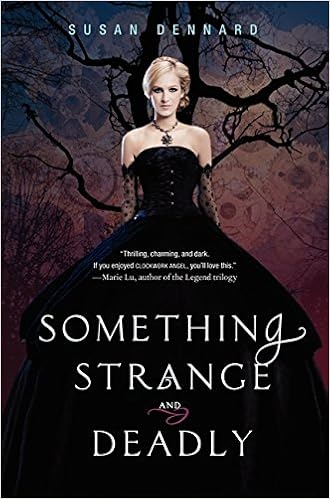
Usually, I don't read horror novels.  Dracula and Frankenstein are about it for me, but I have managed to read Stephen King's The Shining and The Strange Case of Dr. Jekyll and Mr. Hyde by Robert Louis Stevenson, among a handful of other novels that are considered good and scary.  And so, in order to satisfy my challenge criterion and read a horror story, I read Something Strange and Deadly by Susan Dennard.

Although I didn't initially lump Dennard's novel into the horror genre, I reconsidered my stance after necromancy and ritualized violence became involved.  The novel is pretty mild, all things considered--I mean, I certainly wouldn't put it at the level of The Walking Dead or Stephen King, or even Dracula--but it's still rather gory and riddled with a tough kind of suspense that leaves you hanging on the edge of your seat, hoping for more answers.  However, I think it's the zombies that pushed it over the edge and helped me give it a final designation as a horror novel.

I wouldn't call Something Strange and Deadly one of my favorites, but it isn't a bad book; in fact, I initially enjoyed it.  I liked the creepy atmosphere of it coupled with the turn of the century setting, and I even liked the story:  a wicked necromancer comes back from the dead to terrorize Eleanor Fitt, while the Dead continue to rise from their graves across Philadelphia.  It's an intriguing adventure, to say the least; however, I wasn't entirely thrilled with the story when I examined it in retrospect.  The phrase "shut pan" annoyed me to no end.  (Part of me began to think the author found a new, novel phrase and decided to run with it.)

Harper Voyager
Next, in reading the first book in a series by a person of color, I picked up My Soul to Keep by Tananarive Due.  As the first book in the African Immortals series, My Soul to Keep fit the bill perfectly to fulfill this challenge and check it off my list.  I stumbled across it purely by accident, finding it in audiobook form from my local library's website--and I was immediately hooked.

I was intrigued by the premise:  an Ethiopian warrior stumbles across the secret to immortality and spends the rest of his eternal life alternating between identities, enduring a number of years as a slave on a Southern plantation, before becoming a Civil War soldier, a jazz singer, and, finally, a college professor and author.  His story is one of sorrow and loss, desperation in trying to hold tight to the ones he loves.  I was riveted from the first word, from the first moment the narrator spoke and started to weave a complex, beautiful story about Dawit--David--and his wife, Jessica.

At just over eighteen hours long, it took me a number of weeks whittling away at the story to complete it, but I have to say I was thrilled.  It's detailed and strongly written (and narrated by Peter Francis James, who has an amazing voice by the way), and it's absolutely riveting.  The story packs a punch, pulling together a myriad of religions, myths, cultures, and countries to create a flawless tapestry of history and suspense, beauty and sorrow.  I became emotionally invested in Dawit and Jessica's story, and I found myself hoping for the best outcome--and crying (just a little) when tragedy strikes.  I highly recommend picking up My Soul to Keep and reading it for yourself.

Dover Publications
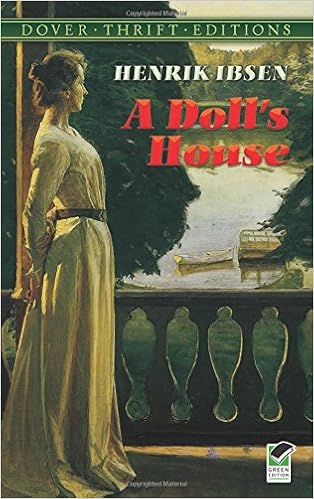
Last, I worked on Henrik Ibsen's A Doll's House.  Having read a portion of the play during a theater history class in college, I was intrigued about the prospect of reading the entire play this time around.  It was just my good fortune that I found a copy of the play for a dollar at my local used bookstore.  It's almost as if it was fated to be.

A Doll's House is an interesting play, not action-packed or suspenseful (like either of the two entries listed above).  For the time period, it's thought-provoking and, even now, it raises a lot of questions about women as spouses and mothers--and what are the typical roles of women in society.  It's a play designed to make you think, rather than thrill you.

Personally, I thought it was fascinating to see how Nora managed to flaunt convention, managed to get what she wanted despite the restrictive constraints of her time that were placed upon her gender, and, more importantly, proved she was capable of making her own decisions.  It's a bit slow, but I think it's worth reading at least once, especially if you're interested in theater.

Thursday, May 5, 2016

How to Read the Solar System: A Guide to the Stars and the Planets

22488004
Pegasus Books
How to Read the Solar System:  A Guide to the Stars and the Planets
Chris North
Paul Abel
2014

The Summary
"What exactly is the solar system?  We've learned the basics at school, but do we really understand what we are seeing in the night sky?  Expert astronomers Chris North and Paul Abel provide a fascinating guided tour of our solar system and explain its many wonders.

"They at all the major players including our more familiar cosmic neighbors--the sun, the planets, and their moons--as well as the occasional visitors to our planet--asteroids, meteors, and comets--in addition to the distant stars and what might lie beyond our solar system, including the mysterious Earth Mark II.  North and Abel recount the history of how our solar system came to be and decipher the myths that once shaped our astronomy.

"Through their cogent explanations of the latest scientific discoveries, they reveal how any amateur astronomer can view and interpret the solar system and enrich their understanding of our universe."

The Good
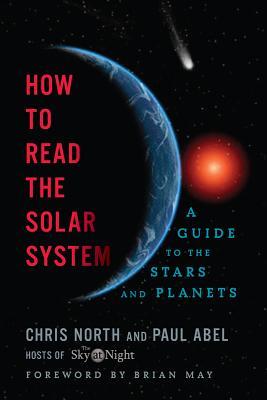
I'm actually really glad I finished How to Read the Solar System, because it offered me insight into the solar system that I certainly didn't have prior to reading North and Abel's book.  While it is a bit dry and quite dense, I should point out that it's not a bad book.

I learned something interesting about each of the planets and a whole assortment of facts about dwarf planets, the Sun, comets and asteroids, and more, which was one of the most important aspects of reading this book.

For instance, I learned that Io, one of Jupiter's many moons, has boasted volcanic activity (specifically cryovolcanic activity, since it's an icy wasteland); sound waves travel faster through plasma, which gives scientists the opportunity to measure the internal activity of the sun (since it's made up primarily of plasma); and meteor showers are essentially the debris left behind by commets, like a dust storm that the Earth passes through during its orbit.  It's fascinating, really.

While How to Read the Solar System isn't a book I would read twice, it's a vast well of information that's sure to hold appeal for readers who greatly enjoy science, astronomy, technology, and even mathematics.  It's definitely worth checking out, especially if you're curious about the solar system and the explorations humankind has made into space thus far.

More importantly, it gets an added bonus point in my book for having an index.  I was able to easily look up the most intriguing bits of information if I didn't feel like skimming.

The Bad
I will admit, I was sometimes bored with this book.  Like terribly bored, so bored that when I read it at night I fell asleep within a few minutes.  Don't get me wrong, it's not a bad book by any means, but I simply lost interest when the authors went into too great a detail.

Like when they explained how amateur astronomers should find a specific location in space, like how to find a particular moon by Jupiter, or which filter to use use in order to observe the sun (helpful, if I understood where one might find such filters.  Or if my telescope worked properly), or pinpointing the exact degree to which one might adjust a telescope to find Venus.

I'll be honest, if it didn't directly link to me in some way, I found myself losing interest.  Quickly.

The Ugly
I wish How to Read the Solar System had had more pictures and photographs to share.  I would have loved some full color photos from the universe, depicting images from deep in space or shots of auroras or pictures of the planets and the Sun.  It was a little dull without them.

Tuesday, May 3, 2016

The Professor and the Madman

Professor and the Madman: A Tale of Murder, Insanity, and the Making of the Oxford English Dictionary
HarperCollins
The Professor and the Madman:  A Tale of Murder, Insanity, and the Making of the Oxford English Dictionary
Simon Winchester
1998

The Summary
"It is known as one of the greatest literary achievements in the history of English letters.  The creation of the Oxford English Dictionary began in 1857, took seventy years to complete, drew from tens of thousands of brilliant minds, and organized the sprawling language into 414,825 precise definitions.  But hidden within the rituals of its creations is a fascinating and mysterious story--a story of two remarkable men whose strange twenty-year relationship lies at the core of this historic undertaking.

"Professor James Murray, an astonishingly learned former schoolmaster and bank clerk, was the distinguished editor of the OED project.  Dr. William Chester Minor, an American surgeon from New Haven, Connecticut, who had served in the Civil War, was one of thousands of contributors who submitted illustrative quotations of words to be used in the dictionary.  But Minor was no ordinary contributor.  He was remarkably prolific, sending thousands of neat, handwritten quotations from his home in the small village of Crowthorne, fifty miles from Oxford.  On numerous occasions Murray invited Minor to visit Oxford and celebrate his work, but Murray's offer was regularly--and mysteriously--refused.

"Thus the two men, for two decades, maintained a close relationship only through correspondence.  Finally, in 1896, after Minor had sent nearly ten thousand definitions to the dictionary but had still never traveled from his home, a puzzled Murray set out to visit him.  It was then that Murray finally learned the truth about Minor--that, in addition to being a masterful wordsmith, Minor was also a murderer, clinically insane--and locked up in Broadmoor, England's harshest asylum for criminal lunatics.

"The Professor and the Madman is an extraordinary tale of madness and genius, and the incredible obsessions of two men at the heart of the Oxford English Dictionary and literary history.  With riveting insight and detail, Simon Winchester crafts a fascinating glimpse into one man's tortured mind and his contribution to another man's magnificent dictionary."

The Good
I greatly enjoyed reading The Professor and the Madman.  I'd seen it in passing when I was collecting a stack of books and, of course, the subtitle caught my attention almost immediately.  After all, what did murder have to do with Oxford English Dictionary--and who was the madman supposedly involved with the entire affair?

I certainly had to find out.

Simon Winchester's book is an interesting creation.  Part narrative and part biography, it reminisces of Erik Larson's work in that it manages to make history sparkle, so to speak.  It makes history accessible and amusing, taking something that sometimes goes dry and stale, making it into a fascinating and informative epic.  Personally, I loved every bit of it.  It appealed to my love of language and my love of history, offering me glimpses into both the creation and history of the language and the history behind one of the English language's most comprehensive book.

Yes, I found it was sometimes slow going.  (I'm very prone to distraction, I'm afraid, and I had a lot of books on my mind at the time.)  However, I loved reading about Professor Murray and Dr. Minor.  Murray and Minor were both brilliant individuals.  Intelligent and bright and innovative, they were the backbone of the Oxford English Dictionary and they helped to make it the incredible repository of information it is today, but they walked two very different paths.

Minor was a man of means, a gentleman of wealth who became a medical doctor and participated in the America Civil War; Murray was an incredibly bright scholar, a self-taught gentleman who eventually became a professor at Oxford and editor for the OED.  Minor's experiences, especially the trauma he faced during the Civil War, helped to shape him in later years and eventually brought him into contact with the dictionary project, but Minor, while fascinating, was not nearly as intriguing to me as James Murray.

Murray received only a rudimentary education, before he was forced out of school to help support his family; however, he eventually continued his education, learned several different languages--including German, French, Latin, et cetera--and became one of the most notable gentlemen at Oxford after he became a professor and an editor for the OED.  In his studies, he even trained local cattle to respond when he called to them in Latin, which made him more than passably interesting in my book.

Overall, I enjoyed reading The Professor and the Madman.  Wonderfully detailed and crafted with remarkable narrative quality, Winchester's book was a fantastic read.  It appealed to me on so many levels as a reader by making history and the English language accessible, but I might be biased.  I found it simply the perfect combination of weird, wacky history and interweaving narrative.

The Bad
No complaints.

Honestly, it was an enjoyable book for me.  As a former English major, I was fascinated by the history of the language and the creation of the OED.  Granted, others who don't care as much for history and English may not find is as interesting or amusing as I did, but I think other readers will be able to appreciate the effort and skill Winchester put into his book.

The Ugly
Much of the Winchester's book wasn't very grim.  Yes, Dr. Minor was entirely mad; yes, he was put into an asylum for the criminally insane; and, yes, his psychosis was alarming and sometimes violent (i.e. the murder of George Merritt), but I found it wasn't particularly graphic or stomach-turning.  Nothing one hasn't heard before in a history book.

However, the bit about "self-abuse" (masturbation) and self-mutilation was a bit much, and I found myself feeling a little squeamish.