"All good books are alike in that they are truer than if they had really happened
and after you are finished reading one you will feel that all that happened to you
and afterwards it all belongs to you; the good and the bad, the ecstasy, the remorse,
and sorrow, the people and the places and how the weather was."
Ernest Hemingway

Tuesday, July 18, 2017

Midnight Riot

Del Rey
Midnight Riot
Ben Aaronovitch
2011

The Summary
"Probationary Constable Peter Grant dreams of being a detective in London's Metropolitan Police.  Too bad his superior plans to assign him to the Case Progression Unit, where the biggest threat he'll face is a paper cut.  But Peter's prospects change in the aftermath of a puzzling murder, when he gains exclusive information from an eyewitness who happens to be a ghost.  Peter's ability to speak with the lingering dead brings him to the attention of Detective Chief Inspector Thomas Nightingale, who investigates crimes involving magic and other manifestations of the uncanny.  Now, as a wave of brutal and bizarre murders engulfs the city, Peter is plunged into a world where gods and goddesses mingle with mortals and a long-dead evil is making a comeback on a rising tide of magic."

The Good
Midnight Riot is a very interesting novel--and I mean that in the very best way.  Ben Aaronovitch's novel is dark, gory and spectacularly spooky; however, he manages to create a light, yet funny glimpse into the supernatural underworld existing beneath the very surface of London.  I especially liked the dynamic between Peter Grant and his partner, Leslie.

Peter and Leslie are hilarious together.  Their entire exchange at the beginning of the novel had me cracking up (I suppose because I understood their references).  They have an easy relationship, a way of joking and teasing one another that's fun and amusing.

Plus, I couldn't help but enjoy Peter's sense of humor most of the time.  He's not a very serious fellow and he almost always has some sort of quip to deliver that will leave you chuckling.  He's also incredibly capable.  He's smart, he's observant, and he's careful to put his talents and training to good use.

The Bad
I didn't always understand what was happening.  I know part of it was a language barrier, since I didn't always grasp the meaning of certain slang terms and I have zero familiarity with London's Metropolitan Police force, but I don't think all of it was a lack of understanding on my part.

Personally, I felt like I was always missing something.  The pace of the novel seemed so quick, and I always felt like I was missing some clue, something that should have been obvious but wasn't for me.  I don't know if it was the pace, the slang, or simply my own reading comprehension; whatever the case, I always seemed to be just a little behind with the story.

The Ugly
Gore.

When I say gore, I mean gore.  Despite its sense of humor and its endearing characters, Midnight Riot can be downright brutal when it wants.  It's a very interesting novel, yes; however, it also pushed at my personal boundaries when it comes to violence.  I liked it, don't get me wrong, but I didn't like imagining someone's face falling off or their head exploding.

Truthfully, it was a bit more than I could stomach.

Thursday, July 13, 2017

Time's Up

Kensington Books
Time's Up
Janey Mack
2015

The Summary
"The police academy gave her the boot--and she knows how to use it.

"All her life, Maisie McGrane dreamed of following in her father and older brother's footsteps and joining the force.  But when she's expelled from the police academy, she's reduced to taking a job as a meter maid.  Now, instead of chasing down perps, she's booting people's cars and taking abuse from every lowlife who can't scrape together enough change to feed the meter.

"McGranes weren't put on this earth to quit, however.  When Maisie stumbles across the body of a City Hall staffer with two bullets in his chest, her badge-wielding brothers try to warn her off the case.  But with the help of her secret crush, shadowy ex-Army Ranger Hank Bannon, Maisie's determined to follow the trail of conspiracy no matter where it leads.  And that could put her in the crosshairs of a killer--and all she's packing is a ticket gun."

The Good
If you like Janet Evanovich's Stephanie Plum series, you'll undoubtedly enjoy Janey Mack's series starring Maisie McGrane.

Headstrong and undeniably tough, Maisie is an intelligent and incredibly talented.  She was an ace at the police academy and she's completely overqualified for being a meter maid, but she takes on the job to prove a point to herself, her family, and the police academy that kicked her out.  She's smart, she's sassy--what's not to like?

The Bad
Time's Up just isn't my cup of tea.  I like tough, strong and intelligent female leads, but I struggled a bit with Maisie.  Part of it might have just been the treatment she faced (it bothered me how much people were willing to crap all over her, just because she was doing her job); part of it just might have been the style of writing; part of it might have been the romantic triangle.

Either way, it's just not for me.

The Ugly
Maisie cannot catch a break.  I mean, she's constantly enduring grief from her brothers and she's working as a meter maid, one of the most hated jobs in Chicago.  She's demeaned, she's bullied, she's abused, she's despised--and that's not even the worst of it.  She's constantly out maneuvered by one person or another, and she's consistently embarrassed by or shoved aside as just an accessory by other characters.

I realize that all the things that happen to her are supposed to show her toughness, her mental acuity, her physical strength, yet I couldn't help thinking it was just one disaster after another.  I like adventure and I like quirky, sassy heroines; however, I don't like seeing a character I'm supposed to like just suffering.

That's what it felt like:  suffering.

Sometimes, life is going to be crappy.  It's going to be tough, it's going to be a learning experience, but Maisie doesn't ever catch a break.  It's one long procession of crappy situations, and it's like there is no end in sight.  I mean, it feels like Maisie has no good days.  There's no light at the end of the tunnel, there's no hope for something better.

Personally, it makes me feel bitter and frustrated--and I'm not even the one dealing with it.  More to the point, I don't know how she can stand her family.  Her family loves her, don't get me wrong, but I feel like they make her life more difficult.

Take her brothers, for instance.  They're very protective of her, but it doesn't feel like there's any affection.  Maybe it's just the way the family is supposed to be portrayed (as in, they're not very good at expressing affection); maybe it's just the way they were written (as in, I'm not 100 percent sure the author did a great job of writing them).  I don't know, I just know I didn't like they way they treated their little sister.

Tuesday, July 11, 2017

Ghostopolis

7293595
Graphix
Ghostopolis
Doug TenNapel
2010

The Summary
"Garth Hale is as good as dead....

"The only problem is he's still alive.

"When Garth Hale is accidentally zapped into the ghost world by Frank Gallows, a washed-up ghost wrangler, he discovers that he has special powers.  Soon he finds himself on the run from the evil ruler of Ghostopolis, who wants to use Garth's newfound abilities to tighten his grip on the spirit world.  After Garth meets Cecil, his grandfather's ghost, the two search for a way to get Garth back home, nearly losing hope until Frank Gallows shows up to fix his mistake."

The Good
I really enjoyed Ghostopolis.  It's such a unique take on the afterlife and how the living (and the dead) deal with it.  Plus, I was fascinated by the idea that there's a bureau in the government set aside just to deal with ghosts--which is where Frank, a washed up has-been if there ever was one, comes into play.

It's interesting to see the imagined technology Frank uses, but it's also fascinating to see how he deals with ghosts on a professional and personal level.  For him, ghosts are just a part of the job.  It's kind of comical how he's used to them by now.

Overall, Ghostopolis is a fun, exciting story.  It deals with the despair of death and dying without giving in to the despair of death and dying.  It's fairly mild; it's easy to read and follow the panels; plus, it's just plain fun.

The Bad
I didn't always understand the physics of the Ghostopolis, which I found bothered me a tiny bit.  I mean, Garth has incredible power when he's in Ghostopolis simply because he's human.  It's like how on the other side, in the world of the living, ghosts are able to float and penetrate walls.  However, I didn't quite understand why such a thing existed or why Garth had such uncommonly powerful abilities.  It doesn't really answer those questions, rather it just leaves them to be suspended with your disbelief.

The Ugly
Death.  Not death as what humankind observes, but death of a more permanent variety.  It's really very sad.

Oh, and the bugs.

I really didn't like the bugs.

Thursday, July 6, 2017

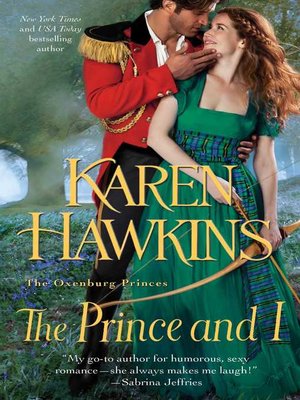
The Prince and I

Cover image for The Prince and I
Pocket Books
The Prince and I
Karen Hawkins
2015

The Summary
"Spirited Murian MacDonald seeks vengeance against the evil earl who's stolen Rowallen Castle from her family.  With a band of loyal retainers, she waylays the earl's wealthy London guests, trying to lure the earl and his guards into pursuit so she can sneak into the castle for evidence of his misdeeds.

"Murian's plan is working splendidly until she stops the coach of Gregori Maksim Romanovin, the commanding prince of Oxenburg, who is in Scotland on an important diplomatic mission.  Max challenges the masked highwayman to a duel and is furious when Murian not only bests him, but escapes!  Max vows to find the tempting Scottish vixen, no matter the cost.

"When Max discovers Murian's lair and hears her story, he resolves to assist her--whether she likes it or not--and a royal battle blazes.  But when Murian is betrayed, Max must choose between the strict dictates of his mission, or protecting the red-haired lass who has stolen his once-cold heart."

The Good
I rather liked The Prince and I.

It was a curious blending of romance and Robin Hood, and I enjoyed it.  Max is the quintessential hero:  dark, brooding, capable, confident--not to mention he's a prince.  Murian, on the other hand, is anything but a damsel in distress:  she's calm, competent, hard-working, and surprisingly agile with a blade.  She's been dealt a terrible hand, having not only lost her husband but her home, but she's making the best of her situation.

However, I think my favorite character was Max's grandmother, Grand Duchess Natasha Nikolaevna.

The Grand Duchess was, by far, the most comical character and, I think, the most knowledgeable.  She doesn't care how other perceive her; rather, she likes being considered a witch.  (It's why she most often threatens to turn others into goats and frogs.  She much prefers infamy to anonymity.)  Moreover, she's often in the thick of trouble, one way or another, and she somehow manages to turn circumstances exactly how she wants them.

This last quality makes me think that she's not the doddering old witch she likes her grandson to think.  Natasha is wily, not senile; in fact, she strikes me as being preternaturally intelligent.  For instance, if she hadn't lost in a card game to the earl, they never would have traveled to Scotland--Max would never have met Murian; Max never would have gotten involved in the earl's business and discovered what he did.

Honestly, Natasha is the force that propels the story forward.  She's the one who helps to shape it and, while she may seem laughably naive or even foolish, I have this feeling she's not.  I have this odd feeling that she knows exactly what she's doing, that she has calculated every move to her--and, by proxy, her grandson's--benefit.

The Bad
The Prince and I is a fine novel.  It's not great, it's not an immediate classic; however, it's not a terrible romance either.  It falls somewhere in between:  not quite fantastic, but enjoyable nevertheless.

The Ugly
The earl--and I can't remember his name to save my life, now--is a terrible character.  He's just a horrible person in general, and I really grew to hate him.  Not only does he manipulate, lie, and cheat, he's quite probably a murderer to boot; however, he was a forgettable sort of evil.  He's a bit of a caricature:  evil and spiteful enough as to be unbelievable.

I suppose it says something that I don't remember his name anymore.

Tuesday, July 4, 2017

Be Frank with Me

William Morrow
Be Frank with Me
Julia Claiborne Johnson
2016

The Summary
"Meet Mimi:  Reclusive literary legend.  Wrote Pulitzer- and National Book Award-winning novel at nineteen.  Hasn't been seen or heard from much since, though, ironically, she lives in a glass mansion in Bel Air.  Lost all her money in a Ponzi scheme, needs to write another novel.  So her publisher sends...

"Alice Whitley:  Editorial assistant.  Twenty-five years old.  Highly competent.  Thinks she's going to be typing up pages and delivering cups of coffee.  Instead finds that her primary job is to be companion to...

"Frank:  Mimi's nine-year-old son.  A boy with the intellect of Albert Einstein, the wardrobe of a 1930s movie star, and very little in common with his fellow fourth graders.  About to give Alice the education of her life."

The Good
I liked Be Frank with Me.

It's zany, it's original, it's a lot of fun, yet it's quietly intense and, quite honestly, heart-wrenching.  I found I quickly became involved in their lives, but, then again, I think it's easy to become wound up in Frank's story.  (It feels like Frank's story, as much as it feels like Alice's.  He's such a larger-than-life character, and he just seems to overshadow everything else.)

Overall, I enjoyed my time with Frank and Alice.  I liked the unexpectedness of their adventures, even if it sometimes led to mayhem.  However, what I liked best about Be Frank with Me was the narration.

Tavia Gilbert does a brilliant job of breathing life into the characters.  She gives Alice depth, a distinctive perkiness that shows her optimistic attitude; she captures Frank's youth and intelligence, his boyish voice and unusual monotone; she gives Zander a gravelly, masculine voice that conveys both his age and his immaturity.

I loved the way Gilbert slipped between personas.  Even when I didn't know who was speaking, I could tell which character I heard.  Gilbert makes each character singularly unique, distinguishing them by tone and accent and attitude.  She's a masterful storyteller, and I enjoyed listening to her lend her talents to Be Frank with Me.

The Bad
I'll admit, I struggled with this story.

I am Alice's age.  I could easily see myself in the same position as Alice, working as an assistant and quickly finding herself engulfed by the work--by all the tiny rules that Mimi snaps at her for not knowing, all the rules that keep Frank to freezing up or freaking out.

I mean, I felt bad for Alice:  here she is living full time in Los Angeles, essentially working as a live-in babysitter, instead of a publisher's assistant.  Not to mention, Mimi treats her poorly; Frank nearly takes off her fingers when they first meet; and Zander--well, Zander feels like just another tragedy waiting to happen.

It's comical all the crazy situations in which Alice finds herself, yet, at the same time, it's frustrating.  I mean, Alice seems like a genuinely nice person.  She might be overly excitable and she might sometimes overstep her bounds, because she wants to do a good job.  I hate the way she's treated by pretty much everyone.

And Zander.

Don't even get me started on Zander.

The Ugly
Human relationships are complicated.  They're ugly and brutal and difficult, and it's easy to see why Frank struggles with them.  I mean, fourth graders aren't exactly the nicest bunch out there and it's easy to see how Frank feels like he doesn't belong.