"All good books are alike in that they are truer than if they had really happened
and after you are finished reading one you will feel that all that happened to you
and afterwards it all belongs to you; the good and the bad, the ecstasy, the remorse,
and sorrow, the people and the places and how the weather was."
Ernest Hemingway

Friday, January 15, 2016

In Progress: A Game of Thrones (Continued)

Bantam
As much as I have enjoyed reading A Game of Thrones by George R.R. Martin, as much as I love his style of writing and the intricacy of his story, I have hit a wall in my reading.  While I was waiting for a copy of A Game of Thrones to return to my library, I made the fatal mistake of picking up another book - and, now, I seem to have my momentum.

I'm just short of being half-way through Martin's novel, but I'm stuck.

Part of me wants to finish the book, but I can't fathom why I would force myself through a book that another part of me isn't so sure I want to finish.  I like A Game of Thrones, but I find myself feeling a bit depressed when I try to continue.  And, as disappointed as I am (with myself) to not finish Martin's novel, I'm equally relieved to simply let it go.

One day, I might try again.

For now, I'm going to just admire Martin's work from afar and rest easy in the knowledge that I might some day return.

Wednesday, January 13, 2016

Uprooted

Del Rey
Uprooted
Naomi Novik
2015

The Summary
"Agnieszka loves her valley home, her quiet village, the forests and the bright shining river.  But the corrupted Wood stands on the border, full of malevolent power, and its shadow lies over her life.

"Her people rely on the cold, driven wizard known only as the Dragon to keep its power at bay.  But he demands a terrible price for his help:  one young woman handed over to serve him for ten years, a fate almost as terrible as falling to the Wood.

"The next choosing is fast approaching, and Agnieszka is afraid.  She knows - everyone knows - that the Dragon will take Kasia:  beautiful, graceful, brave Kasia, all the things Agnieszka isn't, and her dearest friend in the world.  And there is no way to save her.

"But Agnieszka fears the wrong things.  For when the Dragon comes, it is not Kasia he will choose."

The Good
Uprooted is a truly intriguing piece of fantasy.  It has all the elements of traditional fantasy - a menagerie of magical creatures, a malevolent forest, a grumpy wizard - but it feels different from the usual books I pick up.  Sure, I can see where Tolkien, among others, might play a part in Novik's novel, and I can pinpoint familiar myths that have influenced many fantasy writers; however, Naomi Novik pulls from unexpected resources, dipping into multiple mythological pools.  Most notably, she incorporates pieces from Slavic folklore, even engaging Baba Yaga in her work.

For this reason, Novik's novel has a different flavor to it than most fantasy I've read.  It's a complex amalgamation of political and social intrigue, magic, myth and folklore, and, most importantly for young Agnieszka, coming-of-age, but Novik manages to keep it fresh and interesting.  I'm unfamiliar with much of the background, with the intricate history and folklore of Agnieszka's native Polnya, so I found it particularly invigorating.

I also liked Agnieszka.  She's clumsy and inexperienced, but she's very intelligent and she's incredibly candid about her experiences.  As she shares her fears, her hopes and dreams and desires, you have the opportunity to see her character in many different ways and through many different experiences that will change her, mold her and make her into a new person.  She's a fantastic narrator.

I was especially taken with her descriptions of magic.  Agnieszka, who spent her entire childhood and much of her adolescence in the great outdoors, climbing trees and running through the woods in bare feet, has an earthy quality to her character that reflects in her descriptions of the world and, most importantly, magic.  She engages tactile sensations, like digging your fingers into fresh dirt, and offers descriptions that often evokes images of soil, summer, and green, growing things - new life.

I loved the way Agnieszka saw the world.

Additionally, I was pleased with Novik's character development.  Although the Dragon - Sarkan - remained fairly unchanged (he was very stalwart in his refusal to bend), I liked how Agnieszka developed.  She goes from a shy, fearful young woman to a powerful, self-reliant young witch.  I enjoyed seeing her mature, develop and grow as a person and as a magical practitioner.

The Bad
Uprooted felt almost too long.  I mean, don't get me wrong, I don't mind a lengthy story, but Novik's novel just seemed to keep going.  So many secrets unfolded, so many bad things kept happening, so many narrow escapes occurred that it bordered on ridiculous.

I can't tell you how many times Agnieszka escaped an immediate and painful death, even down to the last 50 pages.  As another reviewer pointed out in his article, "It's just that one can't help but be reminded that Novik's Temeraire series will conclude next year as a nine-novel cycle and wonder why a writer so skilled at pacing a long, complicated chronicle over multiple books has crammed this story into one."

This rings true through much of the book.  The last few chapters feel especially rushed, having too much adventure and too many discoveries jammed into a little portion.  Uprooted really does need to be cut into separate novels, preferably a trilogy.

The Ugly
Blood and gore.

Honestly, I didn't expect this novel to be as horrifyingly gory as it was.  Perhaps, because Agnieszka was unused to such violence, we (as readers) see the tragic events as she does - with new eyes and a burgeoning sense of a horror.

Like Agnieszka, we are scarred by terrible things we witness.

---

For more of the article I quoted, check out Mac Roger's article on Slate.com:  http://www.slate.com/articles/arts/books/2015/06/naomi_novik_s_fantasy_novel_uprooted_reviewed.html

Friday, January 8, 2016

Read Harder Challenge 2016

ReadHarderChallenge2016_checklist (1)Last year, I attempted to complete the Read Harder Challenge.  I finished a portion of the list, and I even posted some reviews on another blog I maintained (which I have since let fall into disrepair - unfortunately); however, I let it fall by the wayside after a couple of months.  This year, however, I hope to change that and complete the Read Harder Challenge of 2016.

Here is a snippet of what you can expect:
  • Read a horror book
  • Read a nonfiction book about science
  • Read a biography (not a memoir or autobiography)
  • Read a book originally published in the decade you were born
  • Listen to an audiobook that has won an Audie Award
  • Read a book by an author that is set in the Middle East
  • Read a nonfiction book about feminism or dealing with feminist themes
There's more, of course, but this is just a taste.  Book Riot has added a lot of different challenges this year, and they've changed from the previous year with the goal of getting reader's to branch out into different realms - and, more importantly, get out of their comfort zone.  (Speaking of which, I might have to work a little harder for "Read a book out loud to someone else."  That's definitely outside of my comfort zone.)

Anyway, I've only just started on my list, but I'm hoping to finish it and maybe work on some of my own reading challenges once I'm done.  My goal for the New Year is to read more and read broadly, and maybe find some new favorites along the way.

---

For more information about the Read Harder Challenge, check out Book Riot.  You can find suggestions and recommendations from other readers who are trying to find books just like you!

And for a copy of your own reading challenge, click here.

---

As always, happy reading.

- The Scrivener

Wednesday, January 6, 2016

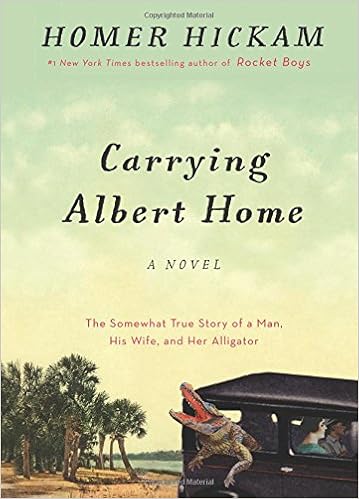
Carrying Albert Home: The Somewhat True Story of a Man, His Wife, and Her Alligator

William Morrow
Carrying Albert Home:  The Somewhat True Story of a Man, His Wife, and Her Alligator
Homer Hickam
2015

The Summary
"Elsie Lavender and Homer Hickam Sr.- the future parents of Homer Hickam Jr. - were high school classmates in the West Virginia coalfields, graduating just as the Great Depression began.  When Homer asked for her hand, Elsie instead headed to Orlando, where she sparked with a dancing actor named Buddy Ebsen (yes, that Buddy Ebsen).  But when Buddy headed for New York, Elsie's dreams of a life with him were crushed and eventually she found herself back in the coalfields, married to Homer.

"Unfulfilled as a miner's wife, Elsie was reminded of her carefree days in Florida every day because of Buddy's unusual wedding gift:  an alligator named Albert who lived in the only bathroom in their little house.  Eventually, Homer gave Elsie an ultimatum:  'Me or the alligator!'  After giving it some thought, Elsie concluded there was only one thing to do - carry Albert home.

"Carrying Albert Home tells the sweet, funny, and sometimes heartbreaking tale of a young couple and their special pet on a crazy 1,000-mile journey.  Told with the warmth and down-home charm that made Rocket Boys a beloved bestseller, Homer Hickam's rollicking novel is truly a testament to that strange and marvelous emotion we call love."

The Good
I enjoyed Carrying Albert Home.  It's a sweet, quirky story:  two people making an oddball journey through the south to return an incredibly expressive alligator to his natural habitat - I mean, it can't get any stranger than that.  Well, it can (and does, on occasion) as Elsie and Homer Senior stumble across bank robbers, bootleggers, rioters, smugglers, serial killers, and all manner of sundry creatures on their journey south.

And speaking of alligators, I loved Albert.  He is, I think, the best alligator I've ever read about in literature - then again, he may be the only alligator I've read about.  Nevertheless, I liked him (and the rooster) and their wild journey from West Virginia to Florida.  Their story, while highly unusual, is simultaneously hilarious and fun; more importantly, it's never boring.

Hickam has a storyteller's prose, weaving a tangled story of suspense and adventure and, ultimately, love.  Moreover, he manages to create wonderful characters that are sure to entertain.  Such as the strange, villainous duo of robbers Homer first encounters, or the bootlegger with whom Elsie spars.  It's a strange gathering of people and animals that left me laughing and shaking my head for the absurdity.

As I was reading, I learned to like Elsie.  Headstrong, defiant, inventive and, yes, courageous in her own way, Elsie was a fascinating female character; however, I have to say, I adore Homer (senior, of course).  Although Homer is a simple man - a coal miner by trade whose only aspirations are a steady job and a happy family - he is a smart man who is loyal to a fault and loves Elsie with all his heart, even if he can't always express it.

A lesser man wouldn't have bothered with a trip to Florida; a lesser man would never have faced bank robbers, rioters (with dynamite), bootleggers, poetry-writing serial killers, smugglers, or hurricanes; a lesser man wouldn't have fought so hard for a woman who wasn't sure of her feelings.  It's a sweet, strange love story that made me wonder from chapter-to-chapter, but I enjoyed it overall.

The Bad
Carrying Albert Home is a strange, strange book.  I don't know if the author intentionally made certain parts of his novel vague, or if he was attempting to give depth and symbolism to Albert's journey (like the rooster, who must play a much larger part than we know, but we never find out), or if he was doing something else entirely.

Either way, I often found myself thinking Elsie and Homer's journey to Florida was much bigger than either of them knew.

The Ugly
Homer and Elsie confront bank robbers, violent rioters in the midst of a strike, dangerous bootleggers, smugglers, serial killers, movie directors, and a number of other dangerous things that each had the potential to kill them.  Perhaps the ones who made my stomach turn most were Carlos and lovely Souffle.

Yes, that is really her name.  And, yes, they are about as strange as you can imagine.

But don't let their names deceive you.  You see, they're a couple of spiders who ensnare and eventually kill lost and wayward men.  Carlos is a poet; Souffle is his mistress - and they're both a special kind of crazy that's hard to describe.  Their method is simple, as Carlos elaborates to Homer:  "Though their souls were artless, Souffle gave them a moment of poetic joy and then I made their deaths perfect."

Souffle seduces them; Carlos kills them.  End of story.

It feels like a story from the Odyssey with Souffle akin to Circe - and, well, Carlos is simply a maniac with a pitch fork and penchant to create horrible poetry.  It's incredibly strange and, admittedly, a little horrifying.
Saturday, January 2, 2016

Bonus: Me Talk Pretty One Day

Little, Brown and Company
Me Talk Pretty One Day
David Sedaris
2000

The Summary
In Me Talk Pretty One Day, David Sedaris recounts his childhood in North Carolina and his eventual migration to Paris via New York.  Full of funny and hilarious essays, Sedaris' book encompasses his entire life experience as a gay man in a rather dysfunctional family.

The Good
Me Talk Pretty One Day is very funny.  Sedaris has a sharp tongue and a scathing wit that makes his essays - or, more accurately, his stories about adolescence in the South and his adulthood in Paris - incredibly enjoyable.  Sedaris is not above poking fun at himself or others; he weaves his life experiences and opinions together, fashioning funny and (sometimes) absurd stories that are sure to make you laugh.

Truthfully, I think his stories about his father, Lou, are perhaps some of his best.  One of my favorites was "I'll Eat What He's Wearing," which was Sedaris's last essay.  It chronicles his dad's bad habit of keeping food long past any reasonable expiration date, including a particularly startling mishap with a hat.

The Bad
While I did enjoy  Me Talk Pretty One Day, I wasn't enthralled.  Sedaris is very humorous and his stories are pretty funny, but I just couldn't seem to stay involved in the book.  I would read a story here or there, but it took me weeks to finish the entire book.

Perhaps, that's the way it's meant to be read, taking one story at a time; however, I couldn't help feeling like I was just not enjoying it as much by reading it piecemeal.  It felt like I was forgetting bits of it as I only picked it up sporadically.  It was put on the back burner a lot more than I'd like to admit.

So, overall, Me Talk Pretty One Day is a decent book.  Not great, but not bad either.

The Ugly
Although Sedaris tells his story with a fair amount of humor, his stories about his drug addiction are rather brutal.  He's honest with himself about his addictions, plus he's honest with his audience, which means he's probably going to tell you everything in explicit detail.