"All good books are alike in that they are truer than if they had really happened
and after you are finished reading one you will feel that all that happened to you
and afterwards it all belongs to you; the good and the bad, the ecstasy, the remorse,
and sorrow, the people and the places and how the weather was."
Ernest Hemingway

Tuesday, July 12, 2016

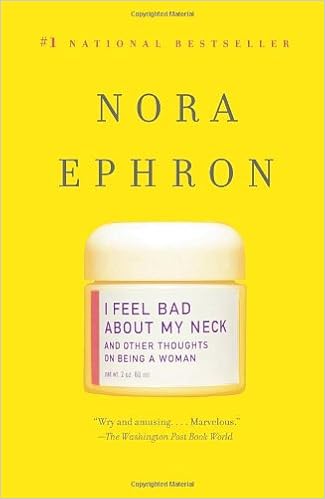
I Feel Bad About My Neck: And Other Thoughts on Being a Woman

Vintage Books
I Feel Bad About My Neck:  And Other Thoughts on Being a Woman
Nora Ephron
2006

The Summary
"With her disarming, intimate, completely accessible voice, and dry sense of humor, Nora Ephron shares with us her ups and downs in I Feel Bad About My Neck, a candid, hilarious look at women who are getting older and dealing with the tribulations of maintenance, menopause, empty nests, and life itself.

"The woman who brought us When Harry Met Sally..., Sleepless in Seattle, You've Got Mail and Bewitched, and the author of best sellers Heartburn, Scribble Scribble, and Crazy Salad, discusses everything--from how much she hates to her purse to how much time she spends attempting to stop the clock:  the hair dye, the treadmill, the lotions and creams that promise to slow the aging process but never do.  Oh, and she can't stand the way her neck looks.  But her dermatologist tells her there's no quick fix for that.

"Ephron chronicles her life as an obsessed cook, passionate city dweller, and hapless parent.  She recounts her anything-but-glamorous days as White House intern during the JFK years ('I am probably the only young woman who ever worked in the Kennedy White House that the President did not make a pass at') and shares how she fell in and out of love with Bill Clinton--from a distance, of course.  But mostly she speaks frankly and uproariously about life as a woman of a certain age.

"Utterly courageous, wickedly funny, and unexpectedly moving in its truth telling, I Feel Bad About My Neck is a book of wisdom, advice, and laugh-out-loud moment, a scrumptious, irresistible treat."

The Good
Nora Ephron's collection of essays is incredibly funny.  Ephron speaks to the universal experiences of all women, pointing out our shared fear of getting older, our worries of wrinkle and our eventual dependence on hair dye, our trouble with large purses (in which it's easy to lose everything, except that random little tic tac that always seems to appear).  It's a short book that's accessible to most, if not all, women who find themselves in similarly hilarious situations.

Overall, I enjoyed I Feel Bad About My Neck.  It's very well-written, incredibly descriptive, and strangely appealing.  I loved her essays because they spoke to me on a personal level, especially where purses are concerned.  (I can certainly see why Ephron dislikes them so, but, like her, I find them a necessary evil for random assortment of things I carry around, such as my books, or candy, or notebooks, or, heaven forbid, something reasonable like a wallet.)

Moreover, Ephron's book is short and it get straight to the point.  Unlike Consider the Lobster by David Foster Wallace, which I attempted to read before I found Ephron, I Feel Bad About My Neck is incredibly appealing, ridiculously funny, and accessible.  It doesn't get stale, because Ephron manages to enchant you with her writing.  She uses short, often funny--and frequently insightful--stories that are sure to appeal to many readers.

The Bad
No complaints.

I enjoyed the entire collection of essays.

The Ugly
Growing older is no picnic, as Ephron makes apparent.

Now, I can't help but wonder what's waiting in store for me.  I suppose I'll just have to find out.  In the mean time, I will learn to better appreciate the neck that I have.

Saturday, July 9, 2016

Bonus: Swamp Sniper

Jana DeLeon
Swamp Sniper
Jana DeLeon
2013

The Summary
"When only a crack shot will do...

"In the two weeks CIA assassin Fortune Redding has been hiding in Sinful, Louisiana, she's been harassed, poisoned, and shot at...and that was the easy part.  Bu now, she's about to face her biggest challenge since setting foot int he tiny bayou town.

"When mayoral candidate Ted Williams is murdered, everyone is surprised.  Ted was a blowhole and a Yankee, but those usually weren't good reasons to kill someone.  When Sinful Ladies Society leader Ida Belle becomes the lead suspect in the crime, Fortune knows she's got to solve a murder and save one of the only friends she's ever had.

"But as the investigation begins, more and more secrets surface, and Fortune realizes that sometimes nothing is as it seems."

The Good
Swamp Sniper has many of the same qualities that I liked:  good characters, decent narrative, fun narrator, lots of adventure and mayhem.  I mean, what's not to love?

And I really don't know what else to say about it.  It's kind of a repeat of the last books, so, if you don't want to go back and rehash the story, you really don't have to.  Swamp Sniper is pretty much self-contained.  It fills you in on the backstory enough that you really don't have to backtrack, because I don't think they bring back any unexpected characters.

(Or, I suppose, you could skip it.  It doesn't really add anything much to Fortune's overall story.  At least, not that I remember.)

The Bad
Pretty much the same old thing:  Ida Belle, Gertie, and Fortune start investigating a murder (this makes three); they bumble their way through an investigation, narrowly avoiding getting shot by bad people or arrested by Deputy LeBlanc; they solve the murder and move on with their lives.  It's pretty much like reading the same books over again.

Not that I didn't enjoy it.  The Miss Fortune Mysteries is something of a guilty pleasure for me, I must admit.  However, I feel like I'm overwhelmed by all the embarrassing antics concocted by Gertie, their crazy excuses for Carter, and their wild excursions into the bayou that inevitably wind up with someone plowing into a bank or falling into the water.

It's the same recipe for disaster and, admittedly, I'm a little tired of it.

The Ugly
Pretty much the same thing, but, this time, the Mob gets involved.

Thursday, July 7, 2016

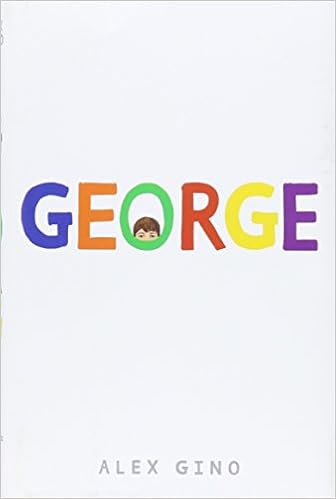
George

Scholastic Press
George
Alex Gino
2015

The Summary
"When people look at George, they think they see a boy.  But she knows she's not a boy.  She knows she's a girl.

"George thinks she'll have to keep this a secret forever.  Then her teacher announces that their class play is going to be Charlotte's Web.  George really, really, REALLY wants to play Charlotte.  But the teacher says she can't even try out for the part...because she's a boy.

"With the help of her best friend, Kelly, George comes up with a plan.  Not just so she can be Charlotte--but so everyone can know who she is, once and for all."

The Good
I read George as part of my Read Harder Challenge of 2016 and I found I really enjoyed reading Alex Gino's novel.  More than I thought I would, admittedly.  It's a sweet little story about George, a boy who would rather be a girl, and his struggle to find acceptance when he reveals to his family--and the rest of his school--the truth about his gender identity.

George is actually a novel for younger readers, so I think Gino's novel reflects the audience age; however, I think it's accessible to a wide variety of readers.  I'll admit, I was a little hesitant to read Gino's novel, because I had my own preconceived notions with which to contend, as well as other doubts that occasionally plagued me in considering this novel.  Given the debate in the media over which bathrooms transgender individuals should and shouldn't use, I really didn't want to read a book that was full of ugly prejudices or a novel that would dwell upon hurtful things.

I was afraid to read a depressing novel.

Luckily, I didn't.  George is surprisingly upbeat, and I found it was rather fun to follow his journey from George to Charlotte, how he managed to fulfill the slogan on the back cover:  "Be Who You Are."  It has a positive message, and it's appealing because it doesn't get bogged down by hateful language; rather, it focuses on George's journey and her success in embracing her own identity.

One of the things I noticed about this book was how George, who did not describe or identify himself as a boy, is consistently referenced with feminine pronouns.  I thought it was a nice touch, because it seemed to make an impact, seemed to impart the importance of a person who is transgender to identify with the gender they choose.  It's an intriguing and eye-opening concept that, I thought, adequately conveyed some of the struggles the George encounters.

Overall, I thought it was a wonderful book that illustrates the struggles of a transgender girl.

The Bad
Although I think George is accessible to readers of all ages (and genders), it's a novel that's likely to appeal to a younger audience.  The language, tone, and story reflect the age of the reader and the age of George.  While I know that may not be appealing to all readers, I didn't find it to be much of a deterrent when I jumped into the story.

Honestly, I couldn't put it down once I picked it up.

The Ugly
Bullying.

I couldn't help feeling sorry for poor George and all the ridicule, derision, and cruelty he had to endure from a couple of his classmates.  It was heartbreaking.

Tuesday, July 5, 2016

The Anatomist's Apprentice

12218678
Kensington Books
The Anatomist's Apprentice
Tessa Harris
2011

The Summary
"In the first in a stunning new mystery series set in eighteenth-century England, Tessa Harris introduces Dr. Thomas Silkstone, anatomist and pioneering forensic detective...

"The death of Sir Edward Crick has unleashed a torrent of gossip through the seedy taverns and elegant ballrooms of Oxfordshire.  Few mourn the dissolute young man--except his sister, the beautiful Lady Lydia Farrell.  When her husband comes under suspicion for murder, she seeks expert help from Dr. Thomas Silkstone, a young anatomist from Philadelphia.

"Thomas arrived in England to study under its foremost surgeon, where his unconventional methods only add to his outsider status.  Against his better judgement he agrees to examine Sir Edward's corpse.  But it is not only the dead, but also the living, to whom he must apply the keen blade of his intellect.  And the deeper the doctor's investigations go, the greater the risk that he will be consigned to the ranks of the corpses he studies..."

The Good
I stumbled across The Anatomist's Apprentice purely by accident.  I was intrigued by the cover when I was skimming a list of audibooks and I clicked the thumbnail, which lead me, of course, to Tessa Harris's novel.  It's not usually the sort of book I would read:  a macabre medical thriller that's set at the tail end of the 18th century.  I mean, I like historical fiction, but medical dramas I'm a little less inclined to read.

However, I was pleasantly surprised by The Anatomist's Apprentice.  It has a good, solid story with an intricately crafted plot, complex characters, and wonderful historical detail.  I especially liked that the author put in the time and effort to describe her characters in such detail, giving them distinctive mannerisms and character quirks that made them instantly recognizable.

I mean, it's hard to forget the corpulent coroner who keeps meat pies hidden in his briefcase, or the egregious Matthew Farrell who flaunts his new wealth after the death of his brother, or the pale, timid creature known as Lady Lydia, who is a lady of perfect breeding (which, confidentially, made her rather boring).  And I certainly can't forget Thomas Silkstone and his mentor, Dr. William Carruthers.

Thomas Silkstone is a fascinating individual.  Although his skills border on the macabre (he is an anatomist, thus his greatest talents lie in the dissection of corpses and the identification of trauma to the human body), he's incredibly intelligent and, being an American caught in England during the American Revolution, he provides a different perspective on English culture and behavior.  More importantly, with his old mentor behind him, he has unique access to a wealth of knowledge--and someone to unceremoniously point out his follies.

Speaking of Thomas's mentor, I have to say I rather liked Dr. Carruthers.  He's practically ancient by normal health standards and he's blind, but he doesn't miss a thing.  He's quick as a whip, intellectually speaking, and he's an excellent sounding board for Thomas.  I loved Thomas' conversations with his old teacher, because they had such an easy rapport, a friendliness that created a unique and quiet lovely dynamic between them.  I grew to appreciate their relationship more than I realized.

One of the greatest things I appreciated about the audiobook, however, was the narrator:  Simon Vance.  Vance does an excellent job of bringing Harris' novel to life, giving a voice to all of the wonderful characters she fabricated.  He uses a variety of accents, playing upon the subtle differences in country and county to provide a broad range of voices that use both a soft, lilting cadence to a deep, rough timbre.  Truthfully, I found it fascinating to listen to him work and I enjoyed The Anatomist's Apprentice more for his narration.

The Bad
I supposed my greatest complaint was the pace.  Tessa Harris (and Simon Vance) do an excellent job of pacing the story, bringing each and every detail to light slowly; however, I found I was sometimes bored by how the story seemed to drag on forever.

Much like Agatha Christie's Murder on the Orient Express, The Anatomist's Apprentice takes multiple chapters to build and seems to unravel all within a few minutes.  While I enjoyed the story overall, I found I didn't like the sudden conclusion.  It had far too many twists at the end for my taste, and I found myself rather confused by the fact that the villain I thought had committed the crime wasn't actually the real mastermind.

It's a bit more convoluted than I would have liked.

As an aside, I do want to point out that I was rather annoyed by how often Lydia was considered to be "fragile," looking "more pale than he'd ever seen her."  Yes, I understand she's a fragile, delicate flower; however, I didn't like being reminded multiple times in the same novel.

The Ugly
Murder.

These people are incredibly inventive.  You think it's one thing, but it's actually quite another.  If it's not murder by bludgeoning, it's murder by drowning or poison or perceived suicide--or, in some cases, attempted murder by physical battery.  It's really very gruesome.

And, speaking of gruesome, I found the booming grave-digging trade to be sickeningly macabre.  Corpses are dug up from the graves and sold to nearby anatomists, who promptly dissect and dispose of the remains.  Even if Thomas does adhere to a set of ethics, which prevents him from taking advantage of the lucrative (if dubious) trade, he is still an anatomist and he still dissects human bodies.

I found myself feeling a bit squeamish from time to time as the narrator described autopsies in graphic detail.  It's more than a little disturbing.

Saturday, July 2, 2016

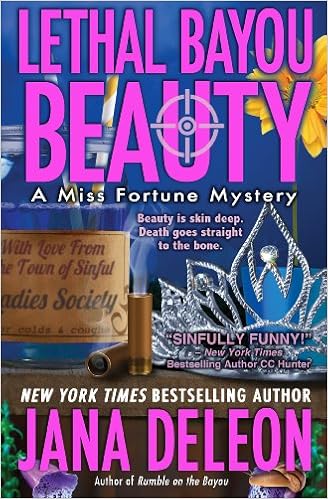
Bonus:Lethal Bayou Beauty

Jana DeLeon
Lethal Bayou Beauty
Jana DeLeon
2013

The Summary
"No one in Sinful liked Pansy Arceneaux, but who hated her enough to kill her?

"When aspiring actress Pansy Arceneax returns to Sinful, Louisiana to head up the beauty pageant portion of the Summer Festival, CIA assassin Fortune Redding knows she's in for trouble.  Her undercover identity as a former beauty queen makes Fortune the perfect choice to chair the event with Pansy, but Pansy's abrasive personality makes it impossible to get through a single rehearsal without a fight.

"When Pansy turns up dead, Fortune is the prime suspect.

"Armed with only her wits and two conniving seniors referred to locally as The Geritol Mafia, Fortune launches an investigation to find the real killer before her cover is blown."

The Good
Lethal Bayou Beauty has many of the same qualities I found endearing in it's predecessor:  a strong, sarcastic narrator; wonderful characters instigating a variety of mishaps; hilarious character interactions; lots of action and adventure and butt-kicking females.  It's fun, it's easy-to-read in an afternoon or two, and, personally, I think it's definitely worth picking up for free on my library website.

Besides, I was intrigued to see how Fortune--who is a self-professed tomboy with zero experience with pageants or, you know, anything remotely feminine--would handle herself in the middle of the strange and exotic world of pageant shows.  It's hilarious to see one mishap after another; it's a rollicking good time.

And, honestly, I found it worth it just to see her deal with Pansy Arceneax.  It's easy to dislike (if not outright hate) Pansy.  She's horribly snobbish and vindictive, she's outright cruel, and she's not above blackmailing and/or threatening people to get her way.  She's a terrible person, so I thought it was nice to see Fortune knock her down a few pegs.

Even if there was some confusion about Lady Gaga that proved embarrassing.  (It's hard to explain.  Better to read the book to understand.)

The Bad
I still liked this book, but I couldn't help thinking that Fortune, Gertie, and Ida Belle endure way too many mishaps.  In the first book, Louisiana Longshot, I could understand why so many plans kept going awry.  Fortune is just getting her feet back on the ground and she's learning new names, meeting new people, and exploring a new terrain.

But Lethal Bayou Beauty is the second in the series, so I feel like it should settle down a little.  Yes, all these crazy adventures helps to propel the story forward, but too many run-ins with Deputy Carter LeBlanc and too many close calls at the wrong end of a rifle causes it to lose it's appeal.

I mean, there really is such a thing as too much adventure.

The Ugly
Murder.  Assault.  Attempted murder.  Poisoning.  Prostitution.  Blackmail.  Tax fraud.

I think the only thing missing is drug dealing.

(But, fear not, that comes later.)