"All good books are alike in that they are truer than if they had really happened
and after you are finished reading one you will feel that all that happened to you
and afterwards it all belongs to you; the good and the bad, the ecstasy, the remorse,
and sorrow, the people and the places and how the weather was."
Ernest Hemingway
Showing posts with label Flowers. Show all posts

Friday, October 23, 2015

Bonus: Garden Spells

Bantam Discovery
Garden Spells
Sarah Addison Allen
2008

The Summary
"In a garden surrounded by a tall fence, tucked away behind a small, quiet house in an even smaller town, is an apple tree that is rumored to bear a very special sort of fruit.  In this luminous debut novel, Sarah Addison Allen tells the story of that enchanted tree, and the extraordinary people who tend it...

"The Waverlys have always been a curious family, endowed with peculiar gifts that make them outsiders even in their hometown of Bascom, North Carolina.  Even their garden has a reputation, famous for its feisty apple tree that bears prophetic fruit, and its edible flowers, imbued with special powers.  Generations of Waverlys have tended this garden.  Their history was in the soil.  But so were their futures.

"A successful caterer, Claire Waverly prepares dishes made with her mystical plants - from the nasturtiums that aid in keeping secrets and the pansies that make children thoughtful, to the snapdragons intended to discourage the attentions of her amorous neighbor.  Meanwhile, her elderly cousin, Evanelle, is known for distributing unexpected gifts whose uses become uncannily clear.  They are the last of the Waverlys - except for Claire's rebellious sister, Sydney, who fled Bascom the moment she could, abandoning Claire, as their own mother had years before.

"When Sydney suddenly returns home with a young daughter of her own, Claire's quiet life is turned upside down - along with the protective boundary she has so carefully constructed around her heart.  Together again in the house they grew up in, Sydney takes stock of all she left behind, as Claire struggles to heal the wounds of the past.  And soon the sisters realize they must deal with their common legacy if they are ever to feel at home in Bascom - or with each other."

The Good
I loved Garden Spells:  I loved the subtle magic of the Waverly family, the apple tree, the small town of Bascom, the edible flowers with their mystical properties - and, simply put, I loved every part of it.  Garden Spells was a perfect blend of magic and family history and love, creating a novel that delves into the past of one tiny Southern town and remarks upon the every day magic of the Waverly family.

Allen does a superb job of creating unique and endearing characters.  I was immediately smitten with all the citizens of Bascomb, and I absolutely loved Claire and Sydney as they reconnected with one another and their Waverly roots.  And Evanelle, their cousin who always seems to supply the right gift at the right time, now holds a place near and dear to my heart for her kindness and her eccentricity.

Furthermore, while Allen has a different tone and style to her writing than the usual novels I read, Garden Spells had a way of enchanting me.  It made me slow down and savor each chapter; it made me take things slowly, read carefully to fully appreciate all the details that Allen had to offer in her novel.  It was like the southern drawls that populate Allen's novels:  sweet, cadenced, slow, but warm and familiar, like hearing an old friend.

I had the opportunity to fall in love with the Waverlys and the town of Bascomb, and I wouldn't mind making a return visit.

The Bad
I don't think I really have any complaints about Garden Spells.  I mean, I will admit that it took me quite a while to sink into the story - it had a different tone, a different style to the novels I'm used to reading - but, once I finally entered Claire and Sydney and Bay's world, I didn't want to put the book down.

My only regret is that I don't own this book for myself.

The Ugly
Domestic abuse.
Wednesday, August 26, 2015

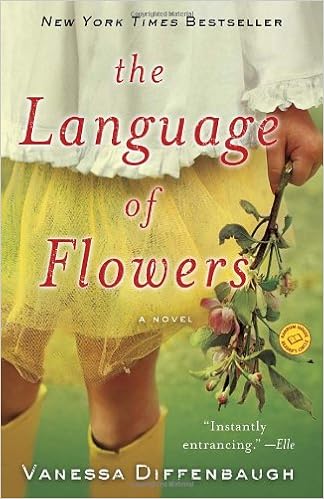
The Language of Flowers

Ballantine Books
The Language of Flowers
Vanessa Diffenbaugh
2011

The Summary
"The Victorian language of flowers was used to convey romantic expressions:  honeysuckle for devotion, asters for patience, and red roses for love.  But for Victoria Jones, it's been more useful in communicating mistrust and solitude.  After a childhood spent in the foster-care system, she is unable to get close to anybody, and her only connection to the world is through flowers and their meanings.  Now eighteen and emancipated from the system with nowhere to go, Victoria realizes she has a gift for helping others through the flowers she chooses for them.  But an unexpected encounter with a mysterious stranger has her questioning what's been missing in her life.  And when she's forced to confront a painful secret from her past, she must decide whether it's worth risking everything for a second chance at happiness."

The Good
I liked that Vanessa Diffenbaugh combined esoteric knowledge of flowers, the literal language of flowers, with the modern plight of a young girl trapped in the foster-care system.  I found it intriguing to see the world from Victoria's perspective, her struggle to find normalcy and stability in a system that's anything but.

I loved learning the meanings of flowers and plants:  moss for motherhood, ferns for secrecy, daisies for innocence, honeysuckle for devotion, turnips for charity, sage for good health.  I was surprised to learn that sunflowers mean "false riches," and yellow roses represent "infidelity."  It was interesting to see the combinations of flowers which Victoria used to communicate.

Likewise, I was intrigued by the glimpses Diffenbaugh gave into Victoria's life - into the life of a foster child, into the life of a young homeless woman struggling to make her own way in the world - and I was sometimes shocked by what I found.  As the parent of a foster child, Diffenbaugh has had an inside view on the types of struggles that foster and adoptive children endure as they transition to a new home - or fall back into the system.

She knows and understands the difficulties these children face; moreover, I think she does fairly well at illuminating these issues in Victoria's character.

The Bad
I didn't feel like I could relate to Victoria.  Something about the way she's characterized, or the way she tells her story, makes it difficult for me to really become attached to her as a narrator, to really sink into her story.  I was eager for her to reach some kind of happy ending, but I wasn't nearly as invested as I could have been.

However, I think I would have better understood Victoria if I had read this passage from the reader's guide:
"The hardest part of writing [The Language of Flowers] was finding the right balance in Victoria's character.  I wanted her to be tough, distrustful, and full of anger:  all characteristics that would be true to her history of being abandoned at birth and never knowing love.  But I also wanted the reader to root for her - to understand her capacity to be gentle and loving, even before Victoria understands it herself.  So in the first fifty pages of the novel she spends much of her time nurturing plants:  smoothing petals,  checking moisture, and cradling shocked roots.  This felt like the perfect way to show both sides of her character, long before it would have been possible for me to describe her displaying affection or kindness toward another human being."
I think I would have better understood the emotional spirals - doubt, fear, distrust, anger and hatred - better had I read the author's interpretation of Victoria.  (For that reason, The Language of Flowers may be worth a second attempt.)

The Ugly
Orphaned from an early age, Victoria bounced between foster homes and half-way houses for her entire life.  She chronicles abuse and emotional distress, which is truly heartbreaking to envision.  Her inability to accept love, to offer it in return is heart-wrenching - and it's even harder to watch her spiral into a familiar passage of doubt, self-recrimination, anger, resentment, depression, and neglect.

Honestly, it will break your heart.