"All good books are alike in that they are truer than if they had really happened
and after you are finished reading one you will feel that all that happened to you
and afterwards it all belongs to you; the good and the bad, the ecstasy, the remorse,
and sorrow, the people and the places and how the weather was."
Ernest Hemingway
Showing posts with label Steampunk. Show all posts

Friday, April 7, 2017

Kiss of Steel

Title details for Kiss of Steel by Bec McMaster - Available
Sourcebooks Casablanca
Kiss of Steel
Bec McMaster
2012

The Summary
"When nowhere is safe….

"Most people avoid the dreaded Whitechapel district.  For Honoria Todd, it’s the last safe haven.  But at what price?

"Blade is known as the master of the rookeries--no one dares cross him.  It’s been said he faced down the Echelon’s army single-handedly, that ever since being infected by the blood-craving he’s been quicker, stronger, almost immortal.

"When Honoria shows up at his door, his tenuous control comes close to snapping.  She’s so…innocent.  He doesn’t see her backbone of steel--or that she could be the very salvation he’s been seeking."

The Good
I was intrigued by this novel and, starting out, I fell in love with the unusual, complex world of verwulfen, blue bloods, vampires, and mechanical creatures.  There’s an unexpected depth to this story.  You have the blue bloods--not quite vampires, not quite human--who basically run society from their Ivory Tower, trailed by human consorts and blood thralls; and then you have verwulfen (werewolves), humans, and others who live outside the blue blood’s pristine city, living on the very fringes of "respectable" society.

Except it's not that clear cut.

Blade rules the rookeries of Whitechapel, and even the Dukes of the Ivory Tower are hesitant to cross him.  Honoria is one of the many humans caught in between, but she's also the daughter of an Institute scientist and a chemist in her own right.  Humans, blue bloods, verwulfen, and more living together in one city, but it’s a tenuous relationship at best.  A variety of variables come into play:  blood taxes, drainers, humanity first insurgents, house rivalries, Slasher gangs and turf wars, and Queen Alexandra, thrall of the Prince Consort.  It all hinges on how far one wants to push the boundaries, because anything could tip the balance and bring London--and Britain--crashing to its knees.

I found all the detail fascinating and, honestly, I wish I could have had more.  Like I was curious to hear about France, which endured a different Reign of Terror in which the blue blood aristocracy was put the guillotine; Spain suffered another Inquisition, in which blue bloods were hunted rather than witches or religious dissidents; Germany didn’t have so much a blue blood ruling class as a massive verwulfen population; China saw the initial outbreak of the craving disease, the first symptoms of vampirism; and America is still a colony to the British Empire.

It's a curious reworking of historical events that I found fascinating.  And that's not even including a close look at the precarious situation of the Fade and the course of the craving disease.  Blue bloods are vampires, as we traditionally view them; however, it's different in Kiss of Steel.  Blue bloods are in control of their hunger (for the most part), but as they age they come closer and closer to the Fade, in which they slowly lose all human aspects and slip closer to an unstoppable, insatiable hunger for blood.  They essentially begin to rot, losing all traces of the person they were previously and they become monsters--they become vampires.

I found it a fascinating concept.

Overall, I enjoyed reading Kiss of Steel.  It's a blending of science fiction, paranormal, steampunk, horror, and fantasy, and it develops an intriguing story--an intriguing world--that kept me captivated.  Once I was hooked, I found there was no going back.  I had to find out what happened with Honoria and Blade--would she be captured by Vickers, Duke of Lannister, and killed?  Would she find a cure that her father had so desperately sought?  Would Blade, who lurked on the fringes of the Fade, finally succumb?

I had to have an answer and, more or less, I was satisfied with the conclusion.  Granted, it's only the first of a series--book one of five (Heart of Iron, follows next, and then My Lady Quicksilver, Forged by Desire, and Of Silk and Steam)--so I have quite a bit more to read if I want to shore up the story and delve a little deeper into this steam-powered world of dangerous creatures.

The Bad
Okay, let me start off by saying, I really enjoyed this book.  The world building was absolutely fantastic, and I loved the political and social complexity that quivered just beneath the immediate surface--beneath Blade and Honoria’s story.

However--and saying this pains me a little--it could have been better.  Like so much better.

I love a little romance mixed in with my adventure stories, but I like to have more of a balance.  That is, I don't like romantic entanglements to overshadow the rest of the novel.  I've slowly become a romance novel fiend over the last year (if that's not already apparent), but I do like my stories to have a little more to them than sultry, steamy moments and gratuitous amounts of sex.

Like with Blade and Honoria.

Sure, yeah, I understand that it's bound to happen considering how desperately they crave each other.  Their relationship is practically incendiary.  However--you're probably going to get tired of me saying this--I would have liked to learn a little more about Honoria's father, her time among the blue bloods, and their shared experiments.  Honoria is a smart girl; in fact, she's frighteningly smart in some respects--and I would have loved seeing her flaunt that intelligence a little more.  I would have enjoyed seeing her continue her father's research, seeing her find, if not a cure, a way to stop the progression of the craving disease.

Don't get me wrong, she's a pretty great character.  She's smart, she's determined, she's handy with a pistol, plus--and this is a big one--she's not some shrinking violet, damsel-in-distress type when faced with danger.  I mean, before the end of the story, she'll face down a vampire not once, not twice, not even three--but four times.  She may not be as swift and skilled as Blade, and she may not be as strong as his verwulfen companion, Will, but that's not to say she’s not powerful in her own right.

I just had this little, lingering wish that she could have done more.  I know that sounds funny, considering she does quite a lot in regards to protecting her brother and sister, and she even saves Blade’s life on a couple of occasions.  I just wish she could have been featured more prominently in the search for a cure or, at least, a treatment; I wish I could have learned more about it and a little more about her.

Maybe, just maybe, the next book will expound upon her discoveries--or potential discoveries.

The Ugly
People get torn apart.

Literally.

Saturday, February 4, 2017

Read Harder Challenge 2017: Part 1

So first up on my Read Harder Challenge, I tackled:
  • Read a debut novel.
  • Read an all-ages comic.
  • Read a superhero comic with a female lead.
Kiss of Steel (London Steampunk, #1)
Sourcebooks
Casablanca
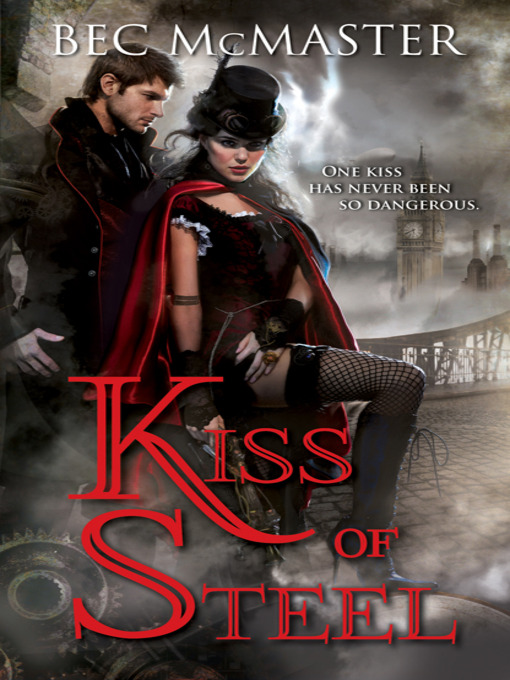
I started with a debut novel, Kiss of Steel by Bec McMaster.  Although I originally intended to read A Man Called Ove, a debut novel by Fredrik Backman, I stumbled across Kiss of Steel purely by accident and discovered it was just what I needed to complete this challenge.  The first book in the London Steampunk series, Kiss of Steel tells the story of an alternative Victorian age in which verwulfen (werewolves), vampires, automatons, humans, and more live side-by-side in a steam-fueled world.

Honoria Todd fled to the rookeries in a desperate attempt to escape the Echelon, the blue-blood (i.e. vampire) aristocracy of London who rule over the city with an iron fist.  But when Blade, de facto master of the rookeries, discovers her living at the fringes of his little kingdom, he becomes embroiled in a series of unexpected mysteries involving Honoria.  Soon, a vampire--a blue-blood who has crossed the Fade, who has completely succumbed to blood lust--is terrorizing the rookeries and it's up to Honoria and Blade to stop it--and the Echelon--before it's too late.

I actually enjoyed reading Kiss of Steel.  It wasn't quite what I expected, but I wouldn't say that's a bad thing.  Granted, it was a bit explicit, hyper-violent, and incredibly grisly; however, McMaster's debut novel was a mixture of action, romance, science-fiction and paranormal fantasy that I found thrilling.  Overall, I enjoyed Kiss of Steel, but I do think it could have been better.  I would have loved to have delved deeper into the alternative history and discovered more about the people--and creatures--that inhabited this world.

Marvel
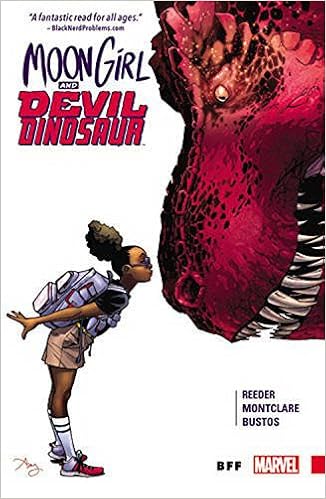
Next, I read Moon Girl and Devil Dinosaur:  BFF (Volume 1) by Brandon Montclare and Amy Reeder, which was a fun and amusing comic featuring Lunella and, of course, the indomitable Devil Dinosaur.  First in the series, Moon Girl and Devil Dinosaur:  BFF is a great comic for kids of all ages--and it's simultaneously amusing for adults.

It starts out with Lunella, who is 9-years-old and quite unlike other girls her age.  She's an unexpectedly talented inventor and she's also an Inhuman--and the Terrigen Mist that's creeping through the city, the amorphous haze that will activate her Inhuman DNA, terrifies her.  Desperate to keep her Inhuman DNA dormant, Lunella sets out to discover alien technology that will help her stop the Terrigen Mist and keep herself human.  That is, if Devil Dinosaur, who was transported to the future with the same alien technology, doesn't destroy everything first.

Overall, I loved reading Moon Girl and Devil Dinosaur.  I admit, I was a little hesitant to read it at first.  I'd seen single issues in the local comic book store and, for some reason, I couldn't imagine myself reading them--and then I discovered the collected volume at the library.  I immediately fell in love.  Moon Girl and Devil Dinosaur is a lot of fun to read.  Although it takes place in the Marvel Universe, readers don't really need a who lot of background about the Kree and the Inhumans and the Terrigen Mist to enjoy the story.  It has a dynamic, intelligent character, and it's a crazy, fun adventure that will lead you across time and the city of New York.

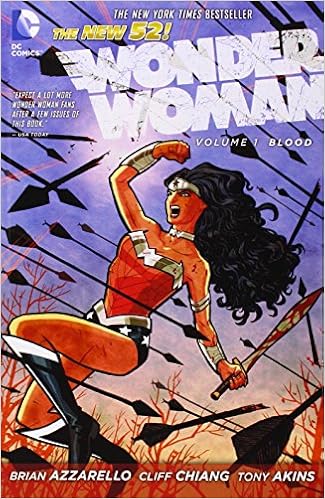
Last, I checked out Wonder Woman:  Blood (Volume 1) by Brian Azzarello, Cliff Chiang, and Tony Akins.  I have long been a fan of comic books.  I love Batman and Superman and even Aquaman, and I've found a recent favorite in Squirrel Girl, Daredevil, and Hawkeye; however, I've not read much of Wonder Woman.  She's an interesting character to be sure, but I've just never found myself compelled to read about her until now.

DC Comics
In Wonder Woman: Blood, first in the New 52 series, Wonder Woman finds herself caught in the middle of a battle for supremacy between the Greek gods of myth.  Diana has long abstained from the more complicated dealings between these capricious gods, but Zeus has gone missing--and Hera is on the war path to destroy the child he left behind.  Now, the remaining gods, including Apollo, Hades, and Poseidon, are in a war for the king of gods' throne, while Hera cuts a bloody swath across Paradise Island to rectify the injustices done to her.

Let me say, I like Greek mythology.  I've always been intrigued by it and I've gone out of my way to discover more about it than what I learned in school, but I wasn't really impressed with their appearance in Wonder Woman.  Honestly, I wasn't really all that impressed with the story in general.  I was a little disappointed, especially since I went into this comic with such high expectations.  I'm a fan of powerful, self-sufficient women, and I love the idea of Wonder Woman, who is a warrior first and foremost; however, I'm not so sure I like her in practice.

It's difficult to describe, but let me put it this way:  I like Batman, because he is human and he is deeply flawed.  I like Superman, because he is an alien who grew up in Kansas and he is good to the best of his ability.  Likewise, I like Aquaman, because he is half-human/half-Atlantean and he struggles daily with his dueling identities.  And all these characters have one thing in common:  they were raised, in my opinion, in a recognizable place and way.  Diana, on the other hand, was raised on Paradise Island with a different set of beliefs and a completely different set of rules, which makes it difficult to relate to her on a personal level.  More to the point, it made Wonder Woman:  Blood (Volume 1) less than enjoyable to read.

Thursday, January 19, 2017

Mechanica

13455099
Clarion Books
Mechanica
Betsy Cornwell
2015

The Summary
"Nicolette's awful stepsisters call her 'Mechanica' to demean her, but the nickname fits:  she learned to be an inventor at her mother's knee.  Her mom is gone now, though, and the Steps have turned her into a servant in their own home.

"Then, on her sixteenth birthday, Nicolette discovers a secret workshop in the cellar and begins to dare to imagine a new life for herself.  Could the mysterious books and tools hidden there--and the mechanical menagerie, led by a tiny metal horse named Jules--be the key to escaping her dreary existence?  With a technological exposition and royal ball on the horizon, the timing might just be perfect for Nicolette to earn her freedom at last.

"Gorgeous prose and themes of social justice and family shine in this richly imagined 'Cinderella' retelling about an indomitable inventor who finds her prince...but realizes she doesn't want a fairy-tale happy ending after all."

The Good
I ended up reading Mechanica in one sitting.  For some reason, I just couldn't seem to put it down.  It was a novel story that managed to combine magic and Faerie kingdoms with science-fiction and steampunk fantasty, while tying in threads of fairy tales--namely, Cinderella--and complex political and/or social conditions.

It reminded me in many ways of Cinder by Marissa Meyer.  Mechanica has many of the same elements:  a downtrodden heroine, a mechanical best friend, a delicate political and social balance between disparate groups (between the human race and the Lunars in Cinder; between humankind of Esting and the magical citizens of Faerie in Mechanica), an endearing human friend, a handsome prince who conceals his identity to mingle with the rest of the population, a mysterious disease.

It's actually quite startling the similarities.  I can see why other readers can draw such parallels--and why more than a few have managed to toss it aside.

However, like Cinder, Mechanica has its own unique Cinderella-esque story.  Like Cinder, Nicolette is a strong and intelligent heroine.  She's a builder, an inventor.  She repairs automatons and maintains her mother's inventions, and she makes them using her own ingenuity...and a little magic.  At its core, Cinder is a science-fiction novel; Mechanica rings of fantasy and fairy tales.

Now that I've gotten those comparisons out of the way, I'd like to talk about just Mechanica.  As the book jacket promises, it's a "richly imagined...retelling" of Cinderella.  I found I liked reading Nicolette's narrative, not only for the inventiveness of her elaborate, steam-fueled world of cogs and glass and metal, but for the depth of her personality.

Nicolette is incredibly introspective and thoughtful.  She's a dreamer, an inventor, and she seems to have this elaborate world stretching out in her head as she imagines new things, creates new inventions, frets over her plans--for she does eventually have plans when she finds her mother's workshop--and wonders at her new friends.  At the same time, she recognizes her faults and her mistakes.

And yet she knows she will make them, regardless, because no one is perfect.

For instance, after Nicolette meets Fin and Caro (you'll hear much more about them, I'm sure), she finds herself slowly falling for Fin, the first boy who has shown an interest in her work and, more to the point, has shown her even the smallest bit of courtesy.  She realizes it's silly to daydream about a boy she barely knows, but she does, because she likes to believe in fairy tales and romance, like, let's face it, we all do:
"I held whole conversations with him in my mind, telling him about the Steps' inanity, or their coldness, or the transparent fawning of whatever beaux they had entertained that day.  I told him about my work as I made it, explaining the movements and turnings...the delicate clockwork that went into replicating Mother's mechanical insects.  I spoke more with my imagined Fin than I did with the real Caro in our letters.  [...]  Every once in a while, I would remember that I could count my actual interactions with him on one of my hands..."
Besides which, I absolutely loved that Nicolette was so self-sufficient.  Not only does she find a way to sell her beautiful baubles and some of her inventions, she uses her money to go the grand "Royal Exposition of Art and Science."  The ball at the beginning of the event is not her goal; no, her true goal is the Expo to show off her inventions, to gain a patron, to open a shop of her own and leave the horrible "Steps" behind.

She doesn't have designs on the prince; in fact, she doesn't want the prince.  She wants to create a life for herself, out of the shadow of her so-called family.  Her happily-ever-after doesn't involve a crown; it involves a socket wrench and a mechanical horse named Jules.  Who needs the heir apparent when you have a strong pair of hands and a noble steed to take you places?

Altogether, I enjoyed Mechanica and, just because it does resemble Cinder in many respects, I don't think it's a novel to easily dismiss.  It has a strong heroine and, I think, it has an interesting story that is rich with detail and magic.  It's a good start to a new series, and I'll be looking for more from Betsy Cornwell.

The Bad
I am a bit ambivalent toward the conclusion of Mechanica.  Don't get me wrong, I love that you get to see Nicolette standing up for herself, fulfilling her wishes and dreams.  It's strangely inspiring; however, it left me with a lot of questions about Faerie, about Esting and its rocky relationship with the Fay, and about Jules--and the Ashes that gave him life.

Granted, Mechanica is only the first in the series, but I would have liked a little more closure.

The Ugly
The stepsisters and their cruel, frigid mother.

Thursday, November 17, 2016

The Girl in the Steel Corset

9166877
Harlequin Teen
The Girl in the Steel Corset
Kady Cross
2011

The Summary
"In 1897 England, sixteen-year-old Finley Jayne has no one...except the 'thing' inside her.

"When a young lord tries to take advantage of Finley, she fights back.  And wins.  But no normal Victorian girl has a darker side that makes her capable of knocking out a full grown man with one punch.

"Only Griffin King sees the magical darkness inside her that says she's special, says she's one of them.  The orphaned duke takes her in from the gaslit streets, against the wishes of his band of misfits.  And Finley thinks she might finally be a part of something, finally fit in--until a criminal mastermind known as the Machinist threatens to tear the group apart..."

The Good
I enjoyed The Girl in the Steel Corset.  It's not quite fully formed, like I could have wished for a little more depth, a little more detail in some of the descriptions and a little more of...something; however, it's a decent teen novel.  I liked it and, truthfully, I found it to be a fascinating little YA book, but I probably won't pursue any more of the series.

I will point out that I did like the concept of the Aether.  It adds a complex, supernatural undercurrent to the story, besides, of course, the obvious (i.e. Finley Jayne and her supernatural strength, reflexes, and speed; Griffin with his unnatural psychic abilities; Sam with his inhuman strength; Emily and her incredible intelligence; or Jasper, using an unrivaled speed and dexterity with a gun.  Take your pick.).

I also liked the unexpected science behind the era, the experiments and technology that seem to run wild with newer, more interesting inventions appearing each chapter--courtesy of the ingenious Emily, of course.  It's a fun series, but it just wasn't my cup of tea.

The Bad
I found The Girl in the Steel Corset to be a little lacking.  I can't quite put my finger on it, but it was missing something that could have made it great.  It had an intriguing plot, especially with its references to The Strange Case of Dr. Jekyll and Mr. Hyde and other classic literature, and it created a fascinating world of Victorian culture and futuristic technology.

However, I didn't sink into the story as I would have liked and I wasn't enamored of the characters as I hoped.  I did like Emily and Jack Dandy managed to make me grin, and I thought the Machinist made a fascinating villain, but, overall, I wasn't enchanted with The Girl in the Steel Corset.

The Ugly
Ugh.  Love triangles.

Have I mentioned that I hate love triangles?  Apparently, any YA novel worth its salt will fabricate a complex (and entirely unnecessary) network of romantic relationships.  For Twilight, it was Edward and Jacob; for The Girl in the Steel Corset, it's Jack Dandy or Griffin King.

Seriously.  Just pick one already.

Monday, November 5, 2012

The Ministry of Peculiar Occurrences: Phoenix Rising

Image courtesy of
www.ministryofpeculiaroccurrences.com
The Ministry of Peculiar Occurrences:  Phoenix Rising
Pip Ballantine
Tee Morris
2011

The Summary
As members of the Ministry of Peculiar Occurrences, Wellington Books and Eliza Braun have become accustomed to the odd, the unusual, and the downright absurd.

But their latest case - an unsanctioned investigation into the murders of more than a dozen factory workers - is the strangest and most deadly they have ever faced.

The Good
Books and Braun are a thoroughly entertaining duo, because they couldn't be more different.  As an archivist for the Ministry, Books is pedantic and modest to the point of being prudish; Braun, on the other hand, is loud and adventurous.  Yet they somehow manage to make phenomenal strides in their investigation.

Between Books's incredible analytical skills and Braun's talent with guns - and dynamite - they make an effective team.  Granted, they never escape without destroying private property or flagrantly disregarding Her Majesty's laws, but they know how to get the job done.

Most notably about this novel, Pip Ballantine and Tee Morris have created a sort of "steampunk" genre for their work.  They've crossed Victorian era concepts with science fiction and modernized technology - and created a steampunk novel.  It's an intriguing blend, to say the least, but I think the authors pull it off quite well.

It's fun, it's absorbing, and it's amusing to the point of being hysterical.  Ballantine and Morris's novel is certainly worth a read.

The Bad
Despite its intriguing qualities, Phoenix Rising can occasionally become confusing.  Given the action-packed nature of this novel, I can understand the technical difficulty involved; however, some sections appear to lack proper execution and explanation.

Moreover, some passages seem a little bipolar by switching between too many characters and leaving more questions than answers.  Books and Braun may solve one mystery, but they're left with about a dozen more.

But I suppose that's the prerogative of a book series:  more mysteries means more books.

The Ugly
Sex, violence, foul language, and so on - you know, all those elements that smack of the label "adult content."

I will admit, however, the orgy was unexpected.  I really did not see that one coming.