"All good books are alike in that they are truer than if they had really happened
and after you are finished reading one you will feel that all that happened to you
and afterwards it all belongs to you; the good and the bad, the ecstasy, the remorse,
and sorrow, the people and the places and how the weather was."
Ernest Hemingway
Showing posts with label Medical history. Show all posts

Sunday, January 1, 2017

Happy New Year: Read Harder Challenge 2016

Since I completed my Read Harder Challenge of 2016 and filled in all the categories recommended by BookRiot, I created some of my own unique categories.  As part of my continued challenge, I've decided to:
  1. Read a book by or about a librarian (or about a library)
  2. Read a medical book (fiction or nonfiction)
  3. Listen to an audiobook romance
  4. Read a brand new, recently published book (anything from 2016)
  5. Read a spin-off from a classic novel and/or fairy tale
  6. Read a book about cake (fiction or nonfiction)
  7. Read a fantasy book featuring dragons
16101121
Gotham Books
I thought it might prove fun to dive into some new books I might not otherwise find.  Some are based on recommendations from co-workers, while others are based on books from my TBR pile--and still others are just ideas that seemed like fun.  And with the countdown to the New Year on, I can't wait to tell you all about the books I've read, starting with a book by (and about) a librarian:  The World's Strongest Librarian by Josh Hanagarne.

If you've never read Josh Hanagarne I highly recommend his memoir.  It's funny, it's candid, it's insightful, and, ultimately, it's uplifting.  Although Hanagarne does discuss religion, his main focus is his family, his battle with Tourette's, his struggles with infertility, and his general love of the library and all things literary.  It's enjoyable to see his passion for his family, his books, and his weightlifting come to the forefront as he learns to balance all the different aspects of his life.  Overall, it's a pretty great read.

Next, I read (or, rather, listened to) a medical book--a historical medical drama, fyi--by Tessa Harris:  The Anatomist's Apprentice.  Narrated by  Simon Vance, The Anatomist's Apprentice was an interesting deviation from my usual reading material.  Thomas Silkstone is a young anatomist from Philadelphia who finds himself in England about the time of the Revolutionary War, caught in the midst of a medical mystery...and a murder  It's dark, rather macabre, but it's ultimately fascinating with the sheer depth of detail and history included.  I enjoyed my time in Silkstone's world, and I found myself quickly gravitating to book number two, The Dead Shall Not Rest.

8546358
Bantam
As for listening to an audiobook romance, I decided to check out more by Sarah Addison Allen and picked up The Peach Keeper.  Now, let me give you a warning, I have read almost everything by Allen, except Lost Lake (that one is currently in my TBR), and I have loved almost everything she's written.  The Peach Keeper was no different.  I loved the characters and the complexity of their histories; I loved the little hints of every day magic she weaves into her novels; I even loved the ghost story, which is saying something, as I am not a fan of ghosts.  It was a wonderful visit back to her world, and it was so much fun recognizing an old friend.

I also picked up a brand new book just published this year, a little novel by J. Ryan Stradal called Kitchens of the Great Midwest.  Another audiobook, I know, but it was just as rewarding as any other.  Although it follows a myriad of characters, it focuses on Eva Thorvald and her life as she grows into her own--and all the foods that influenced her in the process.  That's really the simplified version; Kitchens of the Great Midwest is much more complex, much more nuanced than I make it out to be.  It's a recurring cast of characters centered around Eva, but it's quite unlike anything I've ever read.  It's wonderful, and I absolutely adored the narrators, Amy Ryan and Michael Stuhlbarg.
25938397
G.P. Putnam & Sons

Speaking of new books, I also discovered Jane Steele by Lyndsay Faye, which fit nicely into my category for a spin-off novel based on a classic work or a fairy tale.  There were several options for this particular category, but I decided on Jane Steele because Jane Eyre.  I love Jane Eyre (as is probably apparent here), and I loved having the opportunity to reimagine her story not as the quiet, resolute girl who refused to give ground to anyone or relinquish her personal beliefs, but as the sharp, deadly woman with no qualms whatsoever of killing if it means protecting herself and her own.  It's fascinating the contrasts, and I came to love Jane Steele equally for her unwavering commitment to being bad.  It's a rousing good time.

Next, I decided to keep my love of food alive with a book about cake and sisterhood:  The Secret to Hummingbird Cake by Celeste Fletcher McHale.  While I will admit that I liked Garden Spells and The Glass Kitchen better, I enjoyed reading McHale's debut novel--and I absolutely loved getting to know her characters.  I liked Carrigan and I liked Ella Rae for their bravery, sass, and sheer stubborness, but I adored Laine.  She's the impetus of the story, the reason for it all, and, like Carrigan and Ella Rae, I felt an unexpected affection and wonderful kinship with her.  I enjoyed reading their story more than I thought I would.  For a debut novel, The Secret to Hummingbird Cake was pretty great.

352262
Little, Brown Books for
Young Readers
Last but not least, I read a fantasy book featuring dragons with How to Train Your Dragon by Cressida Cowell.  I picked Cowell's novel up because I fell in love with the movie of the same name; however, I was a little disappointed.  Don't get me wrong, I enjoyed reading How to Train Your Dragon.  It's fun, it's inventive, and it's a great series for young readers (I especially liked the Hairy Scary Librarian), but, unfortunately, it's not what I expected.  I made the critical mistake of judging the book in comparison to the movie--and they're two very different creatures.  How to Train Your Dragon the book is very different from How to Train Your Dragon the movie, and it's best not to go into either one with the same expectations.

Thursday, December 29, 2016

Beloved Poison

28943757
Pegasus Books
Beloved Poison
E.S. Thomson
2016

The Summary
"Set in a crumbling 1850s London infirmary, a richly atmospheric Victorian crime novel where murder is the price to be paid for secrets kept.

"Ramshackle and crumbling, trapped in the past and resisting the future, St. Saviour's Infirmary awaits demolition.  Within its stinking wards and cramped corridors, the doctors bicker and backstab.  Ambition, jealousy, and loathing seethe beneath the veneer of professional courtesy.  Always an outsider, and with a secret of her own to hide, apothecary Jem Flockhart observes everything but says nothing.

"And then six tiny coffins are uncovered, inside each a handful of dried flowers and a bundle of mouldering rags.  When Jem comes across these strange relics hidden inside the infirmary's old chapel, her quest to understand their meaning prises open a long-forgotten past--with fatal consequences.

"In a trail that leads from the bloody world of the operating room and the dissecting table to the notorious squalor of Newgate Prison and the gallows, Jem's adversary proves to be both powerful and ruthless.  As St. Saviour's destruction draws near, the dead are unearthed from their graves while the living are forced to make impossible choices.  And murder is the price to be paid for secrets kept."

The Good
When I picked up Beloved Poison, I read the blurb on the back of the book written by Janet Ellis, author of The Butcher's Hook.  It said:
"Beloved Poison is a marvellous, vivid book with a thoughtful, engaging protagonist at its center--and a fascinating story to tell.  It's immaculately researched and breathtakingly dark.  Elain Thomson's descriptive powers are so great that I was surprised to see twenty-first century London rather than grimy, smelly St. Savior's around me when I--eventually--looked up from its pages."
I felt a familiar jolt of recognition that told me this would be a good book--nay, a great book.  And I was right.

Richly atmospheric, as the book jacket promises, Beloved Poison is a wonderfully descriptive novel that plumbs the depths of London's dark heart.  It sheds light on a horrifyingly brutal series of murders that will rock the denizens of St. Saviour's to their core, tearing back the veil on the social conditions of the poor and highlighting the grim realities of 19th century medical science.  Secrets, lies, and murder will abound.  It's all very horrible.

And yet I enjoyed it.  I enjoyed it very much.

Jem is one of the more intriguing characters I've read.  She's daughter to St. Saviour's apothecary, but she's been raised as his son--and no one, except a very few who may have their suspicions, knows of her identity.  She keeps her hair cut short, she walks and speaks as a man might, she wears clothes as a man would wear.  She's been given a startling taste of independence and, yet, she knows she would be condemned for her abnormal behavior.

Jem is a thoughtful, insightful narrator.  She's conflicted, she's intelligent, and she's unique for her ability to understand the minds of both women and men--as she has lived as both in her lifetime.  She's absolutely fascinating, and I was eager to learn more about her.  In my own way, I grew to love her and her story.  I couldn't wait to read more.

Although her investigation takes center stage, I found myself just as curious about her and her world as the identity of the killers.  Jem, like the coffins she discovers in the old chapel, is a puzzle.  She's complicated, yes, but I liked that Jem had so many layers to her character.  I liked that she was so continuously conflicted by her identity and her struggles as she straddled the world of both men and women.

As you read, you discover she must keep her gender a secret:  she hides behind her marvelously dark birthmark and a caustic wit, she masks any touch of femininity in her character, she learns to act as a man might and treat others as a man would.  She grapples daily with her own doubts and fears, facing the somber reality of Victorian social expectations and her unconventional upbringing.  She's often left wondering whether she's been ruined for her "unnatural" habits--or has she been given an unexpected taste of independence?

I loved it.  I loved the whole book.

The Bad
No complaints.

The Ugly
Although I loved this book, I did not love the violence or carnage or gore.  Or the sexual abuse and exploitation.  Or the callous disregard for human life.  Or, you know, the general uncleanliness practiced by medical professionals of the day.

Moreover, it's quite distressing to read about a man having his leg amputated without any anesthetic or hearing, in detail, about a necropsy. Or, and here's a familiar scene, watching a man inject himself with syphilis.  I remember witnessing something similar in The Anatomist's Apprentice by Tessa Harris and, you'd think, I'd be used to it by now.

But, no, it's no less jarring in Beloved Poison.

Tuesday, July 19, 2016

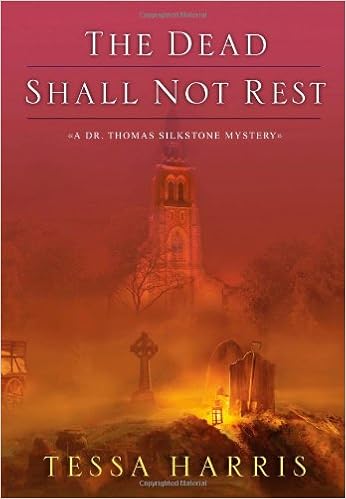
The Dead Shall Not Rest

Kensington
The Dead Shall Not Rest
Tessa Harris
2012

The Summary
"It is not just the living who are prey to London's criminals and cutpurses.  Corpses, too, are fair game--dug up from fresh graves and sold to unscrupulous men of science.  Dr. Thomas Silkstone abhors such methods, but his leading rival, Dr. John Hunter, has learned of the imminent death of eight-foot-tall Charles Byrne, known as the "Irish Giant," and will go to any lengths to obtain the body for his research.

"Thomas intends to see that Byrne is allowed to rest in peace.  Yet his efforts are complicated by concern for his betrothed, Lady Lydia Farrell, who breaks off their engagement without explanation.  When Dr. Hunter is implicated in the horrific murder of a young castrato, Thomas must determine how far the increasingly erratic surgeon will go in the name of knowledge.  For as Thomas knows too well, the blackest of hearts sometimes go undetected--and even an unblemished facade can hide terrifying secrets..."

The Good
Like The Anatomist's Apprentice, The Dead Shall Not Rest is a complex story that pulls upon a variety of narrative threads.  Sometimes, it sends you haring off in a different direction, leading you on a merry chase through a dark and terrible story, before leaving you utterly speechless as you return to the primary narrative.

But it's very, very good.

I was intrigued by the story from the very beginning, because it deals with Charles Byrne, a gigantic man who was known as the "Irish Giant."  His story is a sad, tragic tale of deception and greed--and medical misfortune.  I have to admit, I was very upset when I learned of his fate.  (Fair warning, fellow readers.)

However, it shouldn't deter you from reading (or, as I did, listening) to Tessa Harris' novel.  As the second in her Thomas Silkstone series, The Dead Shall Not Rest has all the things I loved about the first novel:  incredible characters, complex plots and narrative threads, intriguing interpersonal relationships and dynamic dialog, historical fact.

I loved how Harris continued to develop Thomas and Lydia's relationship, offering glimpses into their lives and their feelings toward one another, as well as developing them as individual characters.  Lydia is certainly more complex than I gave her credit in the first novel, but I can't say I like her more this time around.  She still seems to have all the qualities--vulnerabilities, weaknesses, insecurities--I disliked when I first met her; however, after catching a glimpse into her tumultuous past, I can more readily understand her.

I also loved the flavor of the story.  Like its predecessor, The Dead Shall Not Rest draws heavily from cultural and medical history.  Suspense is sprinkled liberally throughout the novel, but it often draws from historical fact, introducing readers to all the quirks and oddities of eighteenth century England.  It shows what life was like during such turbulent times; moreover, it offers a glimpse into the fledgling days of medicine when ignorance was rampant and superstition frequently ruled.

Simon Vance reprises his role as narrator, and I can't even explain how thrilled I was with his narration.  He manages to give a voice to Harris's characters, bringing them to life with his extraordinary range of vocal tones and accents.  He does excellent work, and he definitely doesn't disappoint.

The Bad
I hated the end of this book.  Hated.

Like The Anatomist's Apprentice, it has a bit of a twist ending.  It doesn't end like you expect or hope, and I was displeased by the fate of Charles Byrne--and I was doubly disheartened by the lingering feeling that something terrible was allowed to happen, that the villain (who I perceived as a villain) managed to get away without incurring any consequences for his barbaric actions.

It's truly horrifying.

The Ugly
Venereal disease.

The only reason I mention "venereal disease" is that there's a little episode in the book that describes a certain condition, in sickening detail, and examines its immediate effects on the human body.  I'm not ashamed to say that, afterward, I felt sick to my stomach.

Tuesday, July 5, 2016

The Anatomist's Apprentice

12218678
Kensington Books
The Anatomist's Apprentice
Tessa Harris
2011

The Summary
"In the first in a stunning new mystery series set in eighteenth-century England, Tessa Harris introduces Dr. Thomas Silkstone, anatomist and pioneering forensic detective...

"The death of Sir Edward Crick has unleashed a torrent of gossip through the seedy taverns and elegant ballrooms of Oxfordshire.  Few mourn the dissolute young man--except his sister, the beautiful Lady Lydia Farrell.  When her husband comes under suspicion for murder, she seeks expert help from Dr. Thomas Silkstone, a young anatomist from Philadelphia.

"Thomas arrived in England to study under its foremost surgeon, where his unconventional methods only add to his outsider status.  Against his better judgement he agrees to examine Sir Edward's corpse.  But it is not only the dead, but also the living, to whom he must apply the keen blade of his intellect.  And the deeper the doctor's investigations go, the greater the risk that he will be consigned to the ranks of the corpses he studies..."

The Good
I stumbled across The Anatomist's Apprentice purely by accident.  I was intrigued by the cover when I was skimming a list of audibooks and I clicked the thumbnail, which lead me, of course, to Tessa Harris's novel.  It's not usually the sort of book I would read:  a macabre medical thriller that's set at the tail end of the 18th century.  I mean, I like historical fiction, but medical dramas I'm a little less inclined to read.

However, I was pleasantly surprised by The Anatomist's Apprentice.  It has a good, solid story with an intricately crafted plot, complex characters, and wonderful historical detail.  I especially liked that the author put in the time and effort to describe her characters in such detail, giving them distinctive mannerisms and character quirks that made them instantly recognizable.

I mean, it's hard to forget the corpulent coroner who keeps meat pies hidden in his briefcase, or the egregious Matthew Farrell who flaunts his new wealth after the death of his brother, or the pale, timid creature known as Lady Lydia, who is a lady of perfect breeding (which, confidentially, made her rather boring).  And I certainly can't forget Thomas Silkstone and his mentor, Dr. William Carruthers.

Thomas Silkstone is a fascinating individual.  Although his skills border on the macabre (he is an anatomist, thus his greatest talents lie in the dissection of corpses and the identification of trauma to the human body), he's incredibly intelligent and, being an American caught in England during the American Revolution, he provides a different perspective on English culture and behavior.  More importantly, with his old mentor behind him, he has unique access to a wealth of knowledge--and someone to unceremoniously point out his follies.

Speaking of Thomas's mentor, I have to say I rather liked Dr. Carruthers.  He's practically ancient by normal health standards and he's blind, but he doesn't miss a thing.  He's quick as a whip, intellectually speaking, and he's an excellent sounding board for Thomas.  I loved Thomas' conversations with his old teacher, because they had such an easy rapport, a friendliness that created a unique and quiet lovely dynamic between them.  I grew to appreciate their relationship more than I realized.

One of the greatest things I appreciated about the audiobook, however, was the narrator:  Simon Vance.  Vance does an excellent job of bringing Harris' novel to life, giving a voice to all of the wonderful characters she fabricated.  He uses a variety of accents, playing upon the subtle differences in country and county to provide a broad range of voices that use both a soft, lilting cadence to a deep, rough timbre.  Truthfully, I found it fascinating to listen to him work and I enjoyed The Anatomist's Apprentice more for his narration.

The Bad
I supposed my greatest complaint was the pace.  Tessa Harris (and Simon Vance) do an excellent job of pacing the story, bringing each and every detail to light slowly; however, I found I was sometimes bored by how the story seemed to drag on forever.

Much like Agatha Christie's Murder on the Orient Express, The Anatomist's Apprentice takes multiple chapters to build and seems to unravel all within a few minutes.  While I enjoyed the story overall, I found I didn't like the sudden conclusion.  It had far too many twists at the end for my taste, and I found myself rather confused by the fact that the villain I thought had committed the crime wasn't actually the real mastermind.

It's a bit more convoluted than I would have liked.

As an aside, I do want to point out that I was rather annoyed by how often Lydia was considered to be "fragile," looking "more pale than he'd ever seen her."  Yes, I understand she's a fragile, delicate flower; however, I didn't like being reminded multiple times in the same novel.

The Ugly
Murder.

These people are incredibly inventive.  You think it's one thing, but it's actually quite another.  If it's not murder by bludgeoning, it's murder by drowning or poison or perceived suicide--or, in some cases, attempted murder by physical battery.  It's really very gruesome.

And, speaking of gruesome, I found the booming grave-digging trade to be sickeningly macabre.  Corpses are dug up from the graves and sold to nearby anatomists, who promptly dissect and dispose of the remains.  Even if Thomas does adhere to a set of ethics, which prevents him from taking advantage of the lucrative (if dubious) trade, he is still an anatomist and he still dissects human bodies.

I found myself feeling a bit squeamish from time to time as the narrator described autopsies in graphic detail.  It's more than a little disturbing.

Thursday, April 21, 2016

The Lives They Left Behind: Suitcases from a State Hospital Attic

18867086
Bellevue Literary Press
The Lives They Left Behind:  Suitcases from a State Hospital Attic
Darby Penney
Peter Stastny
2008

The Summary
Willard State Hospital operated for 125 years before it closed its doors in 1995, after which more than 400 suitcases were discovered in the attic--each holding the belongings of someone who disappeared inside Willard and never left its campus again.

The Good
The Lives They Left Behind offers incredible insight into psychiatric care throughout the 20th century, providing an in-depth look at how psychiatric disorders were perceived and treated.  It's both informative and engaging, which I found beneficial when reading.  It gave me statistics, but it also gave me a face to put to the numbers, a unique story behind the cold, hard facts.

I was fascinated to learn that Willard received a disproportionately large number of women as patients, especially at the very beginning when the hospital opened its doors.  Many of these women were often committed because they didn't conform to social standards, suffered from what was then classified as a sexual deviancy, or struggled with other disorders such a menopause, chronic pain, anxiety, PTSD, etc.  Although I found it difficult (and heartbreaking) to read their stories, I was fascinated to learn about what women experienced in society and what society expected of them.

I especially liked that the authors gave an overview of the institution, of general psychiatric care, and zeroed in on specific individuals.  The Lives They Left Behind offers a look at the "big picture" and individual care.  It doesn't just tell you about the things that patients, as a single population, experienced, it gives you the opportunity to witness what one patient versus another experienced.  All stories are different, all treatments were different, and Penney and Stastny reflect that.

The Bad
Although I can say I thought Stastny and Penney did a great job of connecting to readers, showing both the technical and emotional sides of psychiatric care, I thought some of it was a bit dry.  It's an examination of psychiatry and mental health treatment, riddled with statistics and numbers, which sometimes made it feel more like an academic study versus an ongoing narrative of Willard patients.

I'm not saying that makes it a bad book--far from it!--but it does make it a little challenging, a little dense and dull.

The Ugly
The treatments inflicted on mental patients, even at revolutionary compounds like Willard, is very hard to stomach.  Not counting shock therapy, many patients underwent unnecessary operations and received drug prescriptions that often did more harm than good.  Some individuals were even hospitalized necessarily, especially women.

Josephine Smith, for instance, was hospitalized (at a different institution) for 75 years because her family didn't want to deal with her erratic behavior.  Lawrence Marek, who was taken to Willard, likely suffered from some form of mental illness; however, much of his behavior could be attributed to personal tragedies and struggles.

After Ethel Smalls arrived at Willard, she spent the latter half of her life committed because she complained of chronic pains and, most likely, suffered from post-traumatic stress disorder (PTSD) after losing two of her children and enduring years of abuse from her husband.  However, she wasn't treated for PTSD for two reasons:  she wasn't considered to have endured any real trauma, and only soldiers were said to suffer from PTSD.

Margaret Dunleavy, likewise, suffered with chronic pain from tuberculosis and her treatments for tuberculosis.  She, most likely, didn't have any mental disorder at all; rather, she was hospitalized after an unexpected outburst that was caused by several stressors--her work conditions, her disease, her unconventional relationship with her lover, among others--and her employers essentially decided she wasn't worth the hassle, recommending she be committed.  She spent the rest of her days at Willard.

And this is just a small sample of patients who were ripped from their lives simply because they were too much trouble, too burdensome to family, friends, or coworkers.  While some needed institutionalization, because they obviously suffered from some psychological or behavioral disorder, several others didn't need lifelong commitment--they needed more understanding, more empathy, and less time behind bars.