"All good books are alike in that they are truer than if they had really happened
and after you are finished reading one you will feel that all that happened to you
and afterwards it all belongs to you; the good and the bad, the ecstasy, the remorse,
and sorrow, the people and the places and how the weather was."
Ernest Hemingway
Showing posts with label Vampires. Show all posts

Saturday, February 4, 2017

Read Harder Challenge 2017: Part 1

So first up on my Read Harder Challenge, I tackled:
  • Read a debut novel.
  • Read an all-ages comic.
  • Read a superhero comic with a female lead.
Kiss of Steel (London Steampunk, #1)
Sourcebooks
Casablanca
I started with a debut novel, Kiss of Steel by Bec McMaster.  Although I originally intended to read A Man Called Ove, a debut novel by Fredrik Backman, I stumbled across Kiss of Steel purely by accident and discovered it was just what I needed to complete this challenge.  The first book in the London Steampunk series, Kiss of Steel tells the story of an alternative Victorian age in which verwulfen (werewolves), vampires, automatons, humans, and more live side-by-side in a steam-fueled world.

Honoria Todd fled to the rookeries in a desperate attempt to escape the Echelon, the blue-blood (i.e. vampire) aristocracy of London who rule over the city with an iron fist.  But when Blade, de facto master of the rookeries, discovers her living at the fringes of his little kingdom, he becomes embroiled in a series of unexpected mysteries involving Honoria.  Soon, a vampire--a blue-blood who has crossed the Fade, who has completely succumbed to blood lust--is terrorizing the rookeries and it's up to Honoria and Blade to stop it--and the Echelon--before it's too late.

I actually enjoyed reading Kiss of Steel.  It wasn't quite what I expected, but I wouldn't say that's a bad thing.  Granted, it was a bit explicit, hyper-violent, and incredibly grisly; however, McMaster's debut novel was a mixture of action, romance, science-fiction and paranormal fantasy that I found thrilling.  Overall, I enjoyed Kiss of Steel, but I do think it could have been better.  I would have loved to have delved deeper into the alternative history and discovered more about the people--and creatures--that inhabited this world.
Marvel
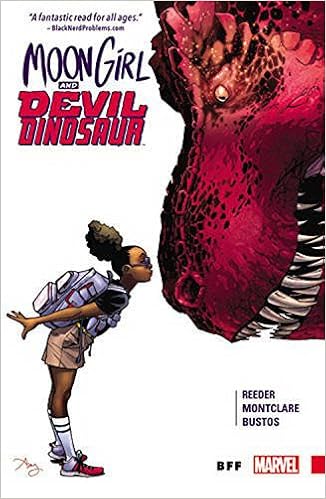
Next, I read Moon Girl and Devil Dinosaur:  BFF (Volume 1) by Brandon Montclare and Amy Reeder, which was a fun and amusing comic featuring Lunella and, of course, the indomitable Devil Dinosaur.  First in the series, Moon Girl and Devil Dinosaur:  BFF is a great comic for kids of all ages--and it's simultaneously amusing for adults.

It starts out with Lunella, who is 9-years-old and quite unlike other girls her age.  She's an unexpectedly talented inventor and she's also an Inhuman--and the Terrigen Mist that's creeping through the city, the amorphous haze that will activate her Inhuman DNA, terrifies her.  Desperate to keep her Inhuman DNA dormant, Lunella sets out to discover alien technology that will help her stop the Terrigen Mist and keep herself human.  That is, if Devil Dinosaur, who was transported to the future with the same alien technology, doesn't destroy everything first.

Overall, I loved reading Moon Girl and Devil Dinosaur.  I admit, I was a little hesitant to read it at first.  I'd seen single issues in the local comic book store and, for some reason, I couldn't imagine myself reading them--and then I discovered the collected volume at the library.  I immediately fell in love.  Moon Girl and Devil Dinosaur is a lot of fun to read.  Although it takes place in the Marvel Universe, readers don't really need a who lot of background about the Kree and the Inhumans and the Terrigen Mist to enjoy the story.  It has a dynamic, intelligent character, and it's a crazy, fun adventure that will lead you across time and the city of New York.

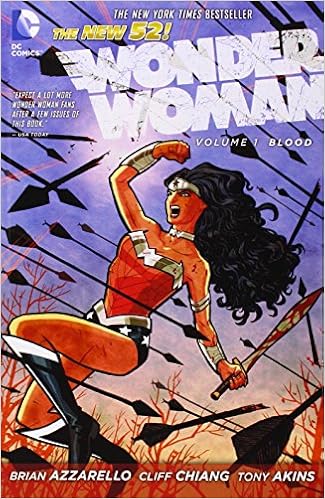
Last, I checked out Wonder Woman:  Blood (Volume 1) by Brian Azzarello, Cliff Chiang, and Tony Akins.  I have long been a fan of comic books.  I love Batman and Superman and even Aquaman, and I've found a recent favorite in Squirrel Girl, Daredevil, and Hawkeye; however, I've not read much of Wonder Woman.  She's an interesting character to be sure, but I've just never found myself compelled to read about her until now.
DC Comics
In Wonder Woman: Blood, first in the New 52 series, Wonder Woman finds herself caught in the middle of a battle for supremacy between the Greek gods of myth.  Diana has long abstained from the more complicated dealings between these capricious gods, but Zeus has gone missing--and Hera is on the war path to destroy the child he left behind.  Now, the remaining gods, including Apollo, Hades, and Poseidon, are in a war for the king of gods' throne, while Hera cuts a bloody swath across Paradise Island to rectify the injustices done to her.

Let me say, I like Greek mythology.  I've always been intrigued by it and I've gone out of my way to discover more about it than what I learned in school, but I wasn't really impressed with their appearance in Wonder Woman.  Honestly, I wasn't really all that impressed with the story in general.  I was a little disappointed, especially since I went into this comic with such high expectations.  I'm a fan of powerful, self-sufficient women, and I love the idea of Wonder Woman, who is a warrior first and foremost; however, I'm not so sure I like her in practice.

It's difficult to describe, but let me put it this way:  I like Batman, because he is human and he is deeply flawed.  I like Superman, because he is an alien who grew up in Kansas and he is good to the best of his ability.  Likewise, I like Aquaman, because he is half-human/half-Atlantean and he struggles daily with his dueling identities.  And all these characters have one thing in common:  they were raised, in my opinion, in a recognizable place and way.  Diana, on the other hand, was raised on Paradise Island with a different set of beliefs and a completely different set of rules, which makes it difficult to relate to her on a personal level.  More to the point, it made Wonder Woman:  Blood (Volume 1) less than enjoyable to read.

Tuesday, December 13, 2016

Batwoman: The Unknowns (Volume 6)

23531234
DC Comics
Batwoman:  The Unknowns (Volume 6)
Marc Andreyko
Georges Jeanty
Karl Story
Guy Major
2015

The Summary
"Clayface:  a desperate man driven to madness and monstrosity by a magical artifact that transformed him into a shapeshifting killer.

"Ragman:  a guardian of Gotham City whose supernatural suit is woven from a thousand lost souls.

"Etrigan the Demon:  a prince of Hell bonded to a human host a millennium ago, desperate to free himself ever sense.

"And Batwoman:  a crimefighter whose alter ego, Kate Kane, maybe have just lost the love of her life, only to find passion in the arms of a creature of the night.

"Heroes, villains, something in between--to each of them, the others are a complete unknown.  But an ancient evil has returned from beyond the grave:  Morgan Le Fey, the mad witch who destroyed King Arthur's Camelot and would do the same to all civilization.  It's an evil this fearsome foursome can only stop together--if they don't tear each other apart first..."

The Good
I was intrigued by this volume collection.  After the cliffhanger leftover from Batwoman:  Webs (Volume 5), I was desperate to get my hands on the next installment of Batwoman's adventures.  What would happen between Batwoman and Nocturna?  And I couldn't help but be drawn in by the cover.  I recognized Clayface and Etrigan, but where were the other two--and what kind of threat did they pose?

I had to find out.

Although The Unknowns feels like it branches away from the familiar artistic style and general feeling crafted by J.H. Williams III and W.H. Blackman, it's still an excellent volume.  Marc Andreyko and his team seem to take Batwoman in a different direction, crafting something new and equally appealing.

The artistry is simplified.  It's beautiful, don't get me wrong, but it's much more straight-forward.  It's filled with all the beautiful detail and art that originally attracted me to Batwoman, but it's easier to distinguish the movement of characters and the direction of panels.  It has changed, but it's not a bad change.

Moreover, the story seems to take a different direction.  It's still dark on an emotional and visual level, but it simply feels different.  Kate's still faced with the same complicated relationships, still faced with the same violence and depravity for which Gotham is known, but she seems to face it with a bit more humor.  And her story has a different flavor to it, a subtle shift in her demeanor or a change in the direction of her story that makes it feel different, but easily likable.

Overall, I enjoyed it.  I liked the characters--Ragman and Red Alice were probably my favorites, aside from our leading heroine, of course--and I liked the story.  Granted, I'm a bit tired of Morgan Le Fey.  I've seen enough of her in literature and the DC Universe to know I'm getting a bit sick of her interference; however, I think it was a well-done story and I liked getting to know Etrigan again, as well as some new "heroes."

The Bad
I did not care for the book end chapters of this volume.  I didn't need Kate's origin story rehashed in Secret Origin, and I wasn't exactly thrilled with Batwoman:  Future's End.  The first, I didn't like the repetition; the other, I didn't like the way it ended.  It left me wondering if this really was Batwoman's fate in five years, or if it was just a one-shot just-for-fun issue that creators are wont to do.

Honestly, I can't tell.

But I know I probably won't be reading it.  It's bad enough that Kate is manipulated by Nocturna; it's worse that they turn her into a vampire.  I'm still a little confused on that, honestly, and I'm not sure I'm a big fan of the whole thing.  It confuses me, rather than amuses me.

The Ugly
Blood.  Gore.  Violence.

You know, the usual.

Thursday, October 20, 2016

Batwoman: Webs (Volume 5)

21556016
DC Comics
Batwoman:  Webs (Volume 5)
Marc Andreyko
Jeremy Haun
Trevor McCarthy
Guy Major
2014

The Summary
"Murderous ghosts.  Machiavellian government agents.  Man-animal hybrids.  Monsters from myth and legend.  Members of her own family.  In the course of Kate Kane's crimefighting career as Batwoman, she has battled an array of adversaries and lived to fight another day.

"But she's about to fall into the web of the Wolf Spider.  And her luck's about to run out.

"A mercenary armed with terrifying toxins and backed by a billionaire's cash, the Wolf Spider has come to Gotham City for reasons unknown.  But one fateful encounter with the Batwoman claims a shocking casualty:  the private life she's fought so desperately to preserve.

"When the calling she's chosen could cost her the woman she loves, what will Batwoman decide?"

The Good
I really enjoyed this volume.  It provided resolution for This Blood is Thick, which I appreciated, and it had an appearance by Batman who was his usual, awesome self; however, it also serves as a nice fulcrum point for the second half of the series.  Hydrology, To Drown the World, World's Finest, and This Blood is Thick have a very distinct artistic style that's simultaneously beautiful and confusing, whereas Webs seems to take the series in a new direction.

It remains visually appealing, like its predecessors, but I noticed it has a distinctly different flavor as Marc Andreyko takes over composition.  The panels are a little easier to read, a little easier to follow, which I liked.  Plus, I enjoyed that Kate's story veering back to the streets of Gotham after such a long and convoluted plot involving Medusa and the DEO.

And, for some reason, I enjoyed the Wolf Spider's story arc immensely.  As a villain, I liked him.  He was snarky, self-serving, and strangely compelling.  Granted, I wanted Batwoman to take him down--and take him down hard (he deserved it)--but, oddly enough, I liked him and I'd like to see more of him down the road.

Overall rating:  Excellent.

The Bad
Cliffhangers.  I really, really hate cliffhangers.

Plus, I was a little less enthusiastic about Nocturna and her plot line.  She wasn't as interesting to me, despite her black widow/creature-of-the-night vibe.  I much preferred Wolf Spider's unexpected and exhilarating romp through Gotham with Batwoman at his heels.

The Ugly
Batwoman:  Webs has the usual blood, gore, gratuitous violence I've come to expect; however, I wasn't expecting the level of heartbreak I'd have to endure.  I like Detective Sawyer and Kate Kane as a couple.  They may not be perfect, but they work so well together.  They have a mutual respect for one another, an affection that is both endearing and enduring--and I hated to see that fragmented in a million tiny pieces.

And I definitely didn't like the direction things went after Natalia became involved.

Thursday, September 8, 2016

Cheshire Red Reports: Bloodshot

Bloodshot by Cherie Priest
Spectra
Bloodshot
Cherie Priest
2011

The Summary
"Raylene Pendle (AKA Cheshire Red), a vampire and world-renowned thief, doesn't usually hang with her own kind.  She's too busy stealing priceless art and rare jewels.  But when the infuriatingly charming Ian Stott asks for help, Raylene finds him impossible to resist--even though Ian doesn't want precious artifacts.  He wants her to retrieve missing government files--documents that deal with the secret biological experiments that left Ian blind.  What Raylene doesn't bargain for is a case that takes her from the wilds of Minneapolis to the mean streets of Atlanta.  And with a psychotic, power-hungry scientist on her tail, a kick-ass drag queen on her side, and Men in Black popping up at the most inconvenient moments, the case proves to be one hell of a ride."

The Good
Bloodshot is strange novel that draws on the terrible, terrifying mythos of Dracula and creates an unsympathetic, tough-as-nails narrator with a dry sense of humor and a wicked temper.  It fashions a fast-paced, adrenaline-pumping story that sends Raylene haring off across the country with a super-secret branch of the government in tow.  It's an odd novel, to say the least.

But I can't say I didn't enjoy it.

Although I wasn't particularly impressed by the historical anecdotes offered by Raylene, as they felt contrived and rather false, I did like the action-packed drama.  Raylene is pretty awesome.  She's a vampire and a thief, a cold-blooded killer and a remorseless criminal.

Sometimes, she has moments of warmth and kindness, but I kind of liked having a narrator for whom I didn't need to feel sympathy.  She does what she wants, which I found kind of appealing.  It made her a wild card for the duration of the story, giving her an air of danger and mystery and darkness that lent itself well to her heritage.

The Bad
Unfortunately, the Cheshire Red Reports is not a series I intend to pursue.  It just wasn't what I anticipated, and it wasn't quite what I wanted in a vampire novel.  I only semi-liked Raylene as a narrator.  She was a touch anti-heroine, but she has a tone of voice that I just couldn't seem to appreciate.

I mean, for a vampire who was sired in the early part of the century, she's surprisingly modern.  I get it, she has adapted to her circumstances and managed to stay attuned to the technological and cultural changes of the ensuing decades.  But she doesn't appear to be influenced by her age.  She doesn't let much slip in the way of her past; rather, her reminiscence feels forced and a bit phony.

For instance, when Raylene speaks about her father, she refers to the Pinkerton Agency.  Being the history buff I am, I found my interest immediately piqued.  I was curious to see how Raylene would refer to her past, how she would describe the glitz and the glamour and the corruption of the Roaring Twenties.  I expected mentions of Prohibition, Al Capone, speakeasies, private eyes, and Casablanca-esque noir, especially when Pinkerton came into the mix.

But I was sorely disappointed.

Truthfully, Raylene's narrative leaves something to be desired all around.  It's hard to describe, but I feel like she didn't really develop as a character--she's a vampire, she's dead, so I wasn't expecting much admittedly--and she didn't really stand out in my mind among all the vampires I've read.  Sure, she's a great representation of the monstrously ruthless, terrifyingly efficient killer; however, she doesn't distinguish herself in any way and she doesn't utilize history to her advantage to give the novel depth.

Thus, I will not be following Raylene's future adventures.

The Ugly
She's a vampire.

As such, the body count is pretty high.

Monday, April 11, 2016

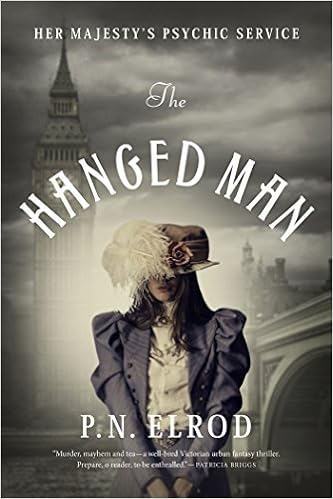
The Hanged Man

Tor
The Hanged Man
P.N. Elrod
2015

The Summary
"On a freezing Christmas Eve in 1879, a forensic psychic reader is summoned to the scene of a questionable death.  Alexandrina Victoria Pendlebury (named after her godmother, the current Queen of England) is adamant that the death in question is a magically compromised murder and not a suicide, as the police had assumed.  After the shocking revelation contained by the body in question, Alex must put her personal loss aside to uncover the deeper issues at stake, before more bodies turn up.

"Turning to some choice allies--the handsome, prescient Lieutenant Brooks, the brilliant, enigmatic Lord Desmond, and her rapscallion cousin James--Alex will have to marshal all of her magical and mental acumen to save Queen and Country from a shadowy threat.  Our singular heroine is caught up in this rousing gaslamp adventure of cloaked assassins, meddlesome family, and dark magic."

The Good
I really liked P.N. Elrod's latest novel.  As an ardent fan of her Vampire Files series (which she wrote during the 1990s), I found I was equally enchanted by her latest series, Her Majesty's Psychic Service.  It's an absurd, adventurous tale full of action and Victorian science and psychics--and, quite possibly, paranormal activity.

It's a great deal of fun and, luckily, it moves at a pace that's satisfying.  It's very much a novel that hits you with something new each chapter and, while it does skirt perilously close to having too much action, it manages to unfold without overwhelming the reader.  The Hanged Man is also full of surprises, not least of all the identity of the hanged man for which it's named; however, it doesn't attempt to throw out any roadblocks or smokescreens to hide the true course of the novel.

No red herrings, so no worries.

Likewise, I was pleased with the characters:  I loved Alexandrina, and I enjoyed Brooks.  She's a mercilessly witty narrator, quick as a whip and equally ruthless with her fists, but she's intelligent and self-sufficient--and she makes a heck of an investigator.  I loved that she was so competent, that she was able to confront and solve mysteries without batting an eye.  Brooks was similarly interesting.  Admittedly, I liked him for the fact that he poses such an intriguing plot twist for future novels.  I'm curious to see where the pair will end up next.

Lord Goldaming's character was also a nice literary touch.  It was a pleasant surprise to find the seamless melding of Victorian literature, history, and expectation--that is, the readers expectations of Victorian culture.

The Bad
The Hanged Man is one of those fun, guilty pleasures.  There isn't much to it, not a great deal of depth, but the ride was fun.  I went into the book knowing this, so I wasn't surprised or even disappointed.

If I have one complaint, it might be that the book feels as if it ended before everything was fully explained.  I've yet to understand the significance of mirrors or the origin of the strange creatures Alexandrina encounters, which was a little disappointing; otherwise, I had quite a lot of fun with Elrod's latest novel.

The Ugly
Betrayal.

It still stings.  Just a little bit.

Monday, January 25, 2016

Nice Girls Don't Have Fangs

nicegirlsfrontfinaltransfer
Pocket Star
Nice Girls Don't Have Fangs
Molly Harper
2009

The Summary
"Maybe it was the Shenanigans gift certificate that put her over the edge.  When children's librarian and self-professed nice girl Jane Jameson is fired by her beastly boss and handed twenty-five dollars in potato skins instead of a severance check, she goes on a bender that's sure to become Half Moon Hollow legend.  On her way home, she's mistaken for a deer, shot, and left for dead.  And thanks to the mysterious stranger she met while chugging neon-colored cocktails, she wakes up with a decidedly unladylike thirst for blood.

"Jane is now the latest recipient of a gift basket from the Newly Undead Welcoming Committee, and her life-after-lifestyle is taking some getting used to.  Her recently deceased favorite aunt is now her ghostly roommate.  She has to fake breathing and endure daytime hours to avoid coming out of the coffin to her family.  She's forced to forego her favorite down-home Southern cooking for bags of O-negative.  Her relationship with her sexy, mercurial sire keeps running hot and cold.  And if that wasn't enough, it looks like someone in Half Moon Hollow is trying to frame her for a series of vampire murders.  What's a nice undead girl to do?"

The Good
I enjoyed Molly Harper's novel pretty well.  I liked that it had a sassy female lead.  I mean, how can I not like her?  She's a librarian for crying out loud, and she's a genuinely nice (and, dare I say it, funny) character.  And I was perpetually intrigued by the authors take on vampires that come out into the open and try to live normal, fulfilling lives.

Yes, I realize this idea has been used before--Sookie Stackhouse, anyone?--but I actually enjoyed Nice Girls Don't Have Fangs a little better than Charlaine Harris' series.  Perhaps that's blasphemy, considering the outrageous popularity that True Blood found on HBO; however, there's something about Harper's style of writing and Jane Jameson's character that I found more appealing.

Jane is a little more fleshed out than the more popular Sookie Stackhouse, I thought, and she strikes me as a being a lot brighter if clumsier.  Sookie seemed almost too perfect, self-deprecating and unrealistic with her heavy southern accent; Jane is clumsy and, one might say, goofy, but she's equally intelligent and, while she has an intense love for southern food and makes note of her southern accent, it isn't...forced.  Her character seems more natural, her decisions more fluid.

And I liked her better for it.

Overall, Nice Girls Don't Have Fangs was an enjoyable book with a great protagonist.  It's a short, quick read, which I finished within a couple of days, and it's a short series that builds on the local vampire population without overwhelming me with information--or, more importantly, confusing me with all the vampire rules, like Sookie Stackhouse's strange and, sometimes, unexplained world.

The Bad
Admittedly, it's not a great story.  I mean, it had a decent plot, but I wasn't thrilled or sitting on the edge of my seat the entire time.  It was fun while it lasted, and I like that it played with the vampire myth a little more, utilizing both traditional and pop culture ideas; however, I wasn't smitten with the series.

I could keep reading it, and I could definitely enjoy it if I picked up another book.  It's sort of a paperback guilty pleasure:  lots of fun, good characters, but not a whole lot of substance.

The Ugly
Blood.  Unexpected violence.  Gore.  So on and so forth.

There are vampires involved.  What did you expect?

Friday, January 23, 2015

Twilight

Image courtesy of
www.booksamillion.com
Twilight
Stephanie Meyer
2005

The Summary
Twilight tells the story of a young girl named Bella Swan, who moves to Forks, Washington, with her father, and begins a complicated love affair with Edward Cullen, a vampire.

The Good
Meyer's book provides you with a simple and easy-to-read format, allowing you to finish it within an afternoon and enjoy the rest of your evening mulling over the quirks of her writing.

More importantly, it promises to offer a unique take on the age-old vampire legends, which, depending on your perspective, might seem like a breath of fresh air.

The Bad
By the same token, the simplicity that Meyer features in her writing can certainly detract from the overall story and mood of Twilight.  Granted, while many of the central characters in her novel are vampires and possess centuries of tradition behind an unchanging facade, that doesn't excuse Meyer's entire lack of development and perpetual use of static characters.

Meanwhile, Meyer receives a gold star for using such creative license in her novel and introducing her audience to the wonderful world of reading; however, I can't done the transition of the vampire from delightful Gothic terror and Creature of the Night to the emasculated horror that terrorizes Bambi in the wilds of Washington and befriends teenage girls.

(Dracula had three wives, controlled ravenous packs of wolves, and terrorized villagers on a nightly basis, not to mention he was a sadistic psychopath, who gleefully slit throats and drained people dry.  Edward Cullen is a far cry from the monstrosity we all know and love in Bram Stoker's work.)

Besides this, the plot appears exceptionally linear and juvenile, not to mention redundant.  This idea of ill-fated lovers has been done before, and done much better.  (Might I suggest Shakespeare?)

I won't say Twilight has absolutely no merits.  It serves as a perfect spring board for introducing young readers to books or as a short vacation from substantially more complex novels, but, honestly, I wouldn't really recommend it to anyone over the age of thirteen.

The Ugly
Bella - and her narrative - possesses a bland uniformity, an annoying monotone, that bored me to tears.  It's not that I didn't enjoy some parts of the story, I just really couldn't stand Bella Swan.  So, if you prefer a little depth to your narrator and some meat on the bones of your plot, you probably won't fall in love with Twilight.

Monday, February 11, 2013

The Vampire Files: Bloodlist

Bloodlist (Vampire Files Series #1)
Image courtesy of
www.barnesandnoble.com
The Vampire Files:  Bloodlist
P.N. Elrod
1990

The Summary
For investigative reporter, Jack Fleming, danger comes with the territory in his line of work.  But his latest story, a piece on the criminal underworld of Chicago, has gotten him into more than a little trouble.

In fact, it's even gotten him killed.

Now, undead and kicking, Jack has every intention of finding his murderer and cracking open one of the most dangerous cases of his career.  That is, if a well-intentioned private investigator doesn't get in his way.

The Good
P.N. Elrod provides a fun, fast-paced story full of twists and turns and danger that will have you hooked from page one.  Her central character and narrator, Jack Fleming, has an entertaining personality and an intriguing voice that conveys every bit of his witty if slightly jaded mentality.

Moreover, Elrod puts a twist on a centuries old concept by not only transplanting the Dracula myth to Chicago in the 1920s, but also by creating a mythos of her own that's steeped in film noir and intrigue.

More importantly, this novel is just plain, ridiculous fun.  It's quick, entertaining, and full of that special kind of charm that only vampires can ever seem to expel.

The Bad
While immensely fun and enjoyable, I occasionally questioned the historical accuracy of Elrod's work.  A minor complaint, considering it is a work of fiction - and it doesn't really matter, given the context of the work and the intent of the story - and isn't exactly based in reality.  But it remained a small question throughout the story, nonetheless.

The Ugly
Vampire Files is not a "G-rated" novel by any means.

Let's be honest, Jack Fleming has been turned into a vampire and, like all good vampires, he is capable of monstrous feats and he drinks blood to survive.  Granted, Elrod's protagonist is a gentleman at his core, which means he doesn't exactly follow in the same vein as Dracula.

But, in spite of this, he's a man accustomed to violence and he's also a bit of a ladies' man.  There's always some kind of debauchery a fellow like Jack can find, especially in the 1920s in the heart of mob-ruled Chicago.

Monday, October 8, 2012

Dracula

Image courtesy of
www.booksamillion.com
Dracula
Bram Stoker
1897

The Summary
Bram Stoker's Dracula collects the journals and personal testimonies of Jonathan and Mina Harker, Dr. John Seward, Lucy Westenra, Arthur Holmwood, Quincey Morris, and Dr. Abraham Van Helsing, in which they confront the world's most terrifying creature:

A vampire.

The Good
Stoker will keep you riveted with his story.  Besides creating one of the literature's most fascinating - and terrifying - villains, he has taken the time and care to recreate the details of life within the pages of his novel.

And, considering the number of correspondences between characters and the specific connections necessary to complete the story, it's an amazingly well-written work.

It's beautifully detailed with marked differences between the individual characters involved.  Each character has their own personality, their own history, their own reactions to a situation - and they become honest, endearing folks.

More importantly, it's absolutely fascinating.  I mean, who can resist the allure one of literature's most prolific vampires?

(And, no, Edward Cullen does not count.)

The Bad
On the flip-side, all the detail makes reading Stoker's novel a bit tricky.  Once you make connections, it's easy to find those tenuous links between characters and locations and mysterious events; however, those can prove to be slightly elusive.

Moreover, chapters can occasionally take a while to "build-up" to a point.  You will battle with bouts of the humdrum and dull, but the story picks up considerably when certain realizations come together.  But, until then, it may seem a little lackluster and disjointed.

The only advice I can offer is persevere.

The Ugly
Guts, gore, mayhem, madness, death, and destruction.  Dracula has it all for the horror enthusiast.  Would you expect anything less from one of the most terrifying creatures written into existence?

Of course, for those of you with a more timid constitution, pace yourself.