"All good books are alike in that they are truer than if they had really happened
and after you are finished reading one you will feel that all that happened to you
and afterwards it all belongs to you; the good and the bad, the ecstasy, the remorse,
and sorrow, the people and the places and how the weather was."
Ernest Hemingway
Showing posts with label Audiobook. Show all posts

Monday, December 4, 2017

Jane Steele: Revisited

31851019
G.P. Putnam's Sons
Jane Steele
Lyndsay Faye
2016

The Summary
"A sensitive orphan, Jane Steele suffers first at the hands of her spiteful aunt and predatory cousin, then at a grim school where she fights for her very life until escaping to London, leaving the corpses of her tormentors behind her. After years of hiding from the law while penning macabre “last confessions” of the recently hanged, Jane thrills at discovering an advertisement. Her aunt has died and her childhood home has a new master: Mr. Charles Thornfield, who seeks a governess.

"Burning to know whether she is in fact the rightful heir, Jane takes the position incognito and learns that Highgate House is full of marvelously strange new residents--the fascinating but caustic Mr. Thornfield, an army doctor returned from the Sikh Wars, and the gracious Sikh butler Mr. Sardar Singh, whose history with Mr. Thornfield appears far deeper and darker than they pretend. As Jane catches ominous glimpses of the pair’s violent history and falls in love with the gruffly tragic Mr. Thornfield, she faces a terrible dilemma: Can she possess him--body, soul, and secrets--without revealing her own murderous past? 


"A satirical romance about identity, guilt, goodness, and the nature of lies, by a writer who Matthew Pearl calls 'superstar-caliber' and whose previous works Gillian Flynn declared 'spectacular,' Jane Steele is a brilliant and deeply absorbing book inspired by Charlotte Brontë’s classic Jane Eyre."


The Good
Not so very long ago, I actually picked up the advanced readers copy of Jane Steele and read it within a couple of days.  More recently, I found the audiobook of Lyndsay Faye's novel and, I have to say, I wasn't disappointed.  I enjoyed rereading Jane Steele and I found I liked the story just as much the second time around.

Susie Riddell does a pretty great job as narrator.  I liked the way she told Jane's story, the cadence and tone of her voice that created a character who felt real.  It was enjoyable, and I found myself finding new facets of the story to appreciate and admire.

Overall, it's a great audiobook.  Short and, while it's definitely not sweet, fun, Jane Steele is an excellent choice for any reader seeking an off-kilter romance or a deeply twisted take on a classic.  However, I will say I enjoyed reading the book more than listening to the audiobook.  For some reason, I just appreciated the feeling of the book in my hands than the earbuds in my ears as I listened to Jane's story.

But that's more personal preference than anything.

The Bad
Honestly, I had a few moments where I became annoyed by the accents.  Don't get me wrong, Susie Riddell does a great job of reading Jane Steele; however, I was always a little annoyed by Thornfield's voice.  It wasn't awful, but it did take me a little longer to acclimate to his character than usual.

Likewise, I never did warm up to Rebecca's voice.  She had a softness to her voice, a sort of whiny sound that I just didn't like.  Confidentially, I was glad when I moved beyond her story and found myself strictly accompanying Jane.

The Ugly
Blood and gore.

Jane, as she warns readers in the first pages of her "memoir," is a murderess.  She's not a gentle, tame individual like the Jane we know from Jane Eyre; rather, she's a rambunctious, foul-mouthed young woman who knows her way around a knife.  She's deadly and she can prove it, too.
Tuesday, July 4, 2017

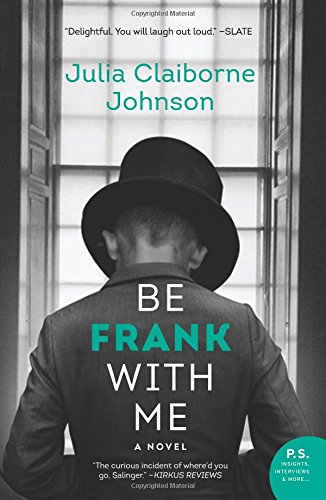
Be Frank with Me

William Morrow
Be Frank with Me
Julia Claiborne Johnson
2016

The Summary
"Meet Mimi:  Reclusive literary legend.  Wrote Pulitzer- and National Book Award-winning novel at nineteen.  Hasn't been seen or heard from much since, though, ironically, she lives in a glass mansion in Bel Air.  Lost all her money in a Ponzi scheme, needs to write another novel.  So her publisher sends...

"Alice Whitley:  Editorial assistant.  Twenty-five years old.  Highly competent.  Thinks she's going to be typing up pages and delivering cups of coffee.  Instead finds that her primary job is to be companion to...

"Frank:  Mimi's nine-year-old son.  A boy with the intellect of Albert Einstein, the wardrobe of a 1930s movie star, and very little in common with his fellow fourth graders.  About to give Alice the education of her life."

The Good
I liked Be Frank with Me.

It's zany, it's original, it's a lot of fun, yet it's quietly intense and, quite honestly, heart-wrenching.  I found I quickly became involved in their lives, but, then again, I think it's easy to become wound up in Frank's story.  (It feels like Frank's story, as much as it feels like Alice's.  He's such a larger-than-life character, and he just seems to overshadow everything else.)

Overall, I enjoyed my time with Frank and Alice.  I liked the unexpectedness of their adventures, even if it sometimes led to mayhem.  However, what I liked best about Be Frank with Me was the narration.

Tavia Gilbert does a brilliant job of breathing life into the characters.  She gives Alice depth, a distinctive perkiness that shows her optimistic attitude; she captures Frank's youth and intelligence, his boyish voice and unusual monotone; she gives Zander a gravelly, masculine voice that conveys both his age and his immaturity.

I loved the way Gilbert slipped between personas.  Even when I didn't know who was speaking, I could tell which character I heard.  Gilbert makes each character singularly unique, distinguishing them by tone and accent and attitude.  She's a masterful storyteller, and I enjoyed listening to her lend her talents to Be Frank with Me.

The Bad
I'll admit, I struggled with this story.

I am Alice's age.  I could easily see myself in the same position as Alice, working as an assistant and quickly finding herself engulfed by the work--by all the tiny rules that Mimi snaps at her for not knowing, all the rules that keep Frank to freezing up or freaking out.

I mean, I felt bad for Alice:  here she is living full time in Los Angeles, essentially working as a live-in babysitter, instead of a publisher's assistant.  Not to mention, Mimi treats her poorly; Frank nearly takes off her fingers when they first meet; and Zander--well, Zander feels like just another tragedy waiting to happen.

It's comical all the crazy situations in which Alice finds herself, yet, at the same time, it's frustrating.  I mean, Alice seems like a genuinely nice person.  She might be overly excitable and she might sometimes overstep her bounds, because she wants to do a good job.  I hate the way she's treated by pretty much everyone.

And Zander.

Don't even get me started on Zander.

The Ugly
Human relationships are complicated.  They're ugly and brutal and difficult, and it's easy to see why Frank struggles with them.  I mean, fourth graders aren't exactly the nicest bunch out there and it's easy to see how Frank feels like he doesn't belong.

Friday, June 23, 2017

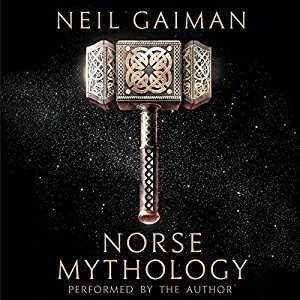
Norse Mythology

34097209
HarperAudio
Norse Mythology
Neil Gaiman
2017

The Summary
"Neil Gaiman has long been inspired by ancient mythology in creating the fantastical reams of his fiction.  Now he turns his attention back to the source, presenting a bravura rendition of the great northern tales.

"In Norse Mythology, Gaiman stays true to the myths in envisioning the major Norse pantheon:  Odin, the highest of the high, wise, daring and cunning; Thor, Odin's son, incredibly strong yet not the wisest of the gods; and Loki--son of a giant--blood brother to Odin and a trickster and unsurpassable manipulator.

"Gaiman fashions these primeval stories into a novelist arc that begins with the genesis of the legendary nine worlds and delves into the exploits of deities, dwarfs, and giants.  Through Gaiman's deft and witty prose emerge these gods with their fiercely competitive natures, their susceptibility to being duped and duping others, and their tendency to let passion ignite their actions, making these long-ago myths breathe pungent life again."

The Good
I listened to Norse Mythology as an audiobook and, personally, I think that's the only way to enjoy Neil Gaiman's latest book.  I absolutely adored Norse Mythology, and I loved listening to Neil Gaiman narrate it.  It has quickly become one of my favorite audiobooks, simply because Gaiman is a master storyteller whether he's using the written word or reciting it aloud.

There's something magical about Norse Mythology.  I mean, you can really tell that Norse myth means something to Gaiman.  He's poured his heart and soul into telling these stories and telling them well, and he's created something that's both familiar and wholly unique.

Moreover, I loved the way Gaiman told the story.  I'm not just talking about the language and cadence of the text; I'm talking about the way he spoke, the way he gave life to his characters by changing tones and inflections to give them depth, real meaning.

For instance, I could tell the difference between Loki and Thor with just a word, because Gaiman imbued them with such distinct personalities.  Likewise, I could envision the enormity and ferocity of Fenris just through his harsh, graveled tones; or the haughty elegance of Freya; or the cool, calculating intelligence of Loki.

Personally, I thought Norse Mythology was fantastic.  After reading The Gospel of Loki by Joanne Harris, I have found myself captivated by Norse myth more and more--and Norse Mythology only lifts these myths higher in my esteem.  Although I know all the stories, Norse Mythology is a wonderful addition to any collection and it's great for readers who are both familiar with the myths and those who are just starting.

The Bad
No complaints.

I absolutely loved every minute of Norse Mythology, all 389 of them.

The Ugly
I'll say the same thing that I said about Joanna Harris' novel:  the gods are cruel, brutal, violent, and licentious.  More often than not, they're terrible people.  I found it difficult to like any of them, plus it's best not to get attached.  If you know anything about Ragnarok, then you know how things are going to end for the gods.

Monday, May 1, 2017

Playing for Pizza

1205297
Doubleday
Playing for Pizza
John Grisham
2007

The Summary
"Rick Dockery was the third string quarterback for the Cleveland Browns.  In the AFC Championship game against Denver, to the surprise and dismay of virtually everyone, Rick actually got into the game.  With a 17-point lead and just minutes to go, Rick provided what was arguably the worst single performance in the history of the NFL.  Overnight, he became a national laughingstock and, of course, was immediately cut by the Browns and shunned by all other teams.

"But all Rick knows is football, and he insists that his agent, Arnie, find a team that needs him.  Against enormous odds Arnie finally locates just such a team and informs Rick that, miraculously, he can in fact now be a starting quarterback.  Great, says Rick---for which team?

"The mighty Panthers of Parma, Italy.

"Yes, Italians do play football, to one degree or another, and the Parma Panthers desperately want a former NFL player--any former NFL player--at their helm.  So Rick reluctantly agrees to play for the Panthers--at least until a better offer comes along--and heads off to Italy.  he knows nothing about Parma (not even where it is), has never been to Europe, and doesn't speak or understand a word of Italian.

"To say that Italy--the land of opera, fine wines, extremely small cars, romance, and football americano--holds a few surprises for Rick Dockery would be something of an understatement."

The Good
Playing for Pizza was unexpectedly good.  Granted, I understood very little of the football plays--what does third down even mean?--or the jargon that goes along with the sport, but I enjoyed listening to Playing for Pizza with Christopher Evan Welch as narrator.  Like I said, it was unexpectedly good.  Rich and vibrant and, well, funny.

Admittedly, it took me a few chapters to really settle into the story, but, once I did, I had so much fun listening to Rick Dockery's story as he journeys to Italy and becomes a Parma Panther.  I especially enjoyed the descriptions Italy--the architecture, the culture, the history, the romance (courtesy of a secondary character from Georgia, who loved all these things)--and, of course, the food.

I was almost always hungry for food while listening to Grisham's novel, but it was totally worth it.

Overall, Playing for Pizza was an excellent choice for my Read Harder Challenge--and it was just a lot of fun.  It's fun, sweet and romantic, but it doesn't try to hide the bad things that happen; rather, it follows the ordeals of an ordinary person finding himself in an extraordinary situation and it rolls with it.  Moreover, while I did find aspects of it sweet and romantic, it didn't border on too sweet or too romantic.

Playing for Pizza struck a good balance, I thought, and it's written very well, narrated very well.  I mean, if you don't like romance, it has explorations of Italy and food and football; if you don't like football, it still has Italy and history and food.  (Did I mention food?)  Personally, I'm not a fan of sports; however, I enjoyed listening to the games in Playing for Pizza--and I couldn't understand half of it.

The Bad
If you don't understand football americano, then you might just struggle through some of this novel.  I did, and I even live in a state where you live and die by football.  However, I will note that I did enjoy the games and, more to the point, Playing for Pizza has a lot to commend it besides the football games.

The Ugly
Sports injuries.

Ouch.

Friday, March 17, 2017

Read Harder Challenge 2017: Part 2

Next up for my Read Harder Challenge, I...
  • Read a book about sports.
  • Read a book you've read before.
  • Read a book published by a micropress.

Admittedly, I wasn't sure how to conquer this first task, because I am not a sports and/or athletic person.  I am, at best, a rather sedentary creature with a great affinity for books and chocolate and good food, preferably in that order; however, I was willing to take a crack at this one, because, surely, I could find a sport liked.  Considering the sheer variety of sports out there, I knew I could find something entertaining.

1205297
Doubleday
And, luckily, I did.  A co-worker recommended Playing for Pizza by John Grisham, and, since the challenge doesn't specify fiction or nonfiction, I thought I'd give it a whirl.  I'm so glad I gave Grisham's novel a chance, because I enjoyed it so much more than I expected.  Granted, I listened to the audiobook, which features Christopher Evan Welch as narrator, but I don't think that matters as Playing for Pizza is a fun, accessible and entertaining novel whether listening or reading.

Not to mention, I really enjoyed the description of food.  (I was craving pasta like mad, before all was said and done.)

Playing for Pizza begins with a game, specifically the worst game of Rick Dockery's career.  Now, marked as the worst player in the NFL--and effectively banished from Cleveland--and sporting a terrible head injury that would leave most player's contemplating retirement, Rick is at his wits end.  Since he can't find a new position in the U.S., his agent directs him to Parma--as in Parma, Italy, where he becomes quarterback for a ragtag group of Italians who just happen to be American football aficionados.  It's a huge change for Rick--and, as Rick learns, it might not be a bad one.

Next, I decided to reread Hush by Jeph Loeb and Jim Lee.  This is one of my favorite Batman comics for the simple fact that it has some of the most alluring, most beautiful art I've encountered, and it has such a richly detailed, incredibly poignant story that it kept me absolutely mesmerized the first time around.  I love every bit of this book, and I found it to be even better the second (okay, third) time.

6375845
DC Comics
Unlike Loeb's earlier works, Long Halloween and Dark Victory, which features Batman's earlier career, Hush follows the weathered and strained Batman/Bruce Wayne as he tries to keep Gotham safe from new and ever worsening dangers.  Together with his cadre of crime-fighting vigilantes--including Nightwing, Robin, Huntress, and Superman (but not quite Catwoman)--Batman sets out to find the puppet master who has set the whole of Gotham's underworld onto his heels.

Hush is one of those comics that will knock your socks off.  It's thoughtful, it's complex, and it explores every emotional side of a Dark Knight who has suffered innumerable losses, endured more grief and pain than most can manage, and defeated some of the most terrifying villains in the world.  Moreover, it has a level of Agatha Christie-esque mystery, which I enjoyed.

I mean, I certainly didn't expect it to end the way it did--and I found Batman to be all the more clever for ultimately solving the mystery.

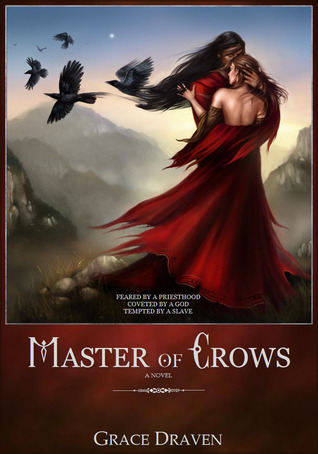
Last, I read Master of Crows by Grace Draven.  Originally published by Amber Quill Press (which, I realize, is not a micropress), it was eventually republished by Grace Draven--and, as the definition of a micropess means it is a small and/or single-person publisher, I decided it would fit nicely into this category to complete my challenge.

Yes, yes, I realize I might be pushing the rules with this one, but I have to point out that I haven't had a lot of luck finding books published by micropresses to which I have easy access.  I know of a few local publishers, but they are publishing companies with a large enough staff that I feel they don't count.  Moreover, I couldn't find something I enjoyed by a micropress to which I had access at my local library, thus the Internet--and Master of Crows--became my go-to choice.
6811150
Amber Quill Press/
Grace Draven

Now, putting aside my (weak) justifications, Master of Crows wasn't a bad novel.  In a world where magic exists and dark creatures lurk at the periphery of civilization, Silhara and Martise are thrust together in an unexpected alliance when one of the old gods--Corruption--returns.  Determined to stop Corruption and deny his fate, Silhara enlists the aid of the Conclave and meets Martise, a slave girl turned spy.  Together, they must discover Corruption's weakness and save the world....or, quite possibly, die trying.

I realize it sounds melodramatic and, yes, I suppose it is; however, it's also an unexpectedly complex novel that I enjoyed.  It has its faults, but, overall, it had interesting characters and created a sturdy setting that I appreciated.  Personally, I think I enjoyed Draven's ability to build her world.  It's rich with detail and magic, and I absolutely loved learning more and more about the creatures, places, and history of Silhara and Martise's world.  I realize it's more of an acquired taste, but it's certainly worth sampling.

Unless, of course, you're not a fan of explicit romance.  In which case, I probably wouldn't recommend it.

Tuesday, February 28, 2017

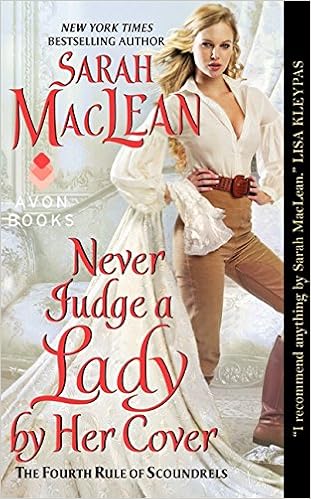
Never Judge a Lady by Her Cover

Avon
Never Judge a Lady by Her Cover
Sarah MacLean
2014

The Summary
"By day, she is Lady Georgiana, sister to a duke, ruined before her first season in the worst kind of scandal.  But the truth is far more shocking--in London's darkest corners, she is Chase, the mysterious, unknown founder of the city's most legendary gaming hell.  For years, her double identity has gone undiscovered...until now.

"Brilliant, driven, handsome-as-sin Duncan West is intrigued by the beautiful, ruined woman who is somehow connected to a world of darkness.  He knows she is more than she seems, and he vows to uncover all of Georgiana's secrets, laying bare her past, threatening her present, and risking all she holds dear...including her heart."

The Good
I was curiously caught up in this story.  It was a bit like a soap opera--dramatic and heart-wrenching and saccharine sweet simultaneously--and, once I was hooked, I couldn't seem to stop.  I found myself committed to the story, because it was complex and rather exciting.

While I wouldn't call it the best audiobook which I've had the pleasure of hearing, it wasn't a bad story.  I mean, character development is decent and romantic entanglements were fairly believable.  Plus, I loved the fact that the main female protagonist took charge of her life and decided she would no longer remain under the thumb of Victorian social expectations.

Honestly, I found Georgiana's courage and her plan to quietly undermine society refreshing.  Her activities, while rather far fetched, make her a formidable and forbidding woman.  She's not a shrinking violet, she's not a damsel in distress; in fact, she can take care of herself and she's done so for nigh on ten years.  Personally, I appreciate that in a character.

The Bad
Justine Eyre did a nice job narrating Never Judge a Lady by Her Cover.  She fits Georgiana's character quite well; however, I hated listening to Temple's voice.  For some reason, her male voices made me cringe.  It wasn't quite to the nails-on-a-chalkboard level, but it did make me think of grinding my teeth.

I'll be honest, I just couldn't stand it and, occasionally, I had to take my earbuds out to take a break.

The Ugly
Mature content.

If it's not explicit sex scenes, then it's domestic abuse and a general array of vices.  Definitely not for younger readers.

Wednesday, February 22, 2017

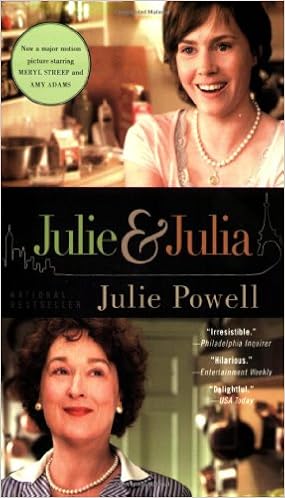
Julie & Julia: 365 Days, 524 Recipes, 1 Tiny Apartment Kitchen: How One Girl Risked Her Marriage, Her Job, and Her Sanity to Master the Art of Living

Hatchette Books
Julie & Julia:  365 Days, 524 Recipes, 1 Tiny Apartment Kitchen:  How One Girl Risked Her Marriage, Her Job, and Her Sanity to Master the Art of Living
Julie Powell
2005

The Summary
"Powell needs something to break the monotony of her life.  So, she invents a deranged assignment:  she will take her mother's dog-eared copy of Julia Child's 1961 classic, Mastering the Art of Frech Cooking, and cook all 524 recipes in the span of just one year."

Truthfully, the subtitle says it all.

The Good
I read Julie and Julia by Julie Powell as part of my Read Harder Challenge for 2016 (which you can read more about here), and I was absolutely delighted with it.

Amusing, candid, and insightful, I really enjoyed listening to Julie Powell's memoir--or food memoir?  I'm not really sure where it falls in the grand scheme of things, but, regardless, I thought it was a wonderful book.  It's riotously funny, yet strangely poignant.  Oddly enough, it reminds me of Jenny Lawson and her memoir, Furiously Happy--yet just a tiny bit less chaotic.

Not by much, considering Julie Powell undertakes to make 524 different recipes, many of which take hours to prepare, in just one year in a crappy little apartment in Queens.  It's astonishing the things she (and her marriage) manages to survive, including:  biological clocks, frozen pipes, disastrous dinner parties, inane dead end secretarial jobs, break downs, Blanche days, and celebrity crushes.

It's really a pretty amusing book, especially if you decide to listen to it as read by the author (which I did--and which I highly recommend); however, it's not quite the food memoir I expected.  In fact, Julie and Julia is more memoir than food.  Julie is hellbent on recreating all of Julia Child's recipes in Mastering the Art of French Cooking, vol. 1 and, in her journey, she learns how to make a variety of dishes and confronts some of the most trying times of her life.

While it features a lot of cooking, Julie and Julia feels like it's more about the experiences of cooking and the results, specifically what happens to the author as she slogs through more than 500 French recipes, than the actual cooking, but I can't say I minded.

Julie and Julia is strangely heartwarming and incredibly amusing.  To me, it strikes just the right balance that makes it a memoir worth reading, especially if you have the chance to listen to the author tell her own story.  It makes Julie and Julia that much more memorable.

The Bad
I will note that while I was listening to the audiobook I discovered I borrowed the abridged version.  I don't know if the audiobook had the full text, but I do know I missed a few things that might otherwise have filled in details or fleshed out the characters involved.  It was my only disappointment in a book that was, otherwise, wonderful.

The Ugly
Okay, I'll be honest:  I liked Julie, but, sometimes, I just couldn't handle very much of her.

I mean, I liked her and I liked her style of writing.  I loved listening to the audiobook, because it has this authenticity to it, this genuine emotion that seeps through every chapter.  However, I could only take so much.  She was very dramatic and she stressed out so easily--and, confidentially, she stressed me out when she went on a rant about how cooking was going to ruin her and so on...and, sometimes, it was just a little too shrill, you know?

Sunday, January 1, 2017

Happy New Year: Read Harder Challenge 2016

Since I completed my Read Harder Challenge of 2016 and filled in all the categories recommended by BookRiot, I created some of my own unique categories.  As part of my continued challenge, I've decided to:
  1. Read a book by or about a librarian (or about a library)
  2. Read a medical book (fiction or nonfiction)
  3. Listen to an audiobook romance
  4. Read a brand new, recently published book (anything from 2016)
  5. Read a spin-off from a classic novel and/or fairy tale
  6. Read a book about cake (fiction or nonfiction)
  7. Read a fantasy book featuring dragons
16101121
Gotham Books
I thought it might prove fun to dive into some new books I might not otherwise find.  Some are based on recommendations from co-workers, while others are based on books from my TBR pile--and still others are just ideas that seemed like fun.  And with the countdown to the New Year on, I can't wait to tell you all about the books I've read, starting with a book by (and about) a librarian:  The World's Strongest Librarian by Josh Hanagarne.

If you've never read Josh Hanagarne I highly recommend his memoir.  It's funny, it's candid, it's insightful, and, ultimately, it's uplifting.  Although Hanagarne does discuss religion, his main focus is his family, his battle with Tourette's, his struggles with infertility, and his general love of the library and all things literary.  It's enjoyable to see his passion for his family, his books, and his weightlifting come to the forefront as he learns to balance all the different aspects of his life.  Overall, it's a pretty great read.

Next, I read (or, rather, listened to) a medical book--a historical medical drama, fyi--by Tessa Harris:  The Anatomist's Apprentice.  Narrated by  Simon Vance, The Anatomist's Apprentice was an interesting deviation from my usual reading material.  Thomas Silkstone is a young anatomist from Philadelphia who finds himself in England about the time of the Revolutionary War, caught in the midst of a medical mystery...and a murder  It's dark, rather macabre, but it's ultimately fascinating with the sheer depth of detail and history included.  I enjoyed my time in Silkstone's world, and I found myself quickly gravitating to book number two, The Dead Shall Not Rest.

8546358
Bantam
As for listening to an audiobook romance, I decided to check out more by Sarah Addison Allen and picked up The Peach Keeper.  Now, let me give you a warning, I have read almost everything by Allen, except Lost Lake (that one is currently in my TBR), and I have loved almost everything she's written.  The Peach Keeper was no different.  I loved the characters and the complexity of their histories; I loved the little hints of every day magic she weaves into her novels; I even loved the ghost story, which is saying something, as I am not a fan of ghosts.  It was a wonderful visit back to her world, and it was so much fun recognizing an old friend.

I also picked up a brand new book just published this year, a little novel by J. Ryan Stradal called Kitchens of the Great Midwest.  Another audiobook, I know, but it was just as rewarding as any other.  Although it follows a myriad of characters, it focuses on Eva Thorvald and her life as she grows into her own--and all the foods that influenced her in the process.  That's really the simplified version; Kitchens of the Great Midwest is much more complex, much more nuanced than I make it out to be.  It's a recurring cast of characters centered around Eva, but it's quite unlike anything I've ever read.  It's wonderful, and I absolutely adored the narrators, Amy Ryan and Michael Stuhlbarg.
25938397
G.P. Putnam & Sons

Speaking of new books, I also discovered Jane Steele by Lyndsay Faye, which fit nicely into my category for a spin-off novel based on a classic work or a fairy tale.  There were several options for this particular category, but I decided on Jane Steele because Jane Eyre.  I love Jane Eyre (as is probably apparent here), and I loved having the opportunity to reimagine her story not as the quiet, resolute girl who refused to give ground to anyone or relinquish her personal beliefs, but as the sharp, deadly woman with no qualms whatsoever of killing if it means protecting herself and her own.  It's fascinating the contrasts, and I came to love Jane Steele equally for her unwavering commitment to being bad.  It's a rousing good time.

Next, I decided to keep my love of food alive with a book about cake and sisterhood:  The Secret to Hummingbird Cake by Celeste Fletcher McHale.  While I will admit that I liked Garden Spells and The Glass Kitchen better, I enjoyed reading McHale's debut novel--and I absolutely loved getting to know her characters.  I liked Carrigan and I liked Ella Rae for their bravery, sass, and sheer stubborness, but I adored Laine.  She's the impetus of the story, the reason for it all, and, like Carrigan and Ella Rae, I felt an unexpected affection and wonderful kinship with her.  I enjoyed reading their story more than I thought I would.  For a debut novel, The Secret to Hummingbird Cake was pretty great.

352262
Little, Brown Books for
Young Readers
Last but not least, I read a fantasy book featuring dragons with How to Train Your Dragon by Cressida Cowell.  I picked Cowell's novel up because I fell in love with the movie of the same name; however, I was a little disappointed.  Don't get me wrong, I enjoyed reading How to Train Your Dragon.  It's fun, it's inventive, and it's a great series for young readers (I especially liked the Hairy Scary Librarian), but, unfortunately, it's not what I expected.  I made the critical mistake of judging the book in comparison to the movie--and they're two very different creatures.  How to Train Your Dragon the book is very different from How to Train Your Dragon the movie, and it's best not to go into either one with the same expectations.

Saturday, December 31, 2016

Read Harder Challenge (Part Eight)

This week, I'm just barely eking by with my Read Harder Challenge.  After reading these last books, I have officially finished my list:
  1. Read a book that is set in the Middle East
  2. Read a nonfiction book about feminism or dealing with feminist themes
  3. Read a food memoir
Little, Brown and Co.
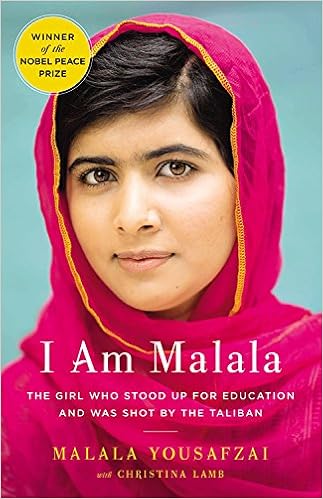
To start off, I finally finished reading I Am Malala by Malala Yousafzai.  It only took my 6 months, but I finished it and, honestly, I'm glad I did.  It's a fascinating story that's both heartbreaking and incredibly informative, offering insight into the various cultures and relations of Afghanistan.  Although her story is grim, it's simultaneously uplifting.  Personally, I enjoyed reading about her and her father's endeavors to bring education to local children--and particularly to the young women of the community.

Malala is a skilled narrator.  She's bright, she's hopeful, she's very detailed and she's very intelligent.  Although her book is a translation, which is sometimes apparent, I felt like I could read and relate to her feelings.  She does a fine job of connecting to her readers, detailing her thoughts and feelings--and making her voice heard.  She makes a compelling argument for education, for giving women equal education opportunities.  Truthfully, you can see why Malala Yousafzai is a Nobel Prize Laureate.

I also had the opportunity to read a short (and rather famous) essay by Virginia Woolf:  A Room of One's Own.  As an avid reader and, ahem, English major in college, you would think I'd have taken the opportunity to read A Room of One's Own, but, until this year, I had yet to make more than a cursory acquaintance with Woolf's work.  Unfortunately, I wasn't enamored by her essay.

Image result
Harcourt Inc.
A Room of One's Own makes some very valid points.  It's important to read and, after reading it, it's something that all young women should have a chance to read at least once in their life.  However, I had a hard time reading Woolf's essay, because I just couldn't seem to focus on one thing before it jumped to another.  For instance, in the first few pages when Woolf described Oxbridge and her experiences at the esteemed university, I thought it took quite a long time to get to the point--and, confidentially, I found myself growing a little bored as I waited for her to come to a conclusion.  Not that her writing is bad, mind you; I just struggled to stay committed given her style of writing, so I'm not sure if that's so much her failing as my own.

The point is, I finished reading A Room of One's Own and I have a new appreciation for Woolf.  She's a talented writer, but, personally, I'm not so sure she's the writer for me.  I appreciate her work and I appreciate the significance of her essay, but I don't think she's the one and only feminist writer for me.

Last but not least, I read Julie and Julia by Julie Powell.  It's riotously funny, yet strangely poignant.  Oddly enough, it reminds me of Jenny Lawson and her memoir, Furiously Happy--yet just a tiny bit less chaotic.  Not by much, considering Julie Powell undertakes to make 524 different recipes, many of which take hours to prepare, in just one year in a crappy little apartment in Queens.  It's astonishing the things she (and her marriage) manages to survive, including:  biological clocks, frozen pipes, disastrous dinner parties, inane dead end secretarial jobs, break downs, Blanche days, and celebrity crushes.

Hatchette Books
It's really a pretty amusing book, especially if you decide to listen to it as read by the author (which I did); however, it's not quite the food memoir I expected.  In fact, Julie and Julia is more memoir than food.  Julie is hellbent on recreating all of Julia Child's recipes in Mastering the Art of French Cooking, vol. 1 and, in her journey, she learns how to make a variety of dishes and confronts some of the most trying times of her life.  While it features a lot of cooking, Julie and Julia feels like it's more about the experiences of cooking and the results, specifically what happens to the author as she slogs through more than 500 French recipes, than the actual cooking, but I can't say I minded.

Julie and Julia is strangely heartwarming and incredibly amusing.  To me, it strikes just the right balance that makes it a memoir worth reading, especially if you have the chance to listen to the author tell her own story.  It makes it memorable.  However, I will note that while I was listening to the audiobook I discovered I borrowed the abridged version.  I don't know if the audiobook had the full text, but I do know I missed a few things that might otherwise have filled in details or fleshed out the characters involved.  It was my only disappointment in an otherwise wonderful book.

Tuesday, August 2, 2016

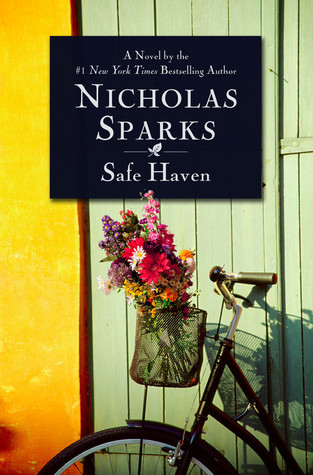
Safe Haven

7812659
Grand Central Publishing
Safe Haven
Nicholas Sparks
2010

The Summary
"When a mysterious young woman named Katie appears in the small North Carolina town of Southport, her sudden arrival raises questions about her past.  Beautiful yet self-effacing, Katie seems determined to avoid forming personal ties until a series of events draws her into two reluctant relationships:  one with her plainspoken neighbor, Jo; and another with Alex, a widowed store owner with two young children.  Despite her reservations, Katie slowly begins to relax her guard, putting down roots in the community and becoming increasingly attached to Alex and his family.

"But even as Katie begins to fall in love, she struggles with the dark secret that still haunts and terrifies her...a past that set her on a fearful journey across the country, to the oasis of Southport.  With Jo's support, Katie eventually realizes that she must choose between a life of transient safety and one of riskier rewards...and in the darkest hour, love is the only true safe haven."

The Good
Oddly enough, I fell in love with Safe Haven.  I've always been reluctant to read Nicholas Sparks.  I was never interested in reading The Notebook and I wasn't thrilled with The Choice, but I loved watching A Walk to Remember and I even liked watching Safe Haven when it came on TV.  Regardless, I was still a little hesitant to begin Safe Haven, because I really didn't know if I would enjoy it--if I would even get past the first chapter.

Well, I did.  And I was pleasantly surprised by how much I enjoyed it.

I've read Nicholas Sparks in the past, but I could never fully enjoy his writing.  Something about The Choice just wasn't appealing to me.  I'm not sure if it was his writing style, or the story, or the format--or if it just wasn't right for me at the time--but I wasn't impressed.  I pretty much brushed Nicholas Sparks aside and discounted him as a writer.

However, I found myself enjoying Safe Haven more than I expected.  It's a sweet little romance with endearing characters set in a small, Southern town on the coast, and it's threaded with very subtle hints of magic.  I might have liked it because it reminded me of Sarah Addison Allen and Linda Francis Lee, but I think I might have liked it best because it's set in North Carolina.  I've been to tiny towns like Southport, I've been to beaches like Katie describes, so the story appealed to me on a deeply personal level.

Most importantly, I think I liked the narrator:  Rebecca Lowman.  Lowman, who also narrated Girl Who Chased the Moon, does a fantastic job of bringing Sparks' works to life.  She's careful to distinguish characters with individual accents, using the soft drawl and twang of a Southern coastal town, while affecting different inflections in others.  I often felt myself drawn into the narrative as Lowman recounted Katie's story and her desperate flight from her past.

Safe Haven was a great audiobook, overall.  It struck a perfect balance of romance, suspense, and drama without leaning in one direction or the other, and it had a little bit of magic thrown into the mix that made it stand out.  It's sure to warm your heart, like it did mine.

The Bad
A few elements of Katie's romance with Alex rubbed me the wrong way, struck me as a little cliche, but it wasn't anything that left a lingering pall over the story.  It's not really even noticeable, just something that would appear every so often and then I would sink back into the story, ignoring it.  Otherwise, I don't really have any other complaints.

The Ugly
Domestic abuse is an ugly, ugly thing.

I didn't like Kevin for obvious reasons; however, I also feel like he wasn't crafted very well.  He has a strange religious/superiority complex that makes him strange, slightly absurd, but I suppose that stems from being purposefully made crazy.  He's not a great character, and he's a horrible human being.

And I really didn't like him.

Thursday, July 28, 2016

The Peach Keeper

8546358
Bantam
The Peach Keeper
Sarah Addison Allen
2011

The Summary
"The New York Times bestselling author of The Girl Who Chased the Moon welcomes you to her newest locale:  Walls of Water, North Carolina, where the secrets are thicker than the fog from the town's famous waterfalls, and the stuff of superstition is just as real as you want it to be.

"It's the dubious distinction of thirty-year-old Willa Jackson to hail from a fine old Southern family of means that met with financial ruin generations ago.  The Blue Ridge Madam--built by Willa's great-great-grandfather during Walls of Water's heyday, and once the town's grandest home--has stood for years as a lonely monument to misfortune and scandal.  And Willa herself has long strived to build a life beyond the brooding Jackson family shadow.

"But Willa has lately learned that an old classmate--socialite do-gooder Paxton Osgood, of the very prominent Osgood family--has restored the Blue Ridge Madam to her former glory, with plans to open a top-flight inn.  Maybe, at last, the troubled past can be laid to rest while something new and wonderful rises from its ashes.  But what rises instead is a skeleton, found buried beneath the property's lone peach tree, and certain to drag up dire consequences along with it.  For the bones--those of charismatic traveling salesman Tucker Devlin, who worked his dark charms on Walls of Water seventy-five years ago--are not all that lay hidden out of sight and mind.  Long-kept secrets surrounding the troubling remains have also come to light, seemingly heralded by a spate of sudden strange occurrences throughout the town.

"Now, thrust together in an unlikely friendship, united by a full-blooded mystery, Willa and Paxton must confront the dangerous passions and tragic betrayals that once bound their families--and uncover truths of the long-dead that have transcended time and defied the grave to touch the hearts and souls of the living.

"Resonant with insight into the deep and lasting power of friendship, love, and tradition, The Peach Keeper is a portrait of unshakable bonds that--in good times and bad, from one generation to the next--endure forever."

The Good
I loved listening to The Peach Keeper.  It reminded me a great deal of Garden Spells and The Girl Who Chased the Moon, but it has its own unique characters--although a few familiar faces do make a repeat appearance--and its own unique story.  It has much the same flavor:  a quirky Southern town, small hints of magic, complex mother-daughter relationships, and a deep sense of family and tradition that influences the thoughts, feelings, and actions of characters.

Like Allen's other novels, The Peach Keeper is weighty with history.  Specifically, it focuses on the turbulent past of the Jackson and Osgood families--and, more importantly, the unshakable bond held by Willa and Paxton's grandmothers, Georgie and Agatha.  It's a complex story with finely detailed characters, deep family roots, and subtle hints of magic that paint a rich tapestry of loss and love.

I loved the way Allen beautifully describes the Appalachian Mountains.  In Garden Spells, The Sugar Queen, and The Girl Who Chased the Moon, readers are introduced to the mountains of southern Appalachia.  However, in The Peach Keeper, we get a glimpse of the Blue Ridge Mountains--a small range of green, sloping mountains and hills in western North Carolina and eastern Tennessee, running right through Virginia--and it's a beautiful sight to behold.

Since I'm familiar with the Blue Ridge Mountains and the surrounding region, I was inordinately pleased by Sarah Addison Allen's descriptions of the mountains and, more importantly, her fictional town Walls of Water.  It's a breathtaking location that feels right at home in the Blue Ridge Mountains.  More importantly, I was excited by her references to landmarks I knew and descriptions I recognized.  It was unexpectedly thrilling.

I also enjoyed the characters.  It's wonderful to see Willa and Paxton's relationship develop, to see a reflection of their grandmothers' relationship in their newly budding friendship, and it's incredibly sweet to see separate romantic interests crop up in their lives.  Love and excitement is the last thing Willa is looking for with Colin, and Paxton is trying to keep the status quo steady between herself and her best friend, Sebastian.

Their relationships are complicated--Willa trying to live down her past, Paxton trying to preserve her dearest friendship--but it's refreshing to see them confront their problems head-on, to see them work through the struggles to see their own self-worth and measure.  I enjoyed watching them grow, figure things out and fall in love.  It's almost sickly sweet, but it's all worth it for the feeling that everything worked out all right in the end.

The Bad
The Peach Keeper feels a little darker than Allen's other novels.  I mean, sure you find a particularly terrifying villain in Julian from The Sugar Queen, and you're confronted with domestic abuse in Garden Spells.  But most of these stories feel lighter, like you know that things will all work out in the end.

The Peach Keeper, on the other hand, has this dark undertone to it that influences much of the novel and makes it a more serious narrative.  Although it begins with Georgie and Agatha's ordeal in 1936, it doesn't really dissipate.  The violence feels fresh, more palpable, more pervasive, especially with the ghost of Tucker Devlin hanging over the story.

The Ugly
Murder.

A justified murder, but murder nonetheless.  It's a rather terrible story.

Tuesday, July 19, 2016

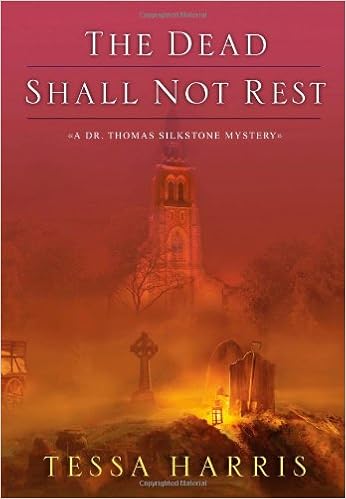
The Dead Shall Not Rest

Kensington
The Dead Shall Not Rest
Tessa Harris
2012

The Summary
"It is not just the living who are prey to London's criminals and cutpurses.  Corpses, too, are fair game--dug up from fresh graves and sold to unscrupulous men of science.  Dr. Thomas Silkstone abhors such methods, but his leading rival, Dr. John Hunter, has learned of the imminent death of eight-foot-tall Charles Byrne, known as the "Irish Giant," and will go to any lengths to obtain the body for his research.

"Thomas intends to see that Byrne is allowed to rest in peace.  Yet his efforts are complicated by concern for his betrothed, Lady Lydia Farrell, who breaks off their engagement without explanation.  When Dr. Hunter is implicated in the horrific murder of a young castrato, Thomas must determine how far the increasingly erratic surgeon will go in the name of knowledge.  For as Thomas knows too well, the blackest of hearts sometimes go undetected--and even an unblemished facade can hide terrifying secrets..."

The Good
Like The Anatomist's Apprentice, The Dead Shall Not Rest is a complex story that pulls upon a variety of narrative threads.  Sometimes, it sends you haring off in a different direction, leading you on a merry chase through a dark and terrible story, before leaving you utterly speechless as you return to the primary narrative.

But it's very, very good.

I was intrigued by the story from the very beginning, because it deals with Charles Byrne, a gigantic man who was known as the "Irish Giant."  His story is a sad, tragic tale of deception and greed--and medical misfortune.  I have to admit, I was very upset when I learned of his fate.  (Fair warning, fellow readers.)

However, it shouldn't deter you from reading (or, as I did, listening) to Tessa Harris' novel.  As the second in her Thomas Silkstone series, The Dead Shall Not Rest has all the things I loved about the first novel:  incredible characters, complex plots and narrative threads, intriguing interpersonal relationships and dynamic dialog, historical fact.

I loved how Harris continued to develop Thomas and Lydia's relationship, offering glimpses into their lives and their feelings toward one another, as well as developing them as individual characters.  Lydia is certainly more complex than I gave her credit in the first novel, but I can't say I like her more this time around.  She still seems to have all the qualities--vulnerabilities, weaknesses, insecurities--I disliked when I first met her; however, after catching a glimpse into her tumultuous past, I can more readily understand her.

I also loved the flavor of the story.  Like its predecessor, The Dead Shall Not Rest draws heavily from cultural and medical history.  Suspense is sprinkled liberally throughout the novel, but it often draws from historical fact, introducing readers to all the quirks and oddities of eighteenth century England.  It shows what life was like during such turbulent times; moreover, it offers a glimpse into the fledgling days of medicine when ignorance was rampant and superstition frequently ruled.

Simon Vance reprises his role as narrator, and I can't even explain how thrilled I was with his narration.  He manages to give a voice to Harris's characters, bringing them to life with his extraordinary range of vocal tones and accents.  He does excellent work, and he definitely doesn't disappoint.

The Bad
I hated the end of this book.  Hated.

Like The Anatomist's Apprentice, it has a bit of a twist ending.  It doesn't end like you expect or hope, and I was displeased by the fate of Charles Byrne--and I was doubly disheartened by the lingering feeling that something terrible was allowed to happen, that the villain (who I perceived as a villain) managed to get away without incurring any consequences for his barbaric actions.

It's truly horrifying.

The Ugly
Venereal disease.

The only reason I mention "venereal disease" is that there's a little episode in the book that describes a certain condition, in sickening detail, and examines its immediate effects on the human body.  I'm not ashamed to say that, afterward, I felt sick to my stomach.

Tuesday, July 5, 2016

The Anatomist's Apprentice

12218678
Kensington Books
The Anatomist's Apprentice
Tessa Harris
2011

The Summary
"In the first in a stunning new mystery series set in eighteenth-century England, Tessa Harris introduces Dr. Thomas Silkstone, anatomist and pioneering forensic detective...

"The death of Sir Edward Crick has unleashed a torrent of gossip through the seedy taverns and elegant ballrooms of Oxfordshire.  Few mourn the dissolute young man--except his sister, the beautiful Lady Lydia Farrell.  When her husband comes under suspicion for murder, she seeks expert help from Dr. Thomas Silkstone, a young anatomist from Philadelphia.

"Thomas arrived in England to study under its foremost surgeon, where his unconventional methods only add to his outsider status.  Against his better judgement he agrees to examine Sir Edward's corpse.  But it is not only the dead, but also the living, to whom he must apply the keen blade of his intellect.  And the deeper the doctor's investigations go, the greater the risk that he will be consigned to the ranks of the corpses he studies..."

The Good
I stumbled across The Anatomist's Apprentice purely by accident.  I was intrigued by the cover when I was skimming a list of audibooks and I clicked the thumbnail, which lead me, of course, to Tessa Harris's novel.  It's not usually the sort of book I would read:  a macabre medical thriller that's set at the tail end of the 18th century.  I mean, I like historical fiction, but medical dramas I'm a little less inclined to read.

However, I was pleasantly surprised by The Anatomist's Apprentice.  It has a good, solid story with an intricately crafted plot, complex characters, and wonderful historical detail.  I especially liked that the author put in the time and effort to describe her characters in such detail, giving them distinctive mannerisms and character quirks that made them instantly recognizable.

I mean, it's hard to forget the corpulent coroner who keeps meat pies hidden in his briefcase, or the egregious Matthew Farrell who flaunts his new wealth after the death of his brother, or the pale, timid creature known as Lady Lydia, who is a lady of perfect breeding (which, confidentially, made her rather boring).  And I certainly can't forget Thomas Silkstone and his mentor, Dr. William Carruthers.

Thomas Silkstone is a fascinating individual.  Although his skills border on the macabre (he is an anatomist, thus his greatest talents lie in the dissection of corpses and the identification of trauma to the human body), he's incredibly intelligent and, being an American caught in England during the American Revolution, he provides a different perspective on English culture and behavior.  More importantly, with his old mentor behind him, he has unique access to a wealth of knowledge--and someone to unceremoniously point out his follies.

Speaking of Thomas's mentor, I have to say I rather liked Dr. Carruthers.  He's practically ancient by normal health standards and he's blind, but he doesn't miss a thing.  He's quick as a whip, intellectually speaking, and he's an excellent sounding board for Thomas.  I loved Thomas' conversations with his old teacher, because they had such an easy rapport, a friendliness that created a unique and quiet lovely dynamic between them.  I grew to appreciate their relationship more than I realized.

One of the greatest things I appreciated about the audiobook, however, was the narrator:  Simon Vance.  Vance does an excellent job of bringing Harris' novel to life, giving a voice to all of the wonderful characters she fabricated.  He uses a variety of accents, playing upon the subtle differences in country and county to provide a broad range of voices that use both a soft, lilting cadence to a deep, rough timbre.  Truthfully, I found it fascinating to listen to him work and I enjoyed The Anatomist's Apprentice more for his narration.

The Bad
I supposed my greatest complaint was the pace.  Tessa Harris (and Simon Vance) do an excellent job of pacing the story, bringing each and every detail to light slowly; however, I found I was sometimes bored by how the story seemed to drag on forever.

Much like Agatha Christie's Murder on the Orient Express, The Anatomist's Apprentice takes multiple chapters to build and seems to unravel all within a few minutes.  While I enjoyed the story overall, I found I didn't like the sudden conclusion.  It had far too many twists at the end for my taste, and I found myself rather confused by the fact that the villain I thought had committed the crime wasn't actually the real mastermind.

It's a bit more convoluted than I would have liked.

As an aside, I do want to point out that I was rather annoyed by how often Lydia was considered to be "fragile," looking "more pale than he'd ever seen her."  Yes, I understand she's a fragile, delicate flower; however, I didn't like being reminded multiple times in the same novel.

The Ugly
Murder.

These people are incredibly inventive.  You think it's one thing, but it's actually quite another.  If it's not murder by bludgeoning, it's murder by drowning or poison or perceived suicide--or, in some cases, attempted murder by physical battery.  It's really very gruesome.

And, speaking of gruesome, I found the booming grave-digging trade to be sickeningly macabre.  Corpses are dug up from the graves and sold to nearby anatomists, who promptly dissect and dispose of the remains.  Even if Thomas does adhere to a set of ethics, which prevents him from taking advantage of the lucrative (if dubious) trade, he is still an anatomist and he still dissects human bodies.

I found myself feeling a bit squeamish from time to time as the narrator described autopsies in graphic detail.  It's more than a little disturbing.

Thursday, May 19, 2016

When in Doubt, Add Butter

13051956
St. Martin's Press
When in Doubt, Add Butter
Beth Harbison
2012

The Summary
"As far as Gemma is concerned, her days of dating are over.  In fact, it's her job to cater other people's dates, and that's just fine by her.  At thirty-seven, she has her own business, working as a private chef, and has five steady clients who keep her hands full.

"There's Lex, the fussy but fabulous department store owner who loves oysters Rockefeller and retro party food; Willa, who is morbidly obese and needs to lose weight under doctor's orders but still believes butter makes everything better; a colorful family who may or may not be part of the Russian mob; an überwealthy Georgetown family in which the monstrously spoiled wife is "allergic to everything"; and, finally, a man she calls "Mr. Tuesday," whom she has never met but to whom she feels a magnetic attraction, in part due to his taste for full-on comfort food.

"For Gemma, cooking is predictable.  Recipes are certain.  Use good ingredients, follow the directions, and you are assured success.  Life, on the other hand, is full of variables.  So when Gemma's takes an unexpected turn on a road she always thought was straight and narrow, she must face her past and move on in ways she never would have imagined.  Because sometimes in life, all you need is a little hope, a lot of courage, and--oh, yes--butter."

The Good
I listened to When in Doubt, Add Butter earlier this year, picking it specifically for the evenings I walked my dog.  I originally chose it based on the title--and, if I'm being honest with myself, I probably picked it for the image of cupcakes on the cover--but I was pleasantly surprised by Beth Harbison's novel and Orlagh Cassidy's narration.  Filled with lots of crazy, quirky characters and heart-warming stories, When in Doubt, Add Butter is a truly fabulous novel.

Gemma was an excellent narrator.  Witty and realistic, plagued by all the regular hopes and fears of a normal woman who worries about her professional and/or financial state, she can easily connect with readers on an emotional level--and, more importantly, she's funny.  She's candid and she has a way of recounting her story so that it has an emotional impact and makes you laugh.  Coupled with Orlagh Cassidy's skills, Gemma comes to life in a way that is, simply put, spectacular.

Speaking of Orlagh Cassiday, I absolutely loved the variety and range of characters she could play.  I was suitably impressed by the emotion and changes of tone that signified specific characters, distinguishing particular personalities apart, that allowed her to convey the story to listeners.  When in Doubt, Add Butter seemed to take on a life of its own, and I couldn't wait to return again and again to the story.

Honestly, I can't think of any reason this book isn't appealing.  It features a fun and heart-warming story, oddball characters, food, an excellent narrator and a dash of humor.  I was immediately drawn in from the first chapter--and if I wasn't, I'd certainly have been hooked by the ignominious incident with a peacock in the second.

The Bad
No complaints.

Perhaps the plot was a bit predictable, like I totally called the identity of Gemma's mysterious "Mr. Tuesday," but, otherwise, I enjoyed the entire novel.

The Ugly
Mature themes would probably be the best way to describe some of the uglier aspects of When in Doubt, Add Butter.  It has an underlying seriousness that reflects the doubts and desperation that plague Gemma, and it picks at the financial and professional and emotional uncertainties that all adults face.

Along with the ugly realities of teen pregnancy.

It's a bit heart-wrenching, I'll admit.

Thursday, May 12, 2016

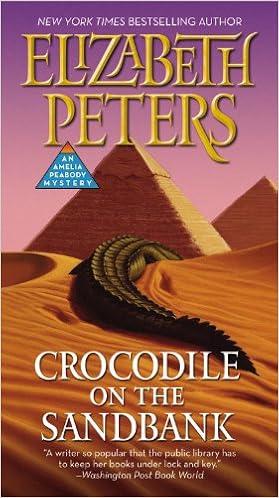
Crocodile on the Sandbank

Grand Central Publishing
Crocodile on the Sandbank
Elizabeth Peters
1975

The Summary
"Amelia Peabody, that indomitable product of the Victorian Age, embarks on her first Egyptian adventure armed with unshakable self-confidence, a journal to record her thoughts, and, of course, a sturdy umbrella.

"On her way, Amelia rescues young Evelyn Barton-Forbes, who has been 'ruined' and abandoned on the streets of Rome by her rascally lover.  With a typical disregard for convention, Amelia promptly hires her fellow countrywoman as a companion and takes her to Cairo.

"Eluding Alberto, Evelyn's former lover, who wants her back, and Evelyn's cousin Lord Ellesmere, who wishes to marry her, the two women sail up the Nile.  They disembark at an archaeological site run by the Emerson brothers--the irascible, but dashing, Radcliffe and the amiable Walter.  Soon their little party is increased by one--one mummy, that is, and a singularly lively example of the species.  Strange visitations, suspicious accidents, and a botched kidnapping convince Amelia that there is a plot afoot to harm Evelyn.

"But no villain, or mummy, is a match for the doughty Amelia.  How she arranges all to her satisfaction is just one of the pleasures of this delightfully witty mystery."

The Good
At the recommendation of a co-worker, I read--or, rather, listened to--Crocodile on the Sandbank and I found it to be a fun, lively little novel with excellent characters and a high sense of adventure.  I loved the setting and the intrigue, the historical anecdotes that the narrator liberally sprinkles throughout her narrative.  It's wonderfully fun and fascinating.

And, speaking of narrator, I really enjoyed listening to Amelia Peabody.

Amelia Peabody is a daring, sassy female protagonist with a dynamic personality and a scorching wit that makes her wholly unique in 19th century society.  She's quite intelligent, incredibly daring, and she's certainly not afraid to speak her mind.  After spending years in spinsterhood, she doesn't much care to ruffle a few feathers and step on a few toes, especially when it comes to hot-headed Radcliffe Emerson.

It's just plain fun, which, I think, is why I liked it so well.  It's full of mystery, romance, adventure, and intrigue, but it has a narrator who's thoughtful and intelligent and, occasionally, belligerent.  It's so much fun to dive into the story and see what happens next.

The Bad
Eleanor is pretty much characterized as the stereotypical shrinking violet, the helpless swooning maid in need of a heroic man--or, in this case, Amelia--to save her.  She's made of sterner stuff, obviously, but, as readers, we don't always get to see that side of her which I found to be a bit of a disappointment.  Amelia is bold and robust, so she often overshadows the softer spoke, more timid Eleanor.

The Ugly
You think the mummy might be the worst of it, but you'd be surprised especially whenever Lord Ellesmere and Alberto get involved.  It's really quite a mess and, when the unmasking comes, it's a regular Scooby-Doo episode.

Saturday, May 7, 2016

Read Harder Challenge (Part Three)

I've discovered some more books as part of my commitment to the Read Harder Challenge of 2016, and I've discovered some great stories in my explorations.  I have managed to:
  1. Read a horror book.
  2. Read the first book in a series by a person of color.
  3. Read a play.
HarperTeen
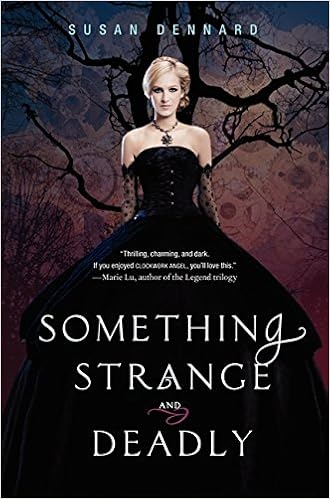
Usually, I don't read horror novels.  Dracula and Frankenstein are about it for me, but I have managed to read Stephen King's The Shining and The Strange Case of Dr. Jekyll and Mr. Hyde by Robert Louis Stevenson, among a handful of other novels that are considered good and scary.  And so, in order to satisfy my challenge criterion and read a horror story, I read Something Strange and Deadly by Susan Dennard.

Although I didn't initially lump Dennard's novel into the horror genre, I reconsidered my stance after necromancy and ritualized violence became involved.  The novel is pretty mild, all things considered--I mean, I certainly wouldn't put it at the level of The Walking Dead or Stephen King, or even Dracula--but it's still rather gory and riddled with a tough kind of suspense that leaves you hanging on the edge of your seat, hoping for more answers.  However, I think it's the zombies that pushed it over the edge and helped me give it a final designation as a horror novel.

I wouldn't call Something Strange and Deadly one of my favorites, but it isn't a bad book; in fact, I initially enjoyed it.  I liked the creepy atmosphere of it coupled with the turn of the century setting, and I even liked the story:  a wicked necromancer comes back from the dead to terrorize Eleanor Fitt, while the Dead continue to rise from their graves across Philadelphia.  It's an intriguing adventure, to say the least; however, I wasn't entirely thrilled with the story when I examined it in retrospect.  The phrase "shut pan" annoyed me to no end.  (Part of me began to think the author found a new, novel phrase and decided to run with it.)

Harper Voyager
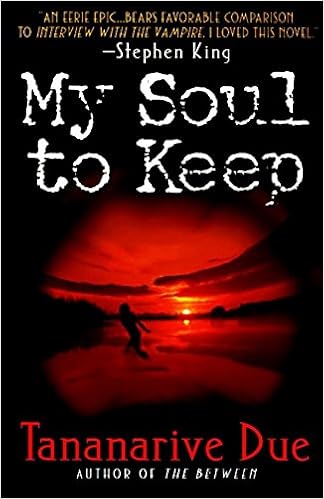
Next, in reading the first book in a series by a person of color, I picked up My Soul to Keep by Tananarive Due.  As the first book in the African Immortals series, My Soul to Keep fit the bill perfectly to fulfill this challenge and check it off my list.  I stumbled across it purely by accident, finding it in audiobook form from my local library's website--and I was immediately hooked.

I was intrigued by the premise:  an Ethiopian warrior stumbles across the secret to immortality and spends the rest of his eternal life alternating between identities, enduring a number of years as a slave on a Southern plantation, before becoming a Civil War soldier, a jazz singer, and, finally, a college professor and author.  His story is one of sorrow and loss, desperation in trying to hold tight to the ones he loves.  I was riveted from the first word, from the first moment the narrator spoke and started to weave a complex, beautiful story about Dawit--David--and his wife, Jessica.

At just over eighteen hours long, it took me a number of weeks whittling away at the story to complete it, but I have to say I was thrilled.  It's detailed and strongly written (and narrated by Peter Francis James, who has an amazing voice by the way), and it's absolutely riveting.  The story packs a punch, pulling together a myriad of religions, myths, cultures, and countries to create a flawless tapestry of history and suspense, beauty and sorrow.  I became emotionally invested in Dawit and Jessica's story, and I found myself hoping for the best outcome--and crying (just a little) when tragedy strikes.  I highly recommend picking up My Soul to Keep and reading it for yourself.

Dover Publications
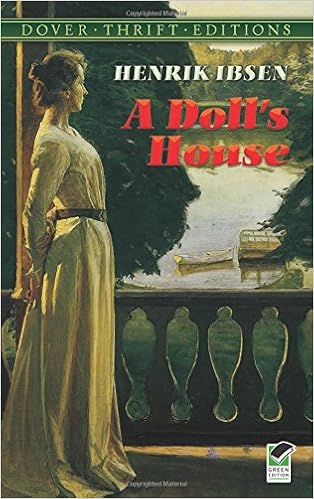
Last, I worked on Henrik Ibsen's A Doll's House.  Having read a portion of the play during a theater history class in college, I was intrigued about the prospect of reading the entire play this time around.  It was just my good fortune that I found a copy of the play for a dollar at my local used bookstore.  It's almost as if it was fated to be.

A Doll's House is an interesting play, not action-packed or suspenseful (like either of the two entries listed above).  For the time period, it's thought-provoking and, even now, it raises a lot of questions about women as spouses and mothers--and what are the typical roles of women in society.  It's a play designed to make you think, rather than thrill you.

Personally, I thought it was fascinating to see how Nora managed to flaunt convention, managed to get what she wanted despite the restrictive constraints of her time that were placed upon her gender, and, more importantly, proved she was capable of making her own decisions.  It's a bit slow, but I think it's worth reading at least once, especially if you're interested in theater.

Tuesday, April 26, 2016

My Soul to Keep

Harper Voyager
My Soul to Keep
Tananarive Due
1997

The Summary
"Jessica is an African-American journalist as ambitious as she is bright.  She is chasing the biggest story of her life, a story that strikes closer to home than she knows.

"Dawit is an immortal, whose ancient thirst for wisdom leads him to break the first commandment of his kind:  not to fall in love.

"Together they are about to pay the ultimate price for their ambition...and their desire."

The Good
Tananarive Due creates a fascinating and inventive novel in My Soul to Keep.  She pulls from religion and myth, drawing from a myriad of cultures and countries and continents, extracting fascinating bits of history to create an intricately woven story of loss and love, life and death and immortality--and all of its terrible implications.  My Soul to Keep is beautifully executed, crafting an exquisite story that's one part tragedy and one part family epic that tosses together a number of people (immortal and otherwise) into a tangled web.

Let me say this, I loved this story.  I stumbled across it purely by accident when I was scrolling through the audiobooks on my local library website and, when I realized it conformed to one of my Read Harder Challenge categories, I jumped at the chance to read it.  Not only was I impressed by depth of the novel, which explores the human heart and the effect of immortality on man, I fell in love with the history Due included in her novel.

My Soul to Keep delves into a particularly dark part of American history, setting a portion of her novel in the Louisiana shortly before the Civil War.  She confronts the reality of slavery, the violence and loss that so many people faced on a daily basis, and she does a spectacular job of illustrating what someone like Dawit might have experienced during those tumultuous times.

Due also draws upon many different parts of history:  Chicago during the Jazz Age, Miami in the bustling modern world, Spain during the Inquisition, and even Ethiopia from Dawit's childhood, four hundred years before the story begins.  She weaves together an enchanting, sometimes terrifying story, that encapsulates a variety of human experience--a tapestry of history that reflects the beliefs, the culture, the language of each and every age she visits in her novel.

My Soul to Keep is exceptional in that regard.

But I really enjoyed the story, too.  It has a complexity that's thrilling, an undercurrent of suspense and menace that leaves the reader on the edge of their seat.  Although it sometimes seems to develop slowly--that is, it took a little longer than I expected for me to put together some of the pieces--I was pleased with how the narrative evolved, how Jessica changed when she learned Dawit's secrets, Dawit's actions in trying to protect his family and his flashbacks to his not-so-immediate past.

Since I listened to Due's novel as an audiobook, I have to say I was particularly pleased with the narration.  Peter Francis James does a stellar job of reading My Soul to Keep, melding flawless narration with an exceptional story.  His voice brought life to the characters, gave them a singularly unique voice and an emotional impact that left me nearly breathless at each chapter.

I loved My Soul to Keep.  It's just a good book all around, and it's probably one of my favorite this year.

The Bad
No complaints.

Seriously, none.  At just over eighteen hours, My Soul to Keep was a bit lengthy for my usual tastes, but I enjoyed it, nonetheless.  It took me about two weeks to finish the story, since I could only listen to it a couple of hours a day when I walked my dog or drove my car, or when I worked early in the morning before opening.  But if you're interested in it, I certainly wouldn't let the time present an obstacle.

Due's novel is worth reading, and I highly recommend it.

The Ugly
There were a few moments during which I had to stop the tape and take a minute to process what had happened.  Sometimes, it was difficult to proceed with the story, because it hurt to see how everything was starting to fall apart for Jessica and Dawit.  My heart was breaking for them as their lives took a turn for the worse.

Wednesday, April 20, 2016

Unfinished (Part 4)

For every ten books I enjoy, I find myself stumbling across a book I simply don't like or one I don't care to finish.  Some books, I initially loved; others, not so much.  Regardless, I must sadly admit defeat and say I didn't finish a single book I have listed here.

-

Punk Planet Books
The Boy Detective Fails by Joe Meno was an interesting book.  I was initially intrigued by the  title and the cover, a gray cover with the white-and-blue image of a young boy (i.e. the boy detective) looking at what appears to be a severed arm.  It's a strikingly macabre illustration that made me first pick up the book; however, as I continued to read the novel, I was less enthusiastic.  While Joe Meno crafts an intriguing young adult novel about a boy still reeling from the loss of his sister to suicide, still struggling to find a new balance in his life and deal with his mental illness, I can't stay I stayed intrigued.

There's something about the tone of the novel that eventually put me off reading.  Part of it may have been the fact that Billy Argo, the Boy Detective, spent the majority of his adolescence in a mental institution, or the fact that Billy, once released, is dead set on finding out what happened to his sister, looking for killers who may or may not exist.  With facts like these, I couldn't help but predict one of two outcomes for the book:  one, Billy Argo is seriously deluded and ends up hurting and/or killing someone in the pursuit of "justice"; or, two, Billy Argo discovers his sister was murdered and then his world/case unravels.

I could have jumped the gun by predicting the outcome of the book.  I mean, I could be completely wrong about how The Boy Detective Fails ends; however, I wasn't ready to risk reading an entire book when my two options seemed so very unappealing.

-

Broadway Books
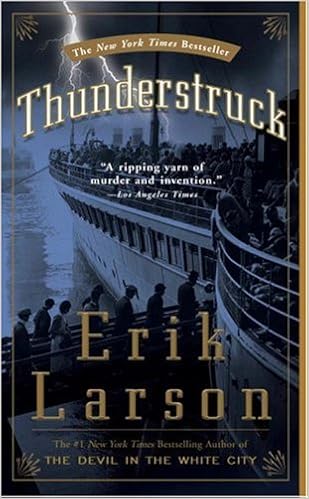
I really enjoyed Erik Larson's Thunderstruck.  As a lover of books and a lover of history, Thunderstruck seemed to hit all the right notes with me.  It helped me learn about an obscure part of history I simply didn't know and it introduced me to a startling new world of science and engineering, telling me about Guglielmo Marconi and his startling new invention, the wireless telegraph.  I mean, I really enjoyed reading Larson's book.

But I couldn't finish it.

Don't ask me why, but I couldn't seem to commit myself to more than a handful of pages at a time.  I'd read five pages, then stop; I'd read another six pages, then stop myself again, and promptly find myself distracted by another book.  (Like The DUFF by Kody Keplinger, or The Martian by Andy Weir--which I highly recommend, by the way--or A Game of Thrones by George R.R. Martin.)  It was a frustrating cycle and, eventually, I just gave up.

I still intend to finish reading Thunderstruck.  I want to find out what happens with Marconi's machine, how a brutal murder in London is connected to the wireless telegraph--and how a mild-mannered physician became what he became.  One day, I'll have answers to these questions; one day, I'll finish reading Larson's book.

Today, however, just isn't that day.

-

Hyperion
The Anatomy of Ghosts by Andrew Taylor was an interesting novel.  Part mystery, part drama, it combines vaguely supernatural elements with human desperation and tragedy.  It's a strangely compelling narrative.  I'd liken it to watching a train crash: you simply can't look away from the devastation.

I listened to it as an audiobook, listening to John Holdsworth's personal tragedies as his life and story begin to unravel, listening as Holdsworth investigates the haunting at Jerusalem College at Cambridge--and, admittedly, I was hooked for several hours.  However, I hit a point in the story when I simply didn't want to hear anymore.  Perhaps, it was the antics of the Holy Ghost Club; perhaps, it was the macabre images of ghosts and corpses; perhaps, it was Frank Overshaw's imprisonment in a mental institution.

Regardless of the cause, I found I couldn't bear to witness anymore and I had to put the story aside and move on to something happier.  Something with a little less gore, I thought.  Something that wouldn't make my stomach squirm quite so much.

As a sidenote, I'll point out that John Telfer was an extraordinary narrator.  I loved how he gave a different tone, different voice to each and every character.  I couldn't help but enjoy how he managed to give each character a uniquely distinguishable voice.  It was wonderful, and I'd love to find another story narrated by him.

-

Image result for a game of thrones book
Bantam
Last, but not least, I must admit failure with one very special, very wonderful book:  A Game of Thrones by George R.R. Martin.

I absolutely loved reading George R.R. Martin's novel.  I loved the way the book felt:  heavy with stories, full of suspense, riddled with elements of fantasy--and don't forget the dragons.  But, for some reason, I just couldn't muddle through A Game of Thrones.  Like Thunderstruck by Erik Larson, I couldn't stay committed to just one book.

I became distracted by other books, by slimmer volumes that offered immediate gratification, by stories that weren't quite so...tragic.  It's a grim story, blood-soaked and twisted.  And after witnessing a number of harrowing misadventures and horrible deaths, I found myself less and less inclined to finish reading A Game of Thrones.

I suppose having the story ruined by the HBO show didn't help matters either.