"All good books are alike in that they are truer than if they had really happened
and after you are finished reading one you will feel that all that happened to you
and afterwards it all belongs to you; the good and the bad, the ecstasy, the remorse,
and sorrow, the people and the places and how the weather was."
Ernest Hemingway
Showing posts with label France. Show all posts

Friday, May 19, 2017

Read Harder Challenge 2017: Part 4

This month, I finished a few more challenges, including:
  • Read a book by an immigrant or with a central immigration narrative.
  • Read a book published between 1900 and 1950.
  • Read a collection of poetry in translation on a theme other than love.

American Street
Balzer + Bray
First up, I read American Street by Ibi Zoboi, which follows Fabiola as she adjusts to life in America with her rowdy cousins and her reclusive aunt.  When she arrives in Detroit, she is confronted by a terrible crossroads that will change her life and haunt her as she goes in pursuit of the American Dream.  A fascinating inspection into the immigrant experience, American Street  was made all the more compelling by the fact that the author, like Fabiola, was emigrated from Haiti when she was only a child.

Overall, I liked American Street.  It's a good, solid book with interesting characters, a wonderful narrator, and a heart-wrenching story.  However, I often found myself divided, because I both loved and hated this book.  It inspired a lot of emotions, not all of them good, but it also made me think and it made me feel and it compelled me to read on through Fabiola's story even when I felt my interest waning.

But, most of all, I loved the hints of magical realism seeded throughout the story.  Fabiola has very strong beliefs and she particularly believes in the ilwas of Vodou, which adds a layer of mystery, a thin veil of magic that enriches her story.  You don't really discover if Bad Leg is really Papa Legba, or if he really is just some junkie off the street, like Fabiola's cousins say, but it's that uncertainty that imbues a certain strength in Fabiola's belief and offers uncommon insight into the landscape of Vodou.

John Carter of Mars (Barnes & Noble Collectible Editions): The First Five Novels
Barnes and Noble
Next, I conquered A Princess of Mars by Edgar Rice Burroughs, who also happens to be author of Tarzan of the Apes.  I picked up A Princess of Mars because I had it on my shelf and, more to the point, it seemed like an acceptable escape from reality; however, I wasn't always enchanted with the story.  I mean, it was really just mindless fun.

Originally serialized in 1912, A Princess of Mars is the first of many novels of the Barsoom Chronicles penned by Burroughs.  It follows John Carter, a former military man from Virginia, who finds himself ambushed in Arizona--and transported to a different world.  Mars (known as Barsoom to the native peoples) is a seemingly desolate land populated with dangerous creatures and war-like citizens, and Carter must find a way to survive if he eventually hopes to return to his home world.

For much of the story, it's really just Carter being really impressive with his super-strength and incredible agility and uncanny ability to learn languages--that is, unless he's rescuing the damsel in distress or endearing himself to the local wildlife.  Something interesting or incredible usually happens at the end of every chapter, so it's a bit of a page turner when Carter isn't boring you with facts that are obviously wrong or making you laugh with physics that could obviously never happen.

24601
New Directions
Last, I checked out Paris Spleen by Charles Baudelaire.  Paris Spleen is a short collection of poetry originally written in French in 1896 by Charles Baudelaire--and none of his poems are about love.  I found it exceedingly difficult to find a collection of poetry that didn't talk about love, because everyone likes to talk about love and relationships and affection.  They're warm, fuzzy feelings to which everyone can relate.

But Baudelaire doesn't base his poetry on warm, fuzzy feelings; instead, he examines a darker side of human life.  He looks at the every day pleasures of intoxicating drink, sensuous women, and fine art; however, he also shines a lot on oppression, city squalor, mistreatment, malice.  His work couldn't be farther from warm, fuzzy feelings, like love.

It worked for my Read Harder Challenge, but, I will admit, it's definitely an acquired taste.  Baudelaire is really something else.

Wednesday, May 17, 2017

When Churchill Slaughtered Sheep and Stalin Robbed a Bank

Picador
When Churchill Slaughtered Sheep and Stalin Robbed a Bank
Giles Milton
2016

The Summary
"More addictive and mind-blowing true tales from history, told by Giles Milton--one of today's most entertaining and accessible yet always intelligent and illuminating historians.

"In the second installment of his outrageously entertaining series, History's Unknown Chapters, Giles Milton shows his customary historical flair as he delves into the little-known stories from history, including when Stalin was actually assassinated with poison by one of his inner circle; the Russian scientist, dubbed the "Red Frankenstein," who attempted to produce a human-ape hybrid through ethically dubious means; the family who survived thirty-eight days at sea with almost no water or supplies after their ship was destroyed by a killer whale; or the plot that served as a template for 9/11, in which four Algerian terrorists attempted to hijack a plane and fly it into the Eiffel Tower."

The Good
Giles Milton's work is as entertaining as always in this latest addition to his series, History's Unknown Chapters.  Personally, I loved learning new things about history that I didn't know, like the rehearsal for D-Day that saw more than 900 casualties.  Or the spy who broke into Auscwitz.  Or the man who broke into Buckingham Palace and decided to hang out in the Queen's chambers.  Or Guy Gabaldon, who captured several hundred Japanese soldiers without even firing a bullet.

When Churchill Slaughtered Sheep and Stalin Robbed a Bank is pared down into manageable, bite-size sections, which makes Mileton's book both easy-to-read and accessible.  Don't want to hear about how Charlie Chaplain's grave was robbed?  Skip it!  Don't care to hear about Stalin's assassination?  Then move on to the next chapter.

This book is great if you like random facts, if you like history, or if you like learning about weird, quirky people and strange happenings across the globe.  It's highly entertaining and it's accessible, which I--and I'm sure other readers--appreciate.

The Bad
As I discovered with When Hitler Took Cocaine and Lenin Lost His Brain, When Churchill Slaughtered Sheep and Stalin Robbed a Bank is a book to be read at short intervals.  I loved the random facts, the quick anecdotes that taught me something new; however, I mostly read it in between other books or when I was waiting--like waiting for an oil change, or waiting for a seat at a restaurant, or waiting for my boyfriend to pick me up.

It's more of a short, entertaining read to be taken up at short intervals, rather than consumed in one large gulp.

The Ugly
Reality truly is stranger than fiction.

Thursday, March 9, 2017

Rejected Princesses: Tales of History's Boldest Heroines, Hellions, and Heretics

Dey St.
Rejected Princesses:  Tales of History's Boldest Heroines, Hellions, and Heretics
Jason Porath
2016

The Summary
"Well-behaved women seldom make history...and these women are far from well behaved.

"Let's face it:  the list of historical women we learn about in school is lacking.  It's safe, it's censored, it's short.  And even when we learn about a true legend--say, Harriet Tubman--we get half the story (and it's usually not the half about her as a plantation-torching Union spy-master).  This is just the list of women we know about.  What of the women we don't?

"In place of complex, real-life heroines, we get sparkly, doe-eyed animated damsels who dominate children's minds everywhere.

"Rejected Princesses is here to provide an alternative to all that.

"In this fully illustrated, deeply researched, and totally entertaining collection, Jason Porath offers 100 women too uncompromising, too untoward, or too uncomfortable to fit the modern princess mold.  Gathering together a diverse set of some famous, some infamous, some forgotten, and some virtually unknown figures from history and myth, from all over the globe, this book presents the female role models we never knew we needed.  Yes, there are a few princesses, but there are also pirates, spies, journalists, activists, concubines, empresses, ninjas, pilots, samurais, mathematicians, sword-slingers, and war-lords too.

"These women were rebels and rulers, pioneers in their fields, and fighters for their causes (and sometimes for themselves).  In a time when women are still pushing for equal pay and equal opportunity, shouldn't we be putting brave women like Sybil Luddington, Hatshepshut, Nzinga Mbande, Josephine Baker, Khutulun, Rani Lakshimbai, Harriet Tubman, Emmeline Parkhurst, and Joan of Arc on equal footing with Cinderella or Sleeping Beauty?

"Women have always played a key, kick-ass role in revolutionizing our world.  The girls of today are the latest links in a long chain of geniuses, warriors, and fearless women.  It is the birthright of every woman to have a connection to that history.  Empowering, uproarious, and anything but traditional, Rejected Princesses seeks to provide just that."

The Good
I loved this book.

Yes, loved.

If it's not already apparent, I'm a bit of a history nerd and I love learning about quirky, unconventional history and feisty females who made their mark on history (see:  Bad Girls), so Rejected Princesses was the best of both worlds for me.

I imagine that many of the women featured in this book were too rebellious, too dangerous and, sometimes, too deadly to make it into high school textbooks; in fact, many of the women--whether resigned to the darkest parts of history or lingering at the edges of myth--were a pleasant surprise.  That is, I'd never read about them and I loved learning about them and the impact they made on history.

Here are some of my favorites:
  • Khutulun
  • Noor Inayat Khan
  • Julie d'Aubigny
  • Annie Jump Cannon
  • Iara
  • Mariya Oktyabrskaya
  • Olga of Kiev
  • Ching Shih
  • Sybil Luddington
  • Alfhild
  • Mary Bowser
  • Nanny of the Maroons
  • Tomo Gozen
  • Marjana
All of these women were incredible.  I mean, on this list alone you have fighters and warriors, spies and astronomers, pirates and Vikings, rebels and freedom fighters.  They're incredible.  Granted, I know some of them didn't exist (Marjana is a literary character, whereas Iara and, I think, Alfhild are myths and/or legends), but it was wonderful getting a glimpse into these individual cultures and their perceptions of women--and how these women flaunted conventions.

It was great.

And, of course, I can't forget the Night Witches from my list.  You can hear about me rhapsodize about the Night Witches here, so I won't go into much detail about them, except to say that they are without a doubt the most incredible pilots of World War II (I'm not joking) and, perhaps, some of the most incredible women about which I've had the pleasure to learn.

Overall, Rejected Princesses is a wonderful book.  Full of humor, colorful art, historical facts and, of course, incredible women, it's a great resource for those who wish to dabble in history--and it will show you just what it means to fight like a girl.


The Bad
No complaints.

I seriously want a copy for myself.

The Ugly
History is not always pretty--and, let's be honest here, it hasn't always been kind to women.  Some were burned at the stake because they were different; others were buried alive or faced a firing squad; some were even assassinated for their own violent reactions to society.  Not all these ladies had the luxury to happily retire.

Tuesday, November 29, 2016

Rook

23399192
Scholastic Press
Rook
Sharon Cameron
2015

The Summary
"History has a way of repeating itself.  In the Sunken City that was once Paris, all who oppose the new revolution are being put to the blade.  Except for those who disappear from their prison cells, a single, red-tipped rook feather left in their place.  The mysterious Red Rook is a savior of the innocent, and a criminal in the eyes of the government.

"Meanwhile, across the sea in the Commonwealth, Sophia Bellamy's arranged marriage to the wealthy René Hasard is the last chance to save her family from financial ruin.  But when the search for the Red Rook comes straight to the doors of the Bellamy House, Sophia discovers that her fiancé is not all he seems.  Which is only fair, because neither is she.

"As the Red Rook grows bolder and the stakes grow ever higher, Sophia and René find themselves locked in a tantalizing game of cat and mouse.

"Daring intrigue, delicious romance, and spine-tingling suspense fill the pages of this extraordinary epic tale from award-winning author Sharon Cameron."

The Good
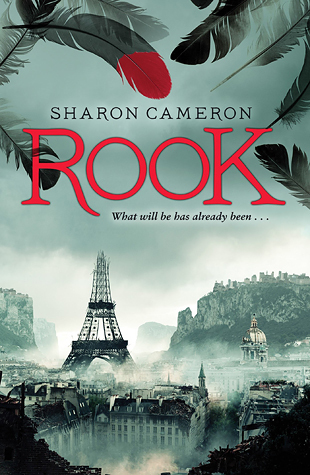
I absolutely loved Rook.  I found it at my library purely by accident, sitting atop a display of random young adult novels in the teen section, and I was immediately attracted to the cover.  I recognized the image of Paris on the cover, replete with a skeleton of the Eiffel Tower rising in the distance.  It looked familiar and yet, at the same time, it was completely and utterly foreign...and I couldn't help myself.

I was immediately intrigued by the Red Rook.  Sophia lives an intriguing double life as both the daughter of an impoverished aristocrat and the Red Rook.  (I'm not ruining anything for readers by mentioning Sophia's alter ego, as her identity is hinted at on the book jacket and confirmed in the first couple of pages.)  She's a clever and capable heroine, who manages to save lives and, ultimately, start a revolution.

Personally, I liked her.

And, while I was a little suspicious of René, I eventually grew to like him.  He and Sophia work well together.  They both have (possibly deadly) secrets; they have unusual skills that help them fit quite nicely in their line of work; and they make a living thwarting the government.  I liked seeing their relationship develop, and I liked seeing how Sophia reacted to someone who had many of the same skills and talents as she.

Granted, I wasn't a fan of the love triangle--René and Sophia seemed to harbor a mutual affection, while Spear and Sophia have history.  Although Sophia views Spear as more of a brother, their relationship is, nevertheless, complicated--but it wasn't as bad as, say, Twilight.  Or Vampire Diaries.  Or Something Strange and Deadly.  Or any number of other young adult fantasy/sci-fi romance.

Overall, I liked Rook.  It reminded me of Cinder and the rest of the Lunar Chronicles by Marissa Meyer.  While it does fall under the rather broad label of dystopian young adult fantasy (think Hunger Games, Divergent, The Maze Runner, Life as We Knew It or, even, The Giver), I really enjoyed Cameron's novel.  I enjoyed the characters, the unexpected twists and turns, the ambiguous references to the past, the complicated political climate.  It's quickly become one of my guilty pleasures.

The Bad
Admittedly, I did dislike the pace of this novel.  For the most part, I enjoyed Rook.  I liked the intermingling of tense, suspenseful story-writing with political intrigue and romance, and I liked how the story would flip between characters and give me insight into what's happening at any given moment.

However, I hated how it slowed toward the end of the story.  I think Rook was bogged down by too many twists and turns, by too much build up.  It would have fared better if it had trimmed out a little of the fluff--the budding romance between Sophia and Rene, the dwelling on LeBlanc's political aspirations, the myriad of preparations to depart for the Sunken City--and focused more on the core of the story.

Also, I would have liked a little more detail about what happened to Paris and society as a whole.  I know about the Great Death, which apparently was a near-extinction level event that practically wiped out the human race, and I understood vaguely that the so-called "Ancients" were essentially us; however, I didn't quite understand what happened between the Great Death and the present day of Sophia's world.

One character postulated some theories, such as a reversal of the magnetic poles or a weakening of the atmosphere, which could have led to the change in climate and the gradual decline of humanity, but I don't have much detail.  I mean, what happened to Paris that it became the Sunken City?  How and why did the Commonwealth build itself into some semblance of Regency era England?  What happened that technology was completely and utterly wiped out--and why was it so distrusted?

I would have loved a little more detail, and I was a little disappointed when I didn't find it.

The Ugly
Death.

There's a lot of gruesome ways to die in this book, whether by guillotine or knife blade or poison or simply exposure in prison.  Le Blanc and the Allemande, intent on quelling the populace and bringing rebels to heel, leave a trail of bodies in their wake--and it's really quite gruesome when you think about it.

Saturday, October 15, 2016

Read Harder Challenge (Part Seven)

I finished some new books for my Read Harder Challenge, and I've completed more reading tasks:
  1. Read a biography (not memoir or autobiography)
  2. Read a dystopian or post-apocalyptic novel
  3. Read a book about religion (fiction or nonfiction)
St. Martin's Griffin
First up, I finished Florence Foster Jenkins by Nicholas Martin and Jasper Rees, which inspired the recently released movie of the same name.  Florence Foster Jenkins was not a traditional singer.  At a young age, she was well known for her skill with a piano and her love--and, more importantly, support--of music; however, it wasn't until she was 76 years old that she undertook to become a concert singer.  She's best remembered for her concert at Carnegie Hall and her vinyl recordings, which introduced the world to her rather...unique voice.

I enjoyed reading Florence Foster Jenkins.  Drawing from multiple resources, including Florence and her common law husband, St. Clair Bayfield, Martin and Rees' book does an incredible job of shedding light on Florence, her work, and her time.  It's intriguing without becoming dull, amusing without ridiculing its rather unorthodox subject, and chock full of interesting historical facts about Florence and the New York artistic scene of the early 20th century.  Overall, I enjoyed it and I highly recommend for any readers to take a moment to listen to Madame Jenkins on YouTube to get a better idea of how her singing voice sounded.  You (probably) won't regret it.

23399192
Scholastic Press
Next, I completed Rook by Sharon Cameron.  The Sunken City--formerly Paris, the City of Lights--is a place of danger, desperation, and despotism.  Ruled by the corrupt Premier Allemande and the bloodthirsty LeBlanc, the Sunken City is brimming with discontent and revolution--and, at the heart of it all, is the mysterious Red Rook who spirits people from their cells and wreaks havoc against the Premier's puppet government.

A story packed with action and adventure, political intrigue and danger, Rook has quickly become one of my guilty pleasures.  I know it falls under the rather broad category of dystopian young adult fantasy (think Hunger Games, Divergent, The Maze RunnerLife as We Knew It or even The Giver), but I really enjoyed Sharon Cameron's novel.  I enjoyed the characters, the unexpected twists and turns, the ambiguous references to the past, the complicated political climate.  I wasn't a fan of the love triangle and, yes, I will admit that the story seemed to drag in a few places; however, altogether, I really liked it and I think it settles in nicely next to Cinder.

Last, I rounded out my reading with God in Pink by Hasan Namir.  Ramy is a young Muslim man living in Iraq in 2003, right in the midst of a war and a cultural revolution--and he also happens to be gay.  Struggling with what he knows his brother would term a "sexual deviancy," Ramy tries to balance his feelings with his obligations to his family and his faith.

Arsenal Pulp Press
Truthfully, I struggled with this novel, because I was not comfortable with all the depictions of heinous violence and wanton savagery.  I understand that mindless cruelty, thoughtless barbarity is simply a fact; I understand that it happens, that it's not something you can ignore if you live on the planet Earth.  I know it exists, but it's still hard to read about terrible things happening to other people.

I didn't hate this novel; rather, the opposite.  I thought God in Pink was a magnificent book depicting life in war-torn Iraq for a gay Muslim man.  It's poignant and it's guaranteed to make an impact, but, at the same time, it will tear out your heart.  I recommend reading it with great caution, like I would for Native Son by Richard White, Beloved by Toni Morrison, or The Grapes of Wrath by John Steinbeck.  Read it, but expect deep emotional turmoil.

Tuesday, August 23, 2016

East

981170
Harcourt
East
Edith Pattou
2003

The Summary
"Rose is the youngest of seven children, meant to replace her dead sister.

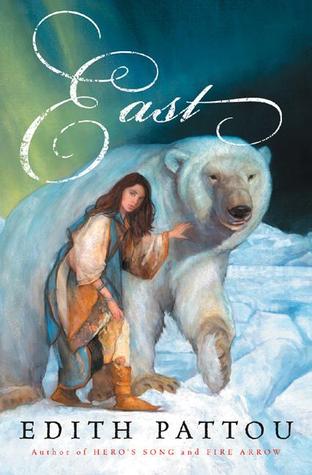
"Maybe because of that, she's never really fit in.  She's always felt different, out of place, a restless wanderer in a family of homebodies.  So when an enormous white bear mysteriously shows up and asks her to come away with it--in exchange for health and prosperity for her ailing family--she readily agrees.

"Rose travels on the bears broad back to a distant and empty castle, where she is nightly joined by a mysterious stranger.  In discovering his identity, she loses her heart--and finds her purpose--and realizes her journey has only just begun.

"As familiar and moving as Beauty and the Beast, yet as fresh and original as only the best fantasy can be, East is a bold retelling of the classic tale, 'East of the Sun and West of the Moon,' a sweeping story of grand proportions."

The Good
East is a curious story that pulls directly from the Norwegian fairy tale, "East of the Sun and West of the Moon," but it seems to draw on everything from history, Beauty and the Beast, Greek mythology--and much more.  It's intriguing and fascinating and strangely beautiful.  Truthfully, it's quickly become one of my favorite books for young readers.

I loved the imagery of East, especially when Rose weaves her stories.  Don't get me wrong, I liked reading Neddy's and their father's narratives, because they both offered insight into Rose's personality as a child and gave some perspective to her unexpected journey.  However, I enjoyed Rose's narrative best because she had a way of looking at the world that impressed upon me the beauty of the far north, a way of chronicling sensations and thoughts that allowed me to better envision her adventure.

She loved to see the world, and she loved beautiful things in nature.  She knew how to capture and convey their appearance, their subtle ferocity and their ethereal beauty, which I absolutely loved.  She weaves a beautiful story, literally and figuratively.  Rose creates beautiful works of art in the cloth she makes, the tapestry she weaves, and she has a similar talent for stringing together words to create a narrative that's both evocative and fascinating.

I loved it.

I also loved its originality.  Yes, I realize it pulls directly from "East of the Sun and West of the Moon"; however, Pattou manages to give the story an added depth by crafting complex characters and expanding upon the goblin myth.  Moreover, I liked that she pulled from all sorts of European myths, drawing out aspects of Beauty and the Beast (an originally French fairy tale) and the story of Cupid and Psyche.  It was interesting to see all these different influences come together.

East was a wonderful book.  I was pleased by the pacing, the imagery, the complexity and depth of the story, the variety of characters.  It had all the best qualities in a book, and I loved it almost immediately.

The Bad
Pattou manages to convey a sense of elapsing time.  Many months pass as Rose sets out with the White Bear, and many more months pass as she journeys to a place "east of the sun, west of the moon" to free him from the clutches of the wicked Troll Queen.  It makes for a rather long book, but, at least, the pacing is spot on and the story merely feels like a natural progression of the narrative.

The Ugly
Superstition and curses.

It can only lead to tragedy.

Thursday, May 26, 2016

When Hitler Took Cocaine and Lenin Lost His Brain

Picador
When Hitler Took Cocaine and Lenin Lost His Brain
Giles Milton
2016

The Summary
"In this first installment of his outrageously entertaining series, History's Unknown Chapters, Giles Milton delves into the little-known stories from history, like when a cook aboard the Titanic pickled himself with whiskey and survived in the icy seas where most everyone else died; or the man who survived the atomic bomb in both Hiroshima and Nagasaki.

"Covering everything from adventure, war, murder, and slavery to espionage--including the stories of the female Robinson Crusoe, Hitler's final hours, Japan's deadly balloon bomb, and the emperor of the United States--these tales deserve to be told."

The Good
I enjoyed this book much more than I expected.  Actually, I shouldn't say that because I expected quite a lot from a book titled When Hitler Took Cocaine and Lenin Lost His Brain.  This is a book that, as my coworker pointed out, "you pick up just for the title alone."  And, honestly, I have to say I agree.

Giles Milton's book is filled with fascinating tidbits of information, weird history, and incredible stories that seem almost too strange to believe.  It's fun and it's interesting without being too overwhelming or dense.  It's divided into short, quick sections, which makes it easy to plow through a whole chapter in a matter of minutes.

Moreover, I loved that I learned new things about history that I never knew.  Like the man who survived two nuclear explosions, one at Nagasaki and one at Hiroshima.  Or the cook who survived the sinking of the Titanic by, he claimed, drinking enough alcohol.  Or Agatha Christie's eleven missing days, during December 1926--before she was found in a distant hotel under the name of her husband's mistress.  Or how Lenin's corpse was preserved and put on display, his brain being donated to another institution for study (and his heart entirely disappearing).

Sure, it sometimes gets a little gruesome and, admittedly, a little weird.  But it's fun and fascinating, grabbing your attention and holding it by offering new and, if possible, even more incredible stories.  It's worth reading, especially if you love history or even just weird, unexpected facts.

The Bad
Giles Milton's book is not an in-depth study of human history.  Primarily, it focuses on historical events starting in 1912 (i.e. the sinking of Titanic) and ends somewhere in the 1960s, which means if you want to look beyond the twentieth century, you may have to look elsewhere.  It's a great book for an overview of facts, rather than a detailed examination of events.

The Ugly
Some of these stories have a (relatively) happy ending, like the cook who survived the sinking of the Titanic, or the seamstress who lived on an inhospitable island for 2 years before she was rescued, or the heroic dog who saved his fellow soldiers during World War I--or the real life Captain America who was twice turned away by the army, and eventually became a highly decorated veteran of World War II.

Other stories, however, are a little more brutal:  the pair of explorers who died on Mount Everest, the assassination of Rasputin, the Englishwoman who adopted several children and subsequently murdered them, or the poor individuals who were put on display before a jeering mob.  These stories, for me, often provoked disgust or sympathy.

Some of these stories are disheartening, some of them are daunting because they reflect an especially dark chapter in human history that, while intriguing and strange and downright weird, are often cringe worthy.

Tuesday, April 19, 2016

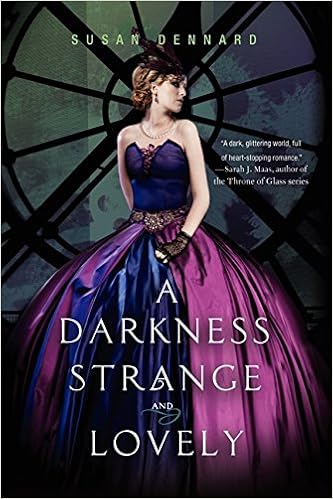
A Darkness Strange and Lovely

HarperTeen
A Darkness Strange and Lovely
Susan Dennard
2013

The Summary
"After helping the Spirit-Hunters save Philadelphia from the walking Dead, Eleanor Fitt must now face the thing she couldn't stop:  her brother's death, her mother's deteriorating health, and the sting of unrequited love.  But when she encounters the necromancer Marcus again, she must seek the help of Joseph, Jie, and the gorgeous Daniel--who have all fled to Paris.

"On her way to France, Eleanor meets Oliver, who claims to have known her brother.  Though friendly, Oliver harbors a secret involving black magic that entices Eleanor.  Trying to resist it, she rejoins the Spirit-Hunters in hopes of stopping Marcus.

"But the Dead have taken over Paris, and there's a whole new evil lurking.  Eleanor is now forced to make a dangerous decision--and her choice could mean life or death for everyone."

The Good
Oddly enough, I devoured this book.  Something about it appealed to me and kept me riveted to the page.  I can't say why, either.  It's packed with action, a handful of decent characters, a few plot twists I didn't expect, and I was somehow hooked--drawn inexplicably into a crazy, wild story that crosses the Atlantic and drives right into the heart of Paris.

I'll be the first to admit that A Darkness Strange and Lovely isn't a great book.  I mean, it isn't an epic or an immediate classic, but it's fun and interesting--and it appealed to me on a certain level.  I liked the idea of zombies using the catacombs of Paris to take more victims, to create more havoc.  It's an intriguing concept.  It's exciting and full of heart-pounding action, a few fascinating inventions and weird (read:  mad scientist) science, but it's fun to read.

I can't really tell you why, but I really liked reading Susan Dennard's novel.  I liked it well enough that I managed to finish it within a couple of days.

The Bad
A Darkness Strange and Lovely doesn't have the best writing.  It isn't always compelling and, admittedly, it lost my attention a couple of times.  Granted, I still finished it in, like, two days, but it's not a great novel.  It's dark and grisly, but it has a bad habit of throwing up unnecessary smokescreens that I found annoying and, more often than not,  offered zero explanation for magic.

It continually led me on to one misadventure after another, propelling the story forward with one event after another, culminating in an obvious (to the reader) conclusion.  I felt there were a few gaps in the story:  why was Marcus in France to begin with?  I mean, it's not like it was a particularly compelling destination.  And why doesn't anyone explain circumstances--and magic--to Eleanor when it would keep her out of danger?

Basically, Eleanor is a loaded cannon.  And, instead of teaching her how to aim in the right direction or, you know, telling her to keep a burning match away from the fuse, they all (but Oliver and Joseph, in particular) seem content to let her walk around in ignorance.  She could had been spared a lot of problems and everyone else could have been saved a lot of trouble if they'd just told her the truth.

Sheesh.

The Ugly
Flesh-eating zombies.

Oh, and soul-sucking demons.

And reanimated animal corpses.

Saturday, January 2, 2016

Bonus: Me Talk Pretty One Day

Little, Brown and Company
Me Talk Pretty One Day
David Sedaris
2000

The Summary
In Me Talk Pretty One Day, David Sedaris recounts his childhood in North Carolina and his eventual migration to Paris via New York.  Full of funny and hilarious essays, Sedaris' book encompasses his entire life experience as a gay man in a rather dysfunctional family.

The Good
Me Talk Pretty One Day is very funny.  Sedaris has a sharp tongue and a scathing wit that makes his essays - or, more accurately, his stories about adolescence in the South and his adulthood in Paris - incredibly enjoyable.  Sedaris is not above poking fun at himself or others; he weaves his life experiences and opinions together, fashioning funny and (sometimes) absurd stories that are sure to make you laugh.

Truthfully, I think his stories about his father, Lou, are perhaps some of his best.  One of my favorites was "I'll Eat What He's Wearing," which was Sedaris's last essay.  It chronicles his dad's bad habit of keeping food long past any reasonable expiration date, including a particularly startling mishap with a hat.

The Bad
While I did enjoy  Me Talk Pretty One Day, I wasn't enthralled.  Sedaris is very humorous and his stories are pretty funny, but I just couldn't seem to stay involved in the book.  I would read a story here or there, but it took me weeks to finish the entire book.

Perhaps, that's the way it's meant to be read, taking one story at a time; however, I couldn't help feeling like I was just not enjoying it as much by reading it piecemeal.  It felt like I was forgetting bits of it as I only picked it up sporadically.  It was put on the back burner a lot more than I'd like to admit.

So, overall, Me Talk Pretty One Day is a decent book.  Not great, but not bad either.

The Ugly
Although Sedaris tells his story with a fair amount of humor, his stories about his drug addiction are rather brutal.  He's honest with himself about his addictions, plus he's honest with his audience, which means he's probably going to tell you everything in explicit detail.

Tuesday, May 13, 2014

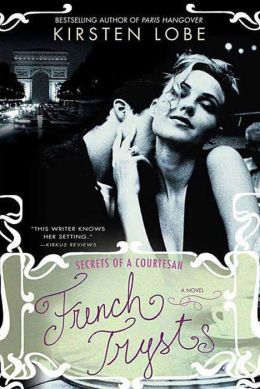
French Trysts: Secrets of a Courtesan

French Trysts: Secrets of a Courtesan
Image courtesy of
Barnes and Noble
French Trysts:  Secrets of a Courtesan
Kirsten Lobe
2007

The Summary
For Alexandra, Paris is the city of her dreams.  Now residing in France, earning her doctorate and living with her boyfriend, Laurent, she's tickled at the opportunity to explore and live in such a beautiful city.

However, when Laurent abruptly leaves and breaks her heart, Alexandra's life is turned upside-down - and when the opportunity presents itself to meet a powerful, dynamic man, Alexandra can hardly resist, even if he is married.

Thus, she abruptly finds herself playing the unique role of courtesan to some very rich - very, very rich - and powerful men.

The Good
Kirsten Lobe's novel is intriguing.  As I've made only a few literary forays into the lives and minds of courtesans, I find Alexandra's story interesting.  How she copes with her new-found sexual prowess and juggles her non-traditional "obligations," so to speak, adds a little appeal to her narrative.

Another point I enjoyed:  Alexandra's descriptions of her surroundings.  When Alexandra takes it into her head to offer a description of a specific location, her asides are frequently rich with detail.  During her tenure as courtesan, she visits some beautiful places, which I find are appealingly described.

The Bad
Although I enjoyed Alexandra's descriptions, I found her personal narrative grievously lacking.  For a Ph.D. hopeful, her story leaves something to be desired.  Her eloquence only reaches so far, apparently, and her emotional appeal was virtually nonexistent, and I really don't think it has anything to do with her roots as a small-town American girl.

There is also an element of repetitiveness that makes French Trysts frustrating.  Yes, we know Alexandra is in awe of her unexpected influence over powerful men and we know she is "one very lucky girl" for the unexpected opportunities she has to visit beautiful places, but we don't need to be reminded in every single chapter.

She's trying far too hard to justify her new lifestyle.

Additionally, Alexandra makes her mark as a sexually precocious and dynamic individual; however, she uses up her quota of surprising her readers by overusing her flippant attitude and indulging in frequent asides about her sexual escapades.  It's less amusing and racy, more vulgar and tiresome (and I might even be so bold as to call it trite).

The Ugly
Alexandra has no filter:  absolute candor is her policy.  Discretion is kicked to the curb.

So, when she mentions an orgy at the beginning of the novel, you can bet she'll eventually share every detail.  Likewise, she fashions a running "tip-sheet" for courtesans and logs the unique observations she makes, which means she's sharing a lot of intimate information about herself and her partners.

Thus, if you find heaps of sexual content (she talks about an orgy on the first page, for crying out loud) and strong language unappealing (yes, there's quite a lot of that going around, too.  Alexandra is exceedingly fond of a four letter word beginning with "F"), I don't think I would recommend French Trysts.