"All good books are alike in that they are truer than if they had really happened
and after you are finished reading one you will feel that all that happened to you
and afterwards it all belongs to you; the good and the bad, the ecstasy, the remorse,
and sorrow, the people and the places and how the weather was."
Ernest Hemingway
Showing posts with label Modern fiction. Show all posts

Saturday, January 6, 2018

Kings of the Wyld

Image result
Hachette Book Group, Inc.
Kings of the Wyld
Nicholas Eames
2017

The Summary
"Glory never gets old.

"Clay Cooper and his band were once the best of the best, the most feared and renowned crew of mercenaries this side of the Heartwyld.

"Their glory days long past, the mercs have grown apart and grown old, fat, drunk, or a combination of the three.  Then an ex-bandmate turns up at Clay's door with a plea for help--the kind of mission that only the very brave or the very stupid would sign up for.

"It's time to get the band back together."

The Good
This is arguably one of the best books I read in 2017.  Sometimes ridiculous, sometimes gory, Kings of the Wyld is an unexpectedly endearing and simultaneously adventurous novel.  It's hilarious, heart-warming, and yet still action-packed.

I absolutely loved it.

I first stumbled across this book at my local library (though I will probably be acquiring a copy for my own shelves) and I was immediately caught by the cover.  At first, I couldn't quite reconcile the gritty, fantasy-esque cover image with the rock band motif.  I mean, "the boys are back in town"?  Really?

It just seemed so weird.  Mercenaries treated like rock stars?  It's absurd, but it was just the right level of absurdity to draw me in to the story.  Full of odd creatures and fascinatingly complex characters, it's a story that turns fantasy (as I have known it) on its head.

As far as fantasy heroes go, Clay and his band are not quite your typical heroes.  Granted, no one is perfect, but Moog, Gabriel, Matrick, and Ganelon are about as far from perfect as you can get.  Moog is a bit demented and terribly forgetful; Gabriel is a drunk whose life has spiraled out of control; Matrick is caught in a loveless marriage with a queen who wants him dead, not to mention he's kind of a horrible person; and Ganelon--well, Ganelon has spent the last decade or two trapped in stone, but, before that, he was a stone-cold killer.

They are seriously flawed, but they kind of grow on you.  I mean, Gabriel, despite being a crappy husband and a not-so-great dad, is setting out to save his daughter, Rose, against all odds, and Clay is going to help him do it.  They're fighting against age, personal demons, and time to save Rose.  While they may be a little more willing to break laws (and bones), they're ultimately good people.

And, personally, I found I liked Clay the best.

He wasn't the narrator, but much of the story is told from his perspective and he offered uncanny insight into the story.  Jaded and tough, gifted with a deadpan sense of humor, Clay was by far my favorite character.  (Moog, however, comes in at a close second.)  He was the driving force within the book, a steady voice, almost like the conscience of the story.

He has a dark past, but I admired him for his tenacity and loyalty.  Moreover, I couldn't help but appreciate the way he loved his wife, Ginny, and his daughter, Talley.  Clay is a big brute of a man, as you read on the first page:  "[His] shadow, drawn out by the setting sun, skulked behind him like a dogged reminder of the man he used to be:  great and dark and more than a little monstrous."

He was not a good man; in fact, he may not even be a very good man, even now.  But he cares about Ginny and Talley, and he'd do anything to protect them.  He respects Ginny, and he admires Talley.  If nothing else, I liked him for being a decent human being who cares about his family and doggedly follows his friends into battle to save another man's daughter.

The Bad
Admittedly, the story is a bit drawn out.  There's always so much happening, so many plot twists and adventures are thrown at our heroes that it can get a little tedious; however, it's an easily forgivable sin.  The ending was so satisfying, the absurd adventures in between were totally worth it.

Overall, it's an excellent debut.

The Ugly
People are not perfect.  They can make terrible mistakes and they can commit truly horrible atrocities.

Tuesday, January 2, 2018

A Dad for Billie

23843292
HQN Books
A Dad for Billie
Susan Mallery
1993

The Summary
"From the moment a baseball smashes through his window, banker Adam Barrington's life is never quite the same.  The guilty party, an eight-year-old tomboy, soon turns his household upside down.  But that shock is nothing compared to when Adam discovers who Billie's mother is...

"Jane Southwick knows that coming back home won't be easy, and that living next door to Adam again will be sweet torture.  But it's pure joy to see the delightful bond growing between him and her daughter, despite the guilty secret that clutches at Jane's heart."

The Good
I love Susan Mallery.  She's one of my favorite contemporary romance novelists, and I can't say I've really been disappointed by any of her books.  While A Dad for Billie isn't my absolute favorite by Mallery, it's a fun, sweet story with an adorable kid (she's so accident prone and messy; she's wonderful) and a lovely, complex romance that will warm your heart.

The Bad
It has many of the tropes familiar to romance novels.  It's predictable; however, I found the predictability reassuring.

The Ugly
Nothing, truthfully.  It's a sweet, mild little romance that invariably made me smile and feel all the warm fuzzies.

Tuesday, July 4, 2017

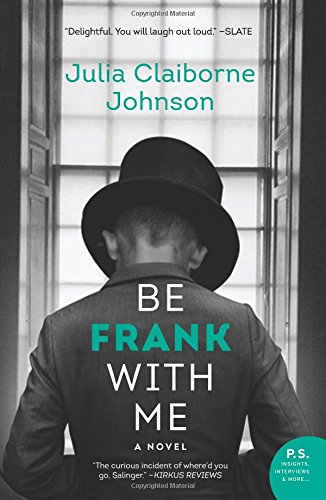
Be Frank with Me

William Morrow
Be Frank with Me
Julia Claiborne Johnson
2016

The Summary
"Meet Mimi:  Reclusive literary legend.  Wrote Pulitzer- and National Book Award-winning novel at nineteen.  Hasn't been seen or heard from much since, though, ironically, she lives in a glass mansion in Bel Air.  Lost all her money in a Ponzi scheme, needs to write another novel.  So her publisher sends...

"Alice Whitley:  Editorial assistant.  Twenty-five years old.  Highly competent.  Thinks she's going to be typing up pages and delivering cups of coffee.  Instead finds that her primary job is to be companion to...

"Frank:  Mimi's nine-year-old son.  A boy with the intellect of Albert Einstein, the wardrobe of a 1930s movie star, and very little in common with his fellow fourth graders.  About to give Alice the education of her life."

The Good
I liked Be Frank with Me.

It's zany, it's original, it's a lot of fun, yet it's quietly intense and, quite honestly, heart-wrenching.  I found I quickly became involved in their lives, but, then again, I think it's easy to become wound up in Frank's story.  (It feels like Frank's story, as much as it feels like Alice's.  He's such a larger-than-life character, and he just seems to overshadow everything else.)

Overall, I enjoyed my time with Frank and Alice.  I liked the unexpectedness of their adventures, even if it sometimes led to mayhem.  However, what I liked best about Be Frank with Me was the narration.

Tavia Gilbert does a brilliant job of breathing life into the characters.  She gives Alice depth, a distinctive perkiness that shows her optimistic attitude; she captures Frank's youth and intelligence, his boyish voice and unusual monotone; she gives Zander a gravelly, masculine voice that conveys both his age and his immaturity.

I loved the way Gilbert slipped between personas.  Even when I didn't know who was speaking, I could tell which character I heard.  Gilbert makes each character singularly unique, distinguishing them by tone and accent and attitude.  She's a masterful storyteller, and I enjoyed listening to her lend her talents to Be Frank with Me.

The Bad
I'll admit, I struggled with this story.

I am Alice's age.  I could easily see myself in the same position as Alice, working as an assistant and quickly finding herself engulfed by the work--by all the tiny rules that Mimi snaps at her for not knowing, all the rules that keep Frank to freezing up or freaking out.

I mean, I felt bad for Alice:  here she is living full time in Los Angeles, essentially working as a live-in babysitter, instead of a publisher's assistant.  Not to mention, Mimi treats her poorly; Frank nearly takes off her fingers when they first meet; and Zander--well, Zander feels like just another tragedy waiting to happen.

It's comical all the crazy situations in which Alice finds herself, yet, at the same time, it's frustrating.  I mean, Alice seems like a genuinely nice person.  She might be overly excitable and she might sometimes overstep her bounds, because she wants to do a good job.  I hate the way she's treated by pretty much everyone.

And Zander.

Don't even get me started on Zander.

The Ugly
Human relationships are complicated.  They're ugly and brutal and difficult, and it's easy to see why Frank struggles with them.  I mean, fourth graders aren't exactly the nicest bunch out there and it's easy to see how Frank feels like he doesn't belong.

Friday, May 26, 2017

Unfinished 7

2082136
W.W. Norton Company
Okay.  So, I started reading Bonk by Mary Roach after I finished reading Packing for Mars.  After reading a review on Goodreads that cracked me up, I decided I would give it a try--and I kind of regret it.

First off, Mary Roach is hilarious.  I liked Packing for Mars, and I think I could have enjoyed Bonk if I just hadn't been traumatized by some of the stories.  I like to think I'm not a prude, but when sex leads to disfigurement, count me out.  I just can't do it.  It gives me this weird squirmy feeling inside, and I just can't cope.

Mary Roach is a great author, but I just don't think I can handle Bonk.

-

25507925
Gallery Books
I picked up Tyler Oakely's Binge out of curiosity.  I'd seen it in the YA section at my local library and I thought it might fit my Read Harder Challenge, so I thought, "Why not?"  It seemed interesting and it would help me mark off one of my challenges.

Wrong.  On both accounts.

Oakley is a pretty funny, I'll give him that; however, I just wasn't taken with his memoir.  I like that he's so very candid about his experiences, even the most embarrassing ones, but I found there is something as too much of a good thing.  Oakley tells me a little more than I would normally like to know about his personal experiences, and I just found myself quietly closing the book and returning it to my library.

-

Death of a Darklord by Laurell K. Hamilton had so much potential.  It was beautifully written, it carried intricate characters with interesting talents, it had magic and fantasy and adventure.  It struck all the right notes for me.  I was so excited to read it, especially as I started in on the first couple of chapters.  I was intrigued by the villain and I wanted to see where the story would go.
30229
Wizards of the Coast

And then I made the mistake of looking up the book on Goodreads and discovering, much to my astonishment, that it was part of a series.  I learned Death of a Darklord is a stand-alone novel in a series roughly based in the same world (or something along those lines).  Not necessarily a bad thing, right?

Except it's part of a horror series.

When I picked up Death of a Darklord, I expected a fantasy novel.  I expected magic, mischief, adventure, trials and tribulations, before eventually culminating in a relatively happy ending.  There's always a little tragedy in every fantasy story; however, I always expect to find a satisfying conclusion, if not an outright happily-ever-after.

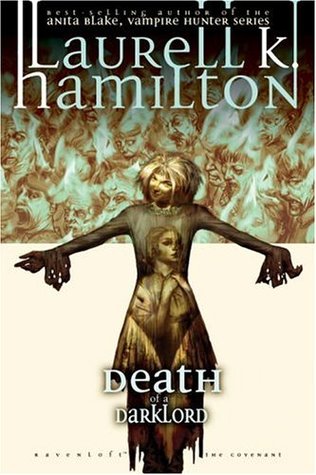
Death of a Darklord is a horror story.  It's full of tragedies, one after the other--and it literally doesn't get any better.  If I'd gone into this novel with the knowledge I was reading a tragic story, I probably would have been fine with it.  As the cover gave no inclination as to what I would find, I started reading with the expectation of a good ending and I was incredibly disappointed.  I put it aside without ever really finishing it.

-

27833668
Pantheon
War and Turpentine wasn't a bad novel.  It's based on Stefan Hertsman's grandfather, a would-be painter who lived through and fought in World War II.  Hertsman regales readers with embellished stories of his grandfather, his grandmother, his family, and, ultimately, his legacy.

It's an interesting book that reminds me of The Things They Carried, in that there are some truths buried beneath the fiction; however, it just didn't grip me like Tim O'Brien's earlier novel.  Personally, Hertsman's novel isn't for me.  I didn't care for the style or the feel of the novel, even though I wanted to enjoy it; I didn't like the characters, I didn't like the way they felt or the way they made me feel; moreover, I found myself growing bored with it at regular intervals and casting it aside for more interesting fare.

I'm sure it's a fine book, but it's just not for me.

Friday, May 19, 2017

Read Harder Challenge 2017: Part 4

This month, I finished a few more challenges, including:
  • Read a book by an immigrant or with a central immigration narrative.
  • Read a book published between 1900 and 1950.
  • Read a collection of poetry in translation on a theme other than love.

American Street
Balzer + Bray
First up, I read American Street by Ibi Zoboi, which follows Fabiola as she adjusts to life in America with her rowdy cousins and her reclusive aunt.  When she arrives in Detroit, she is confronted by a terrible crossroads that will change her life and haunt her as she goes in pursuit of the American Dream.  A fascinating inspection into the immigrant experience, American Street  was made all the more compelling by the fact that the author, like Fabiola, was emigrated from Haiti when she was only a child.

Overall, I liked American Street.  It's a good, solid book with interesting characters, a wonderful narrator, and a heart-wrenching story.  However, I often found myself divided, because I both loved and hated this book.  It inspired a lot of emotions, not all of them good, but it also made me think and it made me feel and it compelled me to read on through Fabiola's story even when I felt my interest waning.

But, most of all, I loved the hints of magical realism seeded throughout the story.  Fabiola has very strong beliefs and she particularly believes in the ilwas of Vodou, which adds a layer of mystery, a thin veil of magic that enriches her story.  You don't really discover if Bad Leg is really Papa Legba, or if he really is just some junkie off the street, like Fabiola's cousins say, but it's that uncertainty that imbues a certain strength in Fabiola's belief and offers uncommon insight into the landscape of Vodou.

John Carter of Mars (Barnes & Noble Collectible Editions): The First Five Novels
Barnes and Noble
Next, I conquered A Princess of Mars by Edgar Rice Burroughs, who also happens to be author of Tarzan of the Apes.  I picked up A Princess of Mars because I had it on my shelf and, more to the point, it seemed like an acceptable escape from reality; however, I wasn't always enchanted with the story.  I mean, it was really just mindless fun.

Originally serialized in 1912, A Princess of Mars is the first of many novels of the Barsoom Chronicles penned by Burroughs.  It follows John Carter, a former military man from Virginia, who finds himself ambushed in Arizona--and transported to a different world.  Mars (known as Barsoom to the native peoples) is a seemingly desolate land populated with dangerous creatures and war-like citizens, and Carter must find a way to survive if he eventually hopes to return to his home world.

For much of the story, it's really just Carter being really impressive with his super-strength and incredible agility and uncanny ability to learn languages--that is, unless he's rescuing the damsel in distress or endearing himself to the local wildlife.  Something interesting or incredible usually happens at the end of every chapter, so it's a bit of a page turner when Carter isn't boring you with facts that are obviously wrong or making you laugh with physics that could obviously never happen.

24601
New Directions
Last, I checked out Paris Spleen by Charles Baudelaire.  Paris Spleen is a short collection of poetry originally written in French in 1896 by Charles Baudelaire--and none of his poems are about love.  I found it exceedingly difficult to find a collection of poetry that didn't talk about love, because everyone likes to talk about love and relationships and affection.  They're warm, fuzzy feelings to which everyone can relate.

But Baudelaire doesn't base his poetry on warm, fuzzy feelings; instead, he examines a darker side of human life.  He looks at the every day pleasures of intoxicating drink, sensuous women, and fine art; however, he also shines a lot on oppression, city squalor, mistreatment, malice.  His work couldn't be farther from warm, fuzzy feelings, like love.

It worked for my Read Harder Challenge, but, I will admit, it's definitely an acquired taste.  Baudelaire is really something else.

Monday, May 15, 2017

American Street

30256109
Balzer + Bray
American Street
Ibi Zoboi
2017

The Summary
"On the corner of American Street and Joy Road, Fabiola Toussaint though she would finally find une belle vie - a good life.

"But after they leave Port-au-Prince, Haiti, Fabiola's mother is detained by U.S. immigration, leaving Fabiola to navigate her loud American cousins, Chantal, Donna, and Princess; the grittiness of Detroit's west side; a new school; and a surprising romance, all her own.

"Just as she finds her footing in this strange new world, a dangerous proposition presents itself, and Fabiola soon realizes that freedom comes at a cost.  Trapped at the crossroads of an impossible choice, will she pay the price for the American dream?

"In her stunning debut, Pushcart-nominated author Ibi Zoboi draws on her own experience as a young Haitian immigrant, infusing this lyrical exploration of America with magical realism and Vodou culture.  Unflinching yet filled with joy, American Street is an evocative and powerful coming-of-age story."

The Good
I read American Street as part of my Read Harder Challenge, and I can't say I regret my decision.  American Street is a provocative, thoughtful novel that portrays both immigrant experiences and, in some cases, daily life in urban areas.  It's beautifully written, well-paced, and fascinating; it's a book that makes you think, makes you feel.

I loved the hints of magical realism seeded throughout the story.  Fabiola is a very spiritual person.  Her beliefs are strong, and her faith in the ilwas of Vodou is even stronger--and, as time goes on, she begins to spot the ilwas work in her daily life.  I found this added a layer of mystery, a thin veil of magic that enriches her story.

Granted, you don't really discover if Bad Leg is really Papa Legba or just some junkie off the street, like Fabiola's cousins claim, but it's that uncertainty that imbues a certain strength to Fabiola's belief and offers uncommon insight into the landscape of Vodou.  It's magical, yet it's firmly grounded in reality as to relate to readers, to connect on a deeply personal level.

The Bad
Personally, this book made me miss being where I am.  I mean, I couldn't stand the cold, gray landscape Fabiola describes.  It felt cruel, sterile and cold.  It made me want to go outside and climb into a tree to really appreciate the cool, green shade.

The Ugly
Fabiola endures so much for a girl her age.  She survives the earthquake that destroyed Port-au-Prince in 2010; she is forced to travel to Detroit alone, because her mother is detained by customs; she must acclimate to a new school, a new culture--and no one, not even her aunt and cousins, seem willing to help her.

And that's just the tip of the iceberg when it comes to this book.

This book does not pull punches.  I'm not even joking.  It's violent, it's hurtful, it's bloody, it's dark, it's tragic--and it really doesn't get any better.  Fabiola is thrust into a new world, moving from her impoverished community in Haiti to a violent neighborhood in Detroit.  She's confronted with some very harsh realities that will, ultimately, break her heart.

I realize this book actually shows some of Zoboi's experiences (if you read the author's note, you'll see just how autobiographical Fabiola's story really is); in fact, it might encapsulate the reality of American life in impoverished urban areas.  However, I did not like the violence or the bloodshed or the drugs or the hard truths that American Street makes you confront.

I mean, for some people, American Street may very well be a portrayal of real life.  I may not have had to deal with many of the things Fabiola encountered--drugs, alcohol, gang violence, prescription abuse--but I know they aren't uncommon experiences, even in more rural regions where I live.  So reading American Street is an uncomfortable wake up call, it's a slap in the face because you can't look away from the glimpse of reality it presents.

I felt divided while I was reading this book, because I both loved and hated it.  It inspired a lot of emotions, not all of them good, but it also made me think and it made me feel and it compelled me to read on through Fabiola's story even when I felt my interest waning--or my heart breaking.

It's a very good book, but know you're getting into a world of heartache before you pick it up.

Monday, May 1, 2017

Playing for Pizza

1205297
Doubleday
Playing for Pizza
John Grisham
2007

The Summary
"Rick Dockery was the third string quarterback for the Cleveland Browns.  In the AFC Championship game against Denver, to the surprise and dismay of virtually everyone, Rick actually got into the game.  With a 17-point lead and just minutes to go, Rick provided what was arguably the worst single performance in the history of the NFL.  Overnight, he became a national laughingstock and, of course, was immediately cut by the Browns and shunned by all other teams.

"But all Rick knows is football, and he insists that his agent, Arnie, find a team that needs him.  Against enormous odds Arnie finally locates just such a team and informs Rick that, miraculously, he can in fact now be a starting quarterback.  Great, says Rick---for which team?

"The mighty Panthers of Parma, Italy.

"Yes, Italians do play football, to one degree or another, and the Parma Panthers desperately want a former NFL player--any former NFL player--at their helm.  So Rick reluctantly agrees to play for the Panthers--at least until a better offer comes along--and heads off to Italy.  he knows nothing about Parma (not even where it is), has never been to Europe, and doesn't speak or understand a word of Italian.

"To say that Italy--the land of opera, fine wines, extremely small cars, romance, and football americano--holds a few surprises for Rick Dockery would be something of an understatement."

The Good
Playing for Pizza was unexpectedly good.  Granted, I understood very little of the football plays--what does third down even mean?--or the jargon that goes along with the sport, but I enjoyed listening to Playing for Pizza with Christopher Evan Welch as narrator.  Like I said, it was unexpectedly good.  Rich and vibrant and, well, funny.

Admittedly, it took me a few chapters to really settle into the story, but, once I did, I had so much fun listening to Rick Dockery's story as he journeys to Italy and becomes a Parma Panther.  I especially enjoyed the descriptions Italy--the architecture, the culture, the history, the romance (courtesy of a secondary character from Georgia, who loved all these things)--and, of course, the food.

I was almost always hungry for food while listening to Grisham's novel, but it was totally worth it.

Overall, Playing for Pizza was an excellent choice for my Read Harder Challenge--and it was just a lot of fun.  It's fun, sweet and romantic, but it doesn't try to hide the bad things that happen; rather, it follows the ordeals of an ordinary person finding himself in an extraordinary situation and it rolls with it.  Moreover, while I did find aspects of it sweet and romantic, it didn't border on too sweet or too romantic.

Playing for Pizza struck a good balance, I thought, and it's written very well, narrated very well.  I mean, if you don't like romance, it has explorations of Italy and food and football; if you don't like football, it still has Italy and history and food.  (Did I mention food?)  Personally, I'm not a fan of sports; however, I enjoyed listening to the games in Playing for Pizza--and I couldn't understand half of it.

The Bad
If you don't understand football americano, then you might just struggle through some of this novel.  I did, and I even live in a state where you live and die by football.  However, I will note that I did enjoy the games and, more to the point, Playing for Pizza has a lot to commend it besides the football games.

The Ugly
Sports injuries.

Ouch.

Friday, April 21, 2017

Read Harder Challenge 2017: Part 3

I finally finished the next part of my Read Harder Challenge.  I finished:
  • Read a book about books.
  • Read a book that is set within 100 miles of your location.
  • Read a collection of stories by a woman.

26531650
Simon & Schuster
Starting out, I finished reading The Bad-Ass Librarians of Timbuktu by Joshua Hammer, which details events beginning in 2012 when more than 350,000 manuscripts--many of which had been painstakingly collected by Abdel Kader Haidara--were endangered by Al Qaeda militants seizing control of Mali.  In his book, Hammer details how Haidara and other manuscript collectors managed to find, preserve, and rescue hundreds of thousands of manuscripts, before smuggling them out of the country under the noses of Al Qaeda.

As the summary attests, it's indeed a "brazen heist worth of Ocean's Eleven."  Personally, I found it fascinating to learn how Haidara became involved in the manuscript preservation business and how he and other librarians managed to steal away more than 350,000 manuscripts from Timbuktu.  I mean, the number is simply mind boggling.

Moreover, I was consistently fascinated by the history and culture of Timbuktu and Mali as a whole.  Hammer offers a rich variety of details, discussing the medical, cultural, historical, scholastic and artistic impact of Timbuktu.  Although his work can grow a little dry, every chapter offers fascinating insight into the history of Timbuktu and, more importantly, provides readers with an eye-opening portrait of the conditions faced by Mali's residents when Al Qaeda invaded.

Beauty and the Mustache
Cipher-Naught
Next, I checked out Beauty and the Mustache by Penny Reid.  Set in Tennessee, Beauty and the Mustache is a short, sweet little romance--which kicks off the Winston Brothers series and continues the Knitting in the City series, both by Penny Reid--that brings together Ashley Winston and Drew Runous.  After spending more than 8 years away from home, Ashley is forced to return to Tennessee to help take care of her ailing mother.  Expecting the same rough treatment from her brothers as from years before, she's surprised to learn they've changed.  She's even more surprised to meet their friend Drew, especially when she realizes he's exactly her type.

Overall, I really enjoyed reading Beauty and the Mustache.  Like I noted above, it's a short, sweet little romance and it's absolutely adorable.  It's sometimes bittersweet, sometimes tragic, but I immensely enjoyed reading Penny Reid's novel.  I found I connected to Ashley, our main character and narrator, on a personal level and I admired her sharp, sarcastic sense of humor, her intelligence, and her ability to go toe-to-toe with Drew's philosophical meanderings.

However, I will note I was bothered by one thing:  I did not like the setting.  I love the Smoky Mountains, don't get me wrong; however, I simply didn't like the narrator's inability to describe her surroundings.  I was incredibly disappointed by the setting descriptions, which were seriously lacking.  I wanted to hear more about the winding roads, the multitude of trees, the softly sloping mountains in the distance, or the way the hills fade against the horizon, deepening to a slate blue before disappearing altogether.

I wanted to hear about places I've known or seen, but, sadly, I didn't get that chance.  It was slightly disappointing.

2782459
Anchor
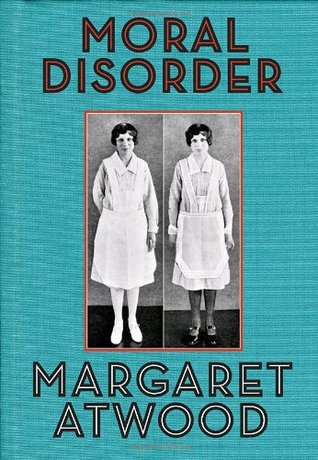
Last, I read Moral Disorder by Margaret Atwood.  I think I might have fudged the challenge parameters with this one, since it's really just a single novel; however, as it's labeled with "Other Stories," I assumed it would do the trick.  It centers around one woman--Nell--but it's a compilation of many short stories from different points in her life.

It begins with "Bad News," toward the tail end of Nell's life, but it jumps through time with each story and catapults Nell into the past, showing readers glimpses of her childhood and her adolescence and, finally, her transition into adulthood.

Truthfully, I didn't enjoy reading Moral Disorder that much.  Atwood is a fantastic writer and her prose packs a punch when she wants it, but, personally, I found I couldn't always connect with the stories in Moral Disorder, I couldn't always connect to Tig and Nell.  Granted, when I did connect with one of these stories, it moved me deeply and I worried for Nell, like I'd worry for a friend; however, I found it was a rather unremarkable journey for me overall.

Friday, April 14, 2017

Moral Disorder

17644
Doubleday
Moral Disorder
Margaret Atwood
2006

The Summary
"Margaret Atwood is acknowledged as one of the foremost writers of our time.  In Moral Disorder she has created a series of interconnected stories that trace the course of a life and also the lives intertwined with it--those of parents, of siblings, of children, of friends, of enemies, of teachers, and even of animals.  As in a photograph album, time is measured in sharp, clearly observed moments.  The '30s, the '40s, the '50s, the '60s, the '70s, the '80s, the '90s, and the present--all are here.  The settings vary:  large cities, suburbs, farms, northern forests.

"By turns funny, lyrical, incisive, tragic, earthy, shocking, and deeply personal, Moral Disorder displays Atwood's celebrated storytelling gifts and unmistakable style to their best advantage.  As the New York Times has noted:  'The reader has the sense that Atwood has complete access to her people's emotional histories, complete understanding of their hearts and imaginations.'

"'The Bad News' is set in the present, as a couple no longer young situate themselves in a larger world no longer safe.  The narrative then switches time as the central character moves through childhood and adolescence in 'The Art of Cooking and Serving,' 'The Headless Horseman,' and 'My Last Duchess.'  We follow her into young adulthood in 'The Other Place' and then through a complex relationship, traced in four of the stories:  'Monopoly,' 'Moral Disorder,' 'White Horse,' and 'The Entities.'  The last two stories, 'The Labrador Fiasco' and 'The Boys at the Lab,' deal with the heartbreaking old age of parents but circle back again to childhood, to complete the cycle.

"Moral Disorder is fiction, not autobiography; it prefers emotional truths to chronological facts.  Nevertheless, not since Cat's Eye has Margaret Atwood come so close to giving us a glimpse into her own life."

The Good
Although I won't call Moral Disorder a favorite, I have to admit that Margaret Atwood made me feel things that I didn't expect.  I couldn't always connect with the stories in Moral Disorder, I couldn't always connect to Tig and Nell; however, when I did connect with one of these stories, I felt it--deeply.

Like when Nell fretted over her mother and sister.  Or when Nell struggled to find her place in the world.  Or when Nell couldn't figure out what to do next with her various jobs.  Or when she suffered for Tig's indecision, his inability to commit and his inexplicable thoughtlessness.  Or when she tried to accept her mother's decline and her father's death.

There are moments--a few, sparse moments--in this book which struck me with all the delicacy of an anvil.  Like I said, I didn't always feel connected to these stories, but when I did, it made an imprint.  It made me feel with the same breadth and depth, as if it had happened to me, which made me appreciate Atwood's skills as a writer even more.

The Bad
I hate to say this, but I was so relieved to finally finish reading Moral Disorder.  I respect Atwood for her work, and I think she is a wonderful writer; however, I just couldn't always connect with this story collection.

Maybe, I felt a disconnect, since it's a time with which I am unfamiliar; maybe, I just haven't hit that point in my life in which these moments in time--these milestones of adulthood and life in general--really strike a chord with me; maybe, I just couldn't connect with Nell, our narrator; or, maybe, I just didn't "get" it.  I don't know.  I just know I was sometimes bored and, more often than not, I didn't like it.

I especially disliked the stories detailing how Tig and Nell met, but I think that was a personal feeling rather than any condemnation of the story or characters or pace.  Stylistically speak, Atwood is wonderful.  It was so easy to follow the story, to trace how Tig and Nell eventually fell in love--did they fall in love?--and to capture the individual grains of their tale, collecting them into cohesive whole.

My problem came as it slowly dawned on me that Tig and Nell were not married; in fact, Tig remained married to another woman for weeks, months--years, actually--while actively living with Nell.  I know I'm going to sound old fashioned when I say I disagreed with this arrangement; however, my reasons aren't prudish.  I couldn't care less if Tig and Nell lived together, married or not, rather I was bothered (perturbed might be a better word) by how Tig refused to divorce Oona, his first wife whom the law recognized as his only wife.

It's weird to say this, but I didn't care that Nell and Tig lived together without being married.  I didn't even care that the relationship Nell and Tig created was essentially built on adultery--which is, as I learned from Nell, an obsolete word that no one really uses anymore and "to pronounce it [is] a social gaffe."  However, I was bothered by how Tig seemed unable to distance himself from his marriage, how he seemed unable to push to have his divorce finalized.

Why couldn't Tig convince his wife--who was, for all intents and purposes, his ex-wife--to have the divorce finalized?  Did he still care too much for his ex-wife to push for divorce, or did he simply not care enough for Nell to get a divorce and marry her?  Or was he too lazy...and, possibly, spineless?  I don't know, I couldn't tell, but I do know that I was not a fan of this situation.

On a personal level, it strikes me as unutterably cruel and incredibly thoughtless of Tig.  I mean, it obviously hurts Nell to be put second next to his ex-wife in their relationship.  She lashes out, she feels an uncertainty and gloom even at the best times; she's trapped, because he refuses to move forward--he refuses to make a change, like he has promised innumerable times--and she's suffocating, she's wavering on a precipice that leaves her wondering if it's worth staying at all.

Admittedly, it hurt my heart to see things playing out between them.  It made me angry, and it made me sad, and it made me sympathize with Nell much more than I expected.

The Ugly
Life is not pretty.  It can't be shuffled into a nice neat pile; it can't be controlled or even managed; it can't even be made to fit, like a square peg trying to fit a round hole.  Life is a mess and, as becomes apparent, Nell's life especially seems messy, which, I admit, sometimes made it difficult to read.

Friday, March 17, 2017

Read Harder Challenge 2017: Part 2

Next up for my Read Harder Challenge, I...
  • Read a book about sports.
  • Read a book you've read before.
  • Read a book published by a micropress.

Admittedly, I wasn't sure how to conquer this first task, because I am not a sports and/or athletic person.  I am, at best, a rather sedentary creature with a great affinity for books and chocolate and good food, preferably in that order; however, I was willing to take a crack at this one, because, surely, I could find a sport liked.  Considering the sheer variety of sports out there, I knew I could find something entertaining.

1205297
Doubleday
And, luckily, I did.  A co-worker recommended Playing for Pizza by John Grisham, and, since the challenge doesn't specify fiction or nonfiction, I thought I'd give it a whirl.  I'm so glad I gave Grisham's novel a chance, because I enjoyed it so much more than I expected.  Granted, I listened to the audiobook, which features Christopher Evan Welch as narrator, but I don't think that matters as Playing for Pizza is a fun, accessible and entertaining novel whether listening or reading.

Not to mention, I really enjoyed the description of food.  (I was craving pasta like mad, before all was said and done.)

Playing for Pizza begins with a game, specifically the worst game of Rick Dockery's career.  Now, marked as the worst player in the NFL--and effectively banished from Cleveland--and sporting a terrible head injury that would leave most player's contemplating retirement, Rick is at his wits end.  Since he can't find a new position in the U.S., his agent directs him to Parma--as in Parma, Italy, where he becomes quarterback for a ragtag group of Italians who just happen to be American football aficionados.  It's a huge change for Rick--and, as Rick learns, it might not be a bad one.

Next, I decided to reread Hush by Jeph Loeb and Jim Lee.  This is one of my favorite Batman comics for the simple fact that it has some of the most alluring, most beautiful art I've encountered, and it has such a richly detailed, incredibly poignant story that it kept me absolutely mesmerized the first time around.  I love every bit of this book, and I found it to be even better the second (okay, third) time.

6375845
DC Comics
Unlike Loeb's earlier works, Long Halloween and Dark Victory, which features Batman's earlier career, Hush follows the weathered and strained Batman/Bruce Wayne as he tries to keep Gotham safe from new and ever worsening dangers.  Together with his cadre of crime-fighting vigilantes--including Nightwing, Robin, Huntress, and Superman (but not quite Catwoman)--Batman sets out to find the puppet master who has set the whole of Gotham's underworld onto his heels.

Hush is one of those comics that will knock your socks off.  It's thoughtful, it's complex, and it explores every emotional side of a Dark Knight who has suffered innumerable losses, endured more grief and pain than most can manage, and defeated some of the most terrifying villains in the world.  Moreover, it has a level of Agatha Christie-esque mystery, which I enjoyed.

I mean, I certainly didn't expect it to end the way it did--and I found Batman to be all the more clever for ultimately solving the mystery.

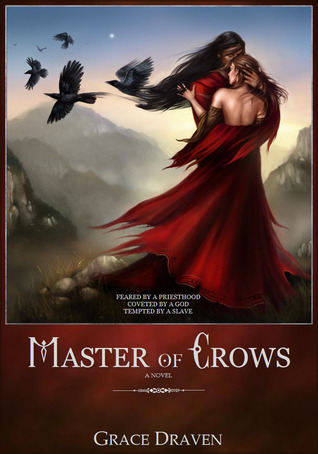
Last, I read Master of Crows by Grace Draven.  Originally published by Amber Quill Press (which, I realize, is not a micropress), it was eventually republished by Grace Draven--and, as the definition of a micropess means it is a small and/or single-person publisher, I decided it would fit nicely into this category to complete my challenge.

Yes, yes, I realize I might be pushing the rules with this one, but I have to point out that I haven't had a lot of luck finding books published by micropresses to which I have easy access.  I know of a few local publishers, but they are publishing companies with a large enough staff that I feel they don't count.  Moreover, I couldn't find something I enjoyed by a micropress to which I had access at my local library, thus the Internet--and Master of Crows--became my go-to choice.
6811150
Amber Quill Press/
Grace Draven

Now, putting aside my (weak) justifications, Master of Crows wasn't a bad novel.  In a world where magic exists and dark creatures lurk at the periphery of civilization, Silhara and Martise are thrust together in an unexpected alliance when one of the old gods--Corruption--returns.  Determined to stop Corruption and deny his fate, Silhara enlists the aid of the Conclave and meets Martise, a slave girl turned spy.  Together, they must discover Corruption's weakness and save the world....or, quite possibly, die trying.

I realize it sounds melodramatic and, yes, I suppose it is; however, it's also an unexpectedly complex novel that I enjoyed.  It has its faults, but, overall, it had interesting characters and created a sturdy setting that I appreciated.  Personally, I think I enjoyed Draven's ability to build her world.  It's rich with detail and magic, and I absolutely loved learning more and more about the creatures, places, and history of Silhara and Martise's world.  I realize it's more of an acquired taste, but it's certainly worth sampling.

Unless, of course, you're not a fan of explicit romance.  In which case, I probably wouldn't recommend it.

Friday, February 24, 2017

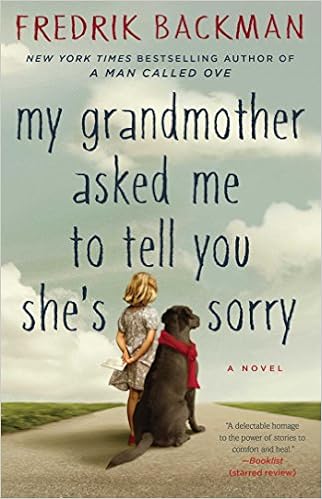
My Grandmother Asked Me to Tell You She's Sorry

Washington Square Press
My Grandmother Asked Me to Tell You She's Sorry
Fredrik Backman
2016

The Summary
"Elsa is seven years old and different.  Her grandmother is seventy-seven years old and crazy--as in standing-on-the-balcony-firing-paintball-guns-at-strangers crazy.  She is also Elsa's best, and only, friend.  At night Elsa takes refuge in her grandmother's stories, in the Land-of-Almost-Awake and the Kingdom of Miamas, where everybody is different and nobody needs to be normal.

"When Elsa's grandmother dies and leaves behind a series of letters apologizing to people she has wronged, Elsa's greatest adventure begins.  Her grandmother's instructions lead her to an apartment building full of misfits, monsters, attack dogs and old crones, but also to the truth about fairy tales and kingdoms and a grandmother like no other.

"My Grandmother Asked Me to Tell You She's Sorry is told with the same comic accuracy and beating heart as Fredrik Backman's bestselling debut novel, A Man Called Ove.  It is a story about life and death and one of the most important human rights:  the right to be different."

The Good
I loved this book.

Although it took me a little time to get into the story, especially when so many characters became involved, I absolutely loved it.  I enjoyed the authentic--sometimes explosive, sometimes heartbreaking, but always genuine--emotions in this book; I enjoyed the oddity of it; I enjoyed the threads of danger and adventure woven into the story; I enjoyed Backman's storytelling, reading about Wolfheart and the Wurse; I even enjoyed Britt Marie (and that's saying something).

Admittedly, I loved the whole thing.

In his novel, Backman will show you the worst side of people:  drugs, alcohol, social and behavioral problems, grief, bullying, and more--so much more that it will break your heart.  He'll show you things that are hard to see; however, he'll balance these things with humor and insight and heartwarming moments of compassion.

I would call his novel bittersweet, because it so closely mirrors life.  It shows you the difficult side of human nature, all the struggles that weigh us down on a daily basis; however, it shows you the sweeter things in life, like best friends and wonderful mothers and good stories and loyalty and, wonder of wonders, laughter.  Sometimes, life isn't always good, but this book makes you feel like things will get better in the end.

Overall, I loved reading My Grandmother Asked Me to Tell You She's Sorry.  I especially liked the characters:  they're so different.  Each with his or her own history that changes them, makes them a unique personality--and yet they're all tied together by the thread of Elsa's grandmother.  She brings them together in an oddball quest to deliver letters, to apologize for the wrongs in her life and rectify the things she can no longer fix.

But Elsa, I think, was my favorite.

She's a smart, headstrong little girl.  She's read the Harry Potter series numerous times, she's proficient in her grandmother's "secret language," and she's a frequent purveyor of Wikipedia, an avid researcher of the mundane and the obscure.  She's such a unique personality, I couldn't help liking her--and, of course, her crazy, paintball-gun-wielding grandmother.  They give the novel a unique flavor that truly makes it one-of-a-kind.

The Bad
No complaints.

The Ugly
Losing a loved one always hurts.  For poor Elsa, she's faced with a doubly great loss:  she loses her grandmother, her best friend, and all the magical stories of Miamas.  It's truly heart-breaking.

Friday, January 13, 2017

Behind Closed Doors

29437949
St. Martin's Press
Behind Closed Doors
B.A. Paris
2016

The Summary
"Everyone knows a couple like Jack and Grace.

"He has looks and wealth; she has charm and elegance.  He's a dedicated attorney who has never lost a case; she's a flawless homemaker and a masterful gardener and cook, and she dotes on her disabled younger sister.  Though they're still newlyweds, they seem to have it all.  You might not want to like them, but you do.  You're hopelessly charmed by the ease and comfort of their home, by the graciousness of the dinner parties they throw.  You'd like to get to know Grace better.

"But it's difficult, because you realize Jack and Grace are inseparable.

"Some might call this true love.  Others might wonder why Grace never answers the phone.  Or why she can never meet for coffee, even though she doesn't work.  How she can cook such elaborate meals but remain so slim.  Or why she never seems to take anything with her when she leaves the house, not even a pen.  Or why there are such high-security metal shutters on all the downstairs windows.

"Some might wonder what's really going on once the dinner parties are over and the front door has closed."

The Good
Behind Closed Doors crossed my desk purely by accident when I glanced through a stack of newly cataloged books--and I was hooked by the first page.  Honestly, I was probably caught a little earlier than that when I skimmed the jacket cover and read:  "The perfect marriage?  Or the perfect lie?"

Moreover, I read this little gem on the back cover that came from Publishers Weekly, which read:
"Appearances can be deceiving[.]  Terror is contagious...and impending peril creates a ticking clock that propels this claustrophobic cat-and-mouse tale toward its grisly, gratifying conclusion."
It sounded slightly scandalous, and more than a little terrifying.  I couldn't wait to dive in.

The plot is simple, straightforward affair.  At its core, Behind Closed Doors is a survival story; however, it hinges upon the suspense which the author builds as she slowly peels back the layers of Grace's story and reveals the monster behind Jack's angelic facade.  (See what I did there, huh?)  It's a psychological thriller and an abuse survivor story rolled all into one--and it will take your breath away.

It was a wonderful book, and I enjoyed reading Grace's narrative.  She's an eloquent narrator who evokes quick emotional responses, because it feels like she could be anyone--a mother, a daughter, a sister, a friend.  Literally, anyone.  And it's so easy to get wrapped up in her story, to feel her gut-wrenching desperation and her dwindling feelings of hope.

And I found it so very, very easy to enjoy the ending.  I don't want to ruin anything, so I won't go into detail, but the conclusion was incredibly gratifying--one would almost say liberating.

The Bad
I like that Paris flashes back to the past, and I like that she gives her readers insight into Jack and Grace's relationship (such as it is).  It helps to flesh out the story, which I really appreciated; however, I couldn't help skimming these chapters for the simple fact that I wanted, more than anything, to find out what happens to Grace.

Yeah, sure, I liked the detail.  It told me a little more about Jack and his psychosis; it told me a little about Grace and her beloved sister.  But I knew Jack was a maniac right out of the gate.  I didn't need more detail telling me what I already knew; instead, I wanted to know if Grace could rescue herself and save her sister.

More importantly, I wanted to know if Jack suffered.

Priorities, you know?

The Ugly
This book made me feel a lot of emotions--and very few of them were good.

If it isn't obvious from the novel summary, Grace's husband, Jack, is not a good person; in fact, he's a horrible person and I despised him from the very beginning.  Even in the first chapter, in which Grace seems to be intentionally vague about her relationship with Jack, you get the feeling that all is not well.  There are red flags that make you perk up, like a dog hearing a whistle, and you can't help thinking, "Something isn't right here."

Well, something wasn't right.

As the story progressed, things went from bad to worse.  Listening to Grace's story, watching with appalled fascination as her terrible ordeal unfolded, I couldn't help feeling very strongly that Jack needed to be stabbed.  Repeatedly.  Possibly drowned for good measure.  As I got to know Grace and her sister, Millie, I couldn't feeling very strongly that Jack needed to die.

Honestly, Behind Closed Doors made me feel very violent, like abnormally violent.  I couldn't stand Jack--and it's all because of an incident with a dog.  I mean, don't get me wrong, I felt so bad for Grace and Millie and the psychological terror they must have endured; however, I was absolutely heartbroken for the dog.

I realize something of this nature had to happen.  It was just one more way of convincing the reader that Jack is horrible and depraved and, in a word, evil.  But I just couldn't handle it.  I can't stand when animals are hurt or killed in books.  My little heart just can't take it.  Besides which, I realize I am not a nice person when something happens to a dog.

I wished all manner of terrible things on Jack.  I even had to skip to the end of the book and find out the ending, so I could reassure myself that I wasn't setting myself up for complete and utter devastation.  Luckily, as one of the book blurbs attests, it has a grisly but oh, so satisfying ending.

That's the only thing that kept me going.

Sunday, January 1, 2017

Happy New Year: Read Harder Challenge 2016

Since I completed my Read Harder Challenge of 2016 and filled in all the categories recommended by BookRiot, I created some of my own unique categories.  As part of my continued challenge, I've decided to:
  1. Read a book by or about a librarian (or about a library)
  2. Read a medical book (fiction or nonfiction)
  3. Listen to an audiobook romance
  4. Read a brand new, recently published book (anything from 2016)
  5. Read a spin-off from a classic novel and/or fairy tale
  6. Read a book about cake (fiction or nonfiction)
  7. Read a fantasy book featuring dragons
16101121
Gotham Books
I thought it might prove fun to dive into some new books I might not otherwise find.  Some are based on recommendations from co-workers, while others are based on books from my TBR pile--and still others are just ideas that seemed like fun.  And with the countdown to the New Year on, I can't wait to tell you all about the books I've read, starting with a book by (and about) a librarian:  The World's Strongest Librarian by Josh Hanagarne.

If you've never read Josh Hanagarne I highly recommend his memoir.  It's funny, it's candid, it's insightful, and, ultimately, it's uplifting.  Although Hanagarne does discuss religion, his main focus is his family, his battle with Tourette's, his struggles with infertility, and his general love of the library and all things literary.  It's enjoyable to see his passion for his family, his books, and his weightlifting come to the forefront as he learns to balance all the different aspects of his life.  Overall, it's a pretty great read.

Next, I read (or, rather, listened to) a medical book--a historical medical drama, fyi--by Tessa Harris:  The Anatomist's Apprentice.  Narrated by  Simon Vance, The Anatomist's Apprentice was an interesting deviation from my usual reading material.  Thomas Silkstone is a young anatomist from Philadelphia who finds himself in England about the time of the Revolutionary War, caught in the midst of a medical mystery...and a murder  It's dark, rather macabre, but it's ultimately fascinating with the sheer depth of detail and history included.  I enjoyed my time in Silkstone's world, and I found myself quickly gravitating to book number two, The Dead Shall Not Rest.

8546358
Bantam
As for listening to an audiobook romance, I decided to check out more by Sarah Addison Allen and picked up The Peach Keeper.  Now, let me give you a warning, I have read almost everything by Allen, except Lost Lake (that one is currently in my TBR), and I have loved almost everything she's written.  The Peach Keeper was no different.  I loved the characters and the complexity of their histories; I loved the little hints of every day magic she weaves into her novels; I even loved the ghost story, which is saying something, as I am not a fan of ghosts.  It was a wonderful visit back to her world, and it was so much fun recognizing an old friend.

I also picked up a brand new book just published this year, a little novel by J. Ryan Stradal called Kitchens of the Great Midwest.  Another audiobook, I know, but it was just as rewarding as any other.  Although it follows a myriad of characters, it focuses on Eva Thorvald and her life as she grows into her own--and all the foods that influenced her in the process.  That's really the simplified version; Kitchens of the Great Midwest is much more complex, much more nuanced than I make it out to be.  It's a recurring cast of characters centered around Eva, but it's quite unlike anything I've ever read.  It's wonderful, and I absolutely adored the narrators, Amy Ryan and Michael Stuhlbarg.
25938397
G.P. Putnam & Sons

Speaking of new books, I also discovered Jane Steele by Lyndsay Faye, which fit nicely into my category for a spin-off novel based on a classic work or a fairy tale.  There were several options for this particular category, but I decided on Jane Steele because Jane Eyre.  I love Jane Eyre (as is probably apparent here), and I loved having the opportunity to reimagine her story not as the quiet, resolute girl who refused to give ground to anyone or relinquish her personal beliefs, but as the sharp, deadly woman with no qualms whatsoever of killing if it means protecting herself and her own.  It's fascinating the contrasts, and I came to love Jane Steele equally for her unwavering commitment to being bad.  It's a rousing good time.

Next, I decided to keep my love of food alive with a book about cake and sisterhood:  The Secret to Hummingbird Cake by Celeste Fletcher McHale.  While I will admit that I liked Garden Spells and The Glass Kitchen better, I enjoyed reading McHale's debut novel--and I absolutely loved getting to know her characters.  I liked Carrigan and I liked Ella Rae for their bravery, sass, and sheer stubborness, but I adored Laine.  She's the impetus of the story, the reason for it all, and, like Carrigan and Ella Rae, I felt an unexpected affection and wonderful kinship with her.  I enjoyed reading their story more than I thought I would.  For a debut novel, The Secret to Hummingbird Cake was pretty great.

352262
Little, Brown Books for
Young Readers
Last but not least, I read a fantasy book featuring dragons with How to Train Your Dragon by Cressida Cowell.  I picked Cowell's novel up because I fell in love with the movie of the same name; however, I was a little disappointed.  Don't get me wrong, I enjoyed reading How to Train Your Dragon.  It's fun, it's inventive, and it's a great series for young readers (I especially liked the Hairy Scary Librarian), but, unfortunately, it's not what I expected.  I made the critical mistake of judging the book in comparison to the movie--and they're two very different creatures.  How to Train Your Dragon the book is very different from How to Train Your Dragon the movie, and it's best not to go into either one with the same expectations.

Friday, December 16, 2016

Now That It's You

Image result for now that it's you
Montlake Romance
Now That It's You
Tawna Fenske
2016

The Summary
"Meg wanted closure.  She found her ex's brother instead.

"Talented chef Meg Delaney hasn't spoken to her cheating ex-fiance, Matt Midland, for two years.  Ditching him at the altar after blurting out 'I can't' instead of 'I do' would sour any relationship.  But now, just as Meg is finally ready to bury the hatchet, she learns closure is permanently off the menu.  And the kicker?  Matt's brother, Kyle, is back in her life, stirring up feelings that are equal parts guilt and lust.

"Meg was the best thing that never happened to Kyle.  He couldn't make a move on his brother's girlfriend--even if Matt didn't value her nearly enough.  The situation is even more complicated now that Meg's bestselling aphrodisiac cookbook has spawned a legal battle with the Midlands.  Maybe he should stay away.  But love, like family, plays by its own rules.  And the one woman he shouldn't want might be the only one who's perfect for him."

The Good
I don't think I've ever laughed so hard with a book, and then felt my heart breaking in my chest within the same hour.  Now That It's You led me on a roller coaster ride of emotions, moving from resentment to grief to love and laughter and back to grief.  And it kept me in stitches for most of the time with it's incredible humor.

I absolutely adored Tawna Fenske's novel.

In some ways, it reminded me of Happiness for Beginners.  For instance, you have a heroine who's looking to turn over a new leaf, a romantic interest who's bound to surprise you (plus, he's rather adorable), and a wild, wacky adventure (that may or may not involve "magical" marshmallows).  It has many of the same qualities that I loved about Katherine Center's novel:  humor, endearing characters, hints of romance, complex romantic and familial relationships, and transformative journeys.

I loved everything about Now That It's You.  I enjoyed the humor, the sweetness, and even the awkward moments.  However, I was probably hooked very early on after an incident with a group of LARPers (Live Action Role-Players) in the local park.  Personally, I think that was my favorite part:  a trio of friends dressed in fantasy gear suddenly pulling Kyle and Meg into an unexpected game involving an invisible dragon named Fallopian and marshmallows-turned-thunderbolts.

It was great.  I don't think I could have stopped laughing if I'd tried.

The Bad
No complaints.

The Ugly
A few moments in this novel broke my heart.  Like well and truly shattered it, and I couldn't help feeling almost as distraught as Meg did.

Wednesday, December 7, 2016

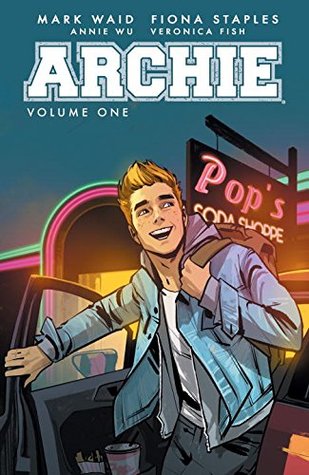
Archie: The New Riverdale (Volume 1)

25852959
Archie Comic Publications, Inc.
Archie:  The New Riverdale (Volume 1)
Mark Waid
Fiona Staples
Annie Wu
Veronica Fish
2016

The Summary
"Welcome to the new Riverdale!  America's Favorite Teenager, Archie Andrews, is reborn in the pages of this must-have graphic novel collecting the first six issues of the comic book series that everyone is talking about.

"Meet Riverdale High teen Archie, his oddball, food-loving best friend Jughead, girl-next-door Betty and well-to-do snob Veronica Lodge as they embark on a modern reimagining of the Archie world.  It's all here:  the love triangle, friendship, humor, charm and lots of fun--but with a decidedly modern twist.

"Brought to you by some of the masters of the comic book genre, including writer Mark Waid and the all-star lineup of artists:  Fiona Staples, Annie Wu, and Veronica Fish, the first volume of Archie presents readers with a new take on the beloved Archie Comics concepts while retaining the best elements of the company's 75 years of history."

The Good
I have to admit, I have never been a fan of Archie.  Despite recommendations from friends and hand-me-down comics, I just couldn't seem to enjoy Archie all that much.  It seemed so old-fashioned and well, boring.  Besides which, I didn't care for the ridiculous love triangle between Betty, Veronica and Archie (is he really such a catch?) and I didn't like the art.  It was cartoony, but not in the way I liked.

However, I have to admit that I enjoyed reading Archie:  The New Riverdale.  Maybe, it's because Mark Waid is involved--and I have quickly become a fan of his work with Kingdom Come and, of course, Daredevil--or, maybe, it's because I liked the art and the modernized content.  I'm not sure which I enjoyed more; regardless, I have a lot more respect for Archie and his Riverdale crew than I did previously.

I especially liked Betty and Jughead.  Betty is a tomboy who knows how to fix cards, and she's Archie's sweetheart for nigh on forever; Jughead is a serious foodie (he's especially serious about his hamburgers), and he's Archie's best friend.  In Archie, they seemed a little more fleshed out and a little more detailed.

For instance, I would never have thought about Betty struggling with her own self-image.

She's smart, sweet, and confident, and she's an old hand at rebuilding engines; however, she sometimes struggles to feel like a "girl"--with makeup, dresses, heels.  You know, the whole nine yards--and she worries she isn't pretty enough.  Like most girls, she battles with how her peers perceive her, how she sees herself, and how she really looks.  Her issues are grounded in real life.  She feels real, which I appreciated.

This latest incarnation of Archie is both humorous and fun, paying homage to the original series while creating a brand new world with intricate relationships and infinite new complexities.  Overall, it's entertaining and humorous and lots of fun.  I'm beyond pleased to know that Archie and his pals are in Mark Waid's capable hands.

The Bad
I honestly have no complaints.  I liked just about everything in Archie and, truthfully, I will probably follow up with subsequent volumes.

The Ugly
I still don't like love triangles.  I have never liked love triangles, but I think that Waid and his team do a great job tastefully incorporating the complex relationships involved in Riverdale.  Yes, there's still a love triangle; yes, Veronica and Betty are still competing for Archie's heart; yes, Archie is still caught between them.

But it's not as silly as I once imagined.

Betty and Veronica are fully fleshed out characters, not the caricatures I'd always imagined them; moreover, Archie is more of a lovable goofball, rather than the obnoxiously oblivious dope as I always characterized him.  Betty is struggling with her feelings for Archie, while simultaneously battling with her dislike of Veronica...and her willingness to be a good person.

They're conflicted.  Things are complicated.  And it's messy.

But that's just the way real life goes.

Thursday, November 10, 2016

Summer's Child

590761
Bantam Books
Summer's Child
Luanne Rice
2005

The Summary
"On the first day of summer, Mara Jameson went out to water her garden--and she was never seen again.  Years after her disappearance, no one could forget the expectant mother whose glowing smile had captured the heart of everyone who'd known her:  Maeve Jameson, still mourning the loss of a granddaughter she had struggled to protect...Patrick Murphy, a dogged police detective obsessed with the vanished woman...and Lily Malone, drawn to the rugged beauty of the Nova Scotia coast and its promise of a new life.

"Here Lily hopes to raise her nine-year-old daughter, Rose, far from the pain and loss of the past.  Here she will meet a gifted scientist, Liam Neill, whose life is on a similar trajectory from heartbreak to hope.  And before the season is over, Lily will find the magic that exists in people we love best...the everyday miracles that can make the extraordinary happen anywhere."

The Good
Although I actually read Summer's Child several years ago, I enjoyed revisiting the rugged coast of Nova Scotia and a special rose garden on the New England coast.  Summer's Child does very well at giving readers a feel for the setting whether it's the conifer-covered coast of Nova Scotia with its rocky shores or the overflowing gardens of small Massachusetts cottages or the antiseptic whiteness of a hospital room.  You really get the feel for these locations, which I greatly appreciated.

I also thought the characters were well developed.  I really liked Lily who still struggles with her choices, who still fights her demons every day, and Liam stole my heart.  (I'll be honest, I had a bit of a crush on the big shark researcher.)  But I also thought the Rice did a wonderful job of characterizing children without making them seem unbelievable.

Take Rose, Lily's daughter, for instance.

Rose is only 9-years-old.  She's a sweet kid, but she's mature for her age because she's had to endure multiple heart surgeries to deal with her terrifying condition, Tetralogy of Fallot.  She doesn't sound like a little adult, but she doesn't sound too young for her age; she's just right, plus she's incredibly bright and incredibly sweet.  I just wanted to give her a hug and tell her it would all be alright.

Summer's Child is just a good wholesome book.  It sticks in my memory, because it's one of the very first purely romantic books I read.  It's very mild, very sweet, but it does a wonderful job of building characters and relationships to make them seem realistic and, more importantly, believable.  It reminded me a little of Jan Karon's Mitford series, in that it had stories laced with tragedy but, at it's core, it's about hope and love.

I liked it.  It gave me the warm fuzzies.

The Bad
No complaints, really.  It could get a little dull at times, especially when I really wanted to know what was happening with Rose.  But, otherwise, I enjoyed it all around.  It's not my favorite romantic novel, but it's definitely up there as one of my all-time favorite comfort books.

The Ugly
Abuse, plain and simple.

I really, really hated Ted.  I mean, he was absolutely despicable.  I disliked Edward, of course, but he was somewhat of a distant memory, a simmering hatred that lingered in the back of my mind.  Ted, however, incurred my active hatred since he was so recently in the past of both Marissa and her daughter, Jessica.

I'll just leave it at that, or else I'm going to spoil a plot twist.

Saturday, October 29, 2016

Bonus: The Gap of Time

24727420
Hogarth Shakespeare
The Gap of Time
Jeanette Winterson
2015

The Summary
"The Winter's Tale is one of Shakespeare's late plays.  It tells the story of a king whose jealousy results in the banishment of his baby daughter and the death of his beautiful wife.  His daughter is found and brought up by a shepherd on the Bohemian coast, but through a series of extraordinary events, father and daughter, and eventually mother too, are reunited.

"In The Gap of Time, Jeanette Winterson's cover version of The Winter's Tale, we move from London, a city reeling after the 2008 financial crisis, to a storm-ravaged American city called New Bohemia.  Her tale is one of childhood friendship, money, status, technology, and the elliptical nature of time.  Written with energy and wit, this is a story of the consuming power of jealousy on the one hand, and redemption and the enduring love of a lost child on the other."

The Good
The Gap of Time was an intriguing novel.  Part tragedy, part story of redemption, The Gap of Time does a fair job of transporting Shakespeare's play to the modern era.  It conveys all the conflict, all the tragedy and love and joy and hurt of The Winter's Tale, but it also gives his characters a little more color, a little more depth.

And, speaking of characters, I want to mention Shep.  Aside from Autolycus, who is basically a crooked car salesman with a heart of gold, Shep is probably my favorite character.  He has this gentle, genuine quality to him that I appreciated the more I got to know him (and the other characters), and he has such a wonderful narrative.

In the first chapter (if it can be called a chapter), Shep details the tragedies that have beset him and tells readers how he happened across Perdita.  Yes, I found his thoughts were rather tangled up with his past, caught up in the regrets that plague him and the memories that haven't quite settled; however, his narrative is heavy with emotion and purpose.  It has a lyrical quality to it that makes his words beautiful.

I loved the way he describes his first encounter with Perdita, how he describes his out of body experience of finding the baby and knowing, just knowing she was in his life for good:  "I realise without realising that I've got the tyre lever in my hand.  I move without moving to prise open the hatch.  It is easy.  I lift out the baby and she's as light as a star."

Or when Shep decided, in one moment the importance of this child in his life--and recognized the impact of important moments:
"The cars come and the cars go between me and my crossing the street.  The anonymous always-in-motion world.  The baby and I stand still, and it's as if she knows that a choice has to be made. 
"Or does it?  The important things happen by chance.  Only the rest gets planned. 
"I walked round the block thinking I'd think about it, but my legs were heading home, and sometimes you have to accept that your heart knows what to do."

His lines are, by far, the best found in the book.

The Bad
I didn't really understand The Gap of Time.  It just didn't strike the right note with me, so to speak, and it didn't appeal to me on an emotional level, because I didn't understand the characters--that is, I couldn't connect with them.  Much of Winterson's novel is told in this odd, almost meandering verse that is part omniscient, omnipresent narration and part stream-of-consciousness monologuing.

It actually reminded me a lot of The Sound and the Fury, in that I didn't quite understand it either.  Not only does it hopscotch through time, it utilizes a style of writing that makes it difficult to read.  It feels scattered, unhinged, especially when Leo is involved.  I couldn't stand when Leo was involved, I couldn't stand his jealous rantings or his madman-like ravings.  It made the story difficult to stomach and altogether too brutal.

Overall, I had a hard time understanding and connecting to Winterson's novel.  It made me squirm, but it didn't make me think.  It made me feel sympathy for Perdita, for Hermione (MiMi) and their shared plight, but it didn't make me feel sorry that Perdita was ripped from her home and given a parent who loved her with the unbounded, unconditional love that a parent feels for their offspring.

It made me feel revulsion, but it didn't make me feel joy, which I found very disappointing.

The Ugly
Leo never seems to understand what he did wrong.  I mean, sure he's remorseful for his actions after they destroy the lives of so many (his wife, his daughter, his best friend, his son, and his own), but, even after the nuclear fallout has settled, he doesn't quite seem to grasp that his actions--his jealousy, his vindictive attitude, his sense of superiority, his abject cruelty--is what drove everyone he loved away and resulted in so many heavy casualties.

At the end, he's not the lion of a man he was at one time; however, he doesn't seem to have learned much of anything either.  Maybe, I don't understand his humor (his racist/anti-semitic playfulness that Pauline merely ignores or his complicated almost cruel relationship with Xeno); maybe, I don't understand him, period.  Either way, I feel like Leo just didn't develop as a character and he didn't learn from his mistakes.

He was too stubborn to accept Perdita as his daughter, too jealous to accept that his wife wasn't sleeping with his best friend, and simply too cruel.  I mean, he doesn't even bother to contact his wife--the woman he supposedly loves beyond comprehension--after their world is torn asunder and he doesn't bother to seek out his daughter, if he ever even accepts that she's his.

I hated Leo.

Yes, hated.

I much preferred Shep.  Like Leo, Shep is grieving and hurt by the "anonymous always-in-motion world," but he doesn't let it hollow him out, turn him into a raving madman or a violent, vindictive father.  He lets Perdita into his life, unlike Leo, and he lets love back into his life.  He doesn't cast it aside, he doesn't try to ruin lives because he's hurt.  He makes an effort to change his life, he makes an effort to be kind.

So, yes, I much prefer Shep and I can't help thinking that Perdita got a much better deal when she wound up in his care.  Just saying.

Tuesday, October 25, 2016

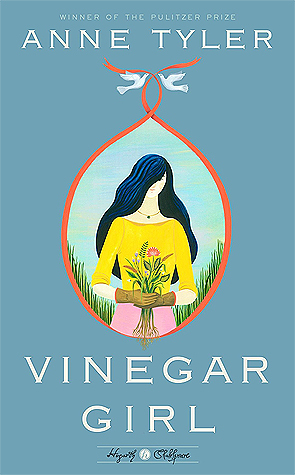
Vinegar Girl

27070127
Hogarth Press
Vinegar Girl
Anne Tyler
2016

The Summary
"Kate Battista feels stuck.  How did she end up running house and home for her eccentric scientist father and uppity, pretty younger sister, Bunny?  Plus, she's always in trouble at work--her preschool charges adore her, but their parents don't always appreciate her unusual opinions and forthright manner.

"Dr. Battista has his own problems.  After years in the academic wilderness, he is on the verge of a breakthrough.  His research could help millions.  There's only one problem:  his brilliant young lab assistant, Pyotr, is about to be deported.  And without Pyotr, all would be lost.

"When Dr. Battista cooks up an outrageous plan that will enable Pyotr to stay in the country, he's relying--as usual--on Kate to help him.  Kate is furious:  this time he's really asking too much.  But will she be able to resist the two men's touchingly ludicrous campaign to bring her around?"

The Good
Vinegar Girl was interesting, to say the least.  A little odd, yes, but it was strangely compelling.  I couldn't help getting wound up in Kate Battista's life, couldn't help wondering what would happen as she struggled to deal with her wild child sister and tried to corral her father's mismanagement and fend off Pyotr's obvious affection.  I was somehow hooked by her story, and I found I couldn't put it down.

I've never read anything by Anne Tyler and, oddly enough, I've never read (but I have seen) The Taming of the Shrew.  Despite my lack of exposure to writer and inspiration, I thoroughly enjoyed Vinegar Girl.  First off, I should state that Tyler is a wonderful writer.  There's something about the story that drew me, a cadence to the narration that made the story appealing on a visceral level for me, and a way the characters were made that kept me coming back for more.

And she's descriptive!

I hate when authors don't set the stage, when they don't offer descriptions of the characters or give weak descriptions about the scene.  Tyler, luckily, does a wonderful job of bringing life to her characters, showing off the little details that make them unique and intriguing, and unfolding an entire world on the pages.  She helps me sink into the story, helps me feel like I'm really there with Kate as she weeds her garden or as she walks the next few blocks to her father's lab because he forgot his lunch (again) or fights with Bunny over the boy she wasn't supposed to bring into the house.

Plus, I found Kate to be singularly enjoyable.  She's headstrong, she's fiery, she's brutally honest and blunt even when speaking to children, and she's incredibly intelligent.  Tyler crafts a compelling and sympathetic character in Kate, creating a complex female character who is pulled in many different directions by her loyalty to her family, her interest in her own career, and her dreams for herself.

And, as an aside, I want to note that I actually appreciated Pyotr's accent.  I mean, after reading What's a Ghoul to Do?, which also features a character with a heavy accent, I realized Anne Tyler does a fantastic job of conveying accents, of individual speech patterns.  Like Dr. Sable in Victoria Laurie's first Ghost Hunter novel, Pyotr does not have a complete grasp of English.

However, unlike Laurie, Tyler manages to make her character's struggle with his second language seem natural, rather than forced.  He trips up on the rules and language quirks that even native speakers may struggle to grasp and he may have difficulty with verbs, articles, and the like, but his lingual missteps seem more like natural mistakes than forced attempts to make him seem cute or bumbling.

The Bad
No complaints, really.  I mean, some part of me did wish for more for Kate, did wish she wasn't so constricted and confined by her family--but isn't that often the way with family and love and marriage?  Sometimes the burdens fall in different patterns, meaning responsibilities (and thus challenges) do not always fall evenly.

But, I suppose, if she's happy with how things turned out, how can I complain?

The Ugly
Family dynamics can get messy.

Let's just leave it at that, okay?