"All good books are alike in that they are truer than if they had really happened
and after you are finished reading one you will feel that all that happened to you
and afterwards it all belongs to you; the good and the bad, the ecstasy, the remorse,
and sorrow, the people and the places and how the weather was."
Ernest Hemingway
Showing posts with label Zombie. Show all posts

Wednesday, June 15, 2016

Afterlife with Archie

18339901
Archie Comic Publications
Afterlife with Archie:  Escape from Riverdale (Volume 1)
Roberto Aguirre-Sacasa
Francesco Francavilla
2014

The Summary
"This is how the end of the world begins...

"All hell breaks loose when a fateful accident sets in motion a series of terrifying events that will threaten the town of Riverdale like never before!  When the dead begin to rise, craving human flesh, it's up to Archie, Betty, and Veronica, and the Gang to fight for their lives against the zombie hordes led by their former pal, Jughead...

"Harvey Award-winning writer Roberto Aguirre-Sacasa (Archie Meets GLEE, Stephen King's The Stand) and Eisner-winning artist Francesco Francavilla (The Black Beetle, Guardians of the Galaxy) bring the apocalypse to the world of Archie in a tale that is both gruesome and heartbreaking."

The Good
A friend recommended reading Afterlife with Archie after we stumbled across Scooby Apocalypse #1 (which I haven't read, but it intrigued me enough that I might) and started on the topic of strange and unusual remakes of our favorite comic books.  She's been a fan of Archie for years and told me it was awesome, even if you aren't a fan of Archie.  So, I decided to go to my local library and check it out.

And I was pleasantly surprised.

Unlike my friend, I'm not really a fan of Archie, or Jughead, or Veronica and Betty.  (I liked Sabrina, but that's a bit of a different story.)  I just couldn't seem to enjoy their interweaving narratives, and I didn't care for the familiar, everyday antics of high school adolescents, especially when I was in high school and saw such things every single day.  I simply wasn't interested.

My attitude toward Archie has changed, of course, since I picked up Afterlife with Archie.  Not only does it offer an intriguing blend of horror and reality, it gives you a new perspective on the characters you once knew.   (Seriously, you'll never look at Jughead the same way again.) It's gut-wrenching to see the gradual collapse of Riverdale, and it tore at my heart to see the safe, calm serenity of Archie's world turned upside-down.

But it was so good.

The story is solid and stands on its own, even if you don't have any experience with Archie or his friends, and it has an unexpected depth; the characters are familiar, but they've been tweaked enough to make them new and intriguing; and the art is stunning, helping to set the grim tone of the entire story and portray the violence the survivors of Riverdale are forced to face.  And it's perfectly scary, enough to give you chills when you're reading it.

Although it incorporates all the old rivalries and romances, it's a story about desperation, loss, and survival--and it's perfectly brutal.  It's a new twist on a favorite classic, and it's well worth reading.  I'd highly recommend it to fans of Archie or the zombie apocalypse genre.

The Bad
Although I didn't have a background with Archie, I understood most of the story and I found it was easy to discern the ties--all the old jealousies, the heated rivalries, and the convoluted friendships--that connected them.  However, I think if I had been familiar with Archie and his friends, I think it would have had more of an impact.

Yes, Afterlife with Archie can stand on its own two feet, but I imagine I would have better understood some of the references to locations, friendships, rivalries, etc. if I'd been familiar with other Archie comics.

The Ugly
Zombies.

Afterlife with Archie is almost on par with The Walking Dead for gore.  No joke, it's hyperviolent and bloody and slightly terrifying.  If you're not a fan of zombies or can't stomach the sight of familiar characters having their throats torn out, I definitely wouldn't recommend it.
Tuesday, May 10, 2016

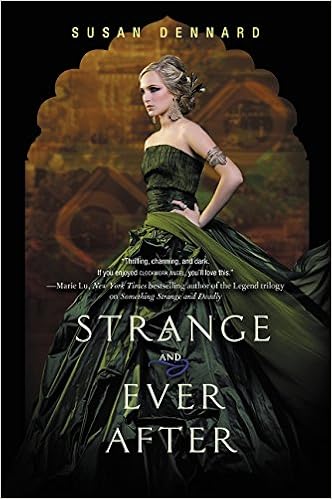
Strange and Ever After

HarperTeen
Strange and Ever After
Susan Dennard
2014

The Summary
"It has been a tumultuous time for Eleanor Fitt since life as she knew it in Philadelphia came abruptly to an end.  While the Spirit-Hunters--Joseph, Jie, and Daniel--have helped her survive her brother's violent death and an invasion of Hungry Dead, Elanor has lost just about everything.

"And now, Jie is missing--taken by the evil necromancer Marcus.  Eleanor is determined not only to get her back but to end this nightmare altogether.  But to do so, she must navigate the hot desert streets of nineteenth-century Egypt amid the rising Dead, her unresolved feelings for Daniel, and her volatile relationships with Joseph and Oliver, her demon.  And it won't be easy.  Because now Allison, her friend from Philadelphia, has tagged along, becoming strangely entangled in Eleanor's mission.

"It will take all of Eleanor's powers of black magic, and all of Daniel's and Joseph's trust, to succeed.  But there will be a price.  And only when it is over will Eleanor truly be able to live a strange and ever after life.

"In the conclusion to this epic trilogy, which began with Something Strange and Deadly and continued with A Darkness Strange and Lovely, Susan Dennard will have readers on the edge of their seats, breathless with anticipation, and begging for this story not to end."

The Good
Strange and Ever After is, like the other books of the Susan Dennard's trilogy, pretty enjoyable.  It combines many of the same elements--the mystery, magic, and intrigue--I'd found appealing in her last novels, and it has many of the same characters I'd liked in the past.  Although the plot began to run a little thin after reading two books dedicated to the exact same subject (i.e. chasing down Marcus and stopping his villainy), it did a fair job of bringing the story to a close.

(Not to say that I was pleased with the conclusion, but more on that later.)

Egypt was also an interesting choice of location for the trilogy conclusion.  After spending an entire book in Philadelphia, then a second in Paris, it seemed like such a strange change of course.  Granted, I suppose the last two books hinted at the course of the story, but I have to say I was still a little surprised.  It was an interesting deviation--and, admittedly, I was intrigued to see where their journey would lead.

Like Something Strange and Deadly and A Darkness Strange and Lovely, I was oddly attracted to this novel.  It's something like a guilty pleasure:  no great epic, no poetic lines of verse, but a fairly enjoyable, action-filled story that drags you in and doesn't let go.  I wanted to see how the story would end, and I was determined to finish what I started, even if I did begin to lose a little interest along the way.

The Bad
I felt like this novel introduced too many new concepts to the story that it only briefly touched upon in the previous two.  For instance, it dives deep into Egyptian myth and belief, pulling ancient Egyptian gods from the ether, shining a bright searchlight on the realm of the realm of the dead, which it didn't even remark upon in past books.  Sure, it's hinted at by Elijah in the first book and it's explored in passing by Oliver in the second, but it truly comes to fruition in the third.

Which doesn't make sense to me.  The natural progression seems distorted, especially since it started to explore voodoo and necromancy, which feel like very distinct entities entirely separate from ancient Egypt.  It felt like a jarring transition, especially since I was very curious about Joseph's and Marcus's education in New Orleans.  I think that would have proved a more interesting direction, but that's just my opinion.

Moreover, I was quickly exhausted by the journey.  It felt like it lasted forever and it just kept adding twists to the plot, making the story last altogether too long.  I mean, I could have dealt with one less betrayal; likewise, I could have dealt with less about the intervening journey--or how much Eleanor wanted to kill Marcus (I could have done with less of her internal dilemmas)--and would have appreciated much more description.

After reading Crocodile on the Sandbank by Elizabeth Peters, which also takes place in Egypt, I realize what I missed in Dennard's final novel:  setting description.  It falls very short in the third novel and, as I think about it more, it's a great disappointment.  I feel like much of it was left to the imagination, leaving me to connect the pieces and envision the landscape from my own recollections of movie/TV cliches.

Yes, I was a little disappointed.

The Ugly
The conclusion.

Most of the time, I can live with the death of a familiar character if it seems necessary or if I'm braced for it.  I can handle tragedy, even if it breaks my heart.  I survived reading J.R.R. Tolkien's The Children of Hรบrin and John Green's The Fault in Our Stars and Markus Zusak's Book Thief, so I think I know how to handle the death of a main character and handle it gracefully.

That is, I may bawl like a baby and lament the death of my favorite characters, but I don't condemn the book for playing with my emotions or socking me in the gut.  It's part and parcel of the story.  While I may not like it, while it may be unexpected or heart-rending or just plain upsetting, I usually accept what happens and, sometimes, I even find those books that evoke the most emotion are the best ones I read.

For crying out loud, The Fault in Our Stars and The Book Thief are two of my favorite books.  I love them, and I will read them again and again despite the heartbreak I endure.

However, I didn't feel that way about Strange and Ever After.  When one of the main characters died--I won't say who, because I don't want to spoil the horrible surprise for other readers--it ruined my entire reading experience.  Sure, in hindsight, I can see a couple of the red flags that should have warned me as to what was going to happen.  And, yes, I can see how it set events in motion that brought Marcus to his knees.

But I don't care.

This one death, this one person who had to die for some ancient riddle to be solved, completely ruined the novel for me.  It seemed so entirely pointless, given what I know about the other characters and their abilities.  I don't care if the novel closed with the characters picking up the pieces, honoring their fallen comrade and moving on to a better, brighter future.  It simply isn't enough.  It will never be enough to redeem this novel for me.

Saturday, May 7, 2016

Read Harder Challenge (Part Three)

I've discovered some more books as part of my commitment to the Read Harder Challenge of 2016, and I've discovered some great stories in my explorations.  I have managed to:
  1. Read a horror book.
  2. Read the first book in a series by a person of color.
  3. Read a play.
HarperTeen
Usually, I don't read horror novels.  Dracula and Frankenstein are about it for me, but I have managed to read Stephen King's The Shining and The Strange Case of Dr. Jekyll and Mr. Hyde by Robert Louis Stevenson, among a handful of other novels that are considered good and scary.  And so, in order to satisfy my challenge criterion and read a horror story, I read Something Strange and Deadly by Susan Dennard.

Although I didn't initially lump Dennard's novel into the horror genre, I reconsidered my stance after necromancy and ritualized violence became involved.  The novel is pretty mild, all things considered--I mean, I certainly wouldn't put it at the level of The Walking Dead or Stephen King, or even Dracula--but it's still rather gory and riddled with a tough kind of suspense that leaves you hanging on the edge of your seat, hoping for more answers.  However, I think it's the zombies that pushed it over the edge and helped me give it a final designation as a horror novel.

I wouldn't call Something Strange and Deadly one of my favorites, but it isn't a bad book; in fact, I initially enjoyed it.  I liked the creepy atmosphere of it coupled with the turn of the century setting, and I even liked the story:  a wicked necromancer comes back from the dead to terrorize Eleanor Fitt, while the Dead continue to rise from their graves across Philadelphia.  It's an intriguing adventure, to say the least; however, I wasn't entirely thrilled with the story when I examined it in retrospect.  The phrase "shut pan" annoyed me to no end.  (Part of me began to think the author found a new, novel phrase and decided to run with it.)

Harper Voyager
Next, in reading the first book in a series by a person of color, I picked up My Soul to Keep by Tananarive Due.  As the first book in the African Immortals series, My Soul to Keep fit the bill perfectly to fulfill this challenge and check it off my list.  I stumbled across it purely by accident, finding it in audiobook form from my local library's website--and I was immediately hooked.

I was intrigued by the premise:  an Ethiopian warrior stumbles across the secret to immortality and spends the rest of his eternal life alternating between identities, enduring a number of years as a slave on a Southern plantation, before becoming a Civil War soldier, a jazz singer, and, finally, a college professor and author.  His story is one of sorrow and loss, desperation in trying to hold tight to the ones he loves.  I was riveted from the first word, from the first moment the narrator spoke and started to weave a complex, beautiful story about Dawit--David--and his wife, Jessica.

At just over eighteen hours long, it took me a number of weeks whittling away at the story to complete it, but I have to say I was thrilled.  It's detailed and strongly written (and narrated by Peter Francis James, who has an amazing voice by the way), and it's absolutely riveting.  The story packs a punch, pulling together a myriad of religions, myths, cultures, and countries to create a flawless tapestry of history and suspense, beauty and sorrow.  I became emotionally invested in Dawit and Jessica's story, and I found myself hoping for the best outcome--and crying (just a little) when tragedy strikes.  I highly recommend picking up My Soul to Keep and reading it for yourself.

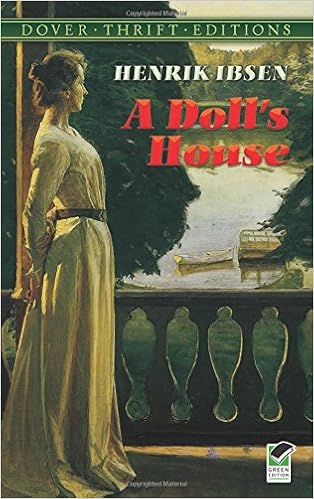
Dover Publications
Last, I worked on Henrik Ibsen's A Doll's House.  Having read a portion of the play during a theater history class in college, I was intrigued about the prospect of reading the entire play this time around.  It was just my good fortune that I found a copy of the play for a dollar at my local used bookstore.  It's almost as if it was fated to be.

A Doll's House is an interesting play, not action-packed or suspenseful (like either of the two entries listed above).  For the time period, it's thought-provoking and, even now, it raises a lot of questions about women as spouses and mothers--and what are the typical roles of women in society.  It's a play designed to make you think, rather than thrill you.

Personally, I thought it was fascinating to see how Nora managed to flaunt convention, managed to get what she wanted despite the restrictive constraints of her time that were placed upon her gender, and, more importantly, proved she was capable of making her own decisions.  It's a bit slow, but I think it's worth reading at least once, especially if you're interested in theater.

Tuesday, April 19, 2016

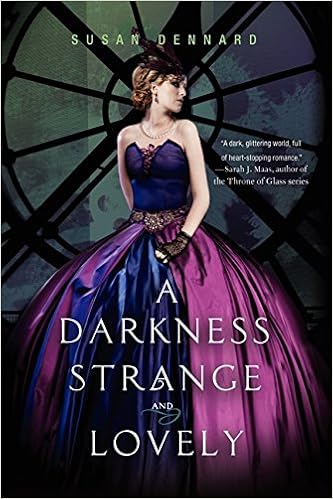
A Darkness Strange and Lovely

HarperTeen
A Darkness Strange and Lovely
Susan Dennard
2013

The Summary
"After helping the Spirit-Hunters save Philadelphia from the walking Dead, Eleanor Fitt must now face the thing she couldn't stop:  her brother's death, her mother's deteriorating health, and the sting of unrequited love.  But when she encounters the necromancer Marcus again, she must seek the help of Joseph, Jie, and the gorgeous Daniel--who have all fled to Paris.

"On her way to France, Eleanor meets Oliver, who claims to have known her brother.  Though friendly, Oliver harbors a secret involving black magic that entices Eleanor.  Trying to resist it, she rejoins the Spirit-Hunters in hopes of stopping Marcus.

"But the Dead have taken over Paris, and there's a whole new evil lurking.  Eleanor is now forced to make a dangerous decision--and her choice could mean life or death for everyone."

The Good
Oddly enough, I devoured this book.  Something about it appealed to me and kept me riveted to the page.  I can't say why, either.  It's packed with action, a handful of decent characters, a few plot twists I didn't expect, and I was somehow hooked--drawn inexplicably into a crazy, wild story that crosses the Atlantic and drives right into the heart of Paris.

I'll be the first to admit that A Darkness Strange and Lovely isn't a great book.  I mean, it isn't an epic or an immediate classic, but it's fun and interesting--and it appealed to me on a certain level.  I liked the idea of zombies using the catacombs of Paris to take more victims, to create more havoc.  It's an intriguing concept.  It's exciting and full of heart-pounding action, a few fascinating inventions and weird (read:  mad scientist) science, but it's fun to read.

I can't really tell you why, but I really liked reading Susan Dennard's novel.  I liked it well enough that I managed to finish it within a couple of days.

The Bad
A Darkness Strange and Lovely doesn't have the best writing.  It isn't always compelling and, admittedly, it lost my attention a couple of times.  Granted, I still finished it in, like, two days, but it's not a great novel.  It's dark and grisly, but it has a bad habit of throwing up unnecessary smokescreens that I found annoying and, more often than not,  offered zero explanation for magic.

It continually led me on to one misadventure after another, propelling the story forward with one event after another, culminating in an obvious (to the reader) conclusion.  I felt there were a few gaps in the story:  why was Marcus in France to begin with?  I mean, it's not like it was a particularly compelling destination.  And why doesn't anyone explain circumstances--and magic--to Eleanor when it would keep her out of danger?

Basically, Eleanor is a loaded cannon.  And, instead of teaching her how to aim in the right direction or, you know, telling her to keep a burning match away from the fuse, they all (but Oliver and Joseph, in particular) seem content to let her walk around in ignorance.  She could had been spared a lot of problems and everyone else could have been saved a lot of trouble if they'd just told her the truth.

Sheesh.

The Ugly
Flesh-eating zombies.

Oh, and soul-sucking demons.

And reanimated animal corpses.

Wednesday, April 13, 2016

World War Z

Random House
World War Z
Max Brooks
2006

The Summary
"We survived the zombie apocalypse, but how many of us are still haunted by that terrible time?  We have (temporarily?) defeated the living dead but at what cost.  Told in the haunting and riveting voices of the men and women who witnessed the horror firsthand, World War Z is the only record of the plague years."

The Good
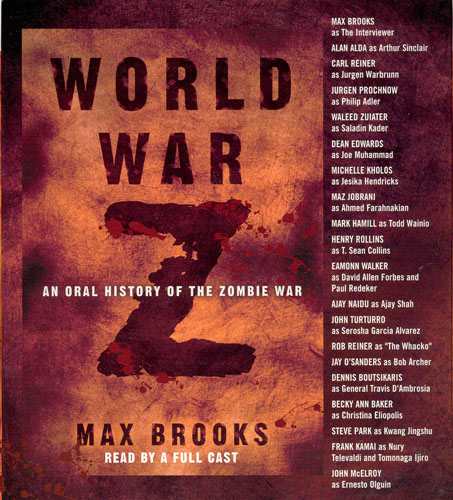
I ventured back into Max Brooks' zombie-infested world recently with the help of an audiobook.  Already an ardent fan of World War Z, I was intrigued by the idea of actually listening to the story and, since it featured a full cast (among them Nathan Fillion, Martin Scorsese, and, of course, Mark Hamill), I couldn't wait to get started.  While I was a little disappointed to learn I found an abridged copy after borrowing it from my library website, I wasn't disappointed by the storytelling.

It was thrilling to hear the stories brought to life, to hear the voices of these characters that I'd envisioned in previous readings of World War Z.  I loved listening to my audiobook and, if I'm being honest, I finished it in a little over two days.  I popped in my earbuds and listened to my audiobook at every opportunity, listening to the brutal civil war in Israel during my car ride to work, listening to Todd Wainio recount the Battle of Yonkers as I walked my dog, listening to events unfold in the castles of England when I cooked dinner.

I couldn't put it away, I couldn't stop.  I was hooked from the introduction, just like I'd been hooked when I first picked up World War Z--when I read those first few stories and became embroiled in the conflict, in the desperation for survival.

The audiobook is just as addictive as the novel.

The Bad
I had an abridged copy of World War Z.

Honestly, I feel like I missed out on so much.  The audiobook barely looked at what happened in India and Japan, didn't even touch upon events in Russia, didn't recount what happened in the flooded catacombs beneath Paris or the Pacific Ocean, and it certainly didn't tell the reader what happened to the astronauts stuck on the space station orbiting Earth.

Those are the stories I missed, the stories I'd dearly loved to have heard.  Don't get me wrong, I enjoyed listening to the audiobook and I would highly recommended it to any fans of World War Z; however, I wish it had had more of the stories I'd enjoyed.

The Ugly
Zombies.  Horrible, mindless, flesh-eating zombies.

It's bound to make you queasy at some point.

Friday, April 1, 2016

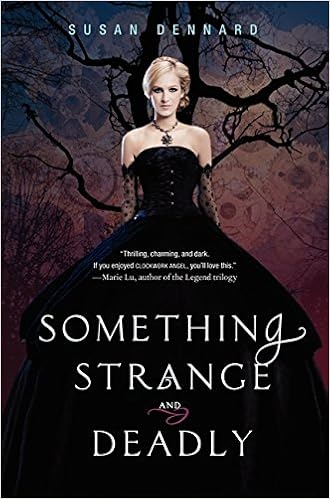
Something Strange and Deadly

HarperTeen
Something Strange and Deadly
Susan Dennard
2012

The Summary
"After her father dies and her brother mysteriously goes missing, Eleanor Fitt is left to deal with her family's declining financial state.  And with her controlling mother trying to marry her off, sixteen-year-old Eleanor doesn't think life could get more complicated.

"But then the Dead start walking.

"Desperate to solve the mystery of her brother's disappearance, Eleanor ventures into the private lab of the elusive Spirit-Hunters, who protect the city from supernatural forces.  Always a social misfit, Eleanor finally feels at home among the intelligent Joseph, feisty Jie, and extremely stubborn yet gorgeous Daniel.  But the more time she spends with them, the more dangerous her life becomes."

The Good
Admittedly, I really liked reading Something Strange and Deadly.  It's something of a guilty pleasure:  magic, zombies, romance--it's something dark and sinister and, oddly enough, fun.  While I can't say it's perfect, I enjoyed Susan Dennard's novel.  It has a strangely intriguing concept, a decent set of characters, and a narrator who isn't half bad.

It's not a complex novel by any means; rather, it sometimes sets out to deflect the readers attention by throwing road blocks in the way.  But it has a simplicity that makes it easy to read and, more to the point, makes it a quick novel.  I finished it in a couple of days and found myself oddly satisfied, even if the story ended with a bit of a cliff-hanger--and a number of unanswered questions.

Overall, I liked it.

The Bad
"Shut pan"?

Let me be honest, I hated that phrase.  It was used far too often, and it was just such a ridiculous phrase, so silly that I found it hard to believe it was an accurate phrase plucked from history.  I tried researching it, trying to find out what exactly it meant and where it originated, but I only found references of it in Old West slang, caught between words like "shave tail" or "gringo" or "horse feathers."

I mean, really?  I could maybe understand Jie, who seems to have some experience with the American west, but Eleanor?  As a proper young lady of the American semi-aristocracy, where would she have even learned it?

And, following the same vein of incredulity, I can't help but wonder why Eleanor seems like such a strange combination of prim, proper society miss and raging feminist.  I feel like she needs to be one or the other:  either she needs to embrace her feminist tendencies and completely balk against social expectations, including her mother's designs for an advantageous marriage, or she should better reflect the conventions of the day.

She shouldn't pretend to be a wilting violet one moment, fanning herself for a young man breaching social etiquette by taking her aside or taking her hand, and then turn around and sneak out of her house with another boy.  I need a little more balance, please.

Not that Eleanor does a very good job of reflecting the social conventions of 19th century Philadelphia.  But that's probably my biggest complaint with Dennard's novel:  inaccurate history.  Granted, I realize it reflects an entirely different age in which necromancy and zombies exist; however, I just couldn't stand that so many historical details were just plain wrong.  It annoyed me more than it probably should have.

In my opinion, if an author is going to write a fantasy novel set in the late 1800s in Philadelphia, either stick to said alternative timeline--where everything is different, including society and its expectations--or stay true to history.  Don't pick and choose.

And Eleanor Fitt's fascination with Shakespeare annoyed me.  Don't ask me why, but it did.

The Ugly
Zombies.

Ugly, horrible, flesh-eating zombies.

Saturday, January 23, 2016

Read Harder Challenge (Part One)

As part of the Read Harder Challenge for 2016, I've picked several books to fulfill some of the criteria.  So far, I've managed to:
  1. Read a middle grade novel
  2. Listen to an audiobook that has won an Audie Award
  3. Read a non-superhero comic that debuted in the last three years
Candlewick Press
For my middle grade novel, I completed Flora and Ulysses:  The Illuminated Adventures by Kate DiCamillo.  A fun little book with amusing illustrations, Flora and Ulysses was a nice surprise for me.  I picked it up for the simple fact that it had a squirrel on the cover.  I simply couldn't help myself--I mean, who wouldn't be enticed by a book that has a squirrel as a main character?  (Not a friend of mine, I can say with certainty.)

Anyway, the main point is that I really liked DiCamillo's novel.  It caters to a younger audience, yes, but it's accessible and enjoyable to read even as an adult.  It toys with more mature themes, like divorce; however, it does so in a way that's understood by children and appealing to parents.  It's a good book with a good story (an odd story, but a good story nevertheless).  DiCamillo is also the author of  Because of Winn Dixie, and she further cements her reputation as an exceptional author with Flora and Ulysses.

Random House
Now, to fulfill my audiobook requirement, I actually revisited World War Z by Max Brooks.  I originally listened to the audiobook simply because I loved World War Z and I was intrigued to see what a full cast would be like reading it (especially since I discovered it featured Nathan Fillion, Martin Scorsese, and, of course, Mark Hamill).  It was just a happy accident that I happened to stumble across an Audie Award winner from 2007.

I highly recommend listening to World War Z if you've read the book--or, actually, even if you haven't read the book.  Having a full cast, World War Z  is singularly entertaining as an audiobook.  It's still full of the same stories, the same diversity and detail that made it such a wonderful novel, but, now, you have the chance to actually listen to those stories and more fully imagine the characters behind them.

(I will note, however, that I think I picked up an abridged version of the novel.  I don't know if the abridged novel is the only one available, or if there's a copy of the audiobook out there that has every single chapter, but, regardless, I recommend trying to get your hands on the full copy for the greatest effect.  My only complaint was that it left out some of my favorite chapters.)

Dark Horse
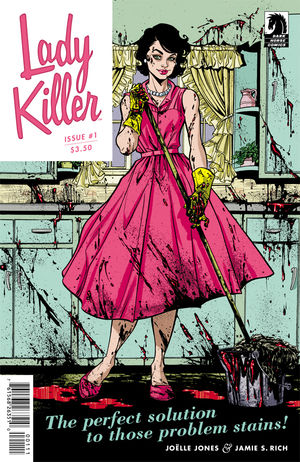
And then there's my non-superhero comic:  Lady Killer by Jamie S. Rich and Joelle Jones.  I picked up Lady Killer at my local comic book store on a whim, because I liked the cover (oddly enough) and I liked the idea of reading about a housewife who worked part-time as a hired killer.  It was a fascinating dynamic that intrigued and compelled me to pick up a copy for myself.

Josie Schuller is far from being a superhero:  she's pragmatic, ruthless, and cold-blooded.  She's a survivor, which means anything goes when it comes to protecting herself and her own (including her darling twin girls).  Overall, I liked reading Lady Killer.  It's probably one of the best comic books I've read within the last year--and it might simply be one of the best I've ever read.  Period.

---

For more on the Read Harder Challenge of 2016, check out Book Riot.  And for more book reviews from Reader's Reach, scroll through the archives to find something you might like.

And, as always, happy reading.

Friday, March 21, 2014

World War Z

Max Brooks - World War Z
Image courtesy of
www.maxbrooks.com
World War Z
Max Brooks
2006

The Summary
As the greatest conflict in human memory, the "Zombie War" changed the world and everyone in it - and one man is intent on retelling the memories of those days, preserving history that may one day be forgotten.

He starts his interviews at the beginning of "The Crisis" and follows the thread of history from one country to the next (China, America, South Africa, England, Antarctica, Israel, etc.), until the "present day" when humanity no longer faces extinction.

The Good
Max Brooks' novel is fabulous.  I personally loved the concept of reading "interviews."  Not only do readers have the opportunity to experience different stories - different characters with different experiences - we have the chance to see what happens to different parts of the world and how various countries encounter the same conflict.

It's also fascinating and inventive.  I mean, World War Z answers questions I didn't even know I had about a zombie apocalypse.  For instance, what happens to astronauts stuck on space stations?  Do zombies float - or do they sink and walk on the ocean floor?  Can a person fool a zombie?  And what happens to the global economy after everything goes kaput?

There's an amazing breadth and depth to Brooks' novel.  Although you never receive a complete explanation as to how the zombies came into being and how or where the apocalypse really beings (there's plenty of supposition between all the characters involved, so you're not completely left in the dark), it's so fully comprehensive that you never notice it lacking.

Honestly, it's enough to see what happens to the world from "Day One" to the end of the war that you're satisfied with the answers you receive.

The Bad
I don't have anything negative to say about Brooks' book.  It's intriguing and detailed and, while there are certain elements that make it difficult to read (on an emotional level), it remains one of the best books I've read.

Perhaps my only complaint was trying to recognize the different names individual characters called zombies:  the tried and true "zombie," but also Zed Heads, Gs, Zacks, etc.  But context clues basically cleared that up.

The Ugly
World War Z is a story about a zombie war, so, of course, you'll be faced with gratuitous amounts of gore and violence and bloodshed.  You'll read "reports" and "interviews" about people being eaten alive, being trapped in their cars and dying of exposure.

And, if that isn't gory and disheartening enough for you, there's stories of human desperation - murder, cannibalism, suicide, genocide - and world-changing amounts of pollution from burning cities and the living dead walking from one corner of the earth to the other.

It isn't a pretty picture.

Brooks creates a terrifying world in his novel, a dystopian future guaranteed to give you chills.  In fact, it's the stuff of nightmares, especially when you're sitting up at midnight and reading with only a dark, creaky house for company.

Saturday, December 7, 2013

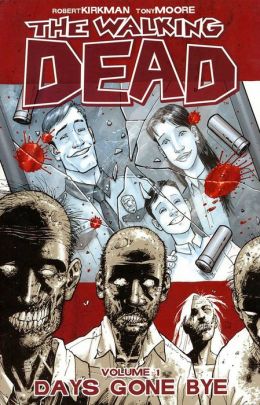
The Walking Dead: Days Gone Bye (Volume One)

The Walking Dead, Volume 1: Days Gone Bye
Image courtesy of
Barnes and Noble
The Walking Dead:  Days Gone Bye (Volume One)
Robert Kirkman
Tony Moore
2006

The Summary
When small-town sheriff Rick Grimes is caught in a shoot-out with his partner, Shane, he doesn't expect to wake up in a coma weeks later - and her certainly doesn't expect to learn the world is a very different place, a place rife with abandoned cities and zombies.  But his grave situation doesn't deter him from finding what's most important:  his wife and his son.

His former partner, however, just might.

The Good
Packed with stimulating art and gripping story-telling, Days Gone Bye is a graphic novel that is sure to please.  Not only does Tony Moore, the artist, render the story with great detail and care, Robert Kirkman, the author, creates a suspenseful tale woven with equal parts tragedy and horror and human insight.

In particular, Kirkman's skills as a story-teller in formulating compelling characters, unique stories, and appropriate amounts of action - and suspense - will keep you on the edge of your seat from cover to cover.

Granted, much of The Walking Dead focuses on the journey of Rick Grimes as he travels to Atlanta in search of his family; however, Kirkman and Moore's novel branches in many different directions as new character and newer dangers emerge.

It's interesting and it's gripping, no two ways about it.

The Bad
I would not recommend The Walking Dead to a younger audience.  Filled with stronger language, gore, frightening images, and a fair dose of horror, Kirkman and Moore's novel is probably a little graphic for some readers.  Honestly, I don't think I read a single issue in this first volume in which multiple people didn't die.

I suggest if you don't like stories that make your stomach twist with grief and worry, or make your heart sink inside your chest, this book may not be for you.

The Ugly
Riddled with gore and tragedy, The Walking Dead is a post-apocalyptic horror story bent on making you squirm the farther you read.  As you learn in these first few issues, it's not just the zombies about which you have to worry - it's the survivors.

Wednesday, September 19, 2012

Pride and Prejudice and Zombies

Pride and Prejudice and Zombies
Image courtesy of
www.barnesandnoble.com
Pride and Prejudice and Zombies
Seth Grahame-Smith
Jane Austen
2009

The Summary
Filled with zombies, romance, gun-toting Bennet sisters, and ninjas - yes, zombies and ninjas - Seth Grahame-Smith's novel lends an interesting and incredibly unusual twist on the classic work of Jane Austen.

The Good
Some aspects of Grahame-Smith's novel are uproariously funny, not least of all for deciding to mix Jane Austen and zombies.  (Because, let's be honest here, what can go wrong with that particular combination?)

Pride and Prejudice and Zombies forges its own genre, so to speak.  It combines classic literature and zombies, horror and romance, and throws in a dash of overly dramatic kung fu.  So, while this novel isn't entirely typical, it manages to remain interesting, absurd, and highly hysterical.

In particular, Grahame-Smith manages to insert a certain dirty humor you simply won't find in Austen's work, which makes his novel particularly amusing.  The fact that Elizabeth finds Darcy "English" in all the right places seems like such a twist from the mild-mannered miss of Austen's novel - and it's certainly a fact worth chuckling over.

The Bad
Although this novel does have several merits for its absurdity and originality, Pride and Prejudice and Zombies is, at its core, a knock off.

Granted, I don't doubt its originality for combining Austen and zombies, but much of it feels to be copied from Austen's work.  She did most of the work, so to speak, and provided Grahame-Smith with much of the material he would use; he simply sprinkled in some zombies and ninjas, and upgraded the Bennet sisters to zombie hunters.

I'm simply pleased credit is given where it is due.

The Ugly
Zombies are flesh-eaters - and the Bennet sisters are a hardcore group of zombie hunters.

Combine the two and zombie carnage is bound to ensue.