"All good books are alike in that they are truer than if they had really happened
and after you are finished reading one you will feel that all that happened to you
and afterwards it all belongs to you; the good and the bad, the ecstasy, the remorse,
and sorrow, the people and the places and how the weather was."
Ernest Hemingway
Showing posts with label Poland. Show all posts

Wednesday, May 17, 2017

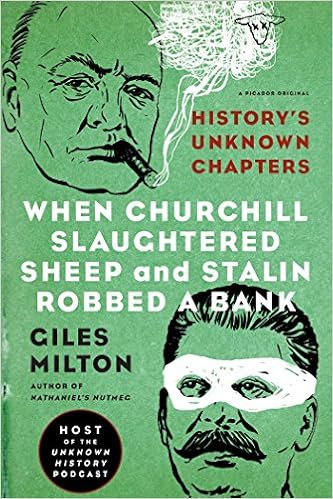
When Churchill Slaughtered Sheep and Stalin Robbed a Bank

Picador
When Churchill Slaughtered Sheep and Stalin Robbed a Bank
Giles Milton
2016

The Summary
"More addictive and mind-blowing true tales from history, told by Giles Milton--one of today's most entertaining and accessible yet always intelligent and illuminating historians.

"In the second installment of his outrageously entertaining series, History's Unknown Chapters, Giles Milton shows his customary historical flair as he delves into the little-known stories from history, including when Stalin was actually assassinated with poison by one of his inner circle; the Russian scientist, dubbed the "Red Frankenstein," who attempted to produce a human-ape hybrid through ethically dubious means; the family who survived thirty-eight days at sea with almost no water or supplies after their ship was destroyed by a killer whale; or the plot that served as a template for 9/11, in which four Algerian terrorists attempted to hijack a plane and fly it into the Eiffel Tower."

The Good
Giles Milton's work is as entertaining as always in this latest addition to his series, History's Unknown Chapters.  Personally, I loved learning new things about history that I didn't know, like the rehearsal for D-Day that saw more than 900 casualties.  Or the spy who broke into Auscwitz.  Or the man who broke into Buckingham Palace and decided to hang out in the Queen's chambers.  Or Guy Gabaldon, who captured several hundred Japanese soldiers without even firing a bullet.

When Churchill Slaughtered Sheep and Stalin Robbed a Bank is pared down into manageable, bite-size sections, which makes Mileton's book both easy-to-read and accessible.  Don't want to hear about how Charlie Chaplain's grave was robbed?  Skip it!  Don't care to hear about Stalin's assassination?  Then move on to the next chapter.

This book is great if you like random facts, if you like history, or if you like learning about weird, quirky people and strange happenings across the globe.  It's highly entertaining and it's accessible, which I--and I'm sure other readers--appreciate.

The Bad
As I discovered with When Hitler Took Cocaine and Lenin Lost His Brain, When Churchill Slaughtered Sheep and Stalin Robbed a Bank is a book to be read at short intervals.  I loved the random facts, the quick anecdotes that taught me something new; however, I mostly read it in between other books or when I was waiting--like waiting for an oil change, or waiting for a seat at a restaurant, or waiting for my boyfriend to pick me up.

It's more of a short, entertaining read to be taken up at short intervals, rather than consumed in one large gulp.

The Ugly
Reality truly is stranger than fiction.
Thursday, May 26, 2016

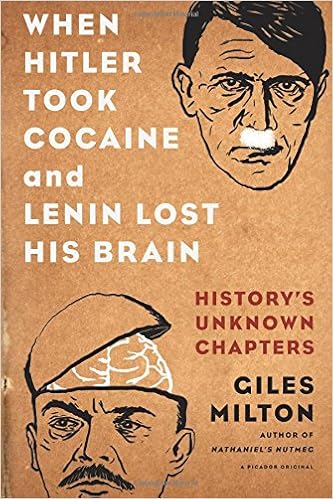
When Hitler Took Cocaine and Lenin Lost His Brain

Picador
When Hitler Took Cocaine and Lenin Lost His Brain
Giles Milton
2016

The Summary
"In this first installment of his outrageously entertaining series, History's Unknown Chapters, Giles Milton delves into the little-known stories from history, like when a cook aboard the Titanic pickled himself with whiskey and survived in the icy seas where most everyone else died; or the man who survived the atomic bomb in both Hiroshima and Nagasaki.

"Covering everything from adventure, war, murder, and slavery to espionage--including the stories of the female Robinson Crusoe, Hitler's final hours, Japan's deadly balloon bomb, and the emperor of the United States--these tales deserve to be told."

The Good
I enjoyed this book much more than I expected.  Actually, I shouldn't say that because I expected quite a lot from a book titled When Hitler Took Cocaine and Lenin Lost His Brain.  This is a book that, as my coworker pointed out, "you pick up just for the title alone."  And, honestly, I have to say I agree.

Giles Milton's book is filled with fascinating tidbits of information, weird history, and incredible stories that seem almost too strange to believe.  It's fun and it's interesting without being too overwhelming or dense.  It's divided into short, quick sections, which makes it easy to plow through a whole chapter in a matter of minutes.

Moreover, I loved that I learned new things about history that I never knew.  Like the man who survived two nuclear explosions, one at Nagasaki and one at Hiroshima.  Or the cook who survived the sinking of the Titanic by, he claimed, drinking enough alcohol.  Or Agatha Christie's eleven missing days, during December 1926--before she was found in a distant hotel under the name of her husband's mistress.  Or how Lenin's corpse was preserved and put on display, his brain being donated to another institution for study (and his heart entirely disappearing).

Sure, it sometimes gets a little gruesome and, admittedly, a little weird.  But it's fun and fascinating, grabbing your attention and holding it by offering new and, if possible, even more incredible stories.  It's worth reading, especially if you love history or even just weird, unexpected facts.

The Bad
Giles Milton's book is not an in-depth study of human history.  Primarily, it focuses on historical events starting in 1912 (i.e. the sinking of Titanic) and ends somewhere in the 1960s, which means if you want to look beyond the twentieth century, you may have to look elsewhere.  It's a great book for an overview of facts, rather than a detailed examination of events.

The Ugly
Some of these stories have a (relatively) happy ending, like the cook who survived the sinking of the Titanic, or the seamstress who lived on an inhospitable island for 2 years before she was rescued, or the heroic dog who saved his fellow soldiers during World War I--or the real life Captain America who was twice turned away by the army, and eventually became a highly decorated veteran of World War II.

Other stories, however, are a little more brutal:  the pair of explorers who died on Mount Everest, the assassination of Rasputin, the Englishwoman who adopted several children and subsequently murdered them, or the poor individuals who were put on display before a jeering mob.  These stories, for me, often provoked disgust or sympathy.

Some of these stories are disheartening, some of them are daunting because they reflect an especially dark chapter in human history that, while intriguing and strange and downright weird, are often cringe worthy.

Saturday, May 9, 2015

Bonus: Once We Were Brothers

St. Martin's Griffin
Once We Were Brothers
Ronald H. Balson
2013

The Summary
"Elliot Rosenzweig, a respected civic leader and wealthy philanthropist, is attending a fundraiswer when he is suddenly accosted and accused of being a former Nazi SS officer named Otto Piatek.  Although the charges are denounced as preposterous, his accuser, Ben Solomon, is convinced he is right.  Solomon urges attorney Catherine Lockhart to take his case, revealing that Otto Piatek was abandoned as a child and raised by Solomon's family only to betray them during the Nazi occupation.  But has he accused the right man?

"Once We Were Brothers is the compelling tale of two boys and a family that struggles to survive in war-torn Poland.  It is also the story of a young lawyer who must face not only a powerful adversary, but her own self-doubt.

"Two lives, two worlds and sixty years all on course to collide in a fast-paced legal thriller."

The Good
Once We Were Brothers has an intriguing premise:  two men, who were once as close as brothers, are suddenly separated by war and political ideology.  It certainly has the bones to make a good story, and I was definitely intrigued when I first set out to read the book.

For the most part, I liked Ronald Balson's novel.  I liked the way Ben began his story, sinking into his history, recounting his experiences and his environment.  And Once We Were Brothers is packed full of comprehensive information.  It gives you a vision of the enormity of the Holocaust, while simultaneously revealing the effects of Nazi occupation in Poland on individuals.  It shows the impact of World War II on an emotional, individual level and a larger, international level.

Moreover, Ben and Hannah's romance is spectacularly sweet.  I was constantly hanging on his words, wondering what would happen to him and Hannah, what would happen to his family after surviving the Holocaust and the war.  I never really expected the ending I received.

The Bad
When I'm reading Ben's words, listening to his tale along with Catherine and everyone else, I can sometimes sink into his story; however, after a certain point, I struggled with the tone of his voice.  I imagine him to have an accent, considering he lived in Poland for a very large portion of his life, and he slips in and out of it, but I can't focus for the interruptions.

Yes, I understand his narrative is an interview, but I don't need to be reminded each and every chapter.  I would like to hear his story in one, cohesive unit, not parsed into bite-size pieces with lots of legal jargon stuffed in between.

Furthermore, I wasn't ecstatic with the character development of Balson's novel.  Sometimes, I thought it seemed rushed, like Catherine's life.  Her story is condensed into a few, quick paragraphs and brief snippets of information, and I personally didn't see very much growth.  Any changes she underwent, any changes to her relationship with Ben always seemed abrupt.

The Ugly
The main story of Once We Were Brothers occurs during World War II.  With a Jewish family.  In Poland.

You can see where I'm leading with this.