"All good books are alike in that they are truer than if they had really happened
and after you are finished reading one you will feel that all that happened to you
and afterwards it all belongs to you; the good and the bad, the ecstasy, the remorse,
and sorrow, the people and the places and how the weather was."
Ernest Hemingway
Showing posts with label Scotland. Show all posts

Wednesday, September 6, 2017

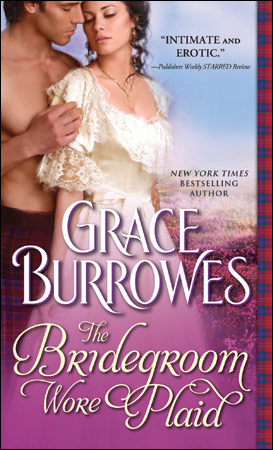
The Bridegroom Wore Plaid

Image result for the Bridegroom wore plaid
Sourcebooks Casablanca
The Bridegroom Wore Plaid
Grace Burrowes
2012

The Summary
"His family or his heart--one of them will be betrayed...

"Ian MacGregor is wooing a woman who is wrong for him in every way.  As the new Earl of Balfour, though, he must marry an English Heiress to repair the family fortunes.

"But in his intended's penniless chaperone, Augusta, Ian is finding everything he's ever wanted in a wife."

The Good
I'll be honest, Grace Burrowes is quickly become one of my favorite romance authors.  I've read several of her novels, but, I think, The Bridegroom Wore Plaid has quickly become my favorite.  Not only was I presented with strong heroes, clever heroines, and romance, but I found a fantastically well written novel riddled with little historical details that made it both believable and incredibly satisfying.

Personally, I loved Augusta and Ian as both individuals and as a couple.  Augusta, though quiet and reclusive, is thoughtful and clever and, if we're being honest, incredibly brave.  Although she suffers unspeakable loss, losing her father, her mother, her fiance, and her home within a year, she doesn't allow her situation to define who she is or keep her down.  She manages to make the best of bad circumstances, even when they seem dire.

Ian is pragmatic, honorable, and considerate.  He loves his family and he loves his home, and he'll do anything to keep them safe--even if it means marrying a woman he doesn't love.  Yet when he does find a woman he loves (Augusta, if that wasn't obvious), he cherishes her.  Although he can't dote upon her publicly, due to their precarious positions, he treats her kindly and he is openly honest with her, creating an intimacy between them that is both fragile and precious.

Their relationship is anything but practical, and yet their happily ever after is that much sweeter for the adversity they must overcome.  It's incredibly sweet and terrifically real, and I absolutely loved it.  I quickly became invested in the characters and their story, and I'm so glad I picked up another of Grace Burrowes' novels.  I highly recommend anything she writes.

The Bad
No complaints.  I enjoyed The Bridegroom Wore Plaid immensely, and I wouldn't mind reading it again or diving into the rest of the series.

The Ugly
Augusta's uncle, remembered by me as simply "The Baron," was an awful, horrible person.  Not to ruin any plot twists, but he's quite literally the cause of all of Augusta's sorrows--and more besides.  He is, without a doubt, the most despicable character in the entire book and I wasn't particularly saddened (or surprised) by his comeuppance.
Thursday, July 6, 2017

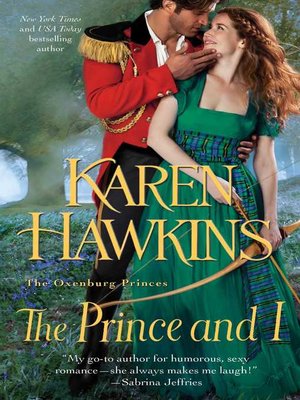
The Prince and I

Cover image for The Prince and I
Pocket Books
The Prince and I
Karen Hawkins
2015

The Summary
"Spirited Murian MacDonald seeks vengeance against the evil earl who's stolen Rowallen Castle from her family.  With a band of loyal retainers, she waylays the earl's wealthy London guests, trying to lure the earl and his guards into pursuit so she can sneak into the castle for evidence of his misdeeds.

"Murian's plan is working splendidly until she stops the coach of Gregori Maksim Romanovin, the commanding prince of Oxenburg, who is in Scotland on an important diplomatic mission.  Max challenges the masked highwayman to a duel and is furious when Murian not only bests him, but escapes!  Max vows to find the tempting Scottish vixen, no matter the cost.

"When Max discovers Murian's lair and hears her story, he resolves to assist her--whether she likes it or not--and a royal battle blazes.  But when Murian is betrayed, Max must choose between the strict dictates of his mission, or protecting the red-haired lass who has stolen his once-cold heart."

The Good
I rather liked The Prince and I.

It was a curious blending of romance and Robin Hood, and I enjoyed it.  Max is the quintessential hero:  dark, brooding, capable, confident--not to mention he's a prince.  Murian, on the other hand, is anything but a damsel in distress:  she's calm, competent, hard-working, and surprisingly agile with a blade.  She's been dealt a terrible hand, having not only lost her husband but her home, but she's making the best of her situation.

However, I think my favorite character was Max's grandmother, Grand Duchess Natasha Nikolaevna.

The Grand Duchess was, by far, the most comical character and, I think, the most knowledgeable.  She doesn't care how other perceive her; rather, she likes being considered a witch.  (It's why she most often threatens to turn others into goats and frogs.  She much prefers infamy to anonymity.)  Moreover, she's often in the thick of trouble, one way or another, and she somehow manages to turn circumstances exactly how she wants them.

This last quality makes me think that she's not the doddering old witch she likes her grandson to think.  Natasha is wily, not senile; in fact, she strikes me as being preternaturally intelligent.  For instance, if she hadn't lost in a card game to the earl, they never would have traveled to Scotland--Max would never have met Murian; Max never would have gotten involved in the earl's business and discovered what he did.

Honestly, Natasha is the force that propels the story forward.  She's the one who helps to shape it and, while she may seem laughably naive or even foolish, I have this feeling she's not.  I have this odd feeling that she knows exactly what she's doing, that she has calculated every move to her--and, by proxy, her grandson's--benefit.

The Bad
The Prince and I is a fine novel.  It's not great, it's not an immediate classic; however, it's not a terrible romance either.  It falls somewhere in between:  not quite fantastic, but enjoyable nevertheless.

The Ugly
The earl--and I can't remember his name to save my life, now--is a terrible character.  He's just a horrible person in general, and I really grew to hate him.  Not only does he manipulate, lie, and cheat, he's quite probably a murderer to boot; however, he was a forgettable sort of evil.  He's a bit of a caricature:  evil and spiteful enough as to be unbelievable.

I suppose it says something that I don't remember his name anymore.

Friday, December 9, 2016

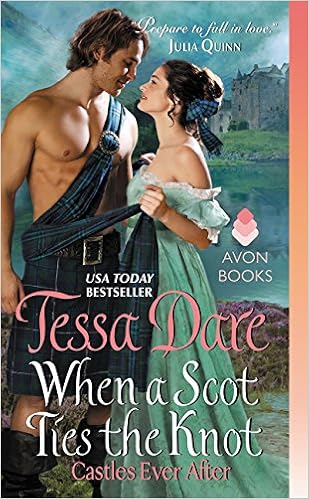
Bonus: When a Scot Ties the Knot

Avon Books
When a Scot Ties the Knot
Tessa Dare
2015

The Summary
"On the cusp of her first London season, Miss Madeline Gracechurch was shy, pretty, and talented with a drawing pencil, but hopelessly awkward with gentlemen.  She was certain to be a dismal failure on the London marriage mart.  So Maddie did what generations of shy, awkward young ladies have done:  she invented a sweetheart.

"A Scottish sweetheart.  One who was handsome and honorable and devoted to her, but conveniently never around.  Maddie poured her heart into writing the imaginary Captain MacKenzie letter after letter...and by pretending to be devastated when he was (not really) killed in battle, she managed to avoid the pressures of London society entirely.

"Until years later, when this kilted Highland lover of her imaginings shows up in the flesh.  The real Captain Logan MacKenzie arrives on her doorstep--handsome as anything, but not entirely honorable.  He's wounded, jaded, in possession of her letters...and ready to make good on every promise Maddie never expected to keep."

The Good
I really liked When a Scot Ties the Knot.  Like A Lady by Midnight, it was a pleasant surprise.

I can't say why, but I enjoyed watching their affections grow and change as they slowly learned more about one another.  When Captain MacKenzie suddenly shows up on Madeline's doorstep with every intention of asking her hand in marriage, even if he has to blackmail her to do it, their relationship gets off to a rough start.  They don't exactly like each other:  she's affronted by his blatant attempts at coercion; he's offended by her presumptuousness to kill him off.

And yet their story is unexpectedly endearing.

Madeline and Logan couldn't be more different in their backgrounds.  He's a Scottish soldier freshly home from war; she's an English spinster who spends her days drawing illustrations of the natural world.  However, they somehow manage to bumble their way through the first days of their "marriage" to find a natural affinity for one another.  Moreover, they come to respect one another for their talents and accept their myriad of faults.

It's not love, exactly; at least, not at first.  Their romance is slow to blossom.  There is sexual tension, of course (I've come to expect nothing less of Ms. Dare and her romance novels), but there exists a complex undercurrent of emotions, like respect and trust and worry and affection and longing.

For instance, as Madeline learns more about Logan, she comes to understand his background and, more to the point, she begins to notice the scars, figurative and literal, he wears.  Likewise, Logan learns to appreciate Maddie's intelligence and her unexpected wit, and he helps her to combat her mortal fear of crowds.  In many ways, they help to support and bolster one another, while simultaneously showing affection--and I liked that about them.

And, speaking of Madeline, I really liked her.  She's a woman ahead of her time:  intelligent, forthright if overly shy, talented and ambitious when it comes to her illustrative work.  Thanks to her fake Scottish sweetheart, she's managed to acquire a small castle in the Scottish Highlands--a gift from her godfather--and make a living for herself through the land and her incredible illustrations for various naturalists.

She's happy with her life and, moreover, she's entirely independent.  I can appreciate a heroine like that.

The Bad
I didn't care for the letters at the beginning of the story.  Granted, I know they're meant to help readers put a finger on the past; however, I just skimmed over them.  I really only paid attention to the last letter, which detailed Madeline's final letter to Captain MacKenzie and, regrettably, how she had to "kill him off" and move on with her life.

The Ugly
Violence, and explicit material.  Otherwise, it's pretty tame.

Oh, and lobsters molting.  For some reason that just grosses me out.

Saturday, November 12, 2016

Bonus: Some Like It Scot

23723771
St. Martin's Paperbacks
Some Like It Scot
Suzanne Enoch
2015

The Summary
"Can a class of wills lead to a love for all time?

"Nineteenth century, Scotland:

"When a mad lass in trousers shoots at him, Munro 'Bear' MacLawry isn't sure what impresses him more--the girl's sure aim or her irresistibly tempting curves.  Catriona MacColl has fled to the Highlands with her half-sister to escape an unwanted wedding, and wants no part of him, nor any man.  But he can't abandon the flame-haired, sharp-tongued wildcat now that he's discovered her--not when she fits so perfectly in his arms..."

"Munro has more than earned his nickname--he's a well-muscled, well-favored mountain of a man with an engaging bad-boy grin and a string of well-satisfied lasses behind him.  Bringing Catriona food, blankets, candles, everything she needs to survive a winter in an abandoned abbey, Munro is an unexpected gift in her reckless bid for freedom--and an unexpected complication.  Clan MacDonald has plans for her, and they don't include her falling for a MacLawry.  But this man makes her feel like a woman--and he may be her one chance to live a life about which she's only dared dream..."

The Good
Oh, my gosh.  This novel.

This is not usually my cup of tea.  Between the scantily clad couple on the cover draped in plaid and the annoying reproduction of a Scottish accent, Some Like It Scot isn't exactly the type of novel I'd ever have pictured reading.  And yet it somehow found its way into my reading queue for the simple fact that I couldn't stop laughing over the title.

Yes, I picked up this book for the title alone.  It's a bit of a bad pun, but I have a weakness for bad puns.  It's why I'm half tempted by the Mad, Bad, and Dangerous in Plaid that precedes this novel; it's also why Sarah MacLean's "Scandal and Scoundrel" series has been calling to me (The Rogue Not Taken, A Scot in the Dark, The Day of the Duchess).

Apparently, I like bad and/or corny titles.  I just can't seem to help myself.

However, unluckily for Ms. Enoch's novel, the title was just about the only endearing thing about this novel.  I liked Catriona MacColl for her wildcat ways, for her indomitable will and sharp tongued retorts, for her ability to survive in the darkest corners of the Highlands...with or without the help of anyone else.  Otherwise, she's not so great and Some Like It Scot sort of fall into that category where my feelings border indifference and apathy.

The Bad
Altogether, Some Like It Scot doesn't exactly rank high on my list.  I didn't care for the accents (I mean, I can't really tell if they're realistic or not as I don't exactly hear Scottish accents on a daily basis); I didn't care for the relationship building; I didn't care for the characters, or their attitudes; I didn't have any particular feelings for this book.

I finished it, but it felt more like a completing a chore than enjoying a novel.  I liked some parts of it and, yes, I adored the title for some inexplicable reason, but I just couldn't fully sink into the story or enjoy it.  It's too contrived, maybe?

It seems to follow a set pattern.  Even if I could appreciate Catriona's unique qualities, even if I thought Munro was darkly scintillating, I just didn't feel very strongly about either one of them or their relationship.  Like I said, it seems to follow the tried and true patterns of other authors--and it just doesn't sit well with me for some reason.

Overall, it's not a book I'd really recommend.

Unless you like gratuitous, explicit love affairs.  If that's what you're looking for, then I'd highly recommend it.

The Ugly
I don't get to see the Scottish Highlands for myself.

Friday, April 24, 2015

Bonus: Laiden's Daughter

CreateSpace Independent
Laiden's Daughter
Suzan Tisdale
2012

The Summary
Raised by a tyrannical stepfather and harassed by her cruel half-brothers, Aishlinn has grown up believing men are scoundrels.  Her opinion is only confirmed when she is attacked by her employer, the Earl of Penrith, and must fight him off - and, subsequently, leaves him for dead.  Fearing for her life, Aishlinn flees to the Scottish Highlands in search of safety.

Injured, starved, and alone, Aishlinn is unexpectedly rescued by a group of warriors led by a man named Duncan McEwan, future leader of the Clan MacDougall.  They vow to help her and protect her from retribution from the Earl of Penrith (for they have no fondness for him), and Aishlinn must learn that there are indeed good men in the world.

The Good
I enjoyed the development of Laiden's Daughter.  The first few chapters were fairly engrossing, fast-paced with a heroine who was willing to protect herself at all costs.  Aishlinn endures a terrible childhood (her current situation isn't much better at the beginning of the book), but she has the potential to mature into a strong, thoughtful, self-sufficient individual.

The Bad
I'll be honest, I really disliked this book.  I was intrigued by the first few chapters, even if they were punctuated by grammatical mistakes and substandard storytelling, but I quickly lost interest as circumstances started to fall into place (conveniently and messily) and slogged through the rest of the book for closure.

Starting out, I rather liked Aishlinn.  She had the groundwork to become a strong, dynamic heroine, which I like in my historical-romance, but Tisdale really let me down with her character development.  After a while, her protests that she was no beauty felt like she was fishing for compliments and her decision-making skills were sorely lacking by the end of the book.

Furthermore, she seemed to waver between a headstrong, self-sufficient woman who learned how to farm, fight, and otherwise fend for herself and a demure, timid kitchen girl.  Considering the abuse she endures at the hands of her stepfather, half-brothers, and her employer, I couldn't understand why she was so naive.

I mean, she stabs a man within the very first chapter, flees from the castle in the dead of night (even with extensive injuries), and manages to escape the country; moreover, she understands hard work, she knows how to ride a horse, and she can string a bow.  She has the makings to be something great - and yet she becomes a damsel in distress waiting for her white knight to ride in on his horse and rescue her from certain danger.

I am unimpressed.

Besides which, I feel like I should point out that the story is set in 1343 in England (and Scotland, too).  Historically speaking, the English and the Scottish haven't had the most stable relationship.  If it wasn't Scotland inciting riots in a bid for independence, then it was England invading in an attempt to place a new monarch on the Scottish throne.

Not exactly the most peaceful relationship, right?

Right.  So, one would think this chaotic political and social climate might influence Laiden's Daughter, correct?  Wrong.  There are no major reprisals, no political ramifications after Aishlinn stabs one of the gentry and flees to Scotland.  I mean, even if no one actually liked the Earl of Penrith, wouldn't someone in significant power have decided it was a breach of political etiquette and reacted, even if for self-serving reasons?

Maybe, I'm nit-picking; maybe, I'm right.  Either way, I would never read Laiden's Daughter again and I would hesitate to recommend it to anyone else.

The Ugly
Don't even get me started.