"All good books are alike in that they are truer than if they had really happened
and after you are finished reading one you will feel that all that happened to you
and afterwards it all belongs to you; the good and the bad, the ecstasy, the remorse,
and sorrow, the people and the places and how the weather was."
Ernest Hemingway
Showing posts with label Women's Studies. Show all posts

Thursday, December 7, 2017

Lady Killers: Deadly Women Throughout History

Harper Perennial
Lady Killers:  Deadly Women Throughout History
Tori Telfer
2017

The Summary
"In 1998, an FBI profiler infamously declared in a homicide, 'There are no female serial killers'--but Lady Killers offers fourteen creepy examples to the contrary.  Though largely forgotten by history, female serial killers such as Erzsebet Bathory, Nannie Doss, Mary Ann Cotton, and Darya Nikolayevna Saltykova rival their male counterparts in cunning, cruelty, and appetite for destruction.

"With a feminist lens and a witty, morbidly humorous tone, Lady Killers dismisses easy explanations (she was hormonal, she did it for love, a man made her do it) and tired tropes (she was a femme fatale, a black widow, a witch), delving into the complex reality of female aggression and predation."

The Good
Honestly, I enjoyed this book far more than I probably should have.

There's something fascinating about female serial killers.  Perhaps, I have been susceptible to the idea that women are softer, gentler, and less likely to kill, despite knowing to the contrary, and find myself aghast that these ladies existed; perhaps, I'm just fascinated by the idea of off-kilter women surviving in any way possible.

Either way, I was absolutely hooked by Lady Killers.

I had a handful of chapters that I really enjoyed:  "The Sorceress of Kilkenny," which featured Alice Kyteler who was accused of being a witch and killing four husbands; "Vipers," featuring Raya and Sakina, prostitutes who owned a brothel murdered several young women (and possibly others) in Egypt after World War I; "Wretched Woman," which focused on Mary Ann Cotton, who killed several of her own children, several of her husbands' children, several husbands (all, but one) and lovers and, quite probably, many more; and, "The Tormentor," Darya Nikolaevna Saltykova, which you can read more about later.

These were just the most fascinating chapters for me; however, every chapter was thought-provoking and captivating in its own right.  Tori Telfer does a fantastic job as an author, creating a thoroughly researched and interesting book on an increasingly morbid topic.  She writes with a sense of humor, but also a deep appreciation of forgotten and/or misinterpreted history.

I especially appreciated Telfer's dedication to telling the truth or, at the very least, getting all her facts straight.  Telfer cuts through the terrible rumors and unfounded accusations that surround these women, dismissing what she cannot prove, and creates a believable portrait of each individual.

Elizabeth Bathory, for instance, is surrounded by a dark mythos of blood, terror, and sex.  She has become, on numerous occasions, a scandalous icon for debauchery and murder, a female counterpart to the wildly popular story of Dracula.  So much of what we know of her is unreal; however, Telfer makes an effort to humanize her, to reveal her a real person.  Yes, she committed heinous crimes and, yes, she was no doubt a murderess, but Telfer tells the story of a woman (albeit, a deeply disturbed woman), rather than a vampire or a dark temptress as she's sometimes portrayed.

The Bad
No complaints.

The Ugly
It's a book about serial killers.  It's going to be awful, horrible, gruesome, and macabre; it's going to have blood, gore, and violence--and all the other horrible things associated with cold-blooded killers.  Don't go into this book thinking, "It can't possibly be that bad.  It's not like it's Charles Manson or Jeffrey Dahmer, or someone like that."

Trust me, you're wrong.

These ladies are downright terrifying, just as much as any male serial killer.  Many of them got away with killing for years, like the murderous women of Nagyrev or Nannie Doss, before they were discovered; some even avoided justice altogether, like Alice Kyteler and Kate Bender.  They're killers, plain and simple, and they're frightening in their own right.

Perhaps one of the most frightening, in my opinion, was Darya Nikolaevna Saltykova.  Darya was a Russian noblewoman who lived during the reign of Catherine the Great and she killed, at the very least, 138 people (mostly women) during her lifetime.  She was inventive in her murders and, at times, she would kill someone with her bare hands if she didn't think anyone else would or could do it.  And, as the author points out, she showed zero remorse:
"So Darya killed and killed again, confident in her impregnability and furious at her serfs for each petty mistake, for getting in her way, for being her responsibility, for existing.  If she was a god, then her serfs were her pitiful playthings.  She could make them clean; she could make them cook; she could make them scream and bleed and beg. [...] 'I am my own mistress,' she cried. 'I am not afraid of anyone.' This belief that she was superior, unassailable, and even consecrated by the law was integral to her sense of self.  Perhaps she killed to prove one simple point:  that she could."

To me, Darya is absolutely terrifying.

Friday, April 28, 2017

A Room of One's Own

340793
Mariner
A Room of One's Own
Virginia Woolf
1929

The Summary
"In A Room of One's Own, Virginia Woolf imagines that Shakespeare had a sister.  A sister equal to Shakespeare in talent, and equal in genius, but whose legacy is radically different.  This imaginary woman never writes a word and dies by her own hand, her genius unexpressed.  If only she had found the means to create, argues Woolf, she would have reached the same heights as her immortal sibling.  In this classic essay, Virginia Woolf takes on the establishment, using her gift of language to dissect the world around her and give voice to those who are without.  Her message is a simple one:  women must have some money and a room of their own in order to have the freedom to create."

The Good
After completely reading A Room of One's Own, I can see why it is essential reading for many literature courses.  Woolf's work is insightful, thoughtful and, more importantly, it makes a very good point about the history of women in the arts.  It's a call to action, a call for equality when women were not expected to be seen or heard or expected to do anything other than marry, bear children, and keep house.

It's inflammatory, grounded in examples from history and insight into the female mind.  It's beautiful, but sharp, filled with words that are meant to make a difference--that are meant to bring blood, to make a point.  And yet it is ultimately uplifting.

I think that perhaps my favorite lines come from the very end of Woolf's essay, when she tells her readers that women can become writers and poets and artists and creators.  It's possible, it's a promise:
"[Then] the opportunity will come and the dead poet who was Shakespeare's sister will put on the body which she has so often laid down.  Drawing her life from the lives of the unknown who were her forerunners, as her brother did before her, she will be born.  As for her coming without that preparation, without that effort on our part, without that determination that when she is born again she shall find it possible to live and write her poetry, that we cannot expect, for that would be impossible.  But I maintain that she would come if we worked for her, and that so to work, even in poverty and obscurity, is worth while."

I love that line.

The Bad
Personally, I struggled with A Room of One's Own.  This isn't an essay to be read in a day; rather, it's to be savored and consumed in small pieces, reread and examined with highlighter or pen in hand.  It's a wonderful book for discussion and, I found, better understood when examined with more than one mind.

The Ugly
Although Woolf fabricates the incident with Shakespeare's sister (he did have sisters, but as far as I have heard, none of them were artistically inclined), her example isn't very far off the mark.  Women who have wanted to create, who wanted to be authors or poets or playwrights or artists, have suffered or were condemned for their genius.

As Virginia Woolf points out, "The indifference of the world which Keats and Flaubert and other me of genius have found so hard to bear was in her case not indifference but hostility.  The world did not say to her as it said to them, Write if you choose; it makes no difference to me.  The world said with a guffaw, Write?  What's the good of your writing?"

Thursday, March 9, 2017

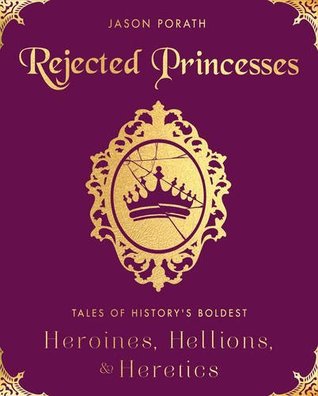
Rejected Princesses: Tales of History's Boldest Heroines, Hellions, and Heretics

Dey St.
Rejected Princesses:  Tales of History's Boldest Heroines, Hellions, and Heretics
Jason Porath
2016

The Summary
"Well-behaved women seldom make history...and these women are far from well behaved.

"Let's face it:  the list of historical women we learn about in school is lacking.  It's safe, it's censored, it's short.  And even when we learn about a true legend--say, Harriet Tubman--we get half the story (and it's usually not the half about her as a plantation-torching Union spy-master).  This is just the list of women we know about.  What of the women we don't?

"In place of complex, real-life heroines, we get sparkly, doe-eyed animated damsels who dominate children's minds everywhere.

"Rejected Princesses is here to provide an alternative to all that.

"In this fully illustrated, deeply researched, and totally entertaining collection, Jason Porath offers 100 women too uncompromising, too untoward, or too uncomfortable to fit the modern princess mold.  Gathering together a diverse set of some famous, some infamous, some forgotten, and some virtually unknown figures from history and myth, from all over the globe, this book presents the female role models we never knew we needed.  Yes, there are a few princesses, but there are also pirates, spies, journalists, activists, concubines, empresses, ninjas, pilots, samurais, mathematicians, sword-slingers, and war-lords too.

"These women were rebels and rulers, pioneers in their fields, and fighters for their causes (and sometimes for themselves).  In a time when women are still pushing for equal pay and equal opportunity, shouldn't we be putting brave women like Sybil Luddington, Hatshepshut, Nzinga Mbande, Josephine Baker, Khutulun, Rani Lakshimbai, Harriet Tubman, Emmeline Parkhurst, and Joan of Arc on equal footing with Cinderella or Sleeping Beauty?

"Women have always played a key, kick-ass role in revolutionizing our world.  The girls of today are the latest links in a long chain of geniuses, warriors, and fearless women.  It is the birthright of every woman to have a connection to that history.  Empowering, uproarious, and anything but traditional, Rejected Princesses seeks to provide just that."

The Good
I loved this book.

Yes, loved.

If it's not already apparent, I'm a bit of a history nerd and I love learning about quirky, unconventional history and feisty females who made their mark on history (see:  Bad Girls), so Rejected Princesses was the best of both worlds for me.

I imagine that many of the women featured in this book were too rebellious, too dangerous and, sometimes, too deadly to make it into high school textbooks; in fact, many of the women--whether resigned to the darkest parts of history or lingering at the edges of myth--were a pleasant surprise.  That is, I'd never read about them and I loved learning about them and the impact they made on history.

Here are some of my favorites:
  • Khutulun
  • Noor Inayat Khan
  • Julie d'Aubigny
  • Annie Jump Cannon
  • Iara
  • Mariya Oktyabrskaya
  • Olga of Kiev
  • Ching Shih
  • Sybil Luddington
  • Alfhild
  • Mary Bowser
  • Nanny of the Maroons
  • Tomo Gozen
  • Marjana
All of these women were incredible.  I mean, on this list alone you have fighters and warriors, spies and astronomers, pirates and Vikings, rebels and freedom fighters.  They're incredible.  Granted, I know some of them didn't exist (Marjana is a literary character, whereas Iara and, I think, Alfhild are myths and/or legends), but it was wonderful getting a glimpse into these individual cultures and their perceptions of women--and how these women flaunted conventions.

It was great.

And, of course, I can't forget the Night Witches from my list.  You can hear about me rhapsodize about the Night Witches here, so I won't go into much detail about them, except to say that they are without a doubt the most incredible pilots of World War II (I'm not joking) and, perhaps, some of the most incredible women about which I've had the pleasure to learn.

Overall, Rejected Princesses is a wonderful book.  Full of humor, colorful art, historical facts and, of course, incredible women, it's a great resource for those who wish to dabble in history--and it will show you just what it means to fight like a girl.


The Bad
No complaints.

I seriously want a copy for myself.

The Ugly
History is not always pretty--and, let's be honest here, it hasn't always been kind to women.  Some were burned at the stake because they were different; others were buried alive or faced a firing squad; some were even assassinated for their own violent reactions to society.  Not all these ladies had the luxury to happily retire.

Saturday, February 25, 2017

In Progress: Rejected Princesses (Completed)

Image result
Dey St.
Okay, so I finished reading Rejected Princesses by Jason Porath--and, in many ways, it makes me proud of my gender right about now.  I mean, sure, there are a few dark parts to history (Boudica, here's looking at you!) and they aren't always nice, considerate, or remotely moral; however, I enjoyed reading Rejected Princesses just for the simple fact that it decided to chronicle interesting, sometimes terrifying, sometimes brutal, but always fascinating women of history.  I learned so much more than I expected.

I've heard of Mata Hari, Joan of Arc, Harriet Tubman, Elizabeth Bathory, Boudica, Ching Shih, and a few others.  I read Bad Girls by Joan Stradling and gained a whole new appreciation for the most infamous women in history; however, Porath offers a more comprehensive look at these famous--and, of course, infamous--ladies and he does it with a touch of humor.  His passages are relatively short (three to four pages, max), but they're simultaneously informative and entertaining.

More importantly, I discovered aspects of history about which I never knew.  I love history and I love learning about history, whether it's in my own back yard or across the ocean, and I loved that I was able to deepen my knowledge of various time periods.  For instance, I was excited to learn more about female contributions to the American Revolution with Sybil Ludington.  Or learning about the Canary Islands, about which I knew nothing, with Andamana.  Or learning more about technological, mathematical, and scientific discoveries with Annie Jump Cannon, Hypatia, Ada Lovelace, and so many more.

It was exciting.

But, I have to say, I think I loved the Night Witches of World War II the best.

I mean, I am fascinated by World War II.  I've read several books about it, and I've studied it probably more than the average person.  I'm not an expert by any means, but I find myself constantly fascinated by conflicts and social/political shifts that occurred in WWII.  It's an era that has such wide-reaching effects we can still see the ripples today; heck, we can still talk to the people who endured it.  I may not enjoy violence, but I like hearing stories about it and I like piecing together my knowledge of it, I like holding those stories.

And yet I've somehow never heard of the Night Witches.

How?

But here's how cool they were:
"The Night Witches mark one of the greatest underdog accomplishments in military history.  Handed a bunch of slow, flammable trainer planes that had been designed only to dust crops, an all-female group of untrained civilians became one of the most decorated divisions in the entire Soviet military.  Flying without armor, guns, sights, radio, cockpits, brakes, parachutes, or virtually any navigation machinery, they dropped bombs on the Germans every three minutes, like clockwork, every night for three years."
Moreover, they would often cut their engines and dive over German military camps on the Eastern front, before kicking on their engines and dropping bombs.  They literally fell out of the sky, dropped bombs, and then did it again and again and again.  "They flew over 1,100 nights of combat, and each pilot flew over 800 missions."

Holy cow.

These women are super women.  They were--and are--amazing.  They pushed the physical limits of the human body, while simultaneously making due with substandard military equipment and challenging the typical military and/or social culture of Soviet Russia.  They're incredible!

Guess, I know what I'll be reading about next.

Saturday, February 18, 2017

In Progress: Rejected Princesses (Continued)

Image result
Dey St.
Okay, so I've made it about half way through Jason Porath's book; however, I have wantonly skimmed it and skipped to some of the more intriguing--not to say they aren't all intriguing, or curious, or fascinating, or strange--entries.  Like the warlord's widow who cultivated an entire school of ninjas in Japan, or the Vietnamese sisters who waged a war against Chinese invaders, or Phoolan Devi (that was a difficult one to read), or Elizabeth Bathory (this one blew my mind).

There are so many of these entries.  Some of them mind-blowing, some of them fascinating, some of them hilarious and/or tragic.  You get the whole spectrum with Rejected Princesses and, truthfully, I haven't been disappointed yet.  I mean, all of these women are powerful and independent, and they don't adhere to the traditional roles of females in society.

Instead, they go out and kick butt, fight against a system that tries to squash them, and, in  general, be awesome.

I love that Porath takes the time to carefully research these ladies; honestly, I love that he makes an effort at all to chronicle the forgotten women of history who worked as shipbuilders and soldiers and strongmen--ahem, strongwomen--and ninjas, and so, so much more.  It's great.  It's not always safe for kids, as his trigger warnings make apparent on the corner at the introduction of each entry; however, it's a nice addition to any burgeoning historian's collection.

I mean, how could you not enjoy learning about these ladies who have made and redefined history and continue to influence our world today?

So far, I have a list of favorites:
  • Khutulun
  • Tatterhood
  • Sybil Ludington
  • Grace O'Malley
  • "Stagecoach" Mary Fields
  • Iara
  • Trung Trac and Trung Nhi
  • Mary Bowser
  • Julie "La Maupin" d'Aubigny
  • Nanny of the Maroons
  • Tomoe Gozen
  • Mariya Oktyabrskaya
  • Ada Lovelace
  • Laskarina Bouboulina
  • Ching Shih

I'm just going to say it again:  This book is great.

Saturday, February 11, 2017

In Progress: Rejected Princesses

28820006
Dey St.
So, I have just had my mind blown by Jason Porath's Rejected Princesses.  Thus far, I've only read a few entries, like Tatterhood and Agnodice, Andamana, Sybil Ludington, and Grace O'Malley; however, I have fallen completely and irrevocably in love with this book and Porath's humorous--yet surprisingly well-researched--entries.  It's funny, it's informative, and it's full of kick ass women who have been overlooked (and/or forgotten) by history.

It's amazing.

I mean, I never knew about Tatterhood.  I love fairy tales and yet, somehow, Tatterhood and her weird, winding story managed to escape me!  Granted, I might have enjoyed her story a little more with Porath's candid commentary on the story; regardless, I think I gained a new appreciation for Norwegian fairy tales and myths.  I'm curious to learn more.

Likewise, I'd love to learn more about Khutulun and Sybil Ludington.  Kutulun was a Mongolian princess (great-great granddaughter to Genghis Khan, by the way) who was an incredible fighter and a skilled ruler.  She issued a challenge to any potential suitors:  if any could best her in wrestling, they would have her hand in marriage; if they could not, she would get their horses.  (Spoiler alert:  she was never defeated.)  She's a fascinating historical figure and, while she isn't quite as brutal as her infamous ancestor, she made a huge impact on Mongolian culture even to this day.  How on earth haven't I heard about her?

And then there's Sybil Ludington.  She could be an American icon, and yet I've never heard her name.  Born in southeastern New York, she was the daughter of Colonel Henry Ludington--and a revolutionary solider in her own right.  Like Paul Revere, she set out on a midnight ride to warn about the impending British invasion; however, she took it a step further and rode out 40 miles in a little over three hours through the dark, rainy forest riddled with bandits and other dangers.  "By contrast," Porath writes, "a certain other someone...only went 12 miles across well-worn streets and was caught by British loyalists at the end of it.  Ahem."

She's awesome.

And, so far, this book is awesome.

I think I'll have to buy a copy for myself.

-

For more of Jason Porath's Rejected Princesses, you can actually check out rejectedprincesses.com for more entries and plenty more fun.

Friday, January 31, 2014

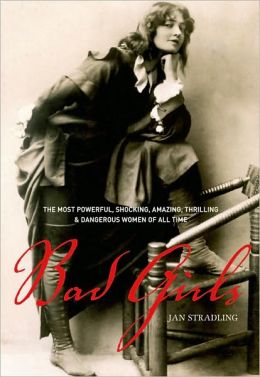
Bad Girls

Bad Girls
Image courtesy of
www.barnesandnoble.com
Bad Girls
Jan Stradling
2008

The Summary
Jan Stradling's book recounts the lives of 22 the world's "most powerful, shocking, amazing, thrilling, and dangerous women of all time," including ladies like Cleopatra, Boudica, Catherine II of Russia, Malinali, Cixi, Madame Mao, Mata Hari, and Elizabeth Bathory.  From Ancient Egypt to the modern world, Stradling looks into the lives, reputations, and psychology of history's most legendary women.

The Good
Bad Girls is full of intriguing material and interesting women; in fact, Stradling appears to make a point of investigating some of history's more obscure figures and providing an incredible amount of detail into their personal histories (and, occasionally, their psychological states).

More importantly, while Stradling does work from an academic perspective - that is, she attempts to produce a scholarly endeavor with her work - her book is concise and consistently interesting.  She has presented her content in such a way that it reads like a narrative, which makes Bad Girls attractive to read but, also, makes it convenient to merely search for the section to interest you most.

The Bad
Stradling's work is fairly hefty.  Considering the author researches 22 separate individuals and presents individualized chapters on each of these ladies, there's a fair bit of content through which to wade to find the most interesting tidbits.

Admittedly, I did spend quite a bit of time skimming through Stradling's novel.  Being occasionally speculative with certain historical elements and dense, Bad Girls is one of those books that, while sure to keep your interests at different times, proves easy to skim.  It's simple to flip to the pages you want to find and still get the gist of everything else.

The Ugly
The ladies compiled in Stradling's book are all powerful, dangerous, daring women with very unique skills and very unique dispositions for the times in which they lived.  Many of these infamous women, however, frequently suffered under the violence of others (or enacted terrible violence of their own) and, more often than not, met a violent and gruesome end.

Cleopatra, for instance, committed suicide.  Elizabeth Bathory, after committing terrible atrocities (among them genocide) in the pursuit of youth and beauty, was locked away for the remainder of her life in complete solitude.  Belle Starr, after spending her life involved in crime, was shot in the back and killed.  Mata Hari, once one of the most sought after exotic dancers in Europe and one of its more infamous courtesans, was charged with treason and executed via firing squad.

And many others met similar fates.

The long and short of it, Bad Girls can seem pretty gruesome.

Thursday, January 3, 2013

Revolutionary Backlash

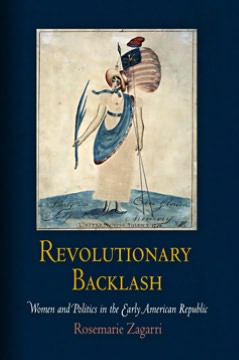
Revolutionary Backlash: Women and Politics in the Early American Republic
Image courtesy of
www.barnesandnoble.com
Revolutionary Backlash
Rosemarie Zagarri
2007

The Summary
Illustrating the lives and accomplishments of ladies throughout early American history, from the formation of the colonies to the presidency of Andrew Jackson, Revolutionary Backlash provides a study into the treatment and condition of women in early America.

The Good
Rosemarie Zagarri does some pretty thorough research in compiling her book.  She sets the stage by providing ample historical references, lists of literary and social accomplishments by notable women, like Mercy Otis Warren and Judith Sargent Murray, and, in a word, she provides proof to support her claim that the American Revolution made a significant impact on the lives of women.

As a note, Zagarri separates her book into distinct chapters that highlight specific historical eras and further breaks down her chapters into manageable bite-size pieces.  So, not only does her book provide ample information for the history enthusiast - or student, as the case may be - it allows for easy research.

The Bad
In her book, Zagarri provides an argument for the social and political growth of American women, during the American Revolution, and a subsequent social backlash.  She provides a compelling argument; however, she often sequesters her research to a specific group of women:  upper and middle-class white women.

To put it bluntly, Revolutionary Backlash doesn't offer much diversity in its study of early America.

The Ugly
Some books are riveting, and some books - well, not so much.

When it gets down to it, Revolutionary Backlash gets a little stale and a little boring.  It's great for research, or if you happen to really enjoy early American history, but I would hesitate to recommend it for recreational reading.