"All good books are alike in that they are truer than if they had really happened
and after you are finished reading one you will feel that all that happened to you
and afterwards it all belongs to you; the good and the bad, the ecstasy, the remorse,
and sorrow, the people and the places and how the weather was."
Ernest Hemingway

Monday, February 9, 2015

In Progress: The Red Tent (Completed)

Picador Publishing
I have finished reading The Red Tent by Anita Diamant and, let me simply say, I've found it to be one of the most exceptional novels I've read.  So much of this book appealed to me - Dinah's voice, her history, her life - and spoke to my reader's heart.

The Red Tent is a perfect combination of storytelling and history and, more importantly, memory.  In fact, I wouldn't hesitate to say that's one of the most important aspects of Diamant's novel:  memory.

And love.

Leading up to her journey to Egypt, Dinah's life is painfully tragic.  She's witnessed so much death, so much bloodshed, and she's endured so much pain.  However, despite her terrible losses, Dinah manages to survive and she recovers or, more accurately, discovers herself.  She regains love, which she thought lost with her first husband, which she finds with Benia, and she grows into her calling as a midwife.

Although it may sound contrived, love helps her heal.  Love for her son, love for Benia, brings her back from the brink.  Love for her dear friend, Meryt, and love for human life, her power as midwife to save the lives of mothers and children, gives her a renewed purpose.  And she has so much to tell, so much knowledge to share with those who would listen.
 
Earlier in her story, Dinah proclaims:
"You come hungry for the story that was lost.  You crave words to fill the great silence that swallowed me, and my mothers, and my grandmothers before them.  [...]  I am so grateful that you have come.  I will pour out everything inside me so you may leave this table satisfied and fortified."
Indeed, she pours out her story.  She fills that "great silence" with her memories and her knowledge, what she knows to be true and what she will pass to the next generation.  Her story, as I've mentioned in previous posts, is another link in the chain of mothers and daughters.

There's a longevity in the words of Dinah - the words that Diamant has so carefully grafted - and they linger, they live on.  By the end of the book, Dinah has gained a kind of immortality, like the lotus flower she mentions:
"Egypt loved the lotus because it never dies.  It is the same for people who are loved.  Thus can something insignificant as a name - two syllables, one high, one sweet - summon up the innumerable smiles and tears, sighs and dreams of a human life."
You can find a certain poetry in her words that makes them undeniably, irrevocably true.

Sunday, February 8, 2015

In Progress: The Red Tent (Continued)

Picador Publishers
I've nearly finished The Red Tent by Anita Diamant.  So far, I have learned of the fate of Dinah, learned the tragedy of her life and, furthermore, the fate of Shechem.  Oh, it's a hard thing to watch as Dinah's story unfolds and her life seems to unravel.

She continues along her route as storyteller, but her tale is no longer the tale of a young girl growing into her maidenhood but a woman who has suffered loss and endured unspeakable things.  You share her agony, you share her worry and her fear and her sorrow.  You see as she sees that some hope may endure, and you feel as she feels whens he turns her back upon the tribe of Jacob.

It's well and truly heart-breaking.

I still enjoy the familiar treats of Diamant's novel:  Dinah's voice, her strength and her sadness and her character, as she weaves an unfamiliar and intimate story.  It's her voice that continues to capture me, to keep me riveted even after I have had my heart broken with her.

And I've learned to enjoy the traditions of the women of her family.  I like that Dinah upholds the unbroken line of mothers.  I like that she has such a link from mother to daughter and so on and so forth into an indeterminate future.  While I cannot say I understand the traditions of the red tent, the traditions of her mother and her mother's mother, I find Dinah's connection to the past and family a reassuring thought.

Her traditions give her depth.  Her traditions give her purpose.  Her traditions give her hope.

Perhaps, that is why I've enjoyed Dinah and her story so completely.  I realize she is a fictional character, a creation woven from one small mention in another greater text, but I find that doesn't matter.  She's so real and raw, and she has a place.

Some element of Dinah does exist, she perseveres in a strange immortality of the written word.  Fictional or not, Dinah lives and breathes on the page as surely as if she had lived and breathed in the lands of her father or the banks of the Egyptian river.

I continue to love Dinah's story.  I continue to love her voice, her tale of girlhood and womanhood and, finally, motherhood.  I continue to enjoy The Red Tent with unabated ardor, and I have a feeling I will continue to do so.

Saturday, February 7, 2015

In Progress: The Red Tent (Continued)

Image courtesy of Barnes and Noble
I've managed to make it midway through The Red Tent by Anita Diamant.  So far, I'm enjoying the journey.  I love the story that Dinah has to tell; more accurately, I love the way in which she tells it.  Dinah has such a unique perspective, an almost poetic way of telling her story that's absolutely enchanting.

For instance, I love her descriptions of her mother, Leah:  "Leah's scent was no mystery.  She smelled of the yeast she handled daily, brewing and baking.  She reeked of bread and comfort..."  Likewise, her description of Rachel is enchanting:  "Rachel smelled like water.  Really!  Wherever my aunt walked, there was the scent of fresh water.  It was an impossible smell, green and delightful and in those dusty hills the smell of life and wealth."

And, if this makes sense, I like how Diamant manages to make Dinah's analogies realistic, reasonable for its context in the ancient world.  For example, when Dinah describes Bilhah as being good - "good the way milk is good, the way rain is good" - her description makes perfect sense.  Both milk and water were necessary for survival in such a harsh landscape, thus they were good.

Furthermore, I like the way that Dinah explains their beliefs.  Their world is one of gods and spirits and demons, so it's intriguing to see the ways in which Dinah describes her mothers' religious beliefs and her own, as they're shaped by the singular god of Jacob's tribe - El, Jehovah, God - and the multitude of gods of her mothers' tribe.

Their time was not as it is now, in which we have explanations for diseases, mathematics and physics to explain natural phenomenon.  So it's interesting to see how their world works and how they worship their gods, looking to them for explanations.  There are so many cultures and ideals clashing, crashing together to form something entirely unique to Dinah.

And that's what I like about Dinah, I think.  I like that Diamant shapes her character to the fullest extent, taking into consideration her heritage and her upbringing and her environment.  Dinah is truly given a life of her own within the pages of The Red Tent.

Oh, and I found a wonderful passage in my reading:
"The women sang like birds, only more sweetly.  They sounded like the wind in the trees, but louder.  Their voices were like the rush of the river's water, but with meaning.  Then their words cease and they began to sing with sound that meant nothing at all, yet gave new voice to joy, to pleasure, to longing, to peace."
Now, after I started reading The Red Tent, I did a little research on its reception in the literary community.  Diamant's novel has received some very high praise and, nearly 18 years later, has managed to maintain a respectable 4 of 5 stars on most websites which use that sort of rating (Barnes and Noble, Amazon, etc.).  However, I've stumbled across some comments that denounce it for its imperfections and question its accuracy.

The Red Tent is a work of fiction.  It's based on biblical characters about whom we know very little, thus it's hard to say it would be completely accurate.  We have no way of knowing how these people truly lived or worked or worshiped.  We can only guess - and, personally, I think that Diamant does a spectacular job of guessing.

As for the biblical integrity of The Red Tent, I can't really speak to that either, but I feel that Diamant does a decent job of paralleling the story in Genesis.  Complaints that Diamant simply tried to vilify individuals in the Bible, attempted to debase them, are weak at best.

For instance, Jacob, regardless of his exalted position in the Bible, had four wives and he begot several children (twelve, to be precise).  More to the point, I think it important to remember that he's only human.  You can't tell me he didn't have some kind of carnal desires.  Likewise, the Bible is filled with indiscretions.  You don't even have to look out of the first book of the Bible to find that Lot, even unintentionally, impregnates his daughters (Genesis 19), or Tamar tricks her father-in-law into having sex with her (Genesis 38).

The list goes on.

If you're going to say the Bible doesn't include sex and debauchery, murderers and liars and thieves, quintessential sin, you obviously haven't read very far or you've found a sanitized version.  The Bible doesn't conceal humankind's faults.  There's no two ways about it, people are sinners and they are going to do bad things.

Diamant, I think, just isn't afraid to point it out.

Friday, February 6, 2015

In Progress: The Red Tent

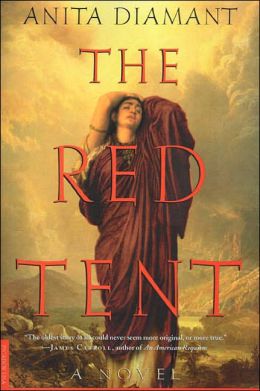
The Red Tent
Image courtesy of
I recently picked up a book called The Red Tent by Anita Diamant.  I found a used copy for a bargain after I saw commercials for a serialized television show on Lifetime, a short series by the same name.  I was intrigued, of course, so I thought, "Why not?"

Turns out, I found an unexpected gem.

So far, I've only managed to slip into the first couple of chapters, in which Dinah tells the stories of her mothers, the wives of Jacob, but I have enjoyed this book immensely.  I like the depth and the detail of it, the way it reaches into the past to bring forth a story that I admit, I hadn't realized existed.  It's a riveting story.

And Diamant has given Dinah such a unique voice.  She is a daughter, a mother, a midwife, a caretaker, and a storyteller, and I find that in her is some ancient female wisdom, some link to a history that is sometimes overlooked and often forgotten.  She brings memories back from the brink, gives them life again.  "It is terrible how much as been forgotten, which is why, I suppose, remembering seems a holy thing."

So much of the Old Testament is patriarchal.  Sons become fathers who beget more sons, and so on and so forth in an unbroken line.  Women, however, are fewer and farther in between these great men who appear in the Bible.  I'm not saying there aren't great women, but so many are the mothers or lovers of great men, rather than individuals in their own right.

Dinah holds in her a link from mother to daughter and beyond, a record-keeping of female knowledge and trust and secrets.  From the beginning, her story seems important - feels important, regardless that it's a work of fiction.  She's a storyteller who is ready to lay her life out before you:
"I am so grateful that you have come.  I will pour out everything inside me so you may leave this table satisfied and fortified.  Blessings on your eyes.  Blessings on your children.  Blessings on the ground beneath you.  My heart is a ladle of sweet water, brimming over."
Confidentially, I love it already.

Wednesday, February 4, 2015

A Place at the Table

Image courtesy of
A Place at the Table
Susan Rebecca White
2013

The Summary
Following the lives of Alice Stone, Bobby Banks, and Amelia Brighton, Susan Rebecca White weaves a subtle tale of loss, acceptance, and life in general as her characters cross paths in the unexpectedly popular Café Andres.

The Good
To be perfectly honest, A Place at the Table is something of a heartbreaker.  Alice Stone, Amelia Brighton, and Bobby Banks all struggle with individual trials as they seek to find themselves and redefine themselves.  Whether its familial turmoil, divorce, or personal loss, Amelia and Alice and Bobby each face tragic circumstances that they must surmount and, in time, accept.

I will say, however, I loved Bobby's story.

Alice's tale comes in bits and pieces, through hints and recollections she sparingly supplies to Bobby and Amelia when they meet, so I didn't really have the opportunity to fully embrace her as a character.  I liked her, but I didn't have much invested in her.

Likewise, I liked and enjoyed Amelia's story.  As a woman who's recently undergone a rocky divorce, Amelia is on a quest to recover herself and uncover who she is and where she comes from.  I really enjoyed reading about how she changed, how she grows into her own and, more importantly, how she learns to love and accept herself after being emotionally devastated by her husband.

However, I simply have a special place in my heart for Bobby.

Maybe, I liked his story best because it came first in the book.  Maybe, I liked his story because he grows up in the southern United States.  Either way, I latched onto his story as my favorite.  As his story progressed, I couldn't help wishing the best for him - and I was infinitely grateful for his Meemaw, who decided, "Your meemaw is not going to let anyone throw you to the wolves.  Your meemaw is going to keep you loved and safe."

That was it for me.  I needed a box of Kleenex.

The Bad
I found very few negatives in A Place at the Table.  I mean, certainly nothing worth pointing out as a major deterrent.

I would like to have read more about Bobby and I would like to have found more of his story further into the book; however, I was suitably captivated by Amelia's story in the latter half of the book that it isn't really a major complaint.  I'll get over it, you know.

The Ugly
Alice faces segregation and prejudice, sometimes blatant racism, and endures a terrible schism in her family.  Bobby finds himself ostracized for his homosexuality and faces further tragedy in losing two of the most important people in his life.  Amelia endures a messy, terrifying divorce, which leaves her to pick up the pieces of her life and put them back together again, and struggles to find her own identity when her family has no past - and no apparent future.

Let me put it bluntly:  it's emotionally draining.