"All good books are alike in that they are truer than if they had really happened
and after you are finished reading one you will feel that all that happened to you
and afterwards it all belongs to you; the good and the bad, the ecstasy, the remorse,
and sorrow, the people and the places and how the weather was."
Ernest Hemingway

Saturday, April 18, 2015

Unfinished 2.0

Like most bibliophiles (or so I assume), I have a very long list of books that are waiting to be read.  Some books, I can dive right in and devour them; others, I find are a little tougher.  And, if we're being honest, I even have some that I let slip through my fingers because I simply can't find it in my heart to complete them.  Here are just a few of those:

-

HarperCollins
Mere Christianity by C.S. Lewis

Honestly, I've always enjoyed C.S. Lewis.  He was a gifted writer and orator, and he produced phenomenal works of literature.  His writing has always seemed wonderful, beautiful and uncannily inspiring.  Even Mere Christianity has that quality, a beautiful simplicity in which one man attempts not to justify or exonerate his faith but to explain it - to show readers and listeners the most important aspects of his religion.

I have honestly tried to read Mere Christianity.  I have succeeded, in some measure, in completing a handful of the essays contained within it; however, I haven't yet managed to complete the entire compilation.  I love the language of Lewis's work, but I find it relatively dense, manifesting in a theological examination of Christianity that simply doesn't hold my attention for long periods of time.

One day I may finish reading it.  Until then, I intend only to read snippets and relish the best parts I find.

-

1new-fp
Jill Sanders
Finding Pride by Jill Sanders

For me, Finding Pride was unreadable.  I mean, if I'd stayed and focused and worked hard to slog through the remainder of the novel, I probably could have done it.  I just didn't want to for the simple fact that I really, really disliked it.

I couldn't appreciate any of the setting descriptions, I didn't care for the characters, and I found the story a bit trite.  The novel seemed to lack something essential, a special quality that could keep me committed.  It lacked vibrancy, it lacked life.  It was like all the characters were carved from stone, emotionless and cold, and I felt absolutely nothing for them.

Finding Pride didn't appeal to me in the least.  Granted, I read it as an e-book, which could make a difference (or explain the hurried errors that seemed to populate the pages); however, I'm not counting on liking it in any format in which it exists.  I doubt I will ever finish it, not if I have anything to say about it.

-
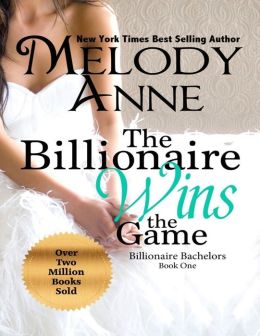
The Billionaire Wins the Game: Billionaire Bachelors - Book One
Lulu Press
The Billionaire Wins the Game by Melody Anne

Let me say, upfront, that I have a bad habit of randomly picking out free e-books on my tablet.  I make some of the worst decisions when it comes to reading material if I'm using an electronic device.  I don't know why, I simply do - and The Billionaire Wins the Game is a stellar example of this.

Not only do the characters feel like caricatures, wavering on a pendulum of extreme emotions, they feel rigid, mechanical.  More to the point, they just feel wrong.  I could never keep track of how they felt, how they were going to feel, and how those emotions would manifest and, before I even reached the middle of the story, I was battling whiplash.

But that isn't even the worst part.  No, I hated the entire interaction between the central protagonists:  the shotgun wedding that occurs as if it's okay to coerce another person into a marriage with veiled threats and poisonous charm, as if its okay to blackmail a woman over the livelihood and custody of her unborn child.

I'll say this now:  It is not okay.  Ever.

And I hated that I was suckered into reading a huge chunk of the novel before I finally gave up, threw it aside (figuratively speaking), and started on something more substantial.  Although I finished a portion of the book (and, yes, I even read the last five pages, because I can't leave any novel without some kind of closure), I will never pick it up again.  Honestly, it wasn't even worth the time I spent to open to the first page.

Friday, April 17, 2015

Bonus: First Grave on the Right

St. Martin's Griffin
First Grave on the Right
Darynda Jones
2011

The Summary
Charlotte - Charley to her friends, living and dead - is a part-time private investigator and consultant with the local police department; however, her full-time occupation is grim reaper.  Yes, like the fellow with the hooded cloak and scythe, but Charley isn't really into dramatics.  She's a portal between the living and the dead, not some hunter of wayward souls.

Besides dealing with the usual dilemmas involved with the dead, Charley is confronted by a very unusual string of murders - and, perhaps even more important, she must contend with a terrifying guardian who is hellbent on protecting her and the portal.

Even if it might cost Charley her life.

The Good
First Grave on the Right is an interesting concept.  The cosmic dynamic it creates - like heaven versus hell, good versus evil - isn't original, but the idea that the grim reaper is a portal between heaven and earth is an intriguing one.  It's fascinating to see how Charley fits into the world (universe?) - and how her not-so-silent protector fits into all this madness.

Additionally, I really liked Charley.  I mean, it took a while for her to grow on me, but, once I was really committed to the novel, I enjoyed her company.  Charley is humorous, sassy, and entirely self-sufficient.  She can hold her own with even the surliest police officer (including her uncle, Ubie); moreover, she can take a beating and give one back.

She's a strong female protagonist, which I am fond of reading in fiction, but she's surprisingly gentle at the same time.  She cares for the ghosts she meets and she isn't afraid to show it.  She has an emotional depth that's definitely nice to find.

The Bad
First Grave on the Right doesn't really distinguish itself from the horde of paranormal-romantic fiction you'll find in bookstores.  It's a good book, don't get me wrong, and it certainly kept me entertained, but I wasn't glued to the pages.  I'm not exactly salivating to read the next novel in the series.

The Ugly
Murder, naturally.

Sunday, April 12, 2015

The Mercy Seller

The Mercy Seller
St. Martin's Griffin
The Mercy Seller
Brenda Rickman Vantrease
2008

The Summary
"In the fifteenth century, with religious intolerance spreading like wildfire across Europe, Englishwoman Anna Bookman and her grandfather, Finn, earn a living in Prague by illuminating precious books - including forbidden translations of the Bible.  As their secret trade grows ever more hazardous, Finn urges Anna to seek sanctuary in England.  Her passage abroad, however, will be anything but easy.

"Meanwhile, a priest in London, Brother Gabriel, dutifully obeys church doctrine by granting pardons...for a small fee.  But when he is sent to France in disguise to find the source of the banned manuscripts finding their way to England, he meets Anna, who has set up a temporary stall as a bookseller.  She has no way of knowing that the rich merchant frequenting her stall is actually a priest - just as he does not know he has met the woman for whom he will renounce his church.

"It is only in England, which is far from the safe harbor once imagined, that their dangerous secrets will be revealed."

The Good
The Mercy Seller is a fascinating story.  I love the way Brenda Rickman Vantrease portrays the troubling dynamic between the Catholic Church, an entity unto itself in fifteenth century England, and the Lollard movement, which opposed the Church, promoted an individualized relationship with God, and translated the Bible into English (among other increasingly radical things).

I found it emotionally draining, especially when things started to fall apart for Anna, but I thought it interesting to see history take shape on the pages.  Vantrease does an excellent job of showing the political, religious, and social climate of the age.  More importantly, she manages to make it feel personal, makes it easy to invest yourself in the characters.

Speaking of which, I liked Anna and Gabriel.  I liked how their relationship initially shows the opposing views of the Lollards and the Church, how they are at one another's throats.  Furthermore, they're both interesting characters:  headstrong, inquisitive in their purpose and faith, and emotionally complex.

Gabriel, in particular, is subject to such emotional complexity as he struggles with his faith and his once stalwart belief in church doctrine.  I found his evolution as an individual, his shift from questing and questioning to decisive action, particularly intriguing.  Admittedly, his story captivated me more than Anna's.

But I'd be a liar if I said I didn't enjoy the romantic aspect of Anna and Gabriel's relationship.  They have a difficult relationship, yes, but it has its sweet, soft moments too.  It speaks something to the redemptive power of love.  (Cliché, I know.  I was a little sappy toward the end.)

The Bad
Vantrease's novel is a work if historical fiction and, as such, spoilers are easy to come by.  If you have any interest in history - or, heck, if you've ever had a high school class in English history - you can probably predict what will happen.

The Ugly
The Mercy Seller is very much a novel rooted in faith, specifically on the examination of Christian faith and division in the fifteenth century.  These characters, based on historical figures, are motivated by their beliefs to the point of fanaticism.  That fanatical faith frequently makes righteous decisions turn foul, leading to religious and social persecution (among other horrible things).

Dissidents, like Lollards, were often tortured and killed for their difference in faith.  Although The Mercy Seller is fictional, it's based on actual events.  While Anna and Gabriel may not have actually existed, events which they witnessed were unnervingly, startlingly true.

Sunday, April 5, 2015

Hush

DC Comics
Hush
Jeph Loeb
Matt Lee
2009

The Summary
After a number of crimes strikes Gotham, Batman is faced with the usual suspects in his investigation:  Poison Ivy, Joker, Harley Quinn, Riddler, Ra's al Ghul.  It's just another normal day in Gotham for the Dark Knight.

Except someone else behind the scenes is pulling the strings, preparing to take the city by storm and take Batman down along with it.

The Good
I absolutely loved Hush.  Granted, I'm an ardent fan of the Dark Knight (which probably explains most of my reading choices when it comes to comics), but I enjoyed Hush because it is singularly wonderful in its own right.

Matt Lee, the illustrator, does a fantastic job of depicting Batman and his usual band of villains in a new light, offering a level of depth and detail that's absolutely astounding.  As Jeph Loeb points out in the foreword, "Where Tim [who illustrated The Long Halloween] works well in the shadows and ink, Jim demands that you see it all.  The magic is in the detail.  What glorious details!"

And it is magical to see everything take shape, to see Batman and Robin and Alfred and Catwoman - and all those wonderful, wicked, and wacky characters - come to life.  It really does make all the difference.

Likewise, Jeph Loeb manages to give Batman and his cohorts an amazing amount of emotional and psychological depth, exploring what has damaged them in the past and what continues to play upon their fears in the present.  More importantly, he manages to breathe life into his characters with the understanding that they have their own unique memories, experiences, fears, and expectations.

The Bad
Although Hush begins in a later chapter of Bruce Wayne/Batman's life, Loeb does an excellent job of filling in the blanks for new readers.  He and Lee transition effortlessly - flawlessly - from previous works and building upon the Batman canon; however, their intention is to tell a story, build a new plot, rather than spoon feed their readers.  It's probably helpful to know a little history about the Dark Knight and Gotham before you begin reading.

The Ugly
The thing about Hush is that it dredges up some spectacularly ugly things from the past:  things that should stay buried.